

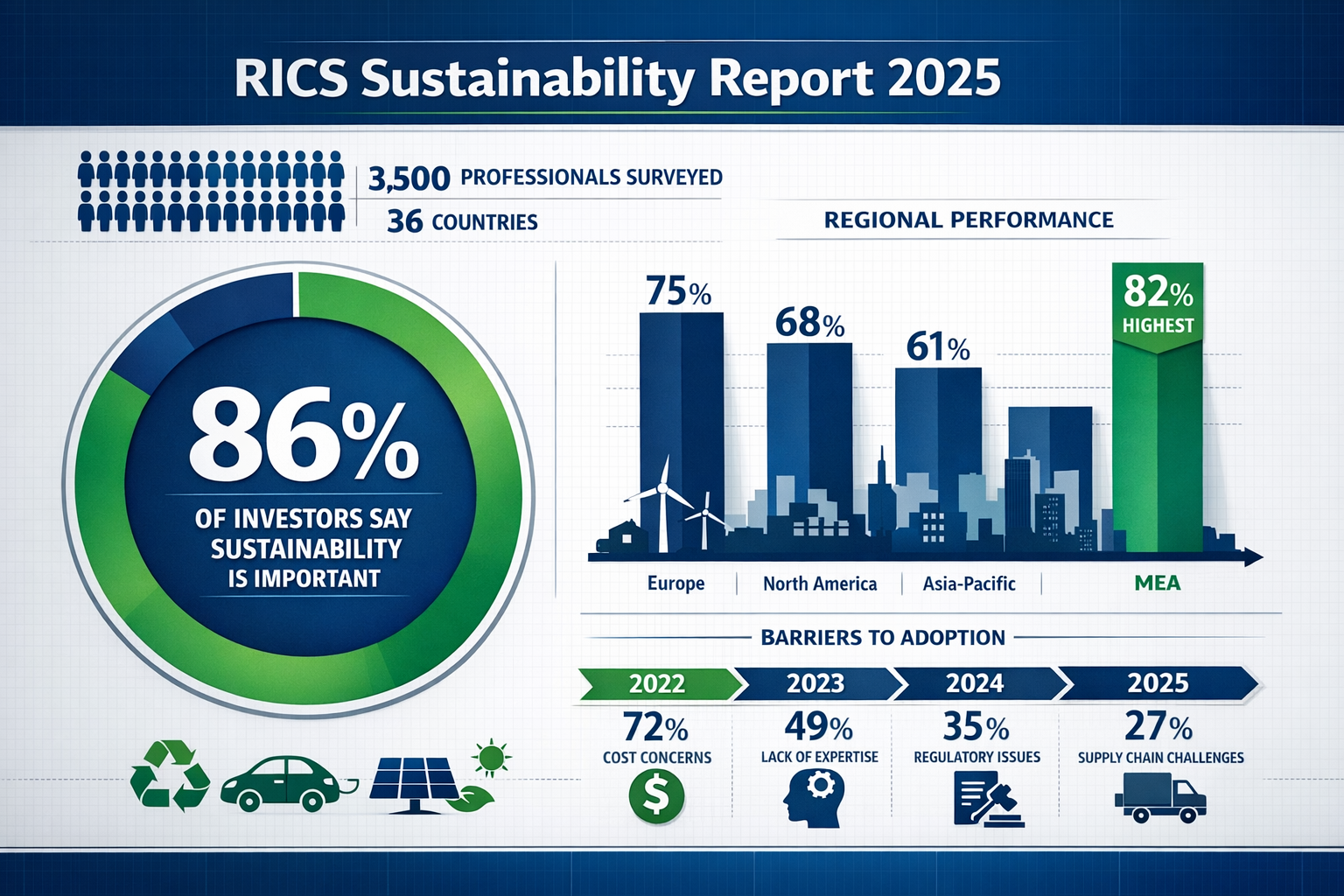
Green building disputes are costing property stakeholders millions in 2026, yet expert witnesses now possess unprecedented ammunition: the RICS Sustainability Report 2025, which surveyed over 3,500 global professionals across 36 countries and revealed that 86% of investors consider green certification critical—while simultaneously exposing a stark disconnect between sustainability rhetoric and actual market capitalization.[2][4] This comprehensive analysis demonstrates how RICS Sustainability Report 2025 Applications in Expert Witness Valuations: Building Cases for 2026 Green Disputes are transforming courtroom strategies and settlement negotiations.
The convergence of sustainability metrics, valuation evidence, and legal proceedings has created a new battleground where chartered surveyors must navigate complex technical testimony. Understanding these applications is essential for property professionals preparing expert witness cases in 2026.
Key Takeaways
- The RICS Sustainability Report 2025 provides empirical data from 3,500+ professionals that expert witnesses can leverage to establish market standards and expectations in green building disputes
- Properties with EPC A ratings achieve only a 2.9% price premium, while EPC B and C properties trade at discounts—critical evidence for valuation challenges
- 86% of investors prioritize green certification, yet adoption remains stagnant—creating a gap that fuels litigation and requires expert testimony
- The report identifies three primary barriers (initial costs, lack of ROI evidence, investor awareness) that expert witnesses can address through structured testimony
- Regional variations, particularly MEA's outperformance, demonstrate that sustainability valuations require location-specific analysis in expert reports
Understanding the RICS Sustainability Report 2025 Framework
The RICS Sustainability Report 2025, published on November 10, 2025, represents the most comprehensive assessment of sustainable building adoption across the commercial real estate and construction sectors.[2] This research examined sentiments and practices across diverse markets, providing expert witnesses with statistically robust data for court proceedings.
Core Findings That Shape Expert Testimony
The report's methodology surveyed professionals in multiple disciplines, creating a multi-dimensional view of sustainability integration. For expert witnesses preparing cases for 2026 green disputes, several findings prove particularly valuable:
Market Sentiment Metrics:
- 86% of respondents confirm green building certification importance for investors[4]
- 94% report occupiers prioritize indoor environmental quality[4]
- Demand growth has slowed despite positive Sustainable Building Index readings[2]
These statistics establish baseline expectations that property valuation experts can reference when testifying about market standards. When a dispute involves claims about sustainability features adding value, expert witnesses can cite these benchmarks to contextualize assertions.
The Three Barriers Framework 🚧
The report identifies three primary obstacles blocking sustainable building investment, ranked by frequency:[4]
- Initial capital costs – The upfront expense barrier
- Lack of ROI evidence – Insufficient data demonstrating financial returns
- Lack of investor awareness or client demand – Knowledge and market education gaps
Expert witnesses can structure testimony around this framework when addressing why sustainability features may or may not have been implemented, or when evaluating claims about reasonable expectations for green building standards.
RICS Sustainability Report 2025 Applications in Expert Witness Valuations: Evidence-Based Testimony
Applying the RICS Sustainability Report 2025 to expert witness valuations requires translating research findings into admissible, persuasive courtroom evidence. The most compelling applications involve connecting empirical data to specific valuation methodologies.
Energy Performance Certificate (EPC) Valuation Evidence
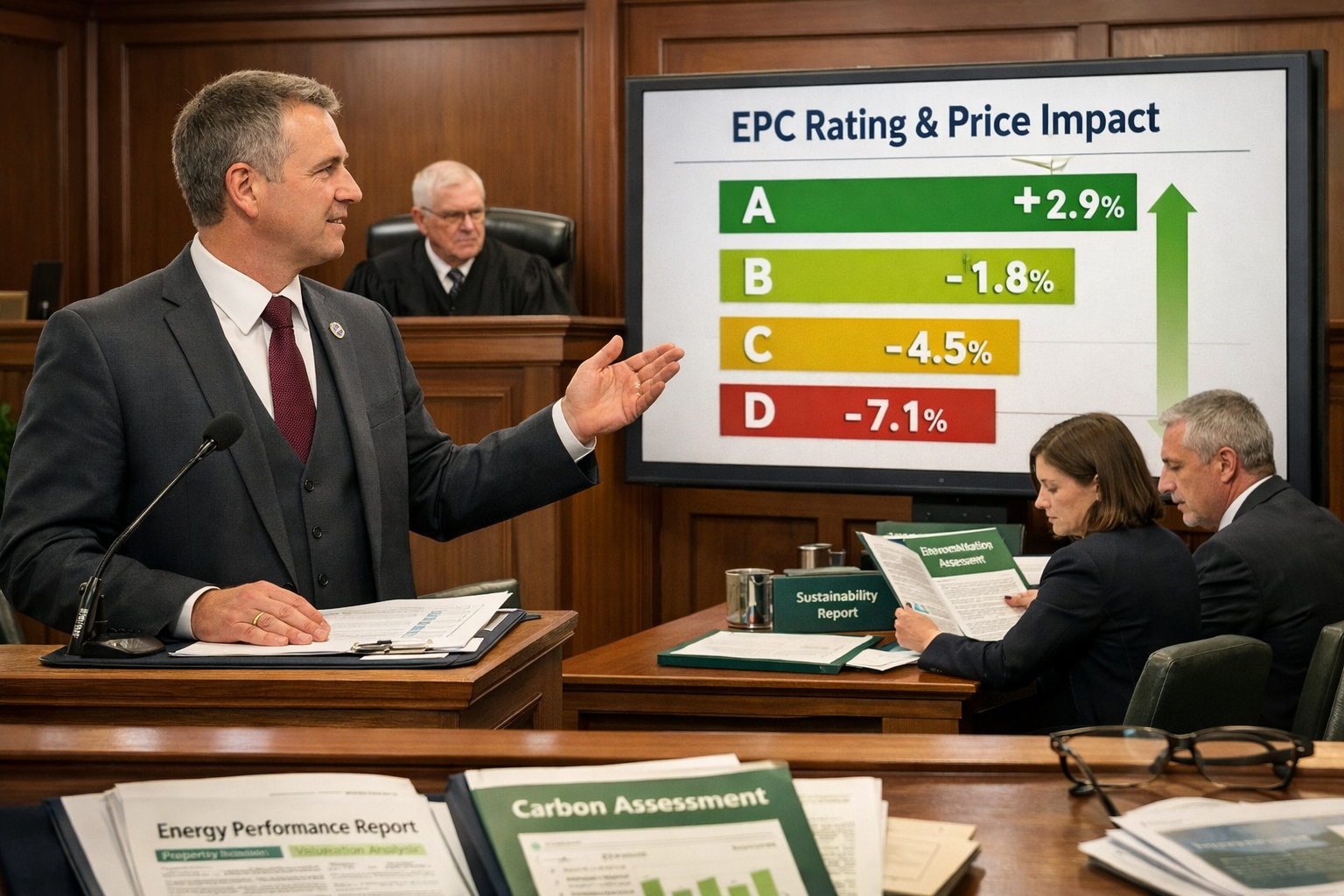
A groundbreaking RICS study analyzing 6.8 million housing transactions in England and Wales between 2014-2024 provides critical evidence for expert witnesses.[3] The findings challenge conventional assumptions about green building premiums:
| EPC Rating | Price Impact per Square Meter | Implication for Disputes |
|---|---|---|
| A | +2.9% premium | Modest positive capitalization |
| B | -2.3% discount | Counterintuitive negative impact |
| C | -1.2% discount | Below baseline performance |
| D | Baseline (0%) | Market reference point |
This data demonstrates that energy efficiency is not consistently capitalized into housing prices.[3] For expert witnesses, this evidence proves invaluable when challenging inflated claims about sustainability value or defending against allegations of undervaluation.
Building Cases with Regional Performance Data
The RICS report reveals significant regional variations, with the Middle East & Africa (MEA) region showing demand growth outpacing all other studied regions.[2] Expert witnesses can leverage this geographic specificity when:
- Comparing local market conditions to global benchmarks
- Establishing reasonable expectations for sustainability adoption in specific jurisdictions
- Contextualizing delays in green building implementation based on regional market maturity
When preparing RICS surveys for litigation purposes, incorporating regional data strengthens the defensibility of valuation conclusions.
Professional Standards and Duty of Care Arguments
The report emphasizes that professional skills and knowledge development is essential for meaningful progress in sustainable practices adoption.[2] This finding supports expert witness testimony regarding:
✅ Standard of care expectations – What level of sustainability knowledge should professionals possess?
✅ Negligence claims – Did a surveyor fail to identify material sustainability defects?
✅ Professional competency – Was the original valuation performed by someone with adequate green building expertise?
Expert witnesses can reference the report's emphasis on professional development to establish benchmarks for competent practice in sustainability-related property assessments.
Building Cases for 2026 Green Disputes: Practical Applications
As 2026 progresses, green disputes increasingly involve complex technical questions requiring expert testimony grounded in authoritative research. The RICS Sustainability Report 2025 provides the foundation for several case-building strategies.
Carbon Assessment Reporting in Litigation
The RICS recommendations include mandating carbon assessment reporting as a policy priority.[2] Expert witnesses can leverage this guidance when disputes involve:
Disclosure obligations – Should sellers have provided carbon assessment data?
Valuation adjustments – How should carbon performance impact property values?
Compliance verification – Were carbon reduction claims accurately represented?
When building evaluation disputes arise, expert witnesses can cite the RICS position on carbon reporting to establish industry expectations and professional standards.
The ROI Evidence Gap Strategy
The report identifies "lack of ROI evidence" as the second-highest barrier to sustainable building investment.[4] This finding creates strategic opportunities for expert witnesses:
For plaintiffs claiming sustainability value:
- Acknowledge the industry-wide evidence gap documented by RICS
- Present case-specific financial analysis demonstrating actual returns
- Distinguish the subject property from the broader market trend
For defendants challenging sustainability premiums:
- Reference the RICS finding that ROI evidence remains insufficient
- Question the basis for claimed value additions without supporting data
- Apply conservative valuation approaches given market uncertainty
This balanced approach, grounded in the RICS research, enhances credibility when presenting property valuation testimony.
Indoor Environmental Quality Claims 🌿
With 94% of respondents reporting that occupiers prioritize indoor environmental quality,[4] expert witnesses can address disputes involving:
- Health and wellness features – Air quality systems, natural lighting, thermal comfort
- Occupancy premiums – Rental rate justifications based on environmental quality
- Defect claims – Failures to deliver promised environmental performance
When evaluating these claims, experts should distinguish between occupier preferences (documented by RICS) and actual market capitalization (which the housing transaction study shows is inconsistent).[3]
Government Policy and Regulatory Compliance
The RICS report recommends that governments define decarbonization pathways, mandate carbon assessment reporting, drive green building investments, and scale biodiversity measures.[2] Expert witnesses can reference these recommendations when disputes involve:
Anticipatory compliance – Was it reasonable to implement features ahead of expected regulations?
Regulatory risk – How should potential future requirements affect current valuations?
Best practice standards – What sustainability measures align with RICS policy recommendations?
These applications prove particularly relevant in disputes involving building regulations and compliance obligations.
Structuring Expert Reports Using RICS Sustainability Data
Effective expert witness reports for 2026 green disputes should integrate RICS Sustainability Report 2025 findings throughout the analytical framework. Consider this structured approach:
Section 1: Market Context and Industry Standards
Begin expert reports by establishing the broader market context using RICS data:
- Reference the 3,500+ professional survey sample size to demonstrate research credibility[2]
- Cite the 86% investor importance statistic to establish baseline expectations[4]
- Acknowledge the stagnant adoption trend to contextualize market conditions[2]
This foundation demonstrates that opinions rest on authoritative industry research rather than individual perspective.
Section 2: Valuation Methodology and Evidence Base
Apply specific RICS findings to valuation approaches:
For comparable sales analysis:
- Reference the 6.8 million transaction study when selecting and adjusting comparables[3]
- Apply the documented EPC rating price impacts (±2.9% to -2.3%) to support adjustments[3]
- Explain why energy efficiency may not warrant significant premiums given market evidence
For income capitalization:
- Cite the 94% occupier preference statistic when analyzing rental premiums[4]
- Address the ROI evidence gap when projecting sustainability-related income benefits[4]
- Consider regional variations documented in the RICS report[2]
Section 3: Professional Standards and Opinions
Conclude with opinions grounded in RICS professional guidance:
- Reference the emphasis on professional skills development when evaluating competency[2]
- Apply RICS policy recommendations regarding carbon assessment and reporting[2]
- Distinguish between industry aspirations and current market realities
This structure creates a defensible expert report that withstands cross-examination and supports effective boundary disputes and valuation challenges.
Cross-Examination Preparation and Rebuttal Strategies
Expert witnesses must anticipate challenges to testimony based on RICS Sustainability Report 2025 applications. Effective preparation involves understanding both the strengths and limitations of the research.
Anticipated Challenges and Responses
Challenge: "The RICS report shows 86% of investors value green certification, yet you're claiming minimal value impact."
Response: "The report documents investor sentiment and priorities, which I've acknowledged. However, the separate RICS study of 6.8 million actual transactions demonstrates that this sentiment is not consistently capitalized into prices. Properties with EPC B and C ratings actually trade at discounts despite being above the D baseline. This distinction between stated preferences and market behavior is critical to accurate valuation."[3][4]
Challenge: "The report shows demand for sustainable buildings remains positive. Doesn't that support a premium valuation?"
Response: "The Sustainable Building Index remains in positive territory, but the report specifically notes that demand growth has slowed and the sector remains stagnant in adopting sustainable practices. This indicates market hesitation rather than robust premium support. Additionally, the report identifies initial costs and lack of ROI evidence as primary barriers, which directly impacts value capitalization."[2][4]
Leveraging Regional Data for Rebuttal
When opposing experts cite general sustainability trends, use the RICS regional findings to introduce nuance:
- MEA outperformance indicates sustainability value varies significantly by location[2]
- Market maturity differences affect reasonable expectations for green building adoption
- Local regulatory environments create jurisdiction-specific valuation considerations
This approach demonstrates sophisticated understanding while maintaining positions grounded in the RICS research.
Integration with Traditional Surveying Practice
The RICS Sustainability Report 2025 Applications in Expert Witness Valuations: Building Cases for 2026 Green Disputes must integrate seamlessly with established surveying methodologies. Expert witnesses should connect sustainability analysis to traditional practice areas.
Linking to Building Surveys and Defect Analysis
When sustainability disputes involve structural defects or performance failures:
- Apply RICS sustainability standards alongside traditional building pathology assessment
- Evaluate whether green building systems were properly installed and maintained
- Consider how sustainability features interact with conventional building elements
For guidance on addressing defects discovered during surveys, review approaches for what to do after a bad building survey report.
Negotiation Support and Settlement Facilitation
Expert witnesses often support settlement negotiations in green disputes. The RICS data provides objective reference points:
- Use the EPC rating price impacts to establish reasonable adjustment ranges[3]
- Reference the three barriers framework to identify compromise solutions[4]
- Apply regional performance data to contextualize settlement positions[2]
These applications mirror strategies used in negotiating property prices with survey evidence.
Professional Development and Competency Standards
The RICS emphasis on professional skills development[2] creates opportunities for expert witnesses to:
- Establish credentials in sustainability valuation through continuing education
- Critique opposing experts' qualifications in green building assessment
- Demonstrate commitment to evolving professional standards
Maintaining expertise requires staying current with RICS guidance and participating in sustainability-focused professional development.
Emerging Trends for 2026 and Beyond
As 2026 progresses, several trends will shape how expert witnesses apply RICS Sustainability Report 2025 findings to green disputes.
Biodiversity and Nature-Based Solutions
The RICS recommendation to scale biodiversity measures[2] signals growing attention to nature-based building features. Expert witnesses should prepare for disputes involving:
- Green infrastructure valuation – Living walls, green roofs, biodiversity corridors
- Ecosystem service quantification – Measuring environmental benefits in monetary terms
- Regulatory compliance – Emerging biodiversity net gain requirements
Decarbonization Pathway Documentation
With RICS recommending defined decarbonization pathways,[2] expect disputes regarding:
- Carbon reduction roadmaps – Were reasonable plans established and followed?
- Interim milestone failures – How should missed targets affect valuations?
- Retrofit obligations – What improvements are reasonably required for existing buildings?
Enhanced Disclosure Requirements
The push for mandatory carbon assessment reporting[2] will likely generate disputes about:
- Historical disclosure failures – Should sellers have provided information not yet required?
- Data accuracy – Were carbon assessments performed competently?
- Materiality thresholds – When does carbon performance become material to value?
Expert witnesses should monitor regulatory developments and update testimony frameworks accordingly.
Conclusion: Leveraging RICS Research for Authoritative Expert Testimony
The RICS Sustainability Report 2025 Applications in Expert Witness Valuations: Building Cases for 2026 Green Disputes represents a paradigm shift in how property professionals approach sustainability litigation. By grounding testimony in empirical research from 3,500+ global professionals and 6.8 million housing transactions, expert witnesses can deliver credible, defensible opinions that withstand rigorous cross-examination.
The key to effective application lies in understanding both the opportunities and limitations within the RICS data. While 86% of investors prioritize green certification, actual market capitalization remains inconsistent. While occupiers value environmental quality, EPC B and C properties trade at discounts. These nuances separate sophisticated expert testimony from superficial analysis.
Actionable Next Steps for Expert Witnesses 📋
Immediate actions:
- Download and study the complete RICS Sustainability Report 2025 and supporting research documents
- Review past expert reports to identify opportunities for incorporating RICS findings
- Update standard methodologies to include EPC rating price impact analysis from the 6.8 million transaction study
- Develop regional databases comparing local market conditions to RICS global benchmarks
Ongoing professional development:
- Participate in RICS sustainability training programs to enhance credentials
- Monitor regulatory developments related to carbon reporting and decarbonization pathways
- Build case study libraries demonstrating successful application of RICS data in testimony
- Network with other expert witnesses to share strategies and emerging best practices
Case preparation protocols:
- Integrate RICS data citations into standard expert report templates
- Prepare cross-examination response documents addressing common challenges
- Develop visual aids presenting RICS statistics for courtroom presentation
- Establish relationships with professional surveyor services for collaborative case development
The convergence of sustainability imperatives, market realities, and legal disputes creates unprecedented demand for expert witnesses who can navigate this complex landscape. Those who master the RICS Sustainability Report 2025 Applications in Expert Witness Valuations: Building Cases for 2026 Green Disputes will position themselves as indispensable resources for resolving the green building conflicts that increasingly define property litigation in 2026 and beyond.
References
[1] Watch – https://www.youtube.com/watch?v=H7KaLmn4MAQ
[2] Sustainability Report 2025 – https://www.rics.org/news-insights/current-topics-campaigns/sustainability/sustainability-report-2025
[3] Future Property Valuation Influence Esg Criteria Residential Buildings – https://www.rics.org/news-insights/future-property-valuation-influence-esg-criteria-residential-buildings
[4] Sustainability Report 2025 Infographic – https://www.rics.org/content/dam/ricsglobal/documents/reports/Sustainability-Report-2025-Infographic.pdf
[5] Q4 2025 Report – https://www.rics.org/content/dam/ricsglobal/documents/about-rics/Q4-2025-report.pdf
[6] Sustainability Report 2025 – https://www.rics.org/content/dam/ricsglobal/documents/reports/Sustainability-report-2025.pdf