

Planning a loft conversion, basement extension, or side return for your terraced or semi-detached home in 2026? Before the first beam is cut or foundation dug, there's a critical legal requirement that catches thousands of homeowners off-guard each year: the Party Wall etc. Act 1996. This comprehensive guide unpacks the Party Wall Essentials for Loft Conversions, Extensions and Basements: A Practical Guide for Terraced and Semi‑Detached Homes, explaining when the Act applies, what triggers formal notices, and the costly mistakes that DIY approaches create.
Understanding party wall procedures isn't just about legal compliance—it's about protecting your project timeline, maintaining neighbour relationships, and avoiding expensive disputes that can delay construction for months. Whether you're converting your loft into a master bedroom, digging down for a basement cinema, or extending sideways for a kitchen-diner, this practical guide delivers the essential knowledge every terraced and semi-detached homeowner needs.
Key Takeaways
- The Party Wall Act 1996 applies to all terraced and semi-detached properties where work affects shared structures, but does NOT apply to detached homes with no adjoining neighbours [1]
- Formal party wall notices must be served 2 months before work begins for structural alterations and 1 month for excavations, with written neighbour consent or surveyor awards required before starting [3]
- Common loft conversion triggers include cutting party walls for beams, removing shared chimney breasts, and excavating within 3-6 metres of neighbouring foundations [4]
- Permitted Development rights don't exempt party wall requirements—even if planning permission isn't needed, party wall notices still apply to structural work [4]
- Professional party wall surveyors prevent costly delays by managing the legal process, documenting pre-work conditions, and resolving disputes through binding awards
Understanding the Party Wall etc. Act 1996 for Home Extensions
The Party Wall etc. Act 1996 is England and Wales legislation designed to prevent and resolve disputes between neighbours when building work affects shared structures. For homeowners in terraced and semi-detached properties, this Act becomes immediately relevant when planning any significant home improvement project.
When Does the Party Wall Act Apply?
The Act specifically applies to properties with party walls—shared boundaries between neighbouring buildings. This means:
✅ Terraced houses (shared walls on both sides)
✅ Semi-detached houses (shared wall on one side)
✅ Flats (shared floors and ceilings)
❌ Detached houses (no party wall requirements) [3]
Importantly, the Act does NOT apply in Northern Ireland or Scotland, which have separate legal frameworks [2].
Three Types of Party Wall Notices
The Act establishes three distinct notice categories, each with specific requirements:
| Notice Type | Application | Notice Period |
|---|---|---|
| Section 1: Party Fence Wall Notice | Building new walls on boundary lines | 1 month |
| Section 2: Party Structure Notice | Work ON existing party walls | 2 months |
| Section 6: Adjacent Excavation Notice | Digging within 3-6m of neighbours | 1 month |
For loft conversions, extensions, and basements in terraced and semi-detached homes, Section 2 and Section 6 notices are most commonly required [4].
Common Misconceptions About Party Wall Requirements
Many homeowners mistakenly believe that obtaining planning permission or Permitted Development rights eliminates party wall obligations. This is categorically false. Even if your loft conversion qualifies as Permitted Development (typically 40m³ for terraced homes, 50m³ for semi-detached homes), you still must serve party wall notices if the work affects shared structures [4].
"The Party Wall Act 1996 and planning permission are completely separate legal requirements. One does not replace or override the other." — Party Wall Surveyor
Another dangerous misconception: neighbours can permanently block your project through party wall disputes. In reality, the Act provides a dispute resolution mechanism through surveyor awards that allow work to proceed even without neighbour agreement [3].
Party Wall Essentials for Loft Conversions: What Triggers the Act
Loft conversions represent one of the most popular home improvement projects in 2026, particularly in space-constrained urban areas. However, the Party Wall Essentials for Loft Conversions, Extensions and Basements require careful attention to specific trigger works.
Works That REQUIRE Party Wall Notices
The following loft conversion activities mandate formal party wall procedures:
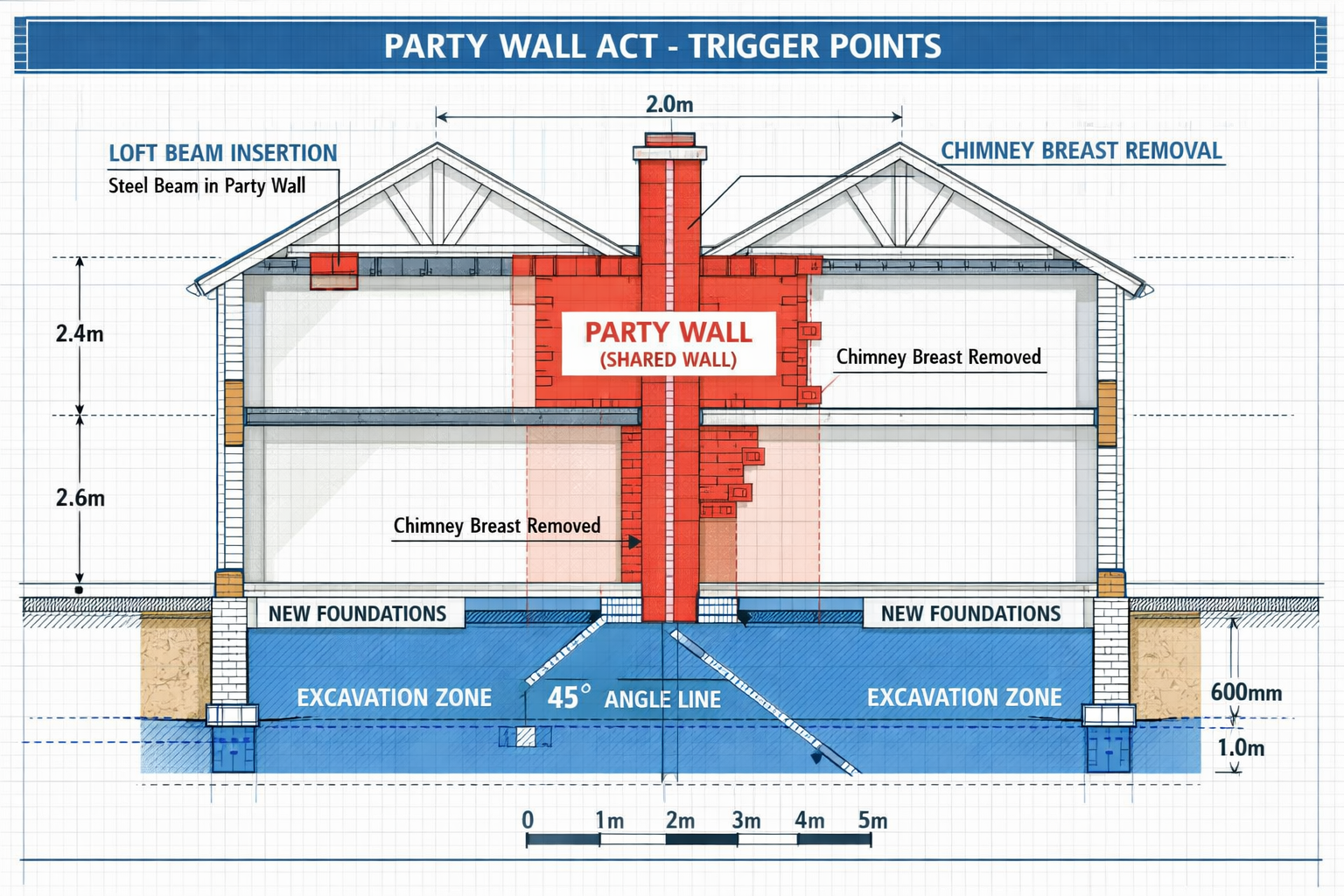
🔨 Cutting into party walls to insert load-bearing steel beams or timber joists
🔨 Removing chimney breasts from shared walls between properties
🔨 Raising party walls to accommodate increased ceiling height
🔨 Underpinning or strengthening party wall foundations
🔨 Inserting damp proof courses along the full length of party walls
🔨 Demolishing and rebuilding portions of shared structures [5]
Hip-to-gable conversions frequently trigger both Section 2 (party structure) and Section 6 (excavation) notices because they involve:
- Extending the roof structure over the party wall
- Excavating for padstones or support posts within 3-6 metres of neighbouring foundations [4]
Works That DON'T Require Party Wall Notices
Not every loft conversion triggers party wall requirements. The following activities typically proceed without formal notices:
✅ Installing Velux roof windows entirely on your own roof slope
✅ Placing beams on purpose-built columns rather than cutting into party walls
✅ Internal insulation and plasterboard work not affecting shared structures
✅ Electrical and plumbing installations within your own property boundaries [3]
The Excavation Rule: Understanding the 3-Metre and 6-Metre Zones
Section 6 Adjacent Excavation Notices apply when digging for foundations, padstones, or basement work. The rules are specific:
3-Metre Rule: Notice required if excavating within 3 metres of a neighbour's structure AND going deeper than their foundations [4]
6-Metre Rule: Notice required if excavating within 6 metres AND the excavation intersects a 45-degree line drawn downward from the bottom of neighbouring foundations [4]
For basement conversions in terraced homes, these excavation rules almost always apply, requiring careful surveyor involvement to document existing foundation depths and plan compliant work schedules.
The Party Wall Notice Process: Timeline and Procedures
Understanding the party wall notice timeline is crucial for project planning. Many homeowners underestimate the time required, leading to construction delays and contractor scheduling conflicts.
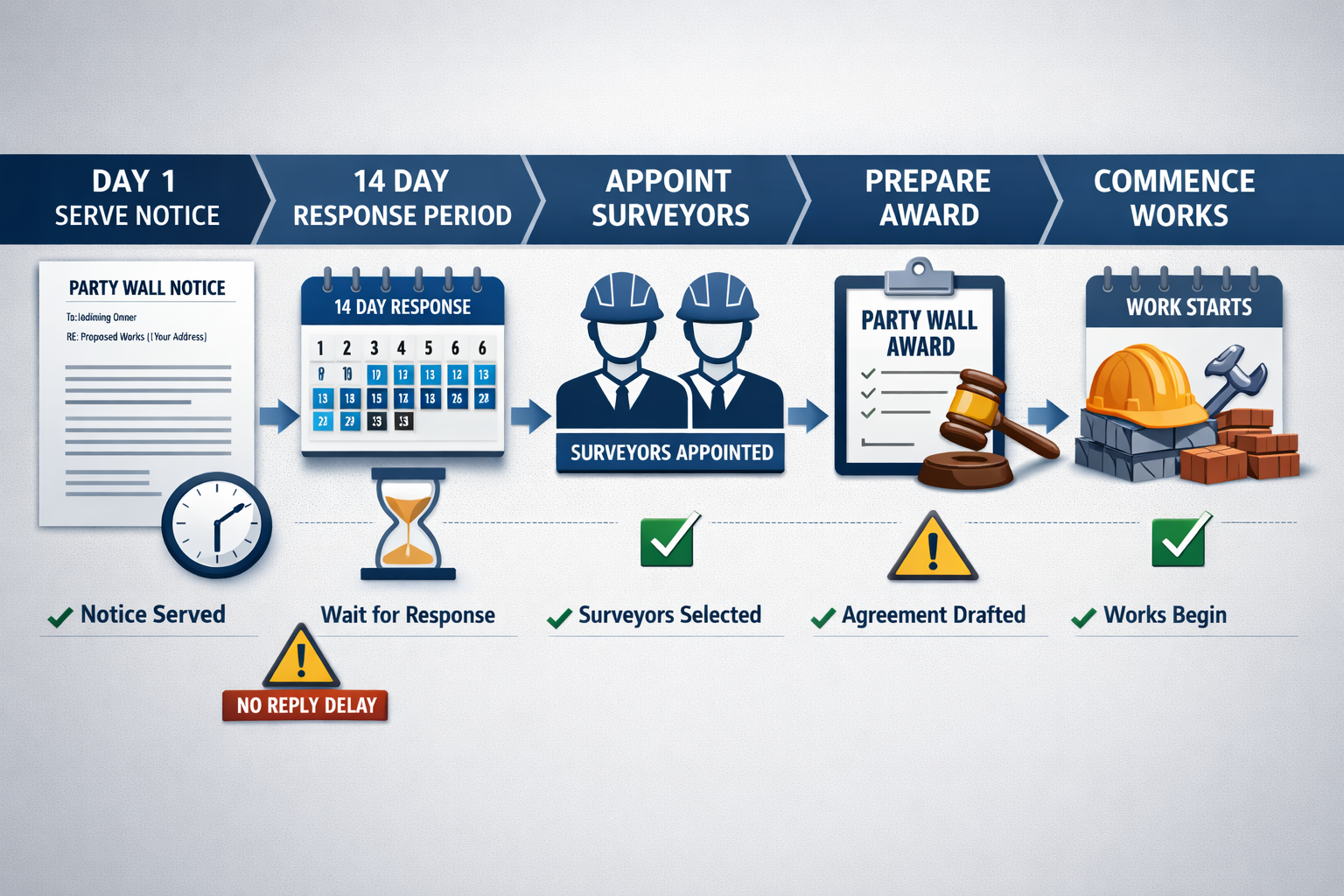
Step 1: Serve Formal Written Notice (2 Months Before Work)
The building owner must serve written party wall notices to all affected adjoining owners. For Section 2 Party Structure Notices, this must occur at least 2 months before the proposed start date [3].
The notice must include:
- Detailed description of proposed works
- Start date for construction
- Technical drawings or plans
- Building owner's contact information
Notices can be hand-delivered or sent by recorded delivery. Email notices are not legally sufficient unless neighbours explicitly agree.
Step 2: Neighbour Response (14-Day Window)
Adjoining owners have 14 days to respond in one of three ways:
- Written consent to the works (simplest outcome)
- Dissent or no response (triggers surveyor appointment)
- Counter-notice requesting additional protective measures
If neighbours consent in writing, work can proceed after the 2-month notice period without further formalities. However, most homeowners still benefit from appointing surveyors to document pre-work conditions and prevent future disputes.
Step 3: Appointing Party Wall Surveyors
When neighbours dissent or don't respond, the Act requires surveyor appointment. Three options exist:
Option A: Agreed Surveyor – Both parties jointly appoint one impartial surveyor
Option B: Two Surveyors – Each party appoints their own surveyor (who then appoint a third surveyor if needed)
Option C: Building Owner Pays – If neighbours refuse to appoint, the building owner can appoint on their behalf [3]
Crucially, building owners pay all reasonable surveyor fees for both sides, including the neighbour's surveyor costs. This is a statutory requirement under the Act.
Professional expert party wall surveyors in London typically charge £800-£1,500 per property for straightforward loft conversions, though complex projects may cost more. Understanding party wall agreement costs helps budget accurately.
Step 4: Party Wall Award Preparation
Appointed surveyors prepare a Party Wall Award—a legally binding document that:
- Describes the works in detail
- Sets conditions for construction (working hours, noise limits, access requirements)
- Documents the condition of neighbouring properties through schedules of condition
- Establishes dispute resolution procedures
- Specifies responsibilities for repairs if damage occurs
Awards typically take 4-8 weeks to prepare, depending on property complexity and surveyor availability. The award must be served on both parties before work commences.
Step 5: Work Commencement and Monitoring
Once the award is in place and notice periods have expired, construction can begin. Surveyors may conduct:
- Pre-work inspections documenting existing cracks, settlement, and structural conditions
- Mid-work monitoring if concerns arise during construction
- Post-work inspections verifying no damage occurred or documenting necessary repairs
This documentation protects both building owners and neighbours, providing clear evidence if disputes arise about construction-related damage.
Party Wall Essentials for Extensions and Basements
While loft conversions dominate party wall discussions, side extensions, rear extensions, and basement conversions create equally important party wall obligations for terraced and semi-detached homeowners.
Side Return Extensions and Party Walls
Single-storey side return extensions—hugely popular in Victorian terraced homes—typically require party wall notices when:
- The new wall is built directly on the boundary line (Section 1 Notice)
- Foundations are excavated within 3-6 metres of neighbouring structures (Section 6 Notice)
- Work involves raising or altering the existing party wall (Section 2 Notice)
Even though side returns often don't physically touch the neighbour's property, the excavation rules frequently trigger Section 6 requirements.
Basement Conversions: Complex Party Wall Scenarios
Basement excavations in terraced homes represent the most complex party wall scenarios because they typically involve:
🏗️ Underpinning party walls to support existing structures during excavation
🏗️ Deep excavations triggering both 3-metre and 6-metre rules
🏗️ Multiple adjoining owners (properties to both sides and potentially rear)
🏗️ Extended construction timelines requiring ongoing surveyor monitoring
Basement projects in terraced properties routinely require party wall agreements with 3-4 neighbouring properties, significantly increasing surveyor costs and procedural complexity.
Rear Extensions and Garden Walls
Two-storey rear extensions trigger party wall requirements when:
- Building on or astride the boundary line with neighbours
- Excavating for foundations within the 3-6 metre zones
- Connecting to or altering existing party walls
Single-storey rear extensions may avoid party wall requirements if they're entirely within your property and don't require deep excavations near boundaries—but this is relatively rare in tightly-packed terraced developments.
Common DIY Mistakes That Cost Thousands
Many homeowners attempt to navigate party wall procedures without professional help, leading to expensive consequences. Here are the most damaging mistakes:
❌ Mistake 1: Starting Work Without Serving Notices
Beginning construction without proper party wall notices is illegal and gives neighbours grounds to seek court injunctions stopping all work. Rectifying this mistake requires:
- Immediate work stoppage
- Retrospective notice service
- Extended waiting periods
- Potential legal costs
- Damaged neighbour relationships
The Party Wall Act 1996 provides neighbours with legal remedies, including injunctions and damages claims.
❌ Mistake 2: Informal Verbal Agreements
Relying on friendly verbal agreements with neighbours creates zero legal protection. The Act requires written consent or formal surveyor awards. When verbal agreements fail:
- No legal documentation exists to proceed
- Neighbours can change their minds
- Future property owners aren't bound by informal arrangements
- Disputes escalate without resolution mechanisms
❌ Mistake 3: Using Template Notices Without Professional Review
Online template party wall notices often contain:
- Insufficient technical detail about proposed works
- Incorrect notice periods or serving procedures
- Missing information required by the Act
- Generic descriptions that don't match actual construction plans
Invalid notices restart the entire timeline, delaying projects by months.
❌ Mistake 4: Failing to Document Pre-Work Conditions
Without professional schedules of condition, homeowners face:
- Unfounded damage claims from neighbours
- Expensive litigation over pre-existing cracks
- No evidence to defend against spurious complaints
- Difficulty obtaining insurance coverage for alleged damage
Professional surveyors create photographic and written records protecting both parties.
❌ Mistake 5: Underestimating Surveyor Costs in Project Budgets
Party wall surveyor fees represent legitimate project costs that must be budgeted alongside:
- Architect fees
- Structural engineer costs
- Building Control charges
- Construction expenses
Failing to budget £2,000-£5,000 for party wall procedures (covering both your surveyor and neighbours' surveyors) creates financial stress mid-project. Reviewing party wall surveyor quotes early prevents budget surprises.
Building Regulations vs. Party Wall Requirements
A critical distinction often confuses homeowners: Building Regulations and Party Wall requirements are completely separate legal obligations.
Building Regulations Apply to ALL Loft Conversions
Virtually every loft conversion—whether in detached, semi-detached, or terraced properties—requires Building Control approval [6]. This includes:
📋 Structural calculations for floor joists and roof alterations
📋 Fire safety compliance (30-minute fire resistance for floors, walls, and escape routes)
📋 Insulation standards meeting current thermal performance requirements
📋 Staircase regulations for pitch, headroom, and handrail specifications
📋 Ventilation requirements for habitable rooms
📋 Sound insulation between floors in conversions creating additional dwellings [2]
Building Control approval proceeds independently of party wall procedures. You can submit Building Regulation applications before, during, or after serving party wall notices—though coordinating both timelines prevents delays.
Fire Safety Standards for Loft Conversions
The 2026 Building Regulations mandate 30-minute fire resistance for all loft conversion structures, typically achieved through:
- 12.5mm fire-resistant plasterboard on floors and walls
- Fire-rated doors on the loft room
- Protected escape routes (fire-resistant stairways) from loft to ground floor
- Interconnected smoke alarms on all floors [2]
These requirements apply regardless of party wall status, emphasizing that party wall compliance represents just one element of lawful loft conversion projects.
When to Involve Building Control and Party Wall Surveyors
Optimal project timeline:
- Week 1-2: Appoint architect and structural engineer for designs
- Week 3-4: Submit Building Regulation application
- Week 4-6: Serve party wall notices (2 months before planned start)
- Week 8-16: Party wall surveyor awards prepared while Building Control reviews plans
- Week 16+: Construction begins once both Building Control approval AND party wall awards are in place
This parallel approach prevents either process from delaying the other.
Choosing the Right Party Wall Surveyor
Selecting an experienced, qualified party wall surveyor makes the difference between smooth procedures and expensive disputes.
Essential Qualifications and Experience
Look for surveyors with:
✓ RICS membership (Royal Institution of Chartered Surveyors)
✓ Specialist party wall experience (not just general building surveying)
✓ Local knowledge of your property type and area
✓ Professional indemnity insurance covering party wall work
✓ Proven track record with similar projects (loft conversions, basements, extensions)
The building surveyor you choose should demonstrate specific expertise in party wall legislation, not just general surveying knowledge.
Questions to Ask Prospective Surveyors
Before appointing a party wall surveyor, ask:
- How many party wall awards have you prepared for loft conversions in terraced homes?
- What's your typical timeline from appointment to award?
- Do you charge fixed fees or hourly rates?
- What's included in your fee (inspections, photography, award preparation)?
- How do you handle disputes between building and adjoining owners?
- Can you provide references from recent clients?
Red Flags to Avoid
Steer clear of surveyors who:
❌ Guarantee neighbour consent (surveyors can't control neighbour decisions)
❌ Offer suspiciously low fees (suggesting inexperience or cutting corners)
❌ Lack professional indemnity insurance
❌ Can't provide examples of previous awards
❌ Promise unrealistic timelines (awards typically take 4-8 weeks minimum)
Protecting Your Investment: Schedules of Condition
Schedules of condition represent one of the most valuable protections party wall surveyors provide. These detailed photographic and written records document:
- Existing cracks in neighbouring properties
- Settlement patterns and structural movement
- Decorative condition of walls, ceilings, and finishes
- External wall conditions and pointing
- Any pre-existing defects or damage
Why Schedules Matter
Without schedules of condition:
- Neighbours can claim your construction caused pre-existing cracks
- Proving the timeline of damage becomes impossible
- Spurious claims escalate into expensive litigation
- Insurance companies may refuse coverage without documentation
Professional schedules create contemporaneous evidence that protects building owners from unfounded claims while ensuring legitimate construction damage is identified and remedied.
When Schedules Should Be Prepared
Optimal timing for schedules of condition:
📸 Before serving party wall notices: Establishes baseline conditions
📸 After award agreement: Confirms conditions immediately before work starts
📸 During construction: Documents any changes if concerns arise
📸 After completion: Verifies final condition and identifies any damage requiring remedy
This comprehensive documentation trail provides legal protection throughout the project lifecycle.
Neighbour Relations: Communication Strategies
While party wall procedures provide legal frameworks, maintaining positive neighbour relationships prevents disputes from arising in the first place.
Proactive Communication Approaches
✉️ Informal preliminary discussion: Before serving formal notices, explain your plans conversationally
✉️ Share visual plans: Provide drawings showing how the conversion affects (or doesn't affect) their property
✉️ Address concerns early: Listen to worries about noise, disruption, or structural impact
✉️ Set realistic expectations: Explain construction timelines and working hours
✉️ Provide contact information: Ensure neighbours can reach you or your builder with concerns
Managing Construction Disruption
Even with party wall awards in place, considerate construction practices maintain relationships:
- Respect agreed working hours (typically 8am-6pm weekdays, 8am-1pm Saturdays)
- Provide advance notice of particularly noisy or disruptive work
- Keep shared access areas clean and clear
- Address complaints promptly and professionally
- Consider goodwill gestures (flowers, chocolates, or dinner vouchers) before major disruption phases
When Disputes Arise
If neighbour disputes escalate despite good-faith efforts:
- Document everything: Keep written records of all communications
- Involve surveyors early: Professional mediators can de-escalate tensions
- Avoid direct confrontation: Let surveyors handle technical disagreements
- Follow award procedures: The party wall award establishes dispute resolution mechanisms
- Seek legal advice if necessary: Solicitors specializing in construction law can advise on serious disputes
Remember: neighbours cannot permanently stop lawful work through party wall disputes. The Act's surveyor mechanism ensures projects proceed even without neighbour agreement [3].
Cost Breakdown: Budgeting for Party Wall Procedures
Understanding the full cost implications of party wall procedures prevents budget surprises mid-project.
Typical Party Wall Surveyor Fees (2026)
| Scenario | Building Owner's Surveyor | Adjoining Owner's Surveyor | Total Cost |
|---|---|---|---|
| Simple loft conversion (1 neighbour) | £800-£1,200 | £700-£1,000 | £1,500-£2,200 |
| Loft conversion (2 neighbours) | £1,200-£1,800 | £1,400-£2,000 | £2,600-£3,800 |
| Basement conversion (3-4 neighbours) | £1,500-£2,500 | £2,100-£4,000 | £3,600-£6,500 |
| Complex extension (multiple notices) | £2,000-£3,000 | £2,500-£5,000 | £4,500-£8,000 |
Remember: Building owners pay ALL reasonable surveyor fees for both sides [3].
Additional Party Wall-Related Costs
Beyond surveyor fees, budget for:
- Photographic schedules of condition: £300-£600 per property
- Structural engineer reports: £500-£1,500 (if required by surveyors)
- Remedial works: Variable (if construction causes damage requiring repair)
- Legal fees: £1,000-£5,000+ (only if disputes escalate to litigation)
False Economy: The Cost of DIY Approaches
Attempting DIY party wall procedures to save surveyor fees often costs far more through:
- Construction delays (£200-£500 per day in contractor standing time)
- Invalid notices requiring reservice (2-month timeline restart)
- Court injunctions stopping work (£5,000-£15,000 legal costs)
- Damage claims without protective schedules (£10,000-£50,000+ potential liability)
- Relationship breakdowns requiring expensive mediation
Professional surveyor fees represent insurance against catastrophically expensive mistakes.
Regional Variations and Local Considerations
While the Party Wall etc. Act 1996 applies uniformly across England and Wales, local factors influence how procedures unfold in practice.
London-Specific Considerations
London's dense terraced housing stock creates unique party wall challenges:
- Multiple adjoining owners: Victorian terraces often share walls with 2-4 properties
- Conservation areas: Additional planning restrictions (though party wall requirements remain unchanged)
- Higher property values: Increased stakes in damage claims and disputes
- Professional surveyor density: More experienced specialists available but also higher fees
Regional Property Types
Different regions feature distinct housing stock affecting party wall procedures:
Northern terraced housing: Typically narrower plots with shared walls on both sides, making party wall notices almost universal for extensions
Suburban semi-detached estates: One shared wall simplifies procedures compared to terraced properties
Victorian/Edwardian conversions: Older properties often have complex shared structures (chimney breasts, roof valleys) requiring careful surveyor assessment
Modern developments: Newer semi-detached homes may have better structural separation, potentially reducing party wall triggers
Future-Proofing: Party Wall Considerations for Property Sales
Party wall compliance affects property values and sale processes, making proper documentation essential for future transactions.
Documentation to Retain
Maintain permanent records of:
📁 Original party wall notices served to neighbours
📁 Party wall awards with all schedules and conditions
📁 Schedules of condition (photographic and written)
📁 Completion certificates from surveyors
📁 Building Control completion certificates
📁 Correspondence with neighbours and surveyors
Impact on Property Sales
When selling properties with loft conversions or extensions:
- Solicitors request party wall documentation during conveyancing
- Missing awards can delay or derail sales
- Retrospective compliance is expensive and time-consuming
- Proper documentation demonstrates professional project management
Buyers' solicitors routinely ask: "Was the Party Wall Act complied with for this conversion?" Inability to provide awards and notices raises red flags, potentially reducing offers or causing buyers to withdraw.
Retrospective Party Wall Awards
If previous owners completed conversions without party wall compliance, options include:
- Obtain retrospective awards: Expensive and complex, requiring neighbour cooperation
- Indemnity insurance: Covers legal costs if disputes arise (£100-£300 one-time premium)
- Price reduction: Negotiate lower purchase price reflecting compliance risk
Prevention through proper initial compliance always costs less than retrospective solutions.
Conclusion
The Party Wall Essentials for Loft Conversions, Extensions and Basements: A Practical Guide for Terraced and Semi‑Detached Homes demonstrates that party wall compliance represents a fundamental legal requirement—not an optional extra—for home improvement projects affecting shared structures. Understanding when the Act applies, the formal notice procedures, and the timeline from initial service to final award prevents the costly delays and neighbour disputes that derail thousands of projects annually.
Key Action Steps for Homeowners
For anyone planning loft conversions, extensions, or basements in terraced or semi-detached properties in 2026:
- Appoint professional party wall surveyors early in the planning process, ideally before finalizing construction contracts
- Serve party wall notices at least 2 months before your intended construction start date
- Budget £2,000-£6,000 for party wall procedures depending on project complexity and number of adjoining owners
- Coordinate party wall and Building Control timelines to prevent either from delaying construction
- Maintain comprehensive documentation for future property sales and legal protection
- Communicate proactively with neighbours while relying on professional surveyors for formal procedures
The Professional Advantage
While the Party Wall Act 1996 permits homeowners to serve notices and manage procedures themselves, the complexity of modern construction projects, the legal consequences of errors, and the relationship sensitivities involved make professional surveyor involvement a wise investment. Experienced party wall surveyors navigate the technical requirements, document conditions, mediate disputes, and ensure compliance—protecting both your project timeline and your financial investment.
The cost of professional party wall services represents a fraction of total loft conversion, extension, or basement budgets, yet provides legal protection worth many times the fee. In 2026's competitive property market, where home improvements add significant value to terraced and semi-detached properties, proper party wall compliance isn't just legally required—it's financially prudent.
Ready to start your project? Consult with qualified party wall surveyors before serving notices, ensure your construction plans trigger appropriate procedures, and maintain the documentation that protects your investment for years to come. The Party Wall Essentials for Loft Conversions, Extensions and Basements aren't obstacles to overcome—they're frameworks that enable ambitious home improvements while protecting everyone's interests.
References
[1] Loft Conversions And The Party Wall Act – https://www.peterbarry.co.uk/blog/loft-conversions-and-the-party-wall-act/
[2] Rules Regulations – https://www.greenmatch.co.uk/loft-conversion/rules-regulations
[3] Party Wall Agreement Loft Conversion – https://www.houseup.co.uk/news/party-wall-agreement-loft-conversion
[4] Party Wall Notice For Loft Conversions – https://www.houricanassociates.com/party-wall-news/party-wall-notice-for-loft-conversions/
[5] Party Wall Agreement Loft Conversion – https://www.houseup.co.uk/news/party-wall-agreement-loft-conversion/
[6] Loft Conversion Building Regulations Everything You Must Know – https://theconversionguy.co.uk/learning-centre/loft-conversion-building-regulations-everything-you-must-know/