
The UK construction sector generates roughly 40% of the nation's total carbon emissions — yet the humble party wall, one of the most legally regulated elements in British residential building, has historically been assessed with almost no reference to its carbon footprint. That gap is closing fast. With RICS publishing its 2nd Edition Whole Life Carbon Assessment (WLCA) standard and launching the global CLEAR coalition in April 2026, the pressure on party wall surveyors to embed sustainability thinking into every award is no longer theoretical — it is professional and regulatory [1][7].
Integrating RICS Whole Life Carbon Assessments into 2026 Party Wall Awards: Survey Protocols for Sustainable Boundary Works is now a defining challenge for practitioners across England and Wales. This guide provides a step-by-step framework for surveyors, building owners, and adjoining owners who want to balance the neighbour-protection duties of the Party Wall etc. Act 1996 with the net zero goals shaping the built environment.
Key Takeaways 📋
- RICS WLCA measures carbon across four life cycle stages — upfront (A), in-use (B), end-of-life (C), and beyond boundary (D) — all of which apply to party wall and boundary works [2].
- The CLEAR coalition (launched April 2026) is harmonising whole-life carbon measurement globally, meaning surveyors should expect evolving reporting benchmarks throughout 2026 [1].
- Party wall awards can specify sustainable materials without breaching the Act, provided specifications remain proportionate and do not impose unreasonable costs on building owners.
- Survey protocols must document existing carbon baseline conditions before works begin to enable accurate whole-life comparison.
- Early-stage collaboration between building owners, adjoining owners, and their appointed surveyors is the single most effective way to reduce embodied carbon in boundary works.
Understanding the RICS WLCA Framework and Its Relevance to Boundary Works
What the Four Life Cycle Stages Mean for Party Walls
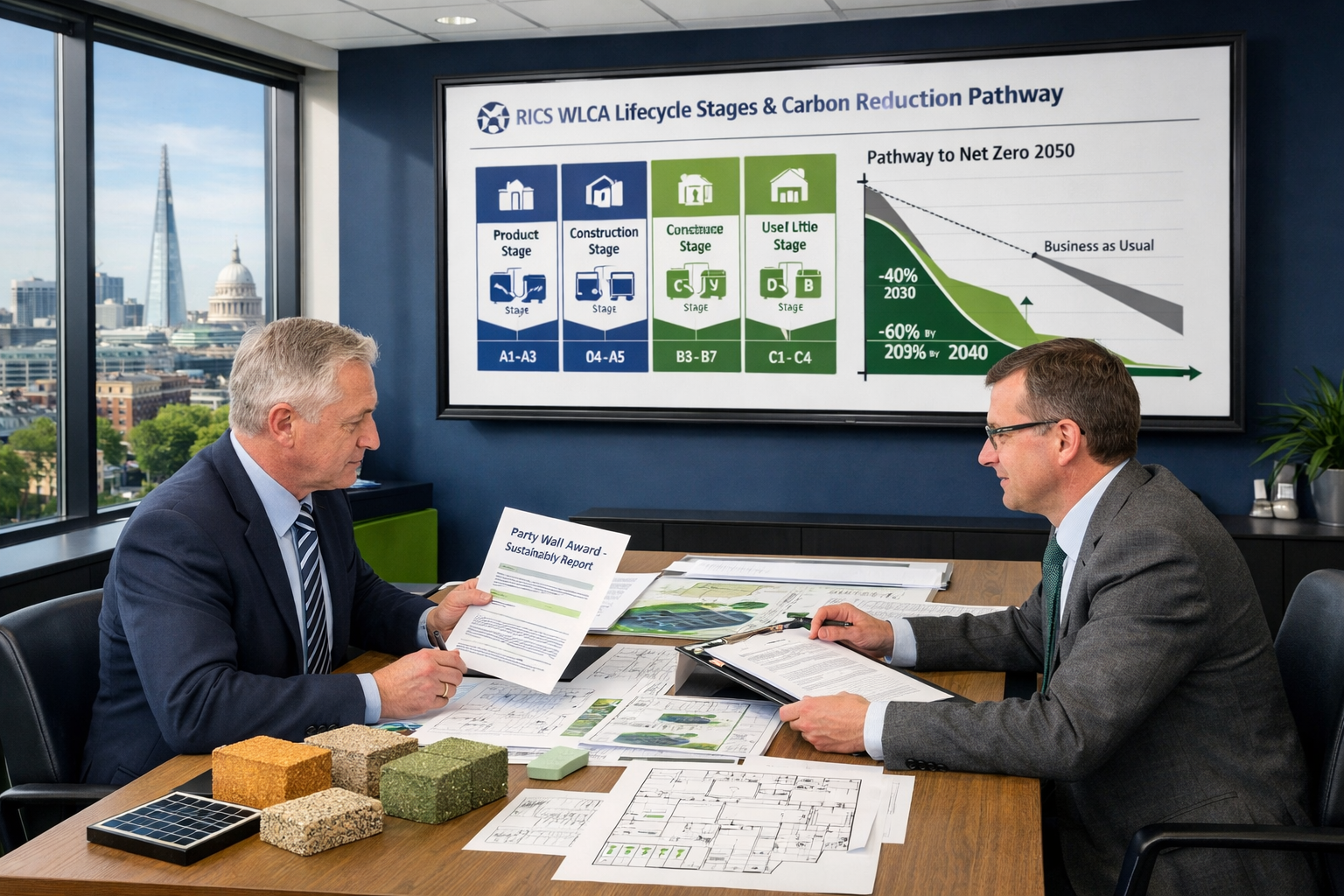
The RICS Whole Life Carbon Assessment standard structures carbon measurement across four distinct modules [2][7]:
| Stage | Code | What It Covers | Party Wall Relevance |
|---|---|---|---|
| Upfront carbon | A1–A5 | Embodied carbon in materials + construction | Masonry, concrete, mortar, scaffolding |
| In-use carbon | B1–B7 | Operational energy + maintenance | Thermal performance of shared wall |
| End-of-life carbon | C1–C4 | Demolition, waste, disposal | Future party wall removal or replacement |
| Beyond boundary | D | Reuse, recovery, recycling potential | Reclaimed brick, salvaged lintels |
For boundary works — whether a new party fence wall, underpinning, or a loft conversion affecting a shared structure — all four stages carry measurable carbon implications. The RICS WLCA 2nd Edition requires assessors to quantify these stages using verified Environmental Product Declarations (EPDs) or, where EPDs are unavailable, recognised secondary datasets [3][7].
💡 Pull Quote: "Whole-life carbon thinking does not end at practical completion. For party walls, the in-use and end-of-life stages often carry more carbon weight than the initial build."
The CLEAR Coalition: What Surveyors Need to Know in 2026
On 20–22 April 2026, RICS announced the Coalition for Life Cycle Emissions Alignment and Reporting (CLEAR) at the Sustainable Buildings and Construction Summit in Lausanne, Switzerland. The coalition's first-year priorities include [1][5]:
- 🌍 Building a global network of carbon assessment practitioners
- 📊 Analysing existing whole-life carbon methodologies for consistency gaps
- 📝 Developing practical resources for industry and policy stakeholders
For party wall surveyors, CLEAR's work matters because it signals that carbon reporting standards will tighten. Awards drafted in 2026 that specify materials without carbon data may need revision as CLEAR benchmarks emerge. Practitioners working in London and surrounding areas should begin familiarising themselves with WLCA reporting formats now rather than waiting for mandatory thresholds.
Survey Protocols for Integrating RICS Whole Life Carbon Assessments into 2026 Party Wall Awards
Step 1: Pre-Notice Carbon Scoping
Before a party wall notice is even served, the building owner's surveyor should conduct a carbon scoping exercise. This is not yet a statutory requirement under the Party Wall etc. Act 1996, but it represents emerging best practice aligned with RICS professional standards [4][7].
The scoping exercise should cover:
- Existing wall construction — material type, age, thermal performance
- Proposed works specification — structural changes, new materials, demolition extent
- Preliminary embodied carbon estimate — using RICS WLCA Stage A methodology
- Low-carbon alternatives — at least two alternative material specifications for comparison
A useful starting point is understanding the Party Wall Act 1996 and its procedural requirements, which set the legal framework within which carbon considerations must operate.
Step 2: Schedule of Condition with Carbon Baseline
The schedule of condition — a standard party wall document recording the pre-works state of the adjoining owner's property — should be expanded in 2026 to include a carbon baseline record. This means:
- Photographing and noting existing materials (brick type, mortar composition, insulation if visible)
- Recording any existing sustainable features (recycled aggregate, reclaimed materials)
- Noting thermal bridging risks that new works may worsen or improve
This baseline serves two purposes: it protects the adjoining owner's legal rights under the Act, and it provides the "before" data point needed for a credible whole-life carbon comparison. For surveyors unfamiliar with condition survey methodology, the RICS survey levels guide provides a clear framework for structuring inspection records.
Step 3: Material Specification within the Award
This is where integrating RICS Whole Life Carbon Assessments into 2026 Party Wall Awards: Survey Protocols for Sustainable Boundary Works becomes most practically challenging. Party wall awards must be fair to both parties — they cannot impose specifications that are disproportionately costly or commercially unreasonable.
However, surveyors have legitimate scope to:
✅ Specify low-carbon cement alternatives (e.g., ground granulated blast-furnace slag blends) where structurally appropriate
✅ Require EPD-backed products for new masonry where equivalent products exist at similar cost
✅ Prohibit unnecessary demolition of existing sound masonry, reducing upfront carbon waste
✅ Encourage reclaimed material reuse in non-structural elements such as coping stones
❌ Surveyors should not:
- Impose premium sustainable products where no cost-equivalent alternative exists
- Require carbon assessments that exceed the project's proportional complexity
- Delay awards pending CLEAR benchmarks that have not yet been published
Understanding UK boundary wall rules is essential context here — material specifications must remain consistent with both planning requirements and structural adequacy standards.
Step 4: Construction Phase Carbon Monitoring Conditions
Awards can include conditions relating to construction methodology that reduce carbon impact without overstepping legal boundaries. Recommended conditions for 2026 awards include:
- Waste segregation requirements — specifying that demolition waste must be sorted for recycling, supporting Stage C carbon reduction [2]
- Plant and equipment restrictions — limiting diesel-powered plant where electric equivalents are available on site
- Material delivery scheduling — reducing vehicle movements through consolidated deliveries
- Temporary works specifications — requiring low-carbon temporary propping where structural support is needed
These conditions align with RICS WLCA Stage A5 (construction process carbon) and Stage C1 (deconstruction) requirements [3].
Step 5: Post-Works Carbon Verification
Once works are complete, the surveyor's closing inspection should include a carbon verification check:
- Were specified low-carbon materials actually installed? (Request delivery notes and EPD certificates)
- Were any material substitutions made during construction? (Substitutions may alter the carbon profile significantly)
- Is the as-built condition consistent with the award specification?
This verification step creates an auditable record — increasingly important as building regulations evolve toward mandatory whole-life carbon disclosure.
Balancing Neighbour Protection with Net Zero Goals in 2026 Party Wall Practice
The Legal Framework Remains Primary
The Party Wall etc. Act 1996 exists to protect adjoining owners from damage and disruption caused by their neighbour's building works. Carbon sustainability is a secondary consideration within this framework — important, but not permitted to override the Act's core protections.
Key legal principles that surveyors must uphold:
- The award must be reasonable — costs imposed on the building owner must be proportionate
- The adjoining owner's rights are paramount — carbon specifications cannot weaken structural protection
- Surveyors act quasi-judicially — they must be impartial, not advocates for environmental policy
Surveyors who receive a party wall notice and are uncertain about their obligations should review what to do when you receive a party wall notice before engaging with carbon assessment requirements.
Where Carbon and Neighbour Protection Align
Encouragingly, many low-carbon construction choices naturally align with good neighbour protection:
- Avoiding unnecessary demolition reduces vibration and dust — protecting the adjoining owner while cutting Stage C carbon [2]
- Using lower-carbon cement mixes often improves workability, reducing the risk of poor-quality joints that could cause future water ingress
- Specifying reclaimed materials from the existing structure preserves the character of shared boundary features that both owners may value
This alignment means that integrating RICS Whole Life Carbon Assessments into 2026 Party Wall Awards: Survey Protocols for Sustainable Boundary Works need not create conflict between surveyors representing different parties. When both sides understand the mutual benefits, agreement is easier to reach.
Managing Disputes Around Carbon Specifications
When building owners and adjoining owners disagree about carbon-related specifications in a draft award, the agreed surveyor or third surveyor must resolve the dispute on the basis of what is reasonable and proportionate. Useful principles include:
- Cost equivalence test — Is the low-carbon alternative within 5–10% of the conventional product cost? If yes, it is generally defensible.
- Structural equivalence test — Does the alternative meet the same structural performance standard? If yes, there is no technical objection.
- Precedent review — Are similar specifications appearing in awards across the industry? RICS consultation on the draft 8th Edition of Party Wall Legislation and Procedure is gathering exactly this kind of emerging practice data [4].
For complex boundary disputes where carbon specifications become contentious, practitioners in areas such as Wimbledon, Richmond, and Notting Hill — where high-value properties often involve sensitive boundary works — may benefit from specialist surveying support.
The Role of RICS Consultation and Evolving Standards
RICS is actively consulting on the 8th Edition of Party Wall Legislation and Procedure, seeking input from surveyors, legal professionals, and stakeholders across England and Wales [4]. This consultation is an opportunity for practitioners to advocate for formal carbon assessment protocols to be embedded in future party wall guidance.
The CLEAR coalition's first-year focus on analysing existing methodologies and developing industry resources [1][5] suggests that by late 2026 or 2027, surveyors may have access to standardised carbon reporting templates specifically designed for boundary and party wall works. Early adopters who develop in-house protocols now will be well positioned when formal guidance arrives.
Practical Checklist: Carbon-Integrated Party Wall Award Protocol 2026
Use this checklist when preparing or reviewing party wall awards for boundary works:
Pre-Award Stage:
- Conduct carbon scoping exercise before notice is served
- Identify low-carbon material alternatives for key elements
- Expand schedule of condition to include carbon baseline data
- Check EPD availability for proposed primary materials
Award Drafting Stage:
- Include material specifications referencing EPD-backed products where cost-equivalent
- Add waste management conditions aligned with WLCA Stage C
- Include plant restrictions for diesel equipment where practicable
- Ensure all carbon conditions pass the cost and structural equivalence tests
Post-Works Stage:
- Verify as-built materials against award specification
- Collect EPD certificates and delivery documentation
- Record any material substitutions for the carbon audit trail
- File carbon verification record with the award documentation
Conclusion: Actionable Next Steps for Surveyors in 2026
The integration of RICS Whole Life Carbon Assessments into 2026 party wall awards is not a distant aspiration — it is a present professional responsibility. The CLEAR coalition's launch signals that global carbon reporting standards are converging [1][5], and RICS's ongoing consultation on party wall legislation [4] suggests that formal guidance is on its way.
Here are the most important steps to take now:
- Download and study the RICS WLCA 2nd Edition and its implementation guides to understand the four-stage lifecycle framework [3][7].
- Update your schedule of condition template to capture carbon baseline data as standard practice.
- Build a materials reference library of EPD-backed products commonly used in party wall and boundary works — masonry, mortar, lintels, insulation.
- Engage with the RICS 8th Edition consultation to ensure that carbon protocols reflect real-world surveying practice.
- Collaborate early — approach building owners and adjoining owners' surveyors at the pre-notice stage to explore low-carbon specifications before positions become entrenched.
The party wall award has always been about protecting people and property. In 2026, it must also begin protecting the planet — one boundary at a time.
References
[1] Rics And Global Partners Launch Clear – https://www.rics.org/news-insights/rics-and-global-partners-launch-clear
[2] Understanding The Rics Whole Life Carbon Assessment Standard – https://www.tsariley.com/news/understanding-the-rics-whole-life-carbon-assessment-standard/
[3] Whole Life Carbon Assessment Implementation Guides And Supporting Documents – https://www.rics.org/profession-standards/rics-standards-and-guidance/sector-standards/construction-standards/whole-life-carbon-assessment/whole-life-carbon-assessment-implementation-guides-and-supporting-documents
[4] rics – https://www.rics.org
[5] Rics Launches Clear To Align Whole Life Carbon Reporting Across Construction – https://oneclicklca.com/en/resources/articles/rics-launches-clear-to-align-whole-life-carbon-reporting-across-construction
[6] Rics Whole Life Carbon Assessment Built Environment – https://globalabc.org/resources/publications/rics-whole-life-carbon-assessment-built-environment
[7] Whole Life Carbon Assessment – https://www.rics.org/profession-standards/rics-standards-and-guidance/sector-standards/construction-standards/whole-life-carbon-assessment