
Falls in the home kill more than 6,000 people in England every year — and the majority of those deaths occur in rented properties where hazards go uninspected and unremedied. From 2026, that reality carries serious legal consequences for landlords.
Building Surveys for Bath, Stair, and Fall Hazards Under Awaab's Law 2026: Level 3 Protocols for Rental Property Compliance represents one of the most significant shifts in residential surveying practice in a generation. Phase 2 of Awaab's Law formally extends regulatory obligations to cover falls associated with baths on level surfaces, on stairs, and between levels — bringing these hazards into the same urgent compliance framework that already governs damp, mould, and emergency repairs [1][2].
For chartered surveyors, this is not a minor update. It demands a fundamental rethink of how Level 3 Building Survey reports are structured, what evidence is gathered on site, and how remediation priorities are communicated to landlords and tenants alike.
Key Takeaways 📋
- Phase 2 of Awaab's Law (2026) adds falls from baths, stairs, and level changes to the list of hazards requiring mandatory investigation and remediation timelines in social rented housing.
- Surveyors have 10 working days to investigate significant fall hazards once aware, with a written summary to tenants due within 3 working days of completing the investigation [3].
- Remedial works must begin within 5 working days of investigation conclusion; complex works must physically commence within 12 weeks [3].
- Level 3 Building Survey reports must now integrate HHSRS fall hazard scoring, photographic evidence, and person-centred vulnerability assessments to support landlord compliance.
- Non-compliance carries serious consequences, including enforcement orders, compensation payments, and potential loss of rental income [1].
What Awaab's Law Phase 2 Actually Means for Fall Hazards in 2026
Awaab's Law takes its name from Awaab Ishak, a two-year-old boy who died in 2020 as a direct result of prolonged exposure to damp and mould in a social rented home. The legislation, embedded in the Social Housing (Regulation) Act 2023, initially targeted damp and mould as Phase 1 hazards — active from 27 October 2025, with emergency repairs required within 24 hours [5].
Phase 2 goes considerably further. From 2026, fall hazards are now a statutory compliance matter for social landlords. This includes:
| Hazard Category | Specific Risk Areas |
|---|---|
| Falls on level surfaces | Wet bathroom floors, bath surrounds, uneven flooring near baths |
| Falls on stairs | Inadequate handrails, worn treads, poor lighting, inconsistent riser heights |
| Falls between levels | Open balustrades, low guarding, level changes without adequate warnings |
Phase 2 also brings excess cold and heat, structural collapse, fire and electrical hazards, and domestic hygiene risks into scope [1]. But for surveyors, fall hazards represent the most complex and technically demanding additions, because they require both physical measurement and contextual judgement about who lives in the property.
💡 Pull Quote: "Fall hazards in rented homes are not just a safety issue — under Awaab's Law 2026, they are a legal liability with strict investigation and remediation deadlines attached."
Phase 3, expected from 2027, will extend obligations to all remaining HHSRS hazards including asbestos, biocides, and carbon monoxide — making 2026 the critical year for surveyors to embed robust fall hazard protocols into their standard practice [5].
Level 3 Survey Protocols: Integrating Bath, Stair, and Fall Hazard Assessment
A standard Level 3 Building Survey already covers structural condition, defects, and maintenance recommendations. Under Building Surveys for Bath, Stair, and Fall Hazards Under Awaab's Law 2026: Level 3 Protocols for Rental Property Compliance, the methodology must now expand to include formal HHSRS (Housing Health and Safety Rating System) fall hazard scoring, person-centred risk assessment, and evidence packs that can withstand regulatory scrutiny.
For surveyors working across London and the wider South East, understanding RICS survey standards and their application to compliance work is essential groundwork before adapting to these new requirements.
🛁 Bathroom and Bath Surround Assessment
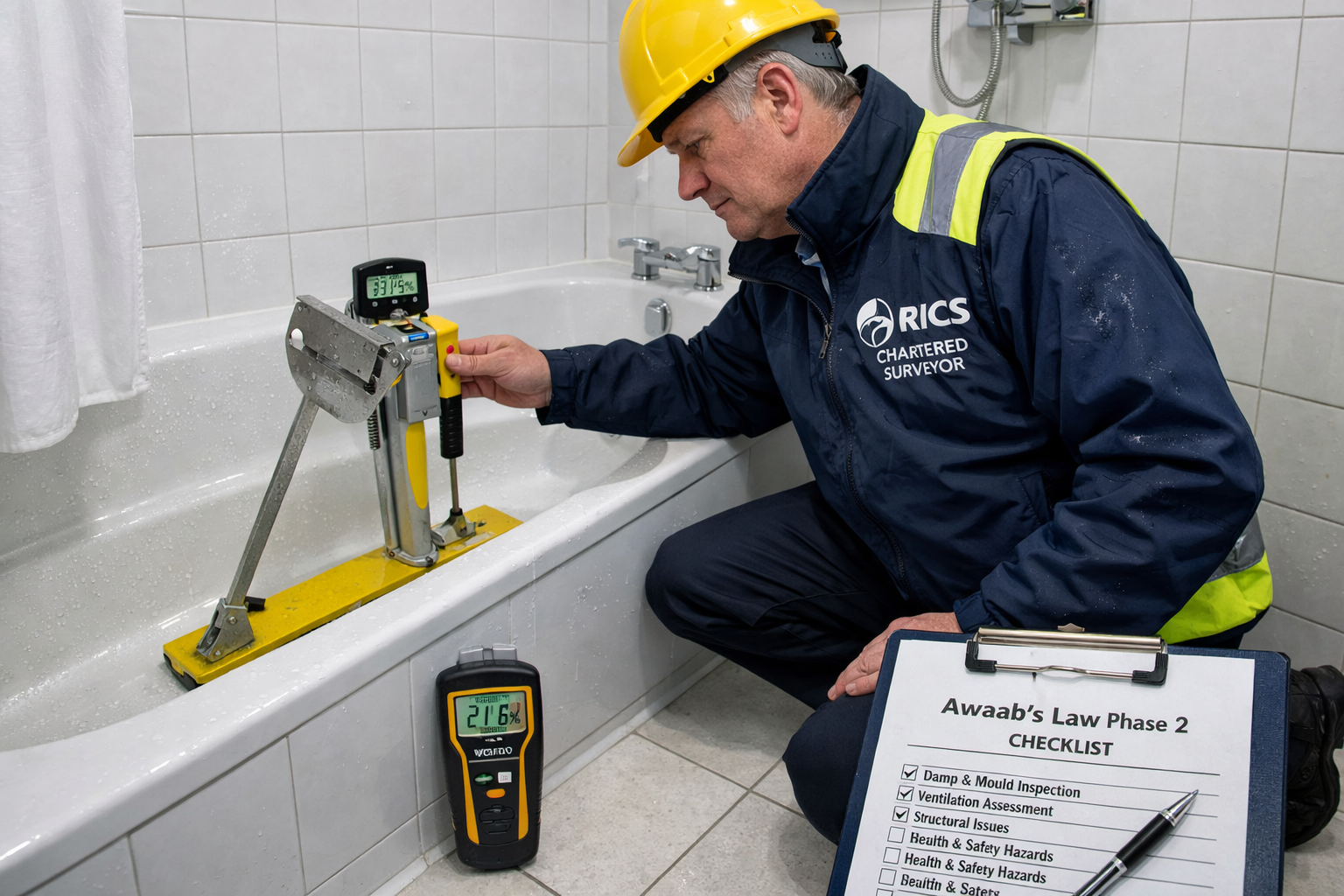
The bathroom is statistically one of the highest-risk rooms in any home. When assessing fall hazards on level surfaces around baths, a Level 3 protocol should capture:
- Floor surface type and slip resistance — ceramic tiles, vinyl, and wet timber all carry different risk profiles
- Bath entry and exit clearance — minimum space for safe transfer, particularly relevant for elderly or disabled tenants
- Grab rail presence, positioning, and load-bearing capacity — absence is a significant defect in properties with vulnerable occupants
- Drainage efficiency — pooling water dramatically increases slip risk
- Flooring condition — lifted edges, grout failure, and soft spots beneath vinyl all require photographic documentation
Each defect identified should be cross-referenced against HHSRS Category 1 (serious hazard) or Category 2 (less urgent) thresholds. A wet, untiled bathroom floor with no grab rail in a property occupied by an elderly tenant would typically score as Category 1.
For surveyors who want to understand how these findings translate into formal report structures, reviewing a complete example of a homebuyers report and property survey guide provides useful context on how defects are evidenced and communicated.
🪜 Staircase and Level-Change Assessment
Staircases require systematic measurement, not just visual inspection. A compliant Level 3 protocol for stair hazards should include:
Handrail assessment:
- Height (should be 900mm–1000mm on open stairs)
- Continuity — gaps or breaks in handrails are a common defect
- Structural integrity — test for movement and fixings
Tread and riser measurement:
- Consistent riser height (maximum 220mm under Building Regulations)
- Tread depth (minimum 220mm going)
- Surface condition — worn carpet, exposed nosings, and loose treads all require flagging
Lighting and visibility:
- Adequate lux levels at each tread
- Light switch positioning — accessible from both top and bottom
Level changes elsewhere in the property:
- Step-ups between rooms (common in older conversions)
- External threshold heights
- Balcony and gallery guarding heights (minimum 1100mm for residential)
Surveyors working in areas with significant older housing stock — such as those providing property surveys in Croydon or building surveys in Woolwich — will frequently encounter Victorian and Edwardian staircases that fall well outside modern Building Regulation standards.
Person-Centred Risk Assessment: The Critical Legal Requirement
One of the most significant — and often overlooked — aspects of Awaab's Law compliance is the requirement for person-centred investigation. Landlords (and by extension, the surveyors who advise them) must consider:
- The vulnerability of current residents: young children, elderly people, and those with mobility impairments or respiratory conditions face elevated risk from the same hazard [3]
- The severity and extent of the hazard — a single worn stair tread is materially different from a staircase with no handrail and inconsistent risers
- The immediacy of risk — is the hazard causing danger now, or is it a developing defect?
This is where Level 3 surveys earn their value. Unlike a Level 2 HomeBuyer Report, a Level 3 survey gives the surveyor scope to investigate accessible areas in depth, test components, and provide detailed commentary. Understanding which home survey is right for a given property is a conversation landlords and their advisors should be having before any compliance deadline approaches.
⚠️ Important: Investigations must be person-centred. A hazard that scores Category 2 for a healthy adult may score Category 1 for an elderly tenant with limited mobility. The surveyor's report must reflect this distinction explicitly [3].
The written summary provided to tenants within 3 working days of completing an investigation should clearly state:
- What hazards were found
- Their severity rating
- What remedial action will be taken
- The expected timeline for that action
Compliance Timelines Every Surveyor Must Know
Strict statutory deadlines apply once a significant fall hazard has been identified [3]. Surveyors advising landlords on compliance must communicate these clearly:
| Stage | Deadline |
|---|---|
| Investigation commences | Within 10 working days of becoming aware of the hazard |
| Written summary to tenant | Within 3 working days of investigation conclusion |
| Remedial works begin | Within 5 working days of investigation conclusion |
| Complex works commence (if unable to start within 5 days) | No later than 12 weeks after investigation |
These are not aspirational targets — they are statutory obligations. Failure to meet them can result in enforcement orders, mandatory compensation payments to tenants, legal cost liability, and loss of rental income if the property becomes uninhabitable [1].
For landlords managing multiple properties, the administrative burden of tracking these timelines across a portfolio is substantial. Surveyors who can provide structured condition survey reports with clear remediation priority flags — rather than generic defect lists — will be significantly more valuable to their clients.
Building Surveys for Bath, Stair, and Fall Hazards Under Awaab's Law 2026: Evidence Gathering Best Practice
A Level 3 report that will withstand regulatory scrutiny — or potential legal challenge — needs a specific evidence base. Here is what best-practice evidence gathering looks like for fall hazard compliance:
📸 Photographic Documentation Standards
- Minimum two photographs per defect: one contextual (showing location within the room) and one close-up (showing the specific defect)
- Include scale reference in photographs of tread wear, riser heights, and guarding gaps
- Timestamp all photographs — this establishes when the hazard was identified
- Photograph from the tenant's perspective — especially for staircases, showing the view from top and bottom
📐 Measurement Records
All measurements should be recorded numerically in the report, not just described qualitatively. "Handrail height inadequate" is insufficient. "Handrail height measured at 780mm against a standard of 900mm–1000mm" is compliant.
🗂️ Defect Classification Table
Every fall hazard identified should appear in a summary table within the report, showing:
- Location
- Defect description
- HHSRS category (1 or 2)
- Recommended action
- Priority timeline (emergency / within 5 days / within 12 weeks)
- Vulnerability flag (if applicable)
Linking Survey Findings to Remediation Costs
Landlords will need to act quickly on findings. Surveyors who can provide indicative cost ranges alongside defect descriptions help landlords prioritise budgets effectively. For context on how remediation costs are typically assessed in London properties, guidance on property survey expenses and cost structures can help frame client expectations.
Where significant structural work is identified — such as staircase reconstruction or bathroom remodelling — surveyors should note whether the works may require Building Regulations approval, Party Wall notifications, or other consents. Properties undergoing building renovations to address fall hazards may trigger additional compliance requirements beyond Awaab's Law itself.
What Happens When Landlords Don't Comply?
The consequences of non-compliance under Awaab's Law are not theoretical. The enforcement framework includes:
- 🔴 Enforcement orders from the Regulator of Social Housing
- 💷 Compensation payments to affected tenants
- ⚖️ Legal cost liability — landlords may be required to cover tenant legal costs
- 🏚️ Loss of rental income if properties are deemed uninhabitable pending remediation [1]
For social landlords managing large portfolios, the reputational and financial risks compound quickly. A single Category 1 fall hazard left unremedied beyond the statutory deadline could trigger regulatory intervention across an entire portfolio.
Surveyors who identify fall hazards during a Level 3 survey and fail to communicate them clearly — or who underrate their severity — may also face professional liability exposure. The RICS Professional Standards framework requires surveyors to report material defects accurately, and Awaab's Law compliance context makes that obligation more consequential than ever.
Conclusion: Actionable Next Steps for Surveyors and Landlords in 2026
Awaab's Law Phase 2 has fundamentally changed the risk landscape for rental property compliance in 2026. Fall hazards — from wet bathroom floors to poorly guarded staircases — are no longer just maintenance concerns. They are statutory obligations with tight investigation and remediation deadlines, person-centred assessment requirements, and serious enforcement consequences.
For surveyors, the immediate priority is updating Level 3 survey templates to include:
- Formal HHSRS fall hazard scoring sections
- Systematic measurement records for staircases and bathroom environments
- Vulnerability flagging for properties with at-risk occupants
- Clear remediation priority tables linked to Awaab's Law timelines
For landlords, the starting point is commissioning a Level 3 Building Survey on any rental property where fall hazards may exist — particularly older properties, those with elderly or vulnerable tenants, and those that have not been surveyed in the last three years.
For both parties, the time to act is now — not when a tenant reports a fall, and certainly not after an enforcement notice arrives.
To discuss a Level 3 survey for a rental property or to understand how Awaab's Law compliance affects a specific portfolio, get a quote from a chartered surveyor with experience in HHSRS assessment and social housing compliance.
References
[1] Awaabs Law Comes Into Force What Does It Mean For Construction – https://www.trowers.com/insights/2025/november/awaabs-law-comes-into-force-what-does-it-mean-for-construction
[2] Awaabs Law Policy Web Version 10 – https://www.southernhousing.org.uk/media/cxvlllnp/awaabs-law-policy-web-version-10.pdf
[3] Awaabs Law Requirements And Deadlines The Complete Breakdown – https://www.procurementforhousing.co.uk/article/awaabs-law-requirements-and-deadlines-the-complete-breakdown/
[4] Awaabs Law – https://www.procurementhub.co.uk/news/awaabs-law/
[5] Awaabs Law Is Here The Surveyors Guide For Compliance – https://www.surventrix.com/blog/awaabs-law-is-here-the-surveyors-guide-for-compliance
[6] S6. Awaabs Law Making Your Home Safer Faster – https://www.fourmillionhomes.org/wp-content/uploads/2025/05/S6.-Awaabs-Law-making-your-home-safer-faster.pdf
[7] Awaabs Law Guidance For Social Landlords Timeframes For Repairs In The Social Rented Sector – https://www.gov.uk/government/publications/awaabs-law-guidance-for-social-landlords/awaabs-law-guidance-for-social-landlords-timeframes-for-repairs-in-the-social-rented-sector