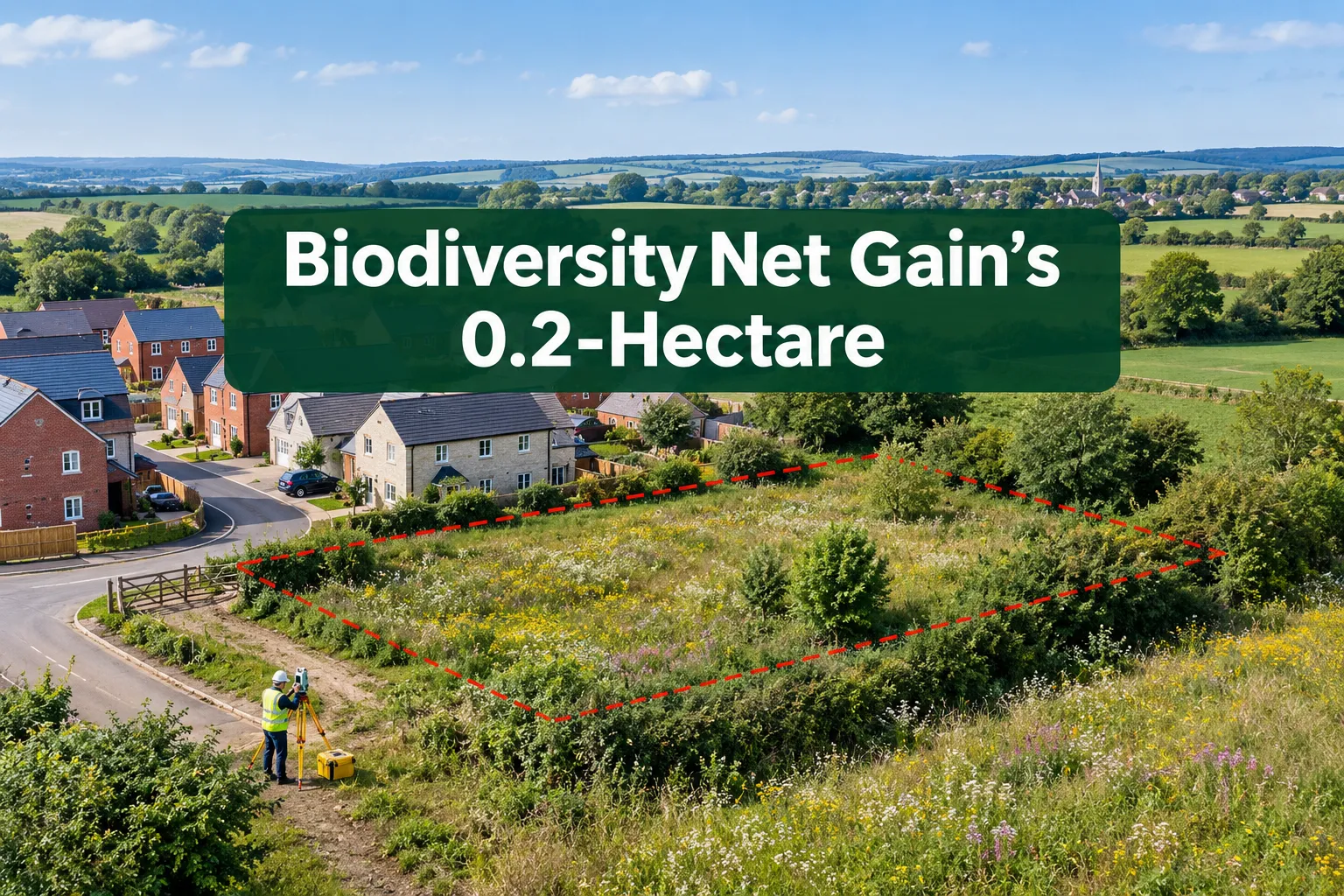
From 6 August 2026, thousands of small planning applications across England became exempt from mandatory Biodiversity Net Gain requirements, but only if they clear several specific hurdles. Biodiversity Net Gain's 0.2-hectare exemption is not a blanket pass for every compact site, and surveyors who treat it as one risk derailing a client's programme, or worse, producing due diligence that misses a material planning constraint.
This article sets out exactly what the exemption covers, where it stops, and the practical checks every UK surveyor should run before advising on a small development.
Key Takeaways
- From 6 August 2026, planning applications where the red-line boundary covers no more than 0.2 hectares (2,000 sq m) are exempt from mandatory BNG, provided no onsite priority habitat is negatively affected.
- The exemption is a new statutory area-based rule, separate from the existing de minimis exemption, and applies only to applications submitted on or after 6 August 2026.
- Priority habitats, protected sites and European protected species can disapply the exemption entirely, making early ecological screening non-negotiable.
- Section 73 variation applications are subject to strict transitional rules: the exemption does not apply where the original permission was applied for or granted before 6 August 2026.
- Even on exempt sites, the NPPF still requires that significant harm to biodiversity be avoided or mitigated, refusal remains possible.
What the 0.2-Hectare Exemption Actually Says
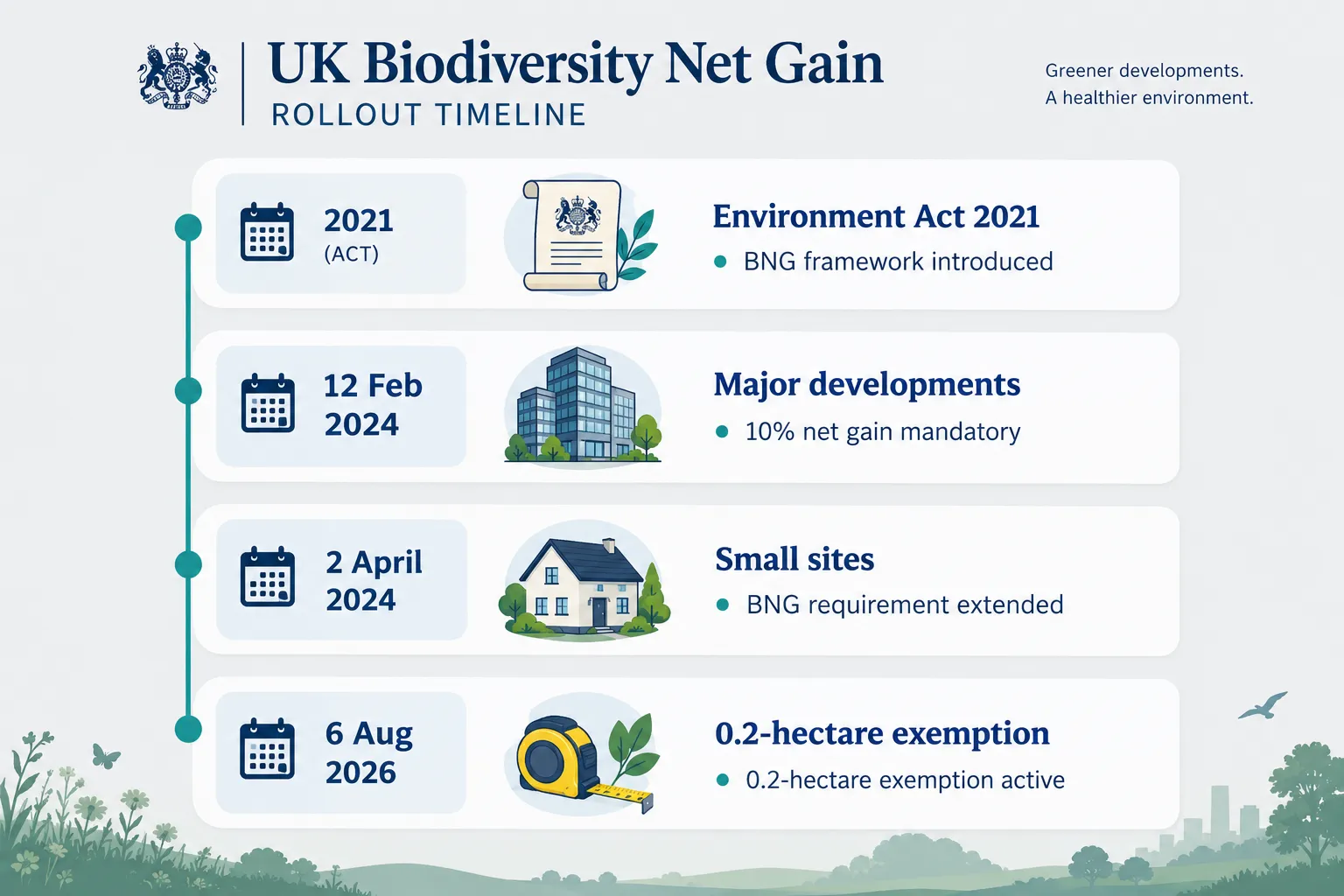
The Environment Act 2021 introduced mandatory BNG for most planning applications in England. From 12 February 2024, major developments had to demonstrate a 10% net gain in biodiversity units. Small sites followed from 2 April 2024 [1][2].
The 0.2-hectare exemption is a separate, newer provision. Government confirmed in its consultation response that the exemption is designed to make BNG requirements more proportionate for the smallest sites, where the administrative and cost burden is disproportionate relative to the ecological benefit delivered [10]. It is not an extension of the pre-existing de minimis (impact-based) exemption; it is an area-based rule that applies regardless of whether a development would have caused significant biodiversity harm [10].
The Defra Environment blog published on 14 July 2026 set out the position plainly: all applications under 0.2 hectares submitted on or after 6 August 2026 are exempt from BNG, unless they negatively affect onsite priority habitat [7]. That single qualifying clause, priority habitat, is where most of the risk sits for surveyors advising on small sites.
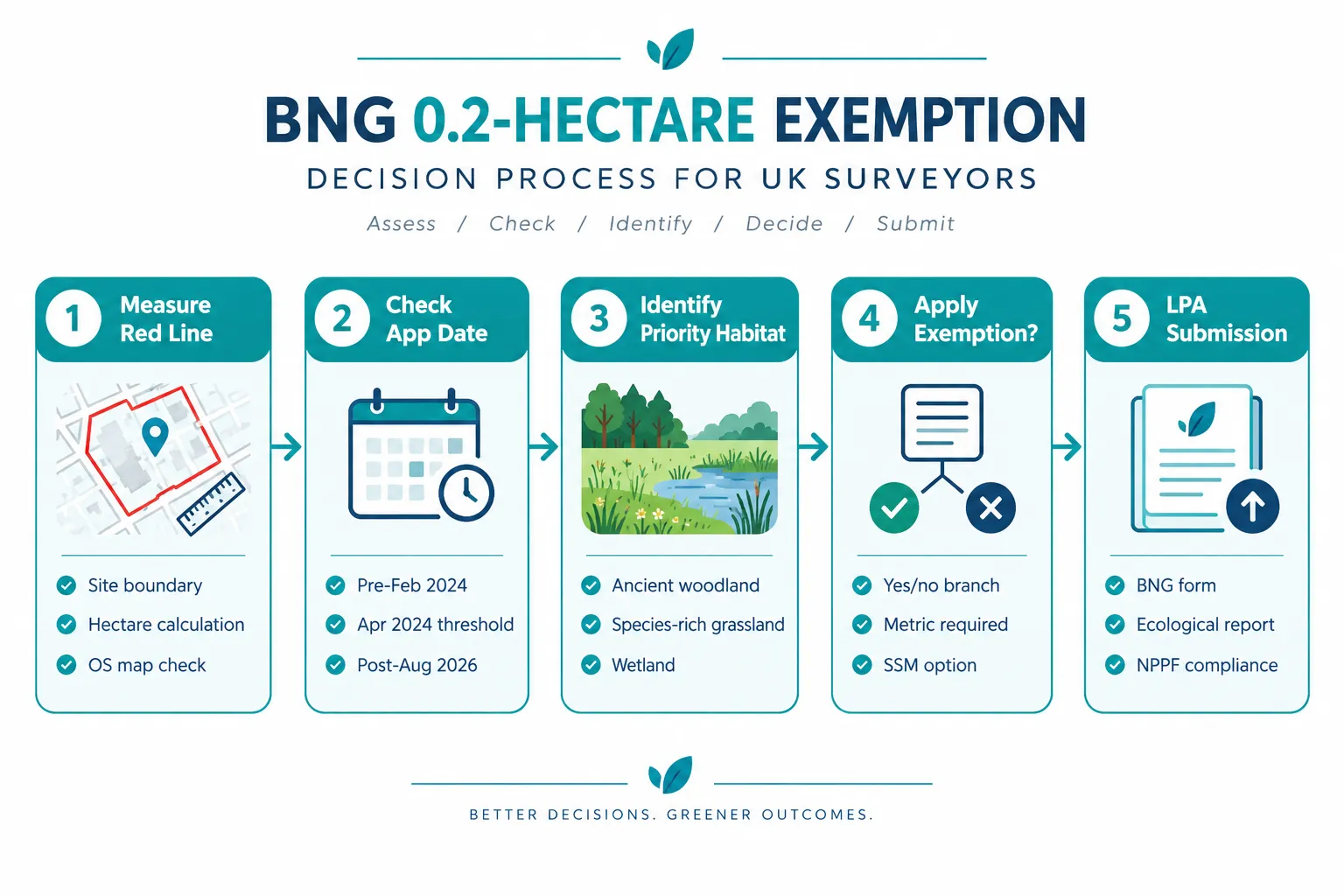
Official guidance on exempt developments confirms the two-part test: site area within the red-line boundary must be 0.2 hectares or less, and the development must not negatively affect onsite priority habitats [1][2]. Both conditions must be satisfied. Fail either one and mandatory BNG applies in full, including the requirement to use the statutory biodiversity metric and, where relevant, the small sites metric (SSM) [9].
Checking the Red-Line Boundary and Application Date
Measuring the Site Area Precisely
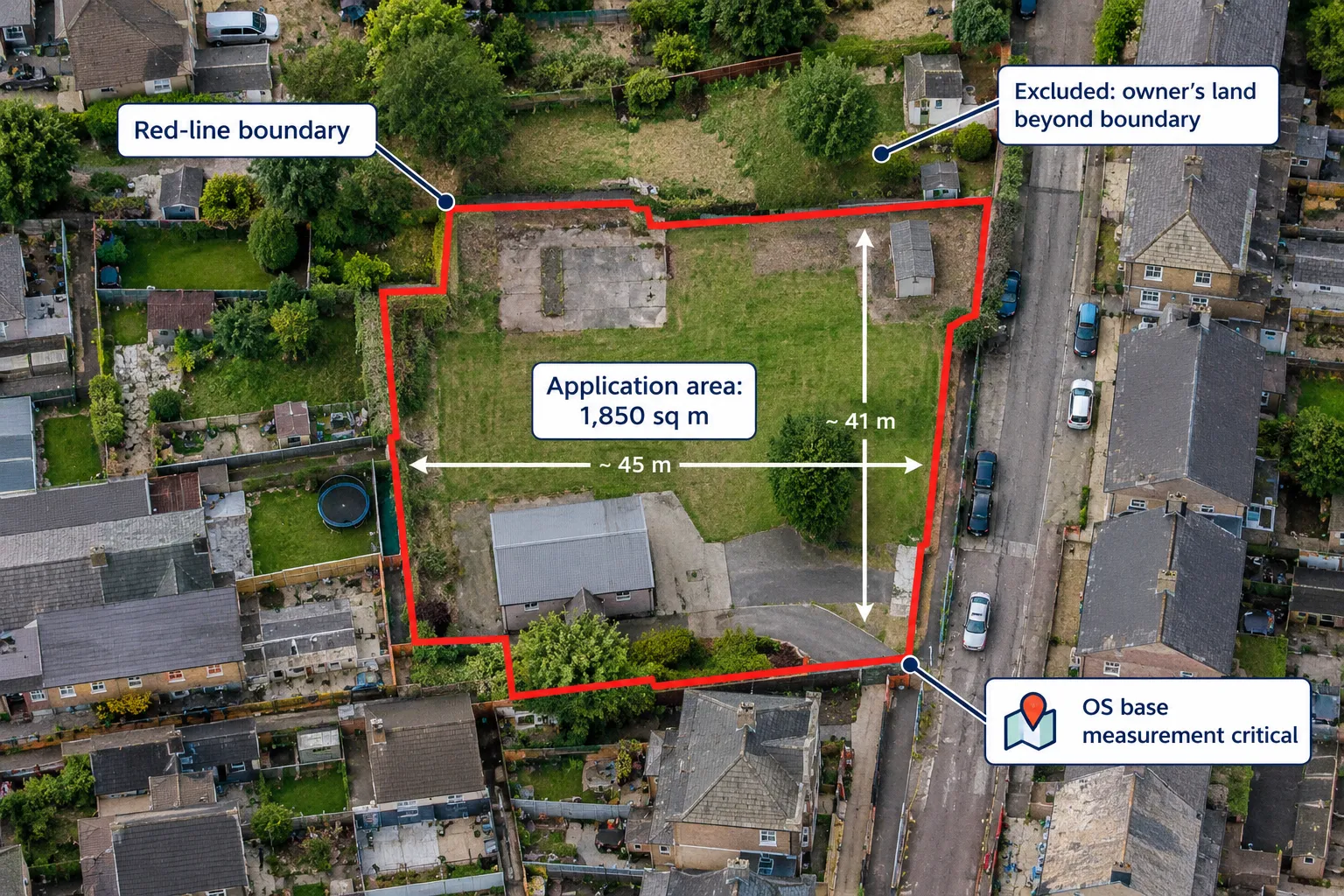
The 0.2-hectare threshold is applied to the area within the red-line boundary of the planning application, not the curtilage of the existing building, not the footprint of the proposed works, and not the land in the applicant's ownership beyond the application site [1][2]. This distinction matters on infill plots, garden developments and farmyard schemes where the red line may be drawn generously.
Surveyors should verify the site area against an accurate Ordnance Survey base plan. A site that appears small on a sketch layout can exceed 2,000 sq m once access routes, drainage swales and landscaping buffers are included within the red line. Where the area is marginal, it is worth advising clients to review the boundary before submission.
Application Date: Three Key Milestones
The exemption applies only to planning applications made on or after 6 August 2026 [2][7]. Earlier applications remain under the rules in force at the time of submission:
| Application submitted | BNG rules that apply |
|---|---|
| Before 12 February 2024 | BNG not required (pre-commencement) |
| 12 February 2024-1 April 2024 | BNG required for major sites only |
| 2 April 2024-5 August 2026 | BNG required for small sites; de minimis exemption available |
| On or after 6 August 2026 | 0.2-hectare area-based exemption available [1][7] |
For any application already submitted before 6 August 2026, the new exemption does not apply retrospectively. Surveyors working on live projects should confirm the submission date before advising that BNG obligations have fallen away.
Section 73 Applications: A Specific Trap
Section 73 applications, variations to existing planning permissions, carry an additional complication. The 0.2-hectare exemption does not apply to a section 73 application where the original planning permission was applied for or granted before 6 August 2026, even if the variation application itself is submitted after that date [2][7]. This means a client seeking to vary a 2025 permission for a small housing scheme cannot assume the exemption applies simply because they submit the variation in late 2026. The original BNG obligations from the parent permission carry through.
Priority Habitats: The Condition That Overrides the Exemption
What Counts as a Priority Habitat
Priority habitats are those listed under section 41 of the Natural Environment and Rural Communities Act 2006. They include ancient woodland, ancient and veteran trees, species-rich grassland, lowland heathland, blanket bog, coastal habitats and a range of freshwater and wetland types. Many small urban and peri-urban sites contain fragments of these habitats, a remnant hedgerow, a patch of unimproved grassland, a pond, that are not immediately obvious from a desk study.
Where a development would negatively affect onsite priority habitats, the 0.2-hectare exemption does not apply [1][2][7]. The application must then deliver at least 10% BNG and use the statutory metric. The statutory metric guidance also confirms that the SSM cannot be used where priority habitats, protected sites or European protected species are present, so the full metric calculation will be required [9].
Why Early Ecological Screening Is Non-Negotiable
The Country Land and Business Association has noted that the exemption will benefit many smaller, brownfield and rural schemes, but emphasises that planning applications on exempt sites can still be refused where significant biodiversity harm cannot be avoided or mitigated [6]. That point is reinforced by the NPPF, which requires development to be refused if significant harm to biodiversity cannot be avoided, mitigated or, as a last resort, compensated [8]. The exemption removes the mandatory BNG calculation; it does not remove the need for ecological assessment.
For surveyors, this means a Phase 1 habitat survey, or at minimum a desktop ecological screening, should be carried out before advising a client that BNG does not apply. A site that qualifies on area alone but contains a species-rich hedgerow or a bat roost could face refusal regardless of its size.
Farmers Weekly commentary from August 2026 makes the same point for agricultural schemes: livestock sheds, slurry lagoons and small housing plots of 0.2 hectares or less will be exempt if they do not affect priority habitats, but planning advisers warn that it is unsafe to assume all sub-0.2-hectare projects are exempt without ecological input.
Practical Due Diligence Checklist for Surveyors
The following checks should form part of any pre-application advice or feasibility report on a small development site in 2026.
1. Confirm the red-line area
Measure the application boundary against an OS base. Confirm it does not exceed 0.2 hectares (2,000 sq m). If the area is borderline, advise the client to reconsider the boundary before submission.
2. Establish the application date
Confirm whether the application will be submitted on or after 6 August 2026. If an earlier application is already live, the exemption does not apply.
3. Check for section 73 implications
If the instruction relates to a variation, confirm the date of the original permission. Where the parent application or permission predates 6 August 2026, BNG obligations from the original permission remain [2][7].
4. Commission ecological screening
Instruct a Phase 1 habitat survey or desktop ecological screening to identify any priority habitats, protected sites (SSSIs, SACs, SPAs) or European protected species. Any of these can disapply the exemption or trigger refusal under the NPPF.
5. Review local authority guidance
Local planning authorities including Wealden and Bassetlaw have published updated BNG guidance reflecting the 6 August 2026 changes [4][5]. Check whether the relevant LPA has issued supplementary planning documents or updated validation requirements.
6. Check NPPF chapter 19 compliance
Even where BNG is not mandatory, the NPPF requires that significant harm to biodiversity be avoided or mitigated [8]. Confirm the scheme can satisfy this test. Where it cannot, refusal risk remains regardless of the exemption.
7. Advise on residual metric requirements
Where the exemption does not apply, because of priority habitats, application date or section 73 rules, confirm whether the full statutory metric or the SSM is appropriate. The SSM is not available where priority habitats or European protected species are present [9].
Implications for Valuation and Feasibility
BNG compliance costs, ecological surveys, metric calculations, habitat management plans and, where off-site units are needed, biodiversity unit purchases, can be material on small schemes. Removing that cost burden through the 0.2-hectare exemption can improve viability on marginal sites. Surveyors preparing development appraisals or residual land value calculations should reflect whether the exemption applies cleanly, applies conditionally (pending ecological screening), or does not apply at all.
Where BNG is still required, the cost of purchasing off-site biodiversity units should be included in the appraisal. Unit prices vary by habitat type and location; they are not trivial on schemes where the baseline biodiversity value is low and the 10% uplift requires significant off-site provision.
For chartered surveyors advising on site acquisitions, the BNG position should be confirmed as part of due diligence alongside title, planning history and physical condition. A site purchased on the assumption that the exemption applies, which then turns out to contain a section 41 habitat, could face a materially different planning outcome and cost profile.
Property surveyors working on residential schemes should also note that the exemption does not affect other environmental requirements, protected species surveys, tree preservation orders, flood risk assessments and water framework directive compliance all remain in place.
How This Sits Within the Wider BNG Framework
The 0.2-hectare exemption sits alongside the existing de minimis exemption (for development with a negligible impact on biodiversity), the temporary development exemption (also introduced on 6 August 2026) and the householder exemption [1][2]. These are distinct categories; a development that does not qualify under one may qualify under another, but surveyors should not conflate them.
The NPPF, updated in late September 2026, confirms that local planning authorities must not set local BNG standards that exceed the statutory requirement for categories of development that are exempt from statutory BNG [8]. This prevents LPAs from effectively reinstating BNG obligations for exempt sites through local plan policy, a point worth checking where a local authority has an ambitious biodiversity strategy.
For those working on social housing or council-led schemes, the complete professional guide to surveyor roles in social housing covers related planning and environmental obligations that run alongside BNG requirements.
Surveyors dealing with party wall matters on small development sites should be aware that BNG obligations, or the absence of them, do not affect the party wall process, but both workstreams often run in parallel on infill and rear-extension projects. The Party Wall Act 1996 guide sets out how those obligations operate separately.
Where a small development site has been subject to a building survey that flagged environmental or ecological concerns, those findings can feed directly into the BNG assessment process. Surveyors preparing building survey reports on sites with development potential should note any visible habitat features, ponds, hedgerows, mature trees, that could affect the BNG position.
FAQ
Does the 0.2-hectare exemption apply to permitted development?
The exemption applies to planning applications. Permitted development rights do not require a planning application, so BNG obligations, which attach to planning permissions, do not apply to permitted development in the same way. Where a full application is required, the exemption rules above apply.
Can a developer split a larger site into sub-0.2-hectare parcels to benefit from the exemption?
Government guidance does not explicitly address artificial subdivision, but local planning authorities can consider the overall development context. Surveyors should advise clients that attempts to engineer the exemption through boundary manipulation carry planning risk and could be treated as a single development for BNG purposes.
What if the site is in a conservation area or near a listed building?
Conservation area designation and listed building status are separate planning considerations. They do not in themselves disapply the 0.2-hectare exemption, but they may trigger additional ecological and heritage assessments that could identify priority habitats or protected species.
Does the exemption apply in Wales, Scotland or Northern Ireland?
No. BNG under the Environment Act 2021 applies in England only. Wales, Scotland and Northern Ireland have separate legislative frameworks.
What happens if an ecological survey identifies priority habitat after the application is submitted?
If priority habitat is identified post-submission, the exemption cannot be claimed. The applicant will need to provide a BNG metric calculation and, if the 10% target cannot be met on site, arrange off-site provision or biodiversity credits.
Where can surveyors find the statutory biodiversity metric tools?
The metric calculation tools and guidance are published by Natural England and referenced in the government's guidance on calculating biodiversity value with the statutory biodiversity metric [9]. The small sites metric is a simplified version for qualifying minor developments.
Does the exemption affect the need for a pre-application ecological assessment?
No. Pre-application ecological screening remains advisable on any site where priority habitats or protected species might be present. Confirming the exemption applies requires ruling out those constraints, which requires an ecological assessment.
Conclusion
Biodiversity Net Gain's 0.2-hectare exemption is a genuine simplification for the smallest planning applications in England, removing a compliance burden that was disproportionate on minor schemes. From 6 August 2026, surveyors advising on small developments have a clearer framework, but the exemption is conditional, not automatic.
The practical steps are straightforward. Measure the red-line boundary accurately. Confirm the application will be submitted on or after 6 August 2026. Check whether the instruction involves a section 73 variation with a pre-August 2026 parent permission. Commission ecological screening to rule out priority habitats, protected sites and European protected species. Review the relevant LPA's updated guidance. And confirm that the scheme can still satisfy the NPPF's biodiversity protection requirements even where BNG is not mandatory.
Surveyors who build these checks into their standard pre-application due diligence will give clients reliable advice on viability, planning risk and programme. Those who assume the exemption applies without running the checks expose clients, and themselves, to avoidable surprises at validation or determination.
For site-specific advice on survey scope and planning constraints, speak to a local surveyor with experience of the relevant LPA area and its ecological baseline.
References
[1] Biodiversity Net Gain Exempt Developments – gov.uk
[2] Biodiversity Net Gain – gov.uk
[3] Understanding Biodiversity Net Gain – gov.uk
[4] Biodiversity Net Gain Guidance – bassetlaw.gov.uk
[5] BNG Changes From 6 August 2026 – wealden.gov.uk
[6] Key Changes Confirmed To Biodiversity Net Gain – cla.org.uk
[7] Biodiversity Net Gain Amendments And Transitional Arrangements Published – defraenvironment.blog.gov.uk
[8] National Planning Policy Framework Chapter 19 Conserving And Enhancing The Natural Environment – gov.uk
[9] Calculate Biodiversity Value With The Statutory Biodiversity Metric – gov.uk
[10] Government Response And Summary Of Responses – gov.uk