

From 1 May 2026, the Renters' Rights Act 2025 came into force across the private rented sector in England, ending fixed-term assured shorthold tenancies and abolishing no-fault evictions in a single legislative stroke [2]. For landlords, the practical consequence is stark: where a Section 21 notice once allowed possession without explanation, every future possession claim now requires evidence. Property condition reports, repair logs, damp observations, and tenant correspondence are no longer optional paperwork, they are the foundation of a defensible tenancy. This article sets out the Renters' Rights Changes and Property Condition Reports: What UK Landlords Should Document in 2026, building a practical inspection framework that protects landlords at every stage of the tenancy lifecycle.
Key Takeaways
- The Renters' Rights Act 2025 commenced on 1 May 2026, converting all assured shorthold tenancies to periodic tenancies and removing no-fault eviction routes [2].
- Possession claims now depend on fault-based grounds, so landlords must hold dated, signed evidence of property condition and repair history.
- A mandatory Renters' Rights Act Information Sheet 2026 must be provided to tenants, and landlords must register on the new national Private Rented Sector Database [3].
- Rent increases are limited to once per year, require Form 4A, and cannot be driven by contractual rent-review clauses [2].
- Local authority enforcement powers have expanded, raising the cost of inadequate documentation for landlords who face civil penalties [6].
What the Renters' Rights Act 2025 Changes for Landlords
The Act received Royal Assent in 2025 and its main provisions took effect on 1 May 2026 [5]. Every existing assured shorthold tenancy automatically converted to a periodic tenancy on that date. New tenancies granted from 1 May 2026 onwards must be periodic from the outset.
The abolition of Section 21 is the headline change, but the supporting obligations are equally significant for day-to-day management:
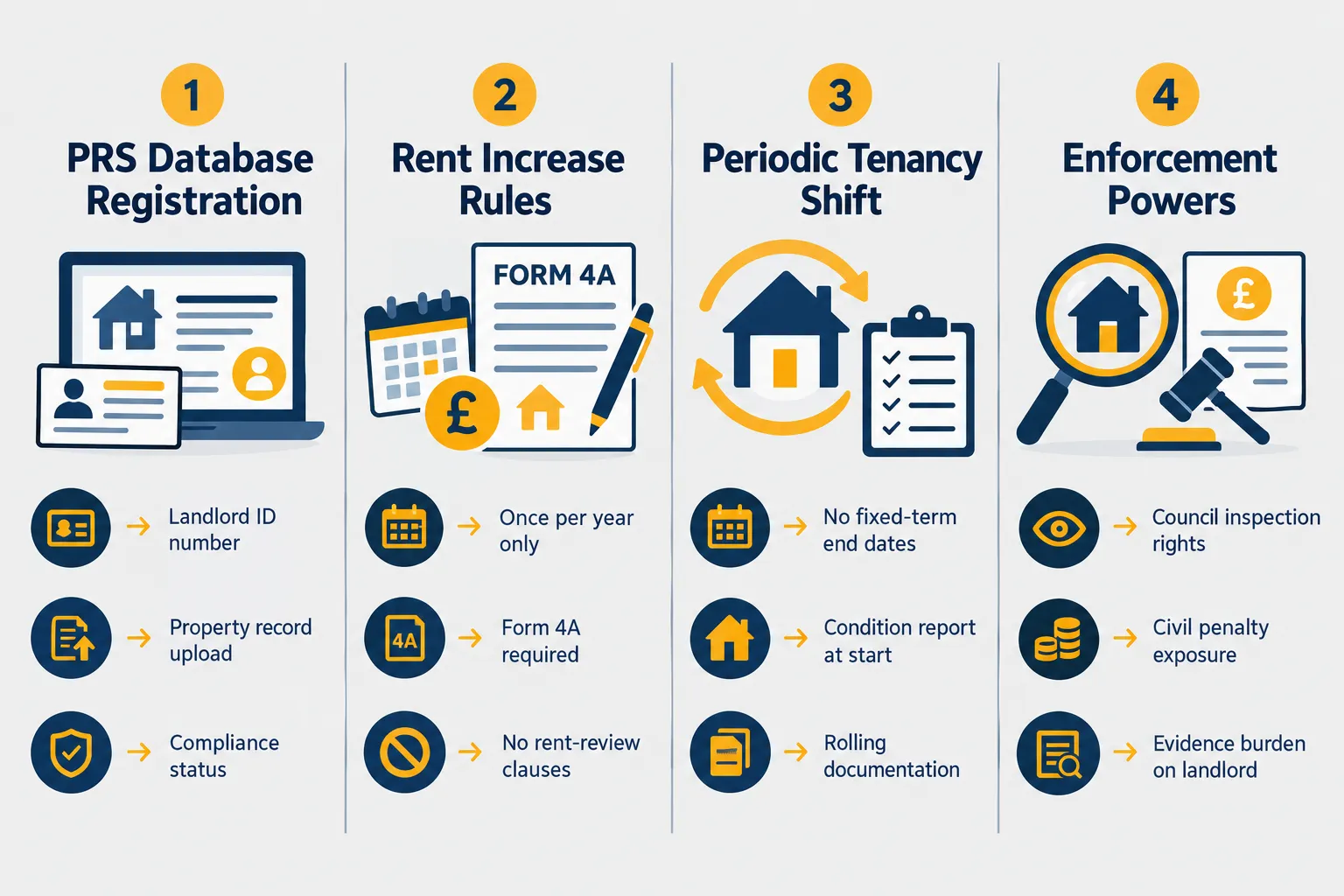
- Periodic tenancies only. There are no fixed-term endings to rely on. Landlords must use fault-based grounds under Schedule 2 of the Housing Act 1988 (as amended) to recover possession [2].
- Mandatory Information Sheet. Landlords must give tenants the Renters' Rights Act Information Sheet 2026 at the start of every tenancy [3]. Failure to serve it correctly may affect the landlord's ability to use certain possession grounds.
- Private Rented Sector Database. Landlords must register themselves and their properties on the new national database, sometimes called the "Register Your Rental Property" service [5]. The database is intended to give councils and tenants visibility of compliance status.
- Rent increases capped to once per year. Increases must be proposed using Form 4A and cannot be imposed through contractual rent-review clauses [2]. Tenants may challenge proposed increases through the First-tier Tribunal.
- Expanded local authority enforcement. Councils have new civil penalty powers and are expected to inspect and audit landlord records more actively [6].
For landlords who have relied on periodic tenancy renewals or Section 21 as a backstop, the shift is material. Sound documentation of property condition is now the primary tool for managing disputes and possession claims.
Building a Property Condition Report Framework Under the New Rules
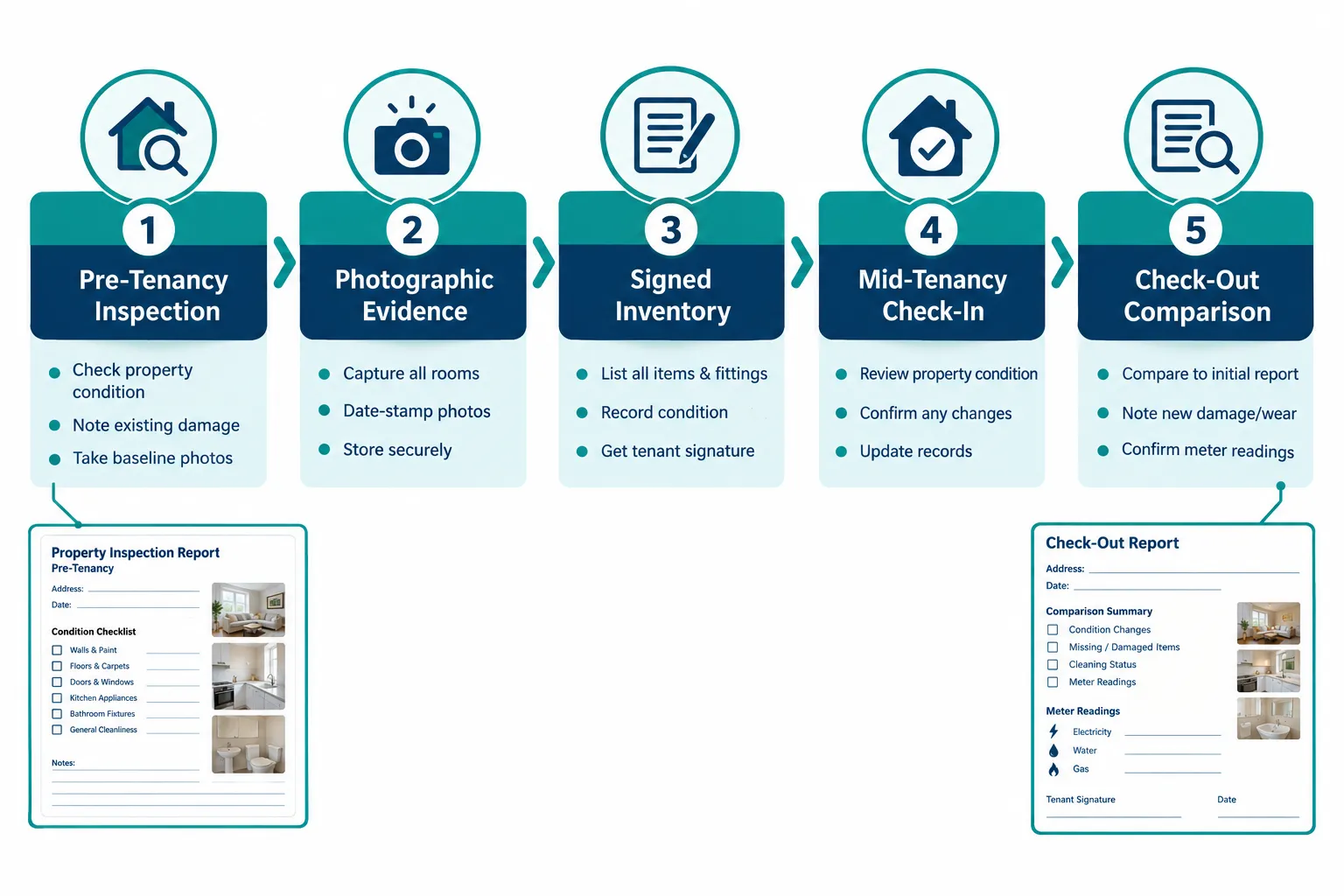
Renters' Rights Changes and Property Condition Reports: What UK Landlords Should Document in 2026 demand a structured approach at three distinct stages: move-in, mid-tenancy, and move-out. Each stage serves a different legal purpose.

Move-In: The Baseline Record
A thorough move-in condition report creates the evidential baseline against which any future dispute, whether about damage, disrepair, or deposit deductions, will be measured. The report should cover:
| Area | What to Record |
|---|---|
| All rooms | Walls, ceilings, floors, doors, windows, condition and any pre-existing defects |
| Kitchen | Appliances, units, worktops, plumbing under sink, ventilation |
| Bathrooms | Sanitaryware, grouting, sealant, extractor fan operation |
| Damp and mould | Any visible staining, condensation marks, or musty odours |
| Heating | Boiler age and service date, radiator condition, thermostat operation |
| Electrics | Consumer unit condition, socket and switch condition, any visible damage |
| Exterior | Gutters, downpipes, roof visible from ground, boundary condition |
| Meters | Gas, electricity, and water meter readings with photographs |
Every entry should carry a date stamp. Photographs must be high resolution, taken in good light, and stored in a format that cannot be easily altered. The tenant should sign the report, or at minimum receive a copy and be given the opportunity to add comments within a set period, typically seven days.
For landlords who want a professional baseline, a building condition assessment carried out by a RICS-regulated surveyor provides a defensible third-party record. This is particularly useful for higher-value properties or those with known structural or damp issues.
Damp and Ventilation: A Specific Documentation Priority
Damp and mould have been a focus of enforcement action since the Homes (Fitness for Human Habitation) Act 2018, and the Renters' Rights Act 2025 reinforces the obligation to maintain properties free from hazards. Landlords should document:
- The type of damp present at move-in (condensation, penetrating, or rising) with photographic evidence.
- Ventilation provision in kitchens and bathrooms, extractor fan make, model, and test result.
- Any remedial works carried out before the tenancy, with contractor invoices and completion dates.
- Tenant guidance on ventilation and heating provided in writing at move-in.
A professional damp survey report prepared before the tenancy begins gives landlords a clear record of baseline conditions and demonstrates proactive compliance. See also the damp survey cost guide for 2026 for current pricing expectations.
Mid-Tenancy: Repair Records and Inspection Notes
Periodic tenancies have no natural end point, so mid-tenancy records become the ongoing audit trail. Landlords should maintain:
- A repair log recording every tenant report, the date received, the action taken, and the date resolved.
- Contractor invoices and completion certificates for all works.
- Periodic inspection notes (typically annual) signed or acknowledged by the tenant.
- Any correspondence about rent increases, including Form 4A notices and tenant responses.
Tenant communication should be in writing wherever possible, email is acceptable and creates a time-stamped record. Verbal agreements should be followed up in writing.
Move-Out: The Comparison Record
At the end of a tenancy, the move-out condition report is compared directly against the move-in baseline. Without a signed move-in report, landlords cannot demonstrate that damage occurred during the tenancy rather than before it. The move-out record should:
- Follow the same structure as the move-in report, room by room.
- Include dated photographs taken on the day of handover.
- Note fair wear and tear separately from damage, the two are not the same, and deposit schemes will not award deductions for fair wear and tear.
- Be completed in the presence of the tenant where possible, or sent to the tenant promptly with an opportunity to respond.
The Private Rented Sector Database and Record-Keeping Duties
The new national Private Rented Sector Database requires landlords to register their details and their properties [5]. The database is designed to give local authorities a tool for identifying non-compliant landlords and to give tenants confidence that their landlord is registered.
Registration is not simply an administrative step. The database will hold information about properties, and councils are expected to cross-reference it against enforcement records [8]. Landlords who cannot demonstrate compliance, including adequate documentation of property condition, face civil penalties that can reach significant sums under the expanded enforcement framework [6].
Coventry City Council's published guidance notes that landlords should keep records of all tenancy documentation, repair communications, and compliance certificates as part of their obligations under the new regime [10]. Walsall Council's FAQ guidance similarly emphasises that landlords need to understand their documentation duties from day one of a tenancy [6].
The mandatory Renters' Rights Act Information Sheet 2026 must be given to tenants at the start of the tenancy [3]. This document sets out tenant rights under the Act, including the right to request repairs, the right to challenge rent increases, and the right to keep a pet in certain circumstances. Landlords should retain a signed copy or a delivery record.
Renters' Rights Changes and Property Condition Reports: Practical Risk Management
The shift from fixed-term to periodic tenancies changes the risk profile of every letting. Under the old model, a landlord could recover possession at the end of a fixed term without giving reasons. Under the 2026 framework, possession requires one of the fault-based grounds in Schedule 2 of the Housing Act 1988 (as amended) to be established and evidenced [2].
Grounds most likely to require condition evidence include:
- Ground 10 and 11, rent arrears. Repair disputes are a common defence to arrears claims. A landlord who cannot show that reported repairs were addressed promptly may find a tenant's disrepair counterclaim reduces or eliminates the arrears figure.
- Ground 12, breach of tenancy obligations. Proving a breach (such as unauthorised alterations or damage) requires a baseline condition record.
- Ground 13, deterioration of the property. This ground requires evidence that the property has deteriorated beyond fair wear and tear, which is only possible with a move-in baseline.
For landlords with properties in London, a RICS-regulated property surveyor in London can prepare condition schedules that carry professional weight in dispute resolution and tribunal proceedings. A homebuyers report example illustrates the level of detail a professional condition record can contain, which is a useful benchmark for landlords preparing their own documentation.
A practical documentation checklist for 2026:
- Signed move-in condition report with dated photographs
- Meter readings at move-in
- Copy of the Renters' Rights Act Information Sheet 2026 served on tenant
- Gas Safety Certificate (annual)
- Electrical Installation Condition Report (every five years)
- Energy Performance Certificate (valid, minimum Band E)
- Deposit protection certificate and prescribed information
- Repair log with dates, descriptions, and resolution records
- Form 4A for any rent increase proposed
- Annual inspection notes
- Signed move-out condition report with dated photographs
Social Housing: Phased Implementation
The Renters' Rights Act 2025 applies primarily to the private rented sector, but social housing landlords face a phased implementation of related documentation and condition standards [1]. Registered providers are expected to align their condition reporting and repair response practices with the principles embedded in the Act, even where specific provisions apply differently to the social sector.
Social housing surveyors and housing officers should be aware that the documentation expectations set by the Act are likely to influence tribunal and ombudsman decisions across both tenures. For professionals working in this area, the surveyor social housing career guide for 2026 covers the evolving role of surveyors in meeting these standards.
FAQ
Do landlords have to use a professional surveyor for condition reports?
No statutory requirement exists to use a RICS surveyor for a move-in condition report. However, a professionally prepared report carries greater evidential weight in a tribunal or court. For high-value properties, properties with known defects, or where a dispute is anticipated, professional preparation is worth considering.
What happens if a landlord does not register on the Private Rented Sector Database?
Non-registration is a civil offence under the Act. Local authorities can issue civil penalties, and unregistered landlords may be restricted from using certain possession grounds [5].
Can a landlord still increase rent?
Yes, but only once in any 12-month period. The increase must be proposed using Form 4A and the tenant has the right to challenge it through the First-tier Tribunal [2]. Contractual rent-review clauses in tenancy agreements have no effect under the new rules.
What is the Renters' Rights Act Information Sheet 2026?
It is a government-prescribed document that landlords must give to tenants at the start of a tenancy. It explains tenant rights under the Act, including repair rights, rent challenge rights, and pet permissions [3].
Does the Act apply to existing tenancies?
Yes. All existing assured shorthold tenancies converted automatically to periodic tenancies on 1 May 2026. Landlords must comply with the new rules from that date regardless of when the tenancy was originally granted [2].
What counts as fair wear and tear?
Fair wear and tear is the gradual deterioration of a property through normal, reasonable use. It is not damage. A worn carpet in a hallway after three years is fair wear and tear; a carpet with burn marks or stains is damage. Deposit schemes apply this distinction strictly, and landlords cannot claim deductions for fair wear and tear.
How long should condition records be kept?
No specific retention period is prescribed by the Act, but landlords should keep all tenancy documentation for at least six years to cover potential civil claims and enforcement investigations.
Conclusion
The Renters' Rights Act 2025 has reshaped the legal relationship between landlords and tenants in England. From 1 May 2026, the absence of a no-fault eviction route means that every possession claim, deposit dispute, and rent challenge will be decided on evidence. Landlords who have invested in thorough condition records, signed inventories, repair logs, and written tenant communications are in a strong position. Those who have not face real exposure.
The practical steps are straightforward. Prepare a detailed, signed move-in condition report with dated photographs. Serve the mandatory Renters' Rights Act Information Sheet 2026. Register on the Private Rented Sector Database. Keep a repair log. Propose rent increases using Form 4A. Carry out periodic inspections and record them. Prepare a move-out report that mirrors the move-in baseline.
For properties where damp, structural condition, or complex repair histories create additional risk, a RICS-regulated surveyor can prepare a condition schedule that provides professional-grade evidence. The investment in proper documentation at the start of a tenancy is substantially smaller than the cost of a contested possession claim or a civil penalty from an enforcement-active local authority.
References
[1] Implementing The Renters Rights Act Social Housing – gov.uk
[2] Renters Rights Act An Overview For Landlords – gov.uk
[3] The Renters Rights Act Information Sheet 2026 – gov.uk
[4] Renters Rights Act Overview For Tenants – gov.uk
[5] Implementing The Renters Rights Act 2025 Our Roadmap For Reforming The Private Rented Sector – gov.uk
[6] Information Landlords – go.walsall.gov.uk
[7] The Renters Rights Act Information Sheet 2026 (PDF) – assets.publishing.service.gov.uk
[8] The Renters Rights Act 2025 – salford.gov.uk
[9] Stronger Protections And Greater Confidence For Renters – gov.uk
[10] Renters Rights Act – coventry.gov.uk