
Roughly 40% of commercial tenants who skip an independent building inspection before signing discover material defects within the first year of occupation, defects that, under a full repairing and insuring (FRI) lease, become their liability from day one. A thorough commercial property inspection checklist covering what to examine before taking a lease or buying a building is not a bureaucratic formality; it is the document that determines whether a deal is sound or a financial trap.
This article sets out what a RICS-qualified surveyor examines, why each element matters, and how the findings feed into lease negotiations, purchase price adjustments, and ongoing repair obligations.
Key Takeaways
- A commercial property inspection must cover fabric, building services, fire safety, accessibility, environmental risk, and legal compliance, not just visible condition.
- Under a full repairing and insuring lease, a tenant inherits the building's existing defects unless those defects are explicitly carved out before signing.
- A Property Condition Assessment (PCA) produces a ten-year capital expenditure estimate that directly supports price or rent negotiation.
- Environmental and planning due diligence must run alongside the physical inspection, not after it.
- Inspection findings are negotiating tools: documented defects can secure rent-free periods, landlord works, or price reductions.
The Scope of a Commercial Property Inspection
A commercial property inspection checklist covers what to examine before taking a lease or buying a building across several distinct disciplines. The RICS framework groups these into building condition, the roof and building envelope, mechanical and electrical (M&E) services, plumbing, fire and life-safety systems, accessibility, site circulation, parking, and utilities. [1][4]
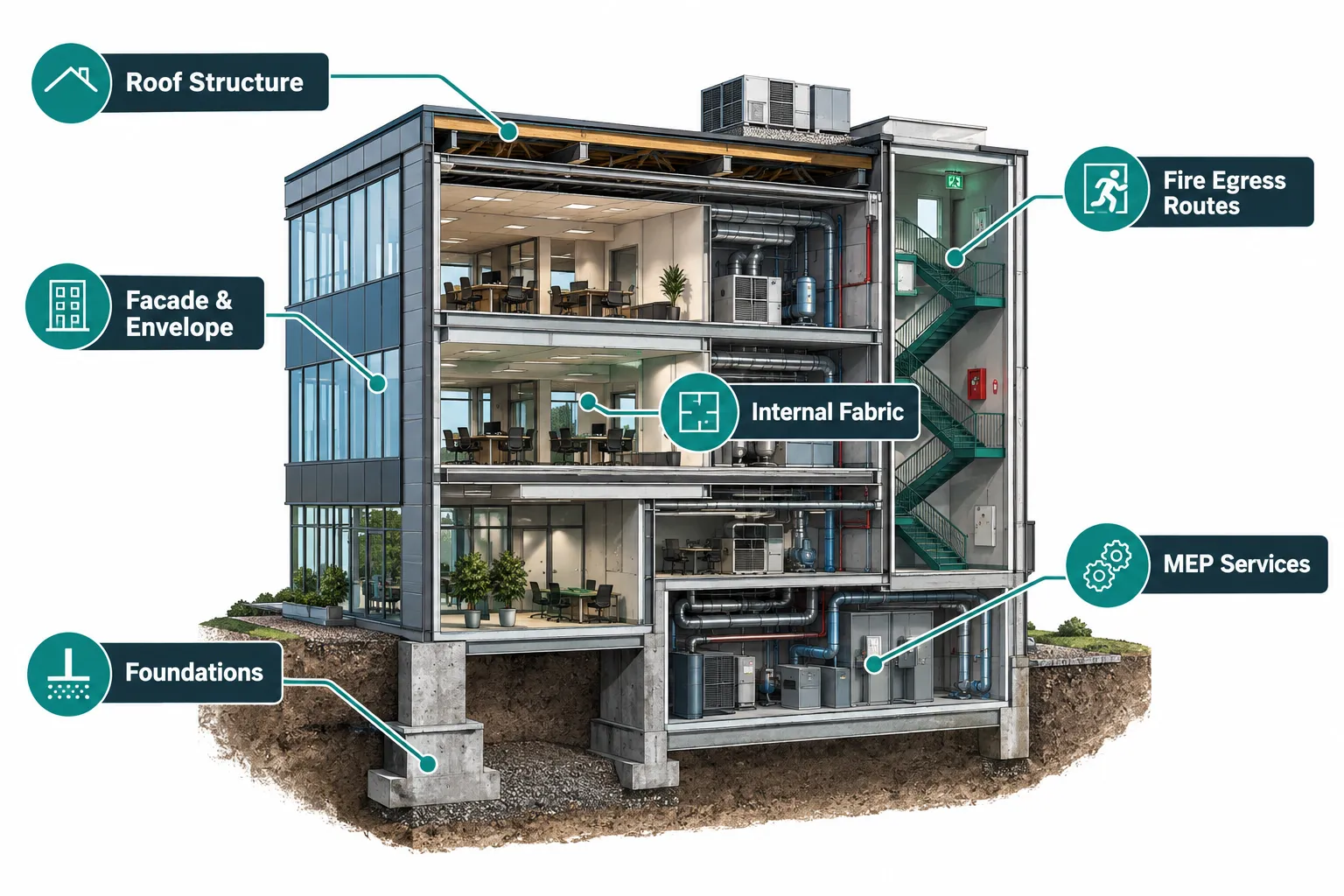
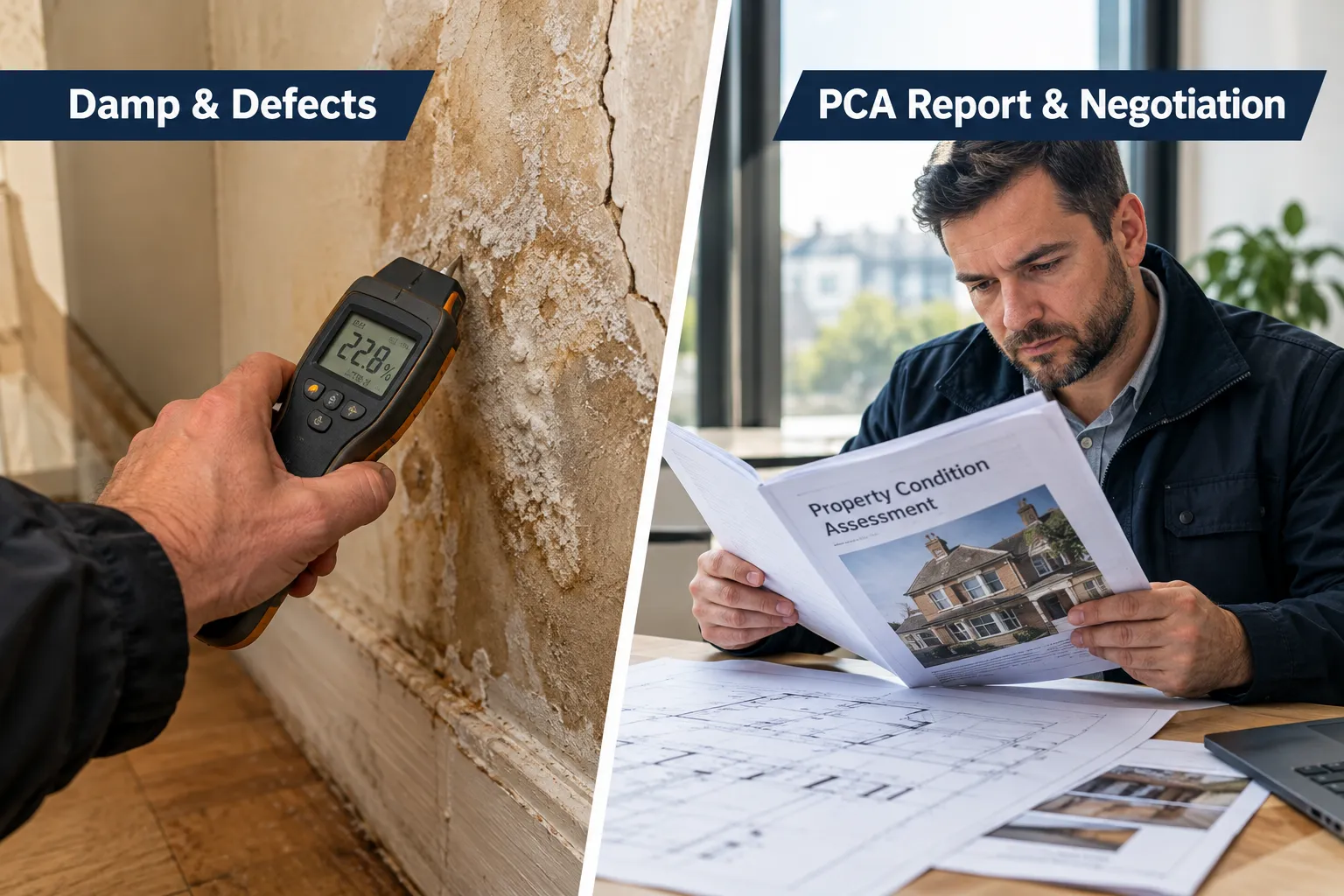
The inspection is led by a qualified building surveyor or structural engineer and is documented with photographs, measured notes, and, for larger assets, a formal Property Condition Assessment report. A PCA typically includes a ten-year capital expenditure reserve schedule, which feeds directly into underwriting, rent negotiation, and any landlord works agreement. [9]
For buyers, the PCA sits alongside legal due diligence. For tenants, it informs the schedule of condition that should be annexed to the lease to cap dilapidations liability at lease end. Understanding what a surveyor does at this stage helps both parties set realistic expectations of the process.
Structural Integrity and Building Fabric
Foundations, Frame, and Walls
Foundations and the primary structural frame are the first priority. A surveyor checks for differential settlement, heave, and crack patterns that indicate ongoing movement rather than historic shrinkage. Crack gauges and high-resolution photographs with scale references allow movement to be tracked over time before a purchase completes. [3]
External and internal walls are examined for:
- Vertical and diagonal cracking at openings and corners
- Spalling or delamination of masonry
- Evidence of previous underpinning or structural repair
- Bulging or bowing in brick or blockwork
Subsidence is a particular concern in areas with shrinkable clay soils or where tree roots are close to the building line.
Roof Structure and Envelope
The roof is inspected for structural integrity, covering condition, drainage, and waterproofing. Flat roofs on commercial buildings are a frequent source of water ingress, and any ponding, blistering, or failed upstand detailing should be costed for remediation. [2][3]
The building envelope, cladding, curtain walling, glazing, and external doors, is assessed for:
- Failed or missing sealant joints
- Corrosion in metal fixings or frames
- Delamination of composite panels
- Compliance with current fire-spread regulations (particularly relevant after post-Grenfell cladding guidance)
Internal Fabric
Internally, floors, ceilings, partitions, and finishes are checked for signs of water damage, settlement cracking, and deferred maintenance. Any tenant alterations from previous occupiers, removed columns, altered floor loadings, penetrations through fire compartment walls, require particular scrutiny. A building evaluation of this depth is distinct from a standard homebuyer's report and requires commercial surveying experience.
Mechanical, Electrical, and Plumbing Systems
Modern commercial buildings carry significant M&E complexity, and obsolete or under-sized services are among the most expensive defects to remedy post-occupation. [2][4]
Heating, Ventilation, and Air Conditioning
HVAC systems should be tested under full-load conditions, not merely switched on. The surveyor or M&E engineer checks:
- Age and remaining service life of plant
- Maintenance records and service contracts
- Adequacy of capacity for the proposed occupancy and layout
- Compliance with current refrigerant regulations (F-Gas)
- Ductwork condition and any asbestos-containing insulation on older pipework
Electrical Systems
Electrical due diligence has become more detailed in 2026 guidance, reflecting the growing risk of under-sized supplies for modern uses. [2][4] Key checks include:
| Item | What to Verify |
|---|---|
| Incoming supply capacity | Adequate for planned equipment and EV charging |
| Distribution boards | Age, condition, RCBO/AFCI protection |
| Wiring condition | Insulation integrity, absence of aluminium wiring |
| Emergency lighting | Tested, certificated, adequate coverage |
| Metering | Sub-metering arrangements and landlord recharges |
An Electrical Installation Condition Report (EICR) should be requested from the landlord or seller. If none exists, the surveyor should recommend commissioning one before exchange or lease execution.
Plumbing and Drainage
Plumbing checks focus on leaks, corrosion, water pressure, and the condition of above-ground drainage. [2] Below-ground drainage is best assessed by CCTV survey, particularly in older buildings or where previous tenants carried out fit-out works. Legionella risk assessment records should also be requested, a landlord's failure to hold these is itself a compliance flag.
Damp and Moisture
Damp is one of the most common and most underestimated defects in commercial buildings. A damp and timber report can identify rising damp, penetrating damp, and condensation before they become a lease-end dispute. The signs of rising damp in commercial premises often differ from residential patterns because of different floor constructions and ventilation regimes.
Fire Safety, Accessibility, and Compliance
Fire Protection Systems
Fire safety compliance is non-negotiable and carries personal liability for directors and responsible persons under the Regulatory Reform (Fire Safety) Order 2005. The inspection checklist should confirm: [4][5]
- Fire alarm system type, age, and last test certificate
- Sprinkler system coverage and last service record
- Fire extinguisher types, locations, and current certification
- Passive fire protection: compartment walls, fire doors, intumescent seals
- Emergency lighting coverage and test records
- Clear and signed escape routes adequate for planned occupancy
Any gap in fire compartmentation from previous tenant alterations must be made good before occupation.
Accessibility
Accessibility compliance under the Equality Act 2010 is frequently overlooked in commercial due diligence. Inspectors should assess: [5]
- Level or ramped access at all principal entrances
- Accessible WC provision
- Lift availability and compliance where multi-storey
- Parking spaces designated for disabled users
- Internal circulation widths and door clear openings
Retrofit costs for accessibility improvements can be substantial, and a new tenant or buyer may inherit the obligation to make reasonable adjustments.
Building Regulations History
Checking building regulations compliance history through local authority searches reveals whether previous works were properly consented and signed off. Uncertified structural or M&E works can create insurance voids and mortgage conditions. Any enforcement notices or outstanding requirements should be resolved before contracts are exchanged or a lease is signed.
Environmental Risk and Legal Due Diligence
Phase I Environmental Site Assessment
Environmental risk assessment is now a standard component of commercial due diligence, particularly for urban sites, former industrial premises, or properties near petrol stations and dry cleaners. [10] A Phase I assessment reviews:
- Historical land uses from maps, records, and aerial photography
- Proximity to registered contaminated land
- Presence of asbestos-containing materials (ACMs) in the fabric
- Hazardous materials such as lead paint, PCBs in old electrical equipment, or underground storage tanks
Where Phase I findings indicate risk, a Phase II assessment involving soil and groundwater sampling is warranted before committing to purchase. Remediation costs can run to hundreds of thousands of pounds and are not always recoverable from a seller.
Asbestos
Any commercial building constructed before 2000 is likely to contain asbestos-containing materials. The Control of Asbestos Regulations 2012 places a duty to manage ACMs on the owner or person in control of non-domestic premises. A buyer or incoming tenant should request the existing asbestos register and management plan, and commission a fresh survey if records are absent or incomplete.
Planning and Title
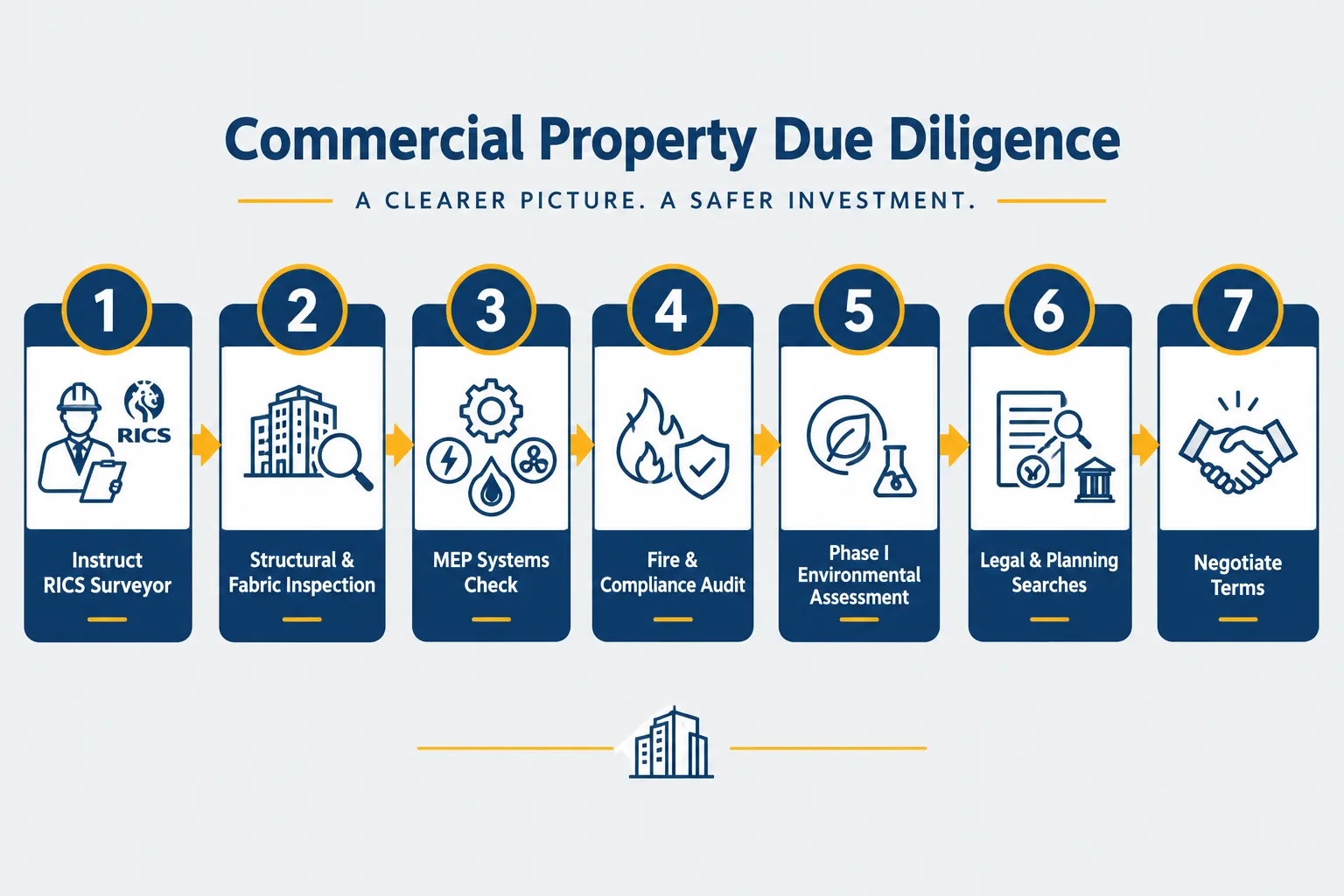
Legal and planning due diligence runs in parallel with the physical inspection. [4][7] Key items include:
- Title review for restrictive covenants, easements, and rights of way
- Local authority search for planning history, road schemes, and financial charges
- Confirmation of lawful use class under the Town and Country Planning (Use Classes) Order 1987 (as amended)
- Listed building or conservation area status, which limits alterations and can restrict operating hours
- Any planning conditions attached to existing consents
Lease agreement obligations, particularly alienation, alterations, and user clauses, should be read alongside the physical findings to identify any mismatch between the tenant's intended use and what the lease permits.
Using Inspection Findings in Negotiation
A commercial property inspection checklist covering what to examine before taking a lease or buying a building is most useful when its findings are treated as negotiating material rather than a pass/fail report. [4]
For buyers, documented defects support:
- A reduction in the agreed purchase price
- A retention from the purchase price pending remediation
- A requirement for the seller to carry out specified works before completion
- Adjustment of the ten-year capital expenditure model used in underwriting
For tenants, findings support:
- A schedule of condition annexed to the lease, limiting dilapidations liability to the state of the building at lease commencement
- A landlord works schedule requiring the landlord to remedy identified defects before the tenant takes occupation
- A rent-free period to compensate for the cost and disruption of making good
- A tenant improvement allowance where the tenant agrees to carry out works
An RICS surveyor can help a buyer or tenant use survey findings to negotiate more effectively, provided the report is detailed, costed, and produced before heads of terms are agreed.
Summary Checklist: What to Examine
The table below consolidates the principal inspection categories for quick reference.
| Category | Key Items |
|---|---|
| Structure & Fabric | Foundations, frame, walls, roof structure, envelope, internal finishes |
| Roof & Waterproofing | Covering, drainage, upstands, flat-roof condition |
| M&E Services | HVAC capacity and age, electrical supply, EICR, sub-metering |
| Plumbing & Drainage | Leaks, pressure, CCTV drainage, Legionella records |
| Damp & Timber | Rising damp, penetrating damp, timber decay, moisture readings |
| Fire Safety | Alarm certificate, sprinklers, extinguishers, compartmentation, egress |
| Accessibility | Entrances, lifts, accessible WCs, parking, internal circulation |
| Environmental | Phase I ESA, asbestos register, hazardous materials |
| Legal & Planning | Title, local authority search, use class, listed status, covenants |
| Tenant Alterations | Unauthorised works, structural changes, fire compartment breaches |
Frequently Asked Questions
Do I need a surveyor for a commercial lease as well as a purchase?
Yes. Under a full repairing and insuring lease, a tenant takes on repair obligations from day one. Without an independent inspection and a schedule of condition, the tenant may be required at lease end to return the building in a better state than it was when they took it. [6][7]
What is a Property Condition Assessment and when is it needed?
A PCA is an independent engineer's or surveyor's report covering structure, building systems, and site improvements. It typically includes a ten-year capital expenditure forecast. It is standard for institutional acquisitions and longer-term leases, and is increasingly required by lenders. [9]
How long does a commercial property inspection take?
A single-storey retail or industrial unit may take half a day. A multi-storey office building with complex M&E will require a full day or more, plus specialist M&E and environmental sub-consultants. Report production typically takes five to ten working days after the site visit.
Who pays for the inspection?
The prospective buyer or tenant pays for their own inspection. It is not recoverable from the landlord or seller unless agreed in heads of terms. The cost is modest relative to the liabilities it can identify.
What is a schedule of condition and why does it matter?
A schedule of condition is a photographic and written record of the building's state at lease commencement. It is annexed to the lease and limits the tenant's repairing obligation to maintaining the building in no better condition than that recorded. Without one, the tenant's liability at lease end is assessed against a theoretical fully repaired standard.
Can inspection findings affect the lease terms after heads of terms are agreed?
Yes, provided the heads of terms include a survey condition or the lease has not yet been executed. Findings should be reported to the solicitor and the landlord promptly so that any required amendments to the lease or landlord works schedule can be agreed before exchange.
What happens if asbestos is found during the inspection?
The existence of asbestos does not automatically prevent a transaction, but it must be properly managed. The buyer or tenant should obtain the asbestos management plan, confirm that ACMs are in good condition and will not be disturbed by planned works, and factor any remediation costs into the deal. [10]
Conclusion
A commercial property inspection checklist covering what to examine before taking a lease or buying a building is the foundation of sound commercial due diligence. Fabric, services, fire safety, accessibility, environmental risk, and legal compliance each carry distinct financial and legal consequences, and under most commercial leases, the tenant or buyer bears those consequences from the moment they sign.
The practical next steps are straightforward. Before agreeing heads of terms, instruct a RICS-qualified building surveyor to carry out a full inspection and, where the building is of any age or complexity, commission specialist M&E and environmental sub-reports. Request the asbestos register, EICR, fire alarm certificate, and drainage records from the landlord or seller as early as possible. Ensure the inspection findings are costed and reported before exchange or lease execution so they can be used to negotiate a schedule of condition, landlord works, or a price adjustment.
For commercial property inspections that cover all of the above, instructing a surveyor with RICS accreditation and direct commercial experience is the most reliable way to protect your position before committing to a long-term liability.
References
[1] Commercial Property Inspection – agorareal.com
[2] Commercial Property Inspection Checklist – homebasecre.com
[3] Commercial Building Inspection Checklist – shererarch.com
[4] Commercial Due Diligence The Complete Guide Before You Buy Or Lease Commercial Property – vbgllc.com
[5] Commercial Building Inspection Checklist – harrisconstructorsinc.com
[6] 10 Essential Due Diligence Steps For Commercial Tenants In 2026 – hughesmarino.com
[7] Pre Lease Due Diligence For Commercial Tenants V2 – kpclegal.com
[8] 10 Essential Due Diligence Steps For Commercial Tenants In 2026 – hughesmarino.com
[9] Commercial Real Estate Due Diligence Checklist – v7labs.com
[10] Commercial Real Estate Due Diligence In Nyc – daeryunlaw.com