

A south-facing garden can add between 5% and 15% to a new-build plot price, according to data from property listing platforms, yet most buyers never ask which direction their prospective home faces until they have already fallen in love with the kitchen. Orientation is not a cosmetic detail. For a RICS-registered surveyor assessing a UK property in 2026, the compass bearing of a dwelling feeds directly into daylight quality, solar gain, energy performance, overheating risk, and ultimately market value. This article examines how north west facing homes and property value interact, and what buyers, sellers, and their advisers need to understand before exchanging contracts.
Key Takeaways
- North west facing homes receive afternoon and evening sunlight rather than the all-day sun of a south-facing aspect, which typically places them below south-facing comparables in market pricing.
- RICS daylighting and sunlighting standards treat orientation as a core assessment criterion, and the RICS Red Book (effective January 2025) strengthens the link between energy performance and value.
- Approved Document O makes overheating a formal design risk category for new homes, meaning west-facing glazing now carries regulatory scrutiny alongside north-facing light deficits.
- The impact of orientation on an EPC rating is measurable and is increasingly reflected in mortgage lender valuations.
- A RICS Level 2 or Level 3 survey is the most reliable way to understand how orientation-related factors, damp, condensation, solar gain, and shading, affect a specific property's condition and price.
What Orientation Actually Means for a UK Home
The "facing" direction of a house refers to the compass bearing of its principal elevation, usually the front facade or the main garden. A north west facing home has its rear garden oriented towards the north west. In the UK, the sun travels from east to west across the southern sky, so a rear garden facing south west or south receives the most direct sunlight across the day. A north west rear garden receives afternoon and evening sun from late spring through early autumn, but very little in winter months when the sun's arc is low and southerly.
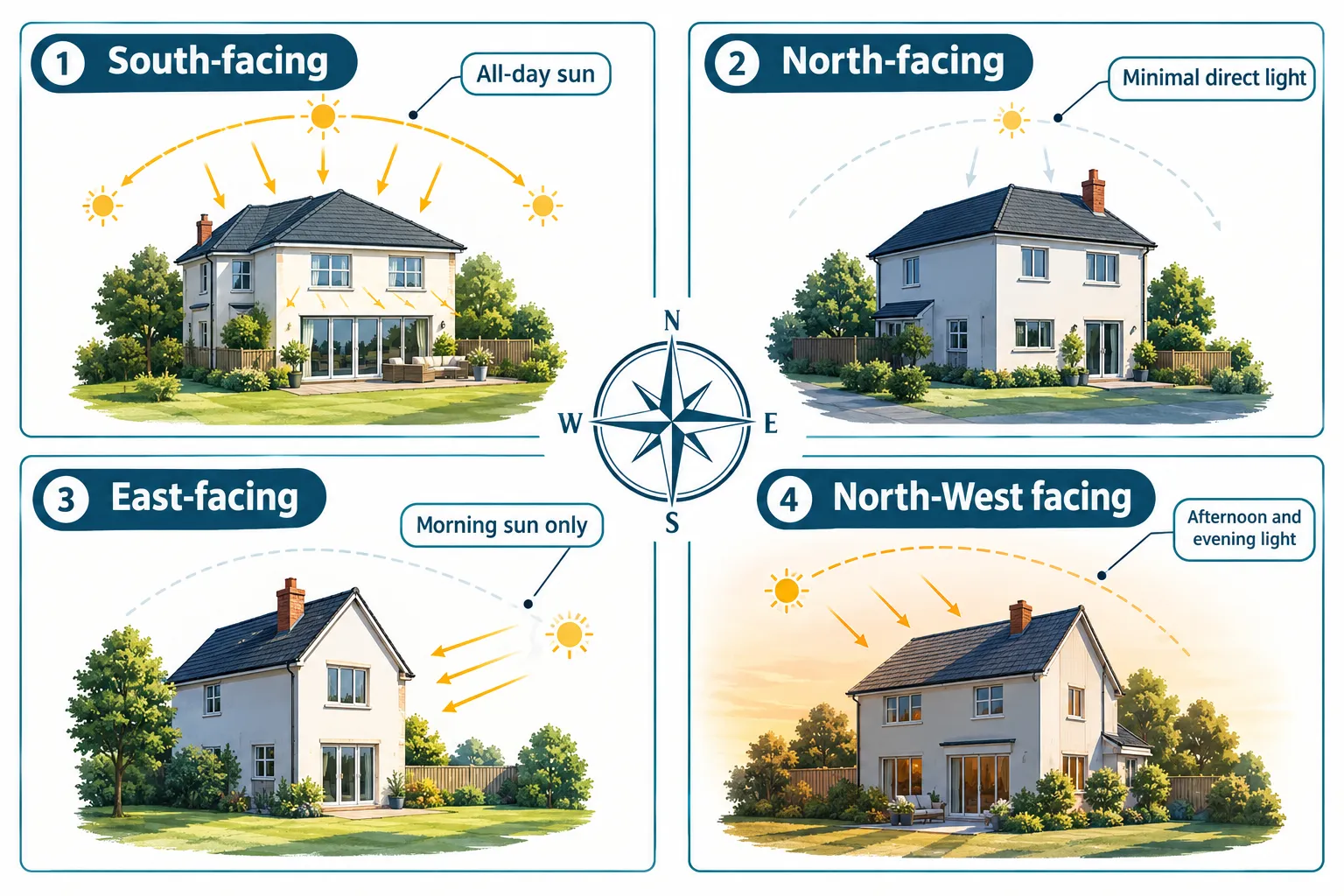
This matters because the UK sits between approximately 50° and 58° north latitude. At those latitudes, the difference between a south-facing and a north-facing garden in terms of annual solar radiation is substantial, studies on building energy modelling indicate that orientation can shift space heating demand by up to 10-15% in a standard UK dwelling [3]. A north west aspect sits in the middle of that range: better than due north, but meaningfully different from due south or south west.
RICS guidance on daylighting and sunlighting sets out how surveyors and planning consultants should assess the adequacy of natural light reaching habitable rooms and outdoor amenity space [1]. The standard is used in planning applications, rights of light disputes, and building surveys alike. It draws on the Building Research Establishment's (BRE) daylight and sunlight guidelines, which define minimum sky factor thresholds and sunlight hours for gardens and windows.
How North West Facing Homes and Property Value Interact in the UK Market
The relationship between orientation and price is real, but it is not uniform. Estate agents and online portals have long noted that south-facing gardens command a premium. Rightmove data cited in property research suggests that premium sits between 5% and 15% depending on property type, location, and season of sale [4]. A north west facing home is not at the bottom of that hierarchy, that position belongs to a due-north aspect, but it sits below south, south west, and south east comparables.
For a new-build development, plot premiums for the best-lit aspects are priced in from the outset. Developers typically charge 5-15% more for plots with south-facing rear gardens [7]. North west plots are often sold at or below the average plot price for a scheme. In a secondary market transaction, the same principle applies but is harder to isolate because buyers are comparing properties with different sizes, conditions, and locations simultaneously.
The valuation implications are clearest in the following scenarios:
| Scenario | Orientation Effect on Value |
|---|---|
| Identical semi-detached pair, one south-facing, one north west-facing | South-facing typically achieves 5-10% more at sale |
| Flat with single north-facing aspect vs dual-aspect flat | Dual-aspect flat commands a premium; single north-facing is discounted |
| New-build plot selection | South-facing plots priced 5-15% above north-facing equivalents |
| Period terraced house with north west rear garden | Discount is smaller; character and location often outweigh aspect |
A RICS Red Book valuation, the formal written opinion required for mortgage lending, probate, and other regulated purposes, must reflect comparable evidence [6]. Where orientation demonstrably affects the achieved prices of comparable sales, a competent valuer will adjust accordingly. For guidance on when a Red Book valuation is required, see When You Need a Red Book Valuation.
Daylight, Sunlight and the RICS Standards
RICS published its daylighting and sunlighting professional standard to give surveyors, planners, and developers a consistent framework for assessing natural light [5]. The standard applies to both new development and alterations to existing buildings. It covers:
- Vertical sky component (VSC): the proportion of sky visible from a window, used to assess whether a room receives adequate diffuse daylight.
- Average daylight factor (ADF): a room-level measure that accounts for window size, glazing transmittance, and room depth.
- Annual probable sunlight hours (APSH): the number of hours per year a garden or window receives direct sunlight, compared against BRE benchmarks.
A north west facing rear garden will typically fall below the BRE benchmark of 25% of annual probable sunlight hours for outdoor amenity space in winter months. In summer, the longer days and the westerly sun mean the garden receives reasonable afternoon and evening light, which is why north west aspects are often described as "pleasant for evening use" in estate agent particulars.
For habitable rooms, the critical issue is whether the main living spaces face the garden or the street. In a typical UK terrace with a north west rear garden, the living room and kitchen-diner often face north west. Those rooms will receive afternoon light but may feel dim in the mornings. A RICS surveyor carrying out a home survey in London will note the orientation of principal rooms as part of the condition assessment, particularly where damp or condensation is present, both of which are more common on north-facing elevations that receive less solar drying.
Overheating: The West-Facing Glazing Problem
Approved Document O, which came into force for new residential buildings in England in June 2022, makes overheating a formal regulatory risk category for the first time [8]. The document requires developers to assess overheating risk using either a simplified method or dynamic thermal modelling. Orientation is a primary variable in that assessment.
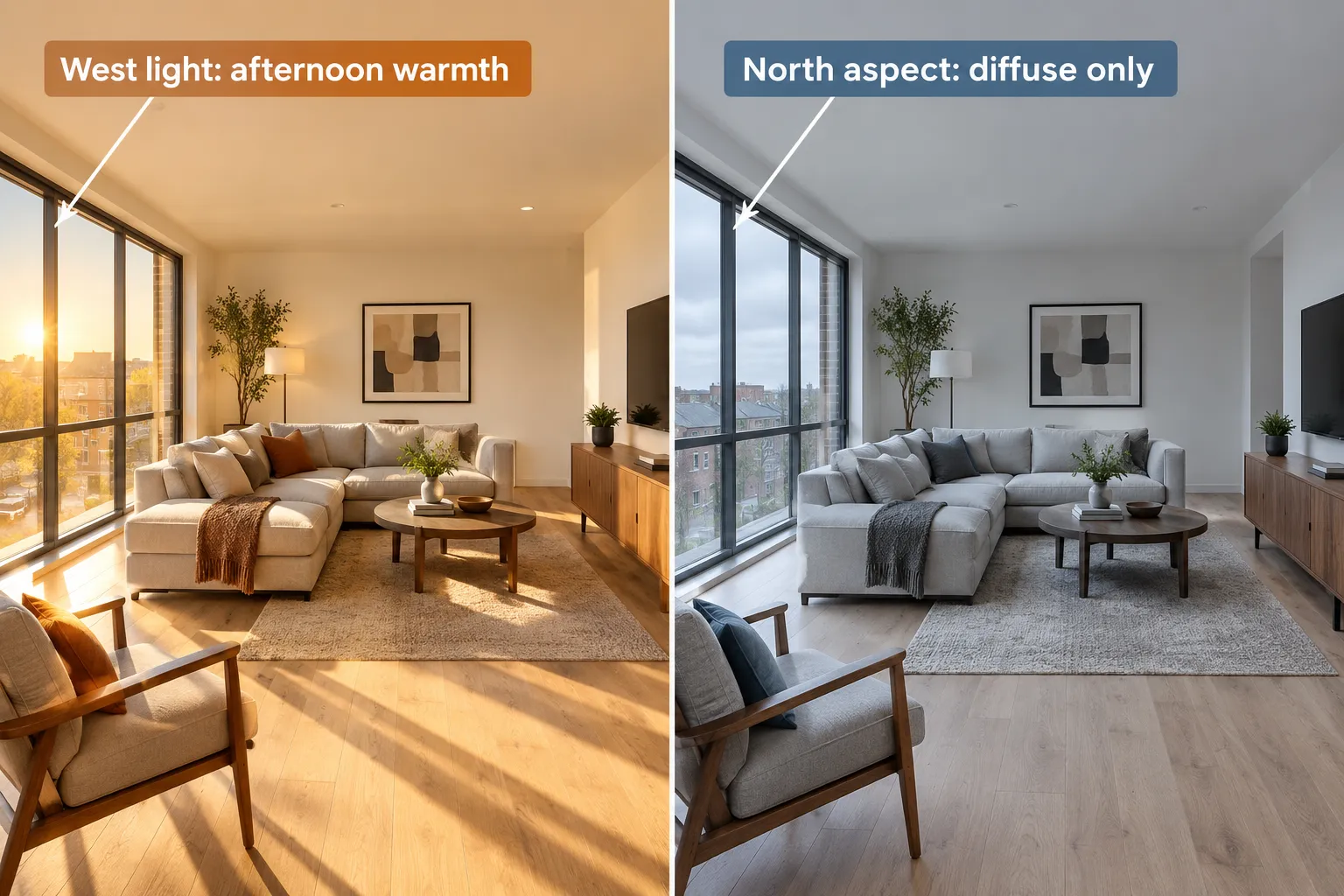
The west-facing element of a north west aspect creates a specific overheating risk that is distinct from the general north-facing light deficit. West-facing glazing receives direct afternoon and evening sun at a low angle, particularly in summer. That low-angle sun penetrates deep into rooms and is difficult to shade with horizontal overhangs. The result can be significant solar gain in living rooms and bedrooms during the hottest part of the day.
RICS has flagged overheating as a mainstream concern for surveyors in 2026 [8]. Key risk factors include:
- High glazing-to-floor-area ratios on west-facing elevations
- Single-aspect layouts where cross-ventilation is impossible
- Top-floor flats with west-facing roof lights or dormer windows
- Poorly insulated roofs combined with west-facing glazing
For buyers of new-build properties with a north west orientation, it is worth asking the developer for the overheating assessment carried out under Approved Document O. For existing properties, a RICS Level 3 Building Survey can identify whether west-facing rooms show signs of thermal discomfort, such as faded finishes, warped timber, or evidence of occupant-installed shading, that point to an overheating issue.
Energy Performance, EPC Ratings and Mortgage Valuations
Orientation affects a property's energy performance in two directions simultaneously. The north-facing elements of a north west home lose more heat in winter because they receive less solar gain to offset fabric heat loss. The west-facing elements may overheat in summer, increasing cooling demand. Both effects show up in an energy model, and both can influence an EPC rating [3].
Since 2023, mortgage lenders have been under increasing pressure from the Bank of England's Prudential Regulation Authority to account for energy performance risk in their valuations. A property with a poor EPC rating, below band D, may attract a lower mortgage offer or a higher interest rate on some green mortgage products. Where orientation is a contributing factor to a low EPC, it is a fixed physical characteristic that cannot easily be changed.
The RICS Red Book (effective 31 January 2025) strengthens the explicit link between energy performance and market value [6]. Valuers are expected to consider EPC ratings and energy-related features as part of their comparable analysis. This means that a north west facing home with a low EPC rating may face a compounded discount: one element for orientation and a second for energy performance, even though the two are partly caused by the same underlying factor.
For buyers using a survey to negotiate, a RICS report that identifies orientation-related energy issues can support a price reduction request. See how an RICS survey can help you negotiate the price of your property for practical guidance on that process.
Rights of Light and Overshadowing
A north west facing home may also be affected by rights of light, the legal entitlement of a building to receive natural light through defined apertures. If a neighbouring development is proposed to the south or south east of a north west facing property, it could reduce the daylight and sunlight reaching the principal rooms and garden.
RICS published a third edition of its rights of light professional standard in March 2024 [10]. That standard sets out how surveyors should assess and quantify the impact of a proposed development on an existing building's light. For a north west facing home, the relevant windows are typically those on the north west and south west elevations. A development to the south east, the direction from which morning light arrives, could materially reduce the VSC to rooms that already receive limited sunlight.
Rights of light disputes are a specialist area. If a planning application near your property raises concerns, a RICS surveyor with rights of light expertise can prepare a formal assessment. For properties in south London, RICS surveys in Southwark and RICS surveys in Bromley are available from chartered surveyors familiar with the dense urban development patterns in those boroughs.
What Buyers and Sellers Should Do in Practice
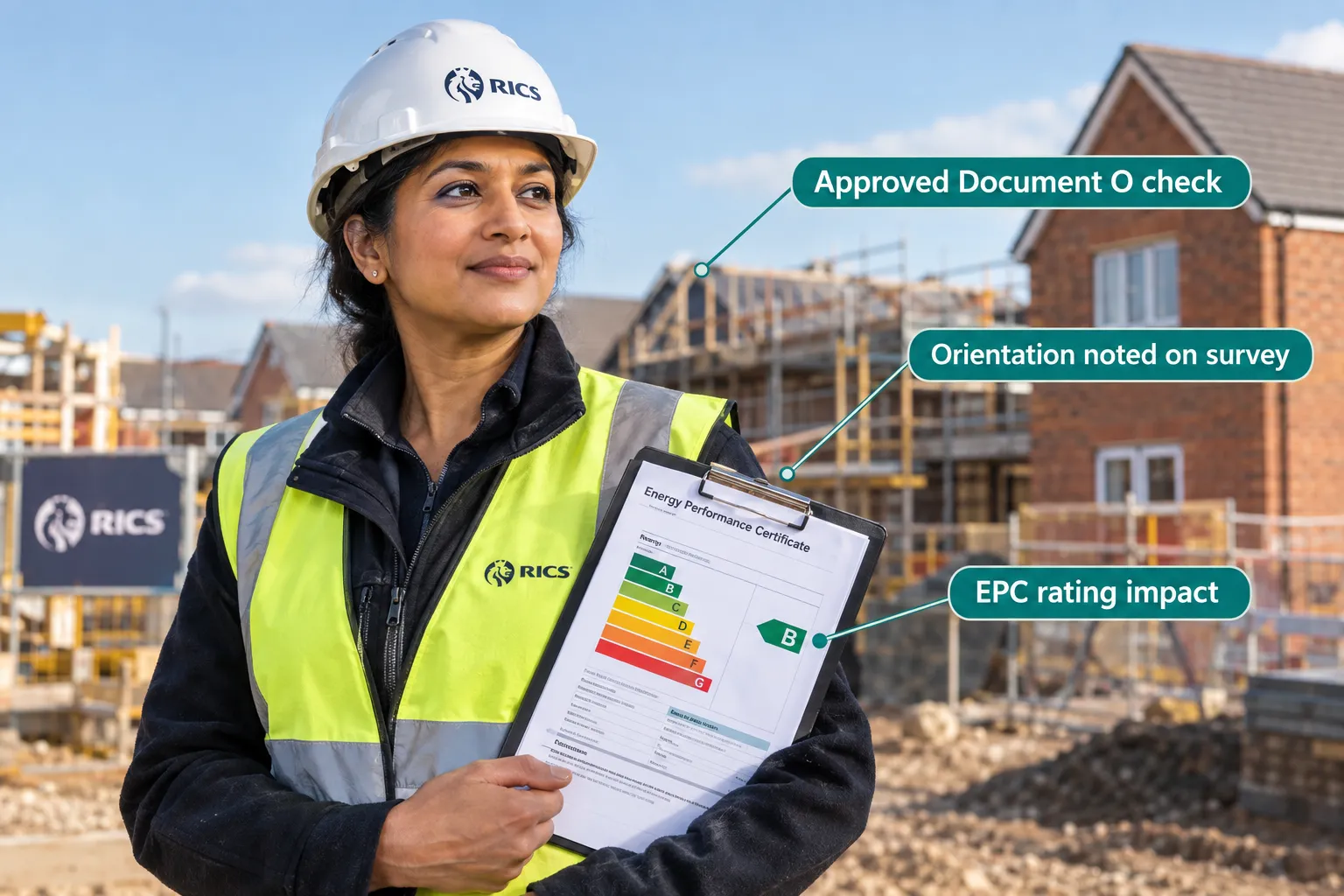
For buyers of north west facing homes, the following steps are worth taking before exchange:
- Check the orientation using a compass app or Ordnance Survey mapping. Several free tools allow buyers to verify the aspect of a property before viewing [2].
- Commission a RICS Level 2 or Level 3 survey. The surveyor will note orientation, assess damp and condensation on north-facing walls, and flag any overheating indicators on west-facing elevations. For properties in east London, RICS surveyors in Bexley and RICS surveyors in Loughton cover those areas.
- Review the EPC. Check whether the energy assessor has noted orientation as a factor in the rating. If the property is below band C, ask whether insulation improvements could offset the orientation-related heat loss.
- For new-builds, request the Approved Document O overheating assessment. This is a legal requirement for new homes and should be available from the developer.
- Consider dual-aspect layouts. A north west facing home with rooms that also face south east will perform significantly better for daylight than a single-aspect property.
For sellers, the practical advice is to present the property at its best for its aspect. A north west garden is at its most appealing on summer evenings, viewings arranged for late afternoon will show the garden in its best light. Highlighting good insulation, a high EPC rating, or effective shading on west-facing glazing can address buyer concerns about energy costs and overheating.
Frequently Asked Questions
Does a north west facing house always sell for less than a south-facing equivalent?
Not always. Location, size, condition, and property type all outweigh orientation in most transactions. The orientation discount is most visible when comparing near-identical properties, such as two plots on the same new-build development, or in high-value markets where buyers scrutinise every feature.
Can orientation be changed?
No. The compass bearing of a building is fixed. What can be changed is how the building responds to its orientation, through insulation, glazing specification, shading devices, and internal layout.
Does a north west aspect cause damp?
Not directly, but north-facing walls receive less solar drying and are more prone to surface condensation in cold weather. A RICS surveyor will check for these issues as part of a standard building survey.
Is overheating only a problem for new builds?
No. Approved Document O applies only to new residential buildings, but overheating can affect any property with significant west-facing glazing, particularly top-floor flats and properties that have had rear extensions with large glazed areas added.
Will climate change affect the value of north west facing homes?
Possibly in a positive direction over the long term. As summer temperatures rise, the south-facing premium may narrow because south-facing gardens become less comfortable in peak summer heat. North west aspects, which receive evening rather than midday sun, may become relatively more attractive. This is speculative, but it is a direction of travel that some valuers are beginning to consider.
Where can I find a RICS surveyor who understands orientation and daylight issues?
RICS-registered surveyors covering London and the south east are available through Wimbledon Surveyors, with coverage across a wide range of London boroughs and Essex locations.
Conclusion
North west facing homes and property value are connected through a chain of measurable factors: daylight adequacy, solar gain, energy performance, overheating risk, and the comparable evidence that RICS valuers use to form their opinions. The connection is not always dramatic, a well-insulated, dual-aspect north west facing home in a strong location will not be heavily discounted, but it is real and is becoming more visible as energy performance regulation tightens and overheating moves up the agenda.
The practical steps are straightforward. Commission a RICS survey before exchange. Check the EPC and ask whether orientation has been factored in. For new-builds, request the Approved Document O assessment. If a neighbouring development threatens your light, take advice from a rights of light specialist. None of these steps is expensive relative to the cost of buying the wrong property at the wrong price.
Orientation is one of the few physical characteristics of a home that cannot be altered after purchase. Understanding its implications before you commit is the most cost-effective survey work you can do.
References
[1] Daylighting Sunlighting – rics.org
[2] How To Check Direction Of House Online – ukcareguide.co.uk
[3] Building Orientation Energy Impact Uk – homeenergymodel.co.uk
[4] Direction House Face – sold.co.uk
[5] Daylighting And Sunlighting – rics.org
[6] Valuation Standards – rics.org
[7] Choosing Right Plot New Build Development – new-builds.co.uk
[8] Overheated Homes Summer – ww3.rics.org
[9] Rics Standards And Guidance – rics.org
[10] Rights Of Light 3rd Ed Ps March 2024 – rics.org