
North West England recorded the strongest regional property value growth in the RICS Q1 2026 survey — a fact that is reshaping how surveyors approach one of the sector's most technically demanding asset classes: the mixed-use development. [5] Flats above shops, live-work units, and retail-anchored residential schemes are multiplying across Manchester, Liverpool, Preston, and Salford, yet many practitioners still reach for single-use valuation frameworks that simply do not fit. Valuing Mixed-Use Developments in North West England's 2026 Uptick: RICS Hybrid Property Assessment Techniques is not merely an academic exercise — it is a live commercial necessity for every surveyor, investor, and developer operating in the region right now.

Key Takeaways 🏗️
- The North West leads the UK's 2026 property recovery, making accurate hybrid valuation of mixed-use assets more commercially critical than ever.
- RICS mandates that valuers select and justify the most appropriate method from five recognised approaches; no single method suits every mixed-use asset. [1]
- Flats-over-shops require a disaggregated then recombined assessment strategy — treating each use class separately before calculating an overall capital value.
- The April 2026 RICS Residential Management Code update directly affects service charge apportionment in mixed-use schemes. [3]
- A structured surveyor checklist reduces valuation risk and supports RICS Red Book compliance on complex development properties. [2]
Why the North West's 2026 Uptick Changes the Valuation Calculus
The regional surge documented in the RICS Q1 2026 survey is not uniform. Industrial assets are showing strong resilience, while traditional high-street retail continues to face occupier headwinds. [5] This divergence sits at the very heart of the mixed-use valuation challenge: a single building can contain a struggling ground-floor retail unit and a fully let residential upper floor, and those two components are moving in opposite directions simultaneously.
"A mixed-use building is not the sum of its parts — it is the product of how those parts interact, compete for value, and respond to different market forces."
For surveyors working across Greater Manchester, Merseyside, and Lancashire, the practical implication is clear. Applying a single capitalisation rate across the whole building will produce a distorted figure. The 2026 uptick in residential values — driven by constrained supply, regeneration investment, and population growth in key urban centres — must be isolated from the commercial component before any aggregation takes place.
Regional benchmarking is essential. Strategies developed for valuing multi-generational homes in North West England offer useful parallels for understanding how local price uptrends affect residential components within mixed-use schemes. [9]
The Commercial Shift Problem 🏪
Retail vacancy rates in secondary North West town centres remain elevated. When the ground floor of a mixed-use block is vacant or let on a short-term licence rather than a full institutional lease, the investment value of that component collapses — yet the residential floors above may be appreciating strongly. Surveyors must resist the temptation to cross-subsidise a weak commercial value with strong residential evidence, or vice versa.
RICS Hybrid Property Assessment Techniques: A Practical Framework
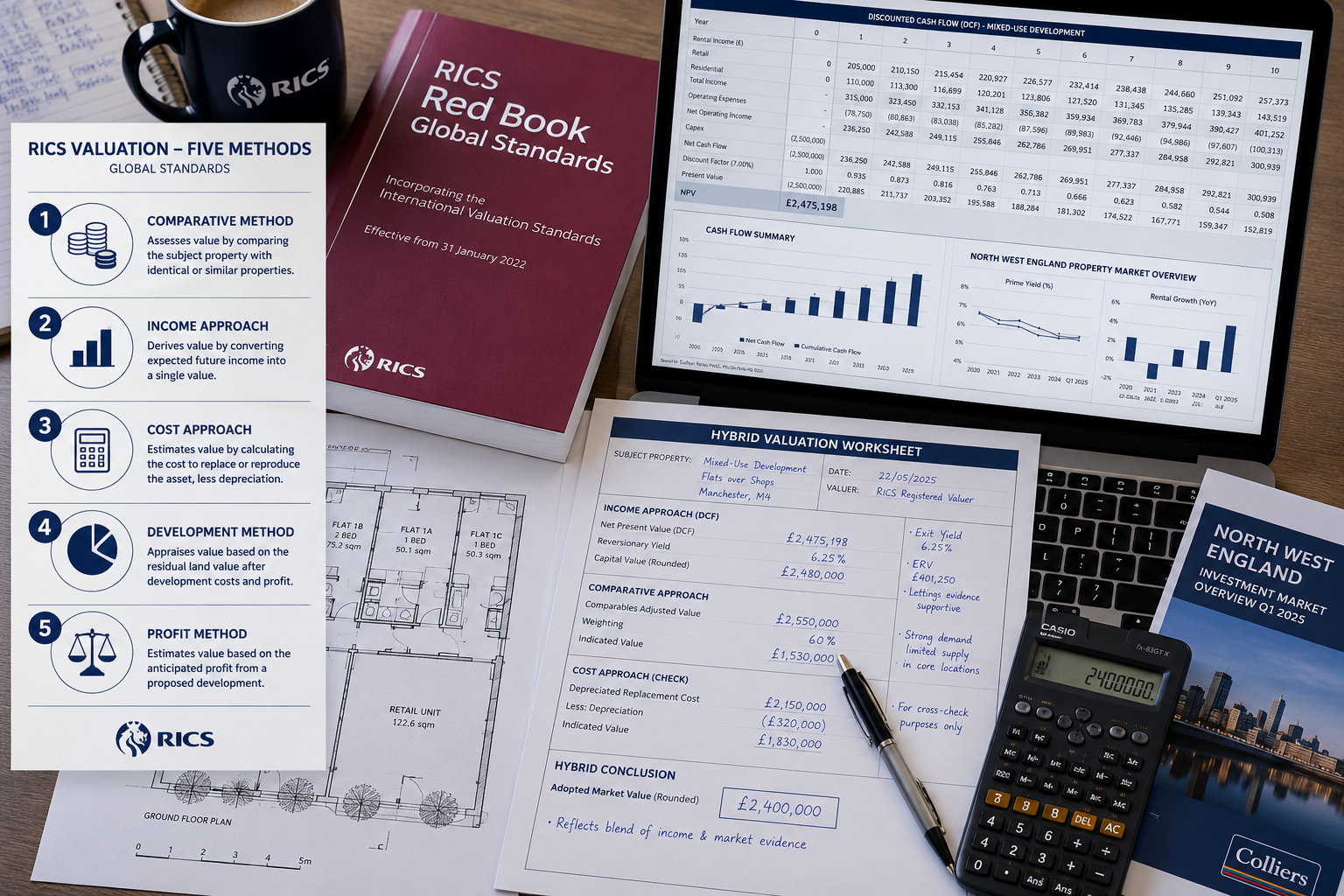
The RICS Valuation – Global Standards (Red Book) identifies three primary valuation approaches — market, income, and cost — which underpin five recognised methods: comparable, investment, profits, residual, and depreciated replacement cost. [1] For mixed-use developments, the hybrid approach draws on at least two of these methods and combines the outputs in a structured, documented way.
Step 1: Disaggregate by Use Class
Before any method is applied, the building must be broken into its constituent use classes:
| Component | Typical Use Class (England) | Primary Valuation Method |
|---|---|---|
| Ground-floor retail/F&B | Class E (commercial) | Investment (yield analysis) |
| Upper-floor residential flats | C3 (residential) | Comparable / Investment |
| Office or live-work units | Class E / sui generis | Investment / DCF |
| Car parking / storage | Ancillary | Comparable or cost |
Each component is valued independently using the most appropriate method. This disaggregation is not optional — RICS guidance on valuing development property explicitly acknowledges the complexity of mixed-use assets and the need for high-level expertise. [2]
Step 2: Apply the Appropriate Method to Each Component
Commercial components are typically assessed using yield analysis: the passing rent (or estimated rental value where vacant) is capitalised at a market-derived yield. Construction Capital's overview of commercial valuation methods confirms that yield analysis, comparable evidence, and discounted cash flow (DCF) analysis are the three workhorses for commercial assets. [10] In the North West's 2026 market, prime retail yields in Manchester city centre differ substantially from secondary retail in smaller towns — surveyors must source localised comparable evidence.
Residential components are assessed using the comparable method where a sufficient transaction pool exists, or the investment method (gross yield capitalisation) for buy-to-let blocks. In the current North West uptick, residential comparable evidence is relatively strong in urban cores, but thinner in peripheral regeneration zones where new-build schemes dominate. [5]
Residual valuation becomes relevant where a mixed-use site has development potential — for example, where permitted development rights allow additional residential storeys above an existing retail unit. The 2026 planning reform landscape has sharpened the importance of residual methods, particularly when assessing sites with uplift potential. [6] RICS's development appraisals web class series, running through July and November 2026, provides structured guidance on this methodology. [7]
Step 3: Recombine and Sense-Check
Once each component has been valued separately, the outputs are aggregated to produce a whole-property capital value. The critical sense-check at this stage involves:
- ✅ Comparing the aggregated value against any available whole-building comparable transactions
- ✅ Testing the implied overall yield against investor appetite for mixed-use assets in the submarket
- ✅ Reviewing whether the component values reflect any interdependencies (e.g., does the retail use generate footfall that supports residential desirability?)
- ✅ Confirming that the valuation basis (market value, investment value, or other) is clearly stated per Red Book requirements [1]
Heritage and Conversion Considerations 🏛️
Many of North West England's most attractive mixed-use opportunities sit within Victorian and Edwardian commercial buildings. Where a building carries listed status or sits within a conservation area, the valuation framework must account for heritage constraints on refurbishment, restricted permitted development rights, and potentially higher maintenance costs. RICS guidance on valuing heritage assets stresses the importance of selecting methodologies that reflect the unique characteristics of such properties and ensuring full compliance with Red Book Global Standards. [4]
Understanding the full structural condition of such buildings is foundational. Surveyors should be familiar with choosing the right property assessment for complex or older stock, and with the implications of damp and timber reports in buildings where Victorian construction methods are common.
Surveyor Checklist for Valuing Mixed-Use Developments in North West England's 2026 Uptick
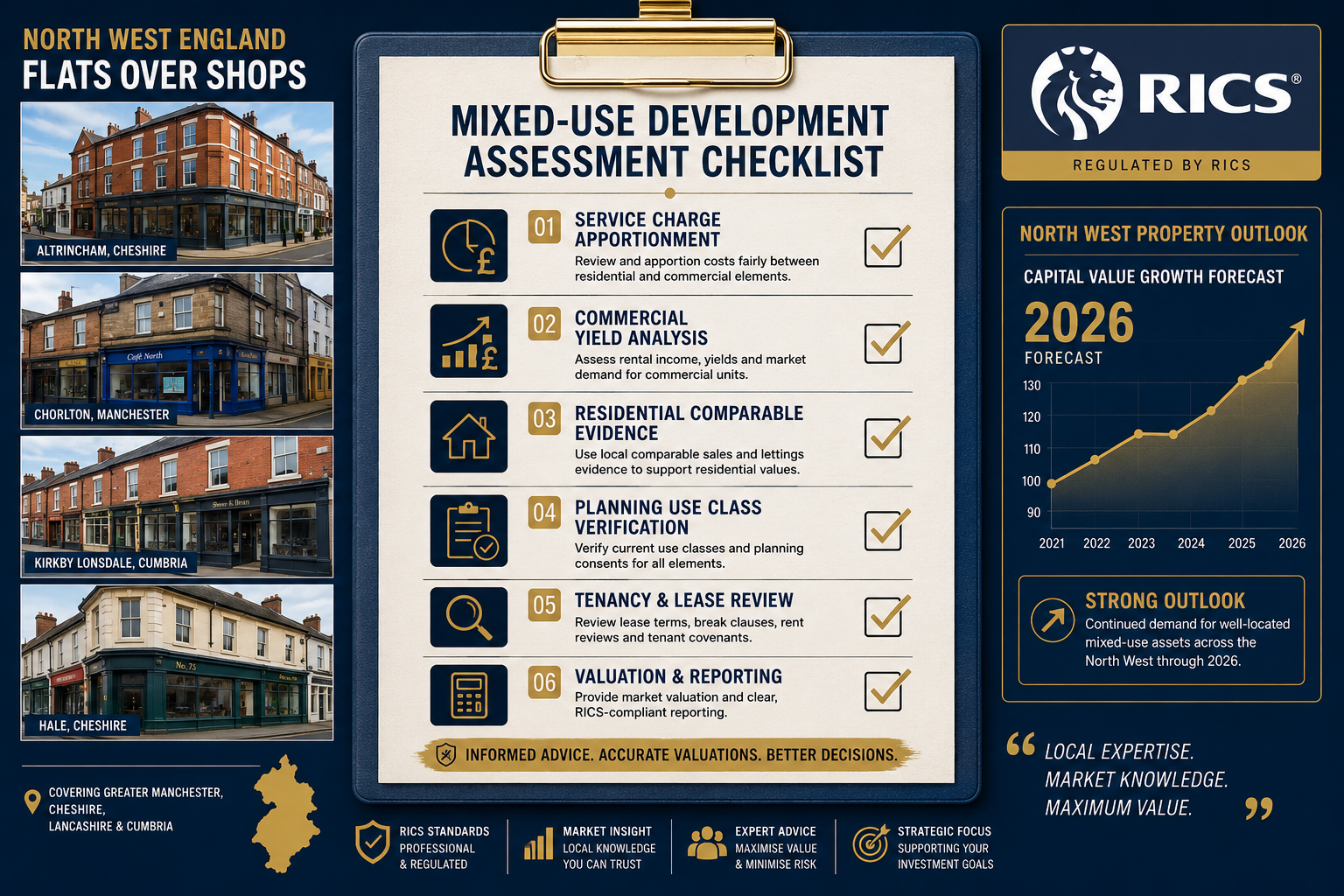
Applying RICS Hybrid Property Assessment Techniques to a live instruction requires a disciplined pre-inspection and reporting workflow. The checklist below is structured around the key risk areas specific to flats-over-shops and similar schemes in the current North West market.
📋 Pre-Instruction Checks
- Confirm the valuation basis required (market value, fair value, investment value)
- Identify all use classes present and obtain copies of all current leases and licences
- Check planning history for any conditions restricting use or future development
- Obtain Energy Performance Certificates for all units — minimum EPC ratings are increasingly affecting lender appetite
- Review title for any restrictive covenants affecting commercial use or residential conversion
📋 Inspection Checks
- Inspect each component separately and note condition, specification, and any defects
- Record net internal areas (NIA) for residential and commercial separately using RICS measurement standards
- Note any shared services, plant rooms, or common areas and assess cost apportionment
- Identify any Japanese knotweed, subsidence indicators, or structural concerns — issues that can materially affect value in older North West stock. See also: could garden trees be causing subsidence?
- Confirm fire safety compliance, particularly for residential upper floors (post-Grenfell regulations remain active)
📋 Service Charge and Leasehold Checks ⚖️
This is a critical area in 2026. The RICS Service Charge Residential Management Code (4th edition), effective April 7, 2026, sets binding professional standards for managing residential leasehold service charges in England. [3] For mixed-use schemes, this update directly affects how service costs are apportioned between commercial and residential occupiers, and how those charges are communicated and audited.
Key checks include:
- Review the existing service charge structure for compliance with the 4th edition code
- Confirm that commercial and residential service charge schedules are clearly separated
- Check for any historic service charge disputes that may represent a latent liability
- Assess whether the current management structure is fit for purpose under the new standards
For leasehold residential components, surveyors should also review the key considerations before buying a leasehold property to ensure all tenure-related risks are captured in the valuation narrative.
📋 Market Evidence Checks
- Source a minimum of three comparable residential transactions within a 0.5-mile radius (or justify a wider search)
- Source commercial lease comparables — ERV evidence — from the same retail hierarchy tier
- Document any adjustments made to comparables for size, condition, lease terms, or location
- Cross-reference against RICS Q1 2026 regional data to confirm alignment with the North West uptick trend [5]
📋 Report and Compliance Checks
- State the valuation approach, method(s) used, and justification for each component
- Include a clear statement of any special assumptions or hypothetical conditions
- Confirm that the report meets Red Book Global Standards and, where applicable, RICS guidance on development property valuation [2]
- Disclose any conflicts of interest and confirm PI insurance covers mixed-use instructions
Common Pitfalls and How to Avoid Them
Even experienced valuers encounter specific traps when handling mixed-use instructions in a fast-moving market. The most frequent errors include:
1. Using a blended yield across the whole building. This obscures the true risk profile of each component. Always apply component-specific yields and document the rationale. [10]
2. Ignoring vacant possession value for the commercial element. Where a retail tenant is holding over or on a below-market rent, the investment value may understate the vacant possession value — particularly where residential conversion is viable under Class MA permitted development.
3. Underestimating service charge liabilities. The April 2026 code update creates new transparency obligations. [3] A poorly structured service charge regime can reduce the marketability of both the commercial and residential components.
4. Failing to account for APC competency requirements. RICS APC candidates must demonstrate competency in valuation by showing understanding of all five methods and the ability to select and justify the appropriate approach. [8] Mixed-use instructions are increasingly used as APC case study evidence — which raises the stakes for accuracy and documentation.
5. Overlooking the residual element. Where a mixed-use building has air rights or roof extension potential, the residual value of that development opportunity can be material. The 2026 planning reform agenda has made this more relevant, not less. [6]
For a broader understanding of what a thorough property assessment should cover, reviewing common myths about property surveys can help both surveyors and clients align expectations on scope and methodology.
Conclusion: Actionable Next Steps for Surveyors in 2026
The convergence of the North West's 2026 property uptick, the April 2026 RICS Residential Management Code update, and evolving planning reform creates both opportunity and risk for surveyors handling mixed-use instructions. Valuing Mixed-Use Developments in North West England's 2026 Uptick: RICS Hybrid Property Assessment Techniques demands a structured, component-by-component approach that is fully documented, Red Book compliant, and grounded in localised market evidence.
Actionable next steps:
- Audit your current mixed-use valuation templates against the five RICS methods and confirm that each component receives a separately justified assessment.
- Update your service charge review process to reflect the April 2026 4th edition code requirements — this is now a compliance issue, not a best-practice recommendation.
- Build a North West comparable database that separates residential and commercial evidence streams, reflecting the divergent performance trends documented in the Q1 2026 RICS survey.
- Enrol in RICS's development appraisals web class series (July and November 2026 sessions) to sharpen residual valuation skills for mixed-use sites with development potential. [7]
- Use the surveyor checklist above as a minimum standard for every mixed-use instruction — adapt it to the specific asset but never reduce its scope.
The North West's recovery is real, it is documented, and it is creating a pipeline of complex mixed-use valuation instructions. Surveyors who master the hybrid assessment framework now will be best placed to serve that market with confidence and compliance.
References
[1] Apc 5 Valuation Methods – https://ww3.rics.org/uk/en/journals/property-journal/apc-5-valuation-methods.html?utm_source=openai
[2] Valuation Of Development Property – https://www.rics.org/profession-standards/rics-standards-and-guidance/sector-standards/valuation-standards/valuation-of-development-property?utm_source=openai
[3] What The 2026 Residential Management Code Update Means For Service Charges In Mixed Use Developments – https://www.sayproperty.co.uk/insights-reports-blog/what-the-2026-residential-management-code-update-means-for-service-charges-in-mixed-use-developmentsnbsp?utm_source=openai
[4] Valuing Heritage Assets – https://ww3.rics.org/uk/en/journals/property-journal/valuing-heritage-assets.html?utm_source=openai
[5] Valuation Divergences In Rics Q1 2026 Survey North West Surge Tactics For Surveyors Targeting Resilient Markets – https://wimbledonsurveyors.com/valuation-divergences-in-rics-q1-2026-survey-north-west-surge-tactics-for-surveyors-targeting-resilient-markets/?utm_source=openai
[6] Valuation Surveys For Properties With Development Potential Rics Appraisals Maximising Uplift In 2026 Planning Reforms – https://www.canterburysurveyors.com/blog/valuation-surveys-for-properties-with-development-potential-rics-appraisals-maximising-uplift-in-2026-planning-reforms/?utm_source=openai
[7] Development Appraisals Method And Process 3 Part Series – https://academy.rics.org/web-classes/valuation/development-appraisals-method-and-process-3-part-series?utm_source=openai
[8] Apc Valuation Competency Advice – https://ww3.rics.org/uk/en/journals/property-journal/apc-valuation-competency-advice.html?utm_source=openai
[9] Valuing Multi Generational Homes In North West England Survey Strategies For 2026 Price Uptrends – https://wimbledonsurveyors.com/valuing-multi-generational-homes-in-north-west-england-survey-strategies-for-2026-price-uptrends/?utm_source=openai
[10] Commercial Property Valuation Methods – https://constructioncapital.co.uk/guides/commercial-property-valuation-methods?utm_source=openai