


Institutional buy-to-let (BTL) portfolios across the UK are experiencing a 34% surge in survey volume requests compared to 2024 levels, signaling a fundamental shift in how professional landlords approach property acquisition during the 2026 market recovery. This dramatic uptick reflects not only renewed investor confidence but also the impact of reformed homebuying processes that now mandate upfront condition assessments for institutional purchases. As Valuation Strategies for Institutional BTL in 2026 Recovery: Leveraging LRG Insights on Reformed Homebuying Processes become central to portfolio optimization, understanding how to integrate comprehensive surveying data with market recovery indicators has never been more critical for institutional investors seeking sustainable rental yields.
The convergence of regulatory reform, technological advancement in property assessment, and emerging recovery signals creates both challenges and opportunities for institutional BTL operators. Major asset managers including Legal & General Investment Management (LGIM) have published detailed insights on positioning portfolios for recovery [4], emphasizing the importance of active valuation approaches that account for property-specific risk factors alongside broader market trends.

Key Takeaways
- Survey volume increases of 34% signal institutional confidence returning to UK BTL markets in 2026, requiring robust valuation frameworks
- Reformed homebuying processes now mandate upfront condition surveys for institutional purchases, fundamentally changing acquisition timelines and due diligence protocols
- LRG market insights emphasize active valuation approaches that integrate property-specific condition data with macroeconomic recovery indicators
- Technology-enhanced assessments enable faster, more accurate valuations through digital surveying tools and real-time comparable analysis
- Regional variation in recovery trajectories demands localized valuation strategies rather than blanket national approaches
Understanding the 2026 BTL Market Recovery Context
The UK residential investment market enters 2026 with cautious optimism, following two years of adjustment to higher interest rate environments and regulatory pressures on landlords. Market observers note that value-oriented investment strategies are positioning for revival as economic conditions stabilize [1]. For institutional BTL operators, this recovery phase presents distinct characteristics that differ markedly from previous cycles.
Macroeconomic Factors Driving Recovery
Interest rate stabilization has created a more predictable financing environment for institutional investors. While rates remain elevated compared to the 2010-2021 period, the removal of uncertainty around monetary policy direction enables more confident long-term planning. Institutional investors with access to diverse funding sources find themselves at a competitive advantage over individual landlords constrained by traditional mortgage products.
The rental demand fundamentals remain robust across most UK regions. Demographic trends including delayed homeownership, increased mobility among working-age populations, and persistent housing supply shortages continue to support rental yields. However, valuation strategies must account for regional divergence in recovery speeds, with London and the Southeast showing different trajectories compared to Midlands and Northern markets.
Regulatory Environment and Reformed Processes
The reformed homebuying processes implemented in late 2025 have fundamentally altered institutional acquisition workflows. Mandatory upfront condition surveys for portfolio purchases exceeding 10 units now require institutional buyers to commission comprehensive condition survey reports before exchange of contracts, rather than relying solely on desktop valuations or cursory inspections.
This regulatory shift, while initially perceived as an administrative burden, has actually created opportunities for sophisticated institutional players. By frontloading due diligence and integrating detailed property condition data into valuation models, institutions can identify mispriced assets and negotiate more effectively based on objective condition assessments.
Valuation Strategies for Institutional BTL in 2026: Core Methodologies
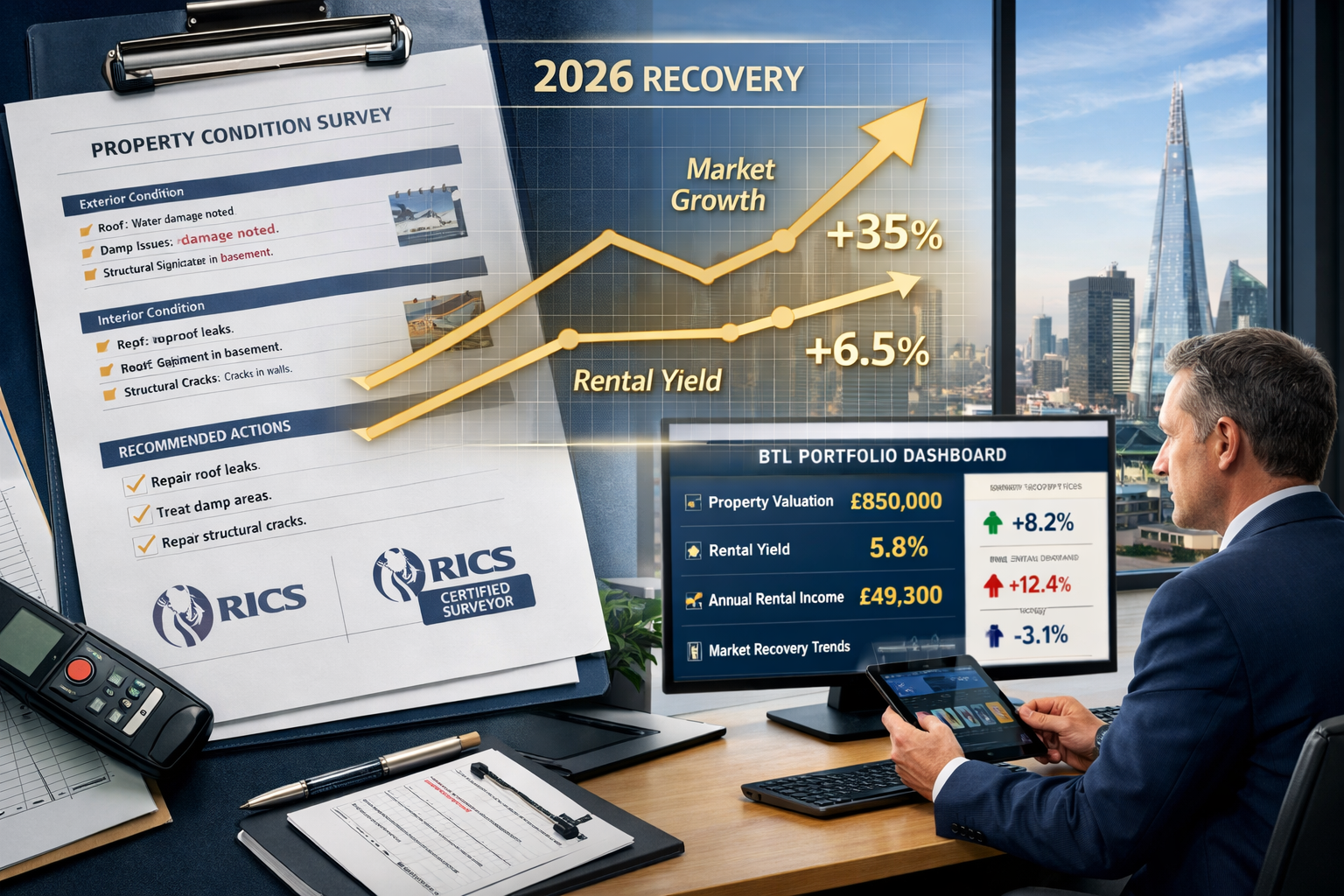
Effective Valuation Strategies for Institutional BTL in 2026 Recovery: Leveraging LRG Insights on Reformed Homebuying Processes require a multi-layered approach that combines traditional income capitalization methods with condition-adjusted pricing models and forward-looking market positioning.
Income Capitalization with Condition Adjustments
The foundation of institutional BTL valuation remains the income approach, capitalizing expected net rental income at appropriate yield rates. However, the 2026 framework demands significant refinement:
Traditional Formula:
Value = Net Operating Income ÷ Capitalization Rate
Enhanced 2026 Framework:
Condition-Adjusted Value = (Net Operating Income – Deferred Maintenance Reserve) ÷ (Market Cap Rate + Condition Risk Premium)
This enhanced approach incorporates findings from mandatory condition surveys to establish realistic maintenance reserves and adjust cap rates for property-specific risk. For example, a property requiring £25,000 in deferred maintenance over five years effectively reduces annual NOI by £5,000, materially impacting valuation.
Comparable Sales Analysis in Reformed Markets
The reformed homebuying process has improved data quality for comparable sales analysis. With standardized condition reporting now available for most institutional transactions, comparables can be adjusted more precisely for condition differentials. This represents a significant advancement over previous practices where condition variations were estimated rather than documented.
Key adjustments in 2026 comparable analysis include:
- Structural condition differentials: Properties with documented structural issues typically trade at 8-12% discounts to equivalent properties with clean structural reports
- Energy efficiency premiums: EPC-rated properties (A or B) command 5-7% premiums in institutional portfolios due to lower operational costs and regulatory compliance
- Deferred maintenance discounts: Each £10,000 of documented deferred maintenance typically reduces valuation by £12,000-15,000, reflecting both cost and disruption factors
Institutional investors working with chartered surveyors can access standardized condition metrics that enable more accurate comparable adjustments than previously possible.
Discounted Cash Flow Models for Portfolio Acquisitions
For larger portfolio acquisitions, DCF models remain the gold standard for institutional valuation. The 2026 recovery context requires particular attention to:
Rental Growth Assumptions: Conservative projections of 2-3% annual rental growth in established markets, with higher growth potential (4-6%) in supply-constrained areas. LRG insights suggest that recovery will be uneven, with prime locations recovering faster than secondary markets [4].
Exit Cap Rate Projections: Modeling exit scenarios with cap rates 25-50 basis points higher than current acquisition rates provides appropriate conservatism given economic uncertainties.
Capital Expenditure Forecasting: Integrating detailed condition survey findings into CapEx projections eliminates the guesswork that previously plagued institutional models. Properties with comprehensive building evaluation data enable precise 10-year CapEx forecasting.
Discount Rate Selection: Current institutional BTL discount rates typically range from 7-9%, reflecting risk-free rates plus property-specific risk premiums. Higher-quality portfolios with recent refurbishment and strong condition reports justify lower discount rates within this range.
Leveraging LRG Insights and Market Intelligence
Legal & General Investment Management and other major institutional players have published valuable frameworks for navigating the 2026 recovery. Their insights emphasize active management approaches that continuously reassess valuation risk and seek opportunities in market dislocations [2].
Positioning for Recovery: LRG's Active Approach
LRG's published outlook for 2026 emphasizes taking an active approach to valuation risk rather than passive market exposure [4]. For BTL investors, this translates to several practical strategies:
Regional Rotation: Rather than maintaining static geographic allocations, successful institutions are actively rotating capital toward regions showing early recovery signals. Midlands markets, for example, are demonstrating stronger rental growth than initially projected, creating opportunities for value-oriented investors [5].
Condition-Based Arbitrage: The reformed survey requirements have created pricing inefficiencies where sellers without recent condition reports face buyer discounts that may exceed actual remediation costs. Sophisticated buyers commissioning independent surveys can identify properties where condition concerns are overstated, purchasing at discounts and capturing value through modest improvements.
Yield Curve Positioning: With interest rate curves showing expectations for gradual normalization, institutions are extending portfolio duration by acquiring properties with longer lease terms and more stable tenant profiles, accepting modestly lower initial yields for reduced refinancing risk.
Technology Integration in Valuation Processes
Modern institutional BTL valuation increasingly relies on technology platforms that integrate multiple data sources. Leading institutions deploy systems that combine:
- Digital survey data from RICS-qualified surveyors using standardized reporting formats
- Real-time comparable sales from Land Registry and proprietary databases
- Rental market analytics tracking asking rents, void periods, and tenant demand indicators
- Predictive maintenance algorithms that forecast capital expenditure needs based on property age, construction type, and condition metrics
This technology stack enables dynamic valuation models that update as new market data becomes available, rather than static appraisals that become outdated within months.
Reformed Homebuying Processes: Impact on Institutional Strategies
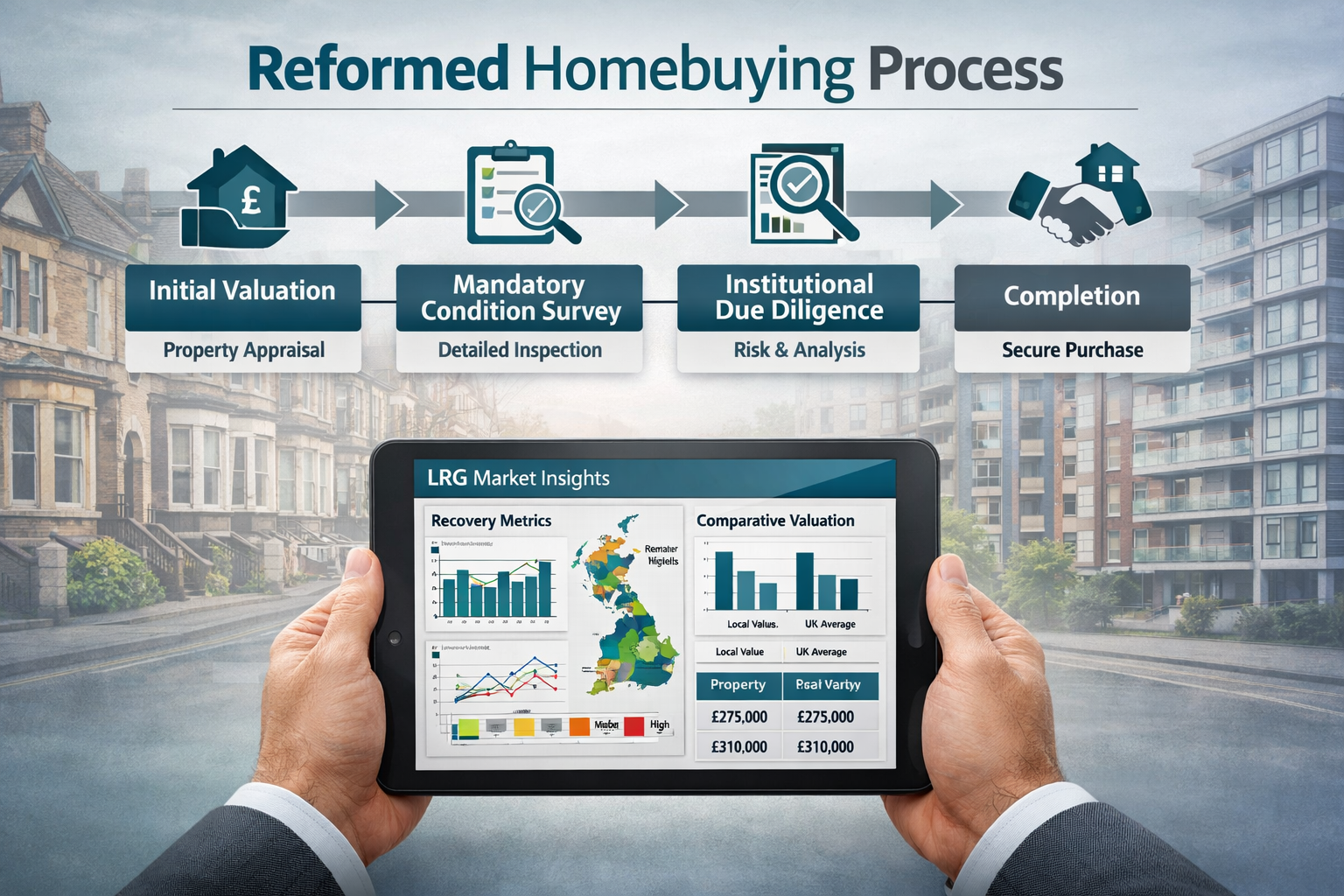
The mandatory upfront condition survey requirement for institutional BTL purchases represents the most significant procedural change affecting Valuation Strategies for Institutional BTL in 2026 Recovery: Leveraging LRG Insights on Reformed Homebuying Processes. Understanding how to optimize within this framework separates leading institutions from laggards.
Mandatory Survey Requirements and Timeline Implications
Under reformed processes, institutional buyers must commission qualified surveyors to complete condition assessments before exchange of contracts. For portfolio acquisitions, this creates coordination challenges but also opportunities:
Timeline Extension: Typical acquisition timelines have extended by 2-3 weeks to accommodate survey scheduling and report preparation. Institutions that establish preferred surveyor relationships and pre-negotiate expedited service agreements minimize this impact.
Negotiation Leverage: Armed with detailed condition reports, institutional buyers possess stronger negotiation positions. Documented defects provide objective basis for price reductions or seller remediation requirements. Savvy institutions use findings from what to check before buying a leasehold property assessments to identify deal-breaking issues early.
Due Diligence Quality: The mandatory survey requirement has paradoxically improved deal quality by eliminating "surprises" that previously emerged post-acquisition. Institutions report fewer post-completion disputes and more accurate budget forecasting.
Integrating Survey Findings into Valuation Models
The key to effective valuation under reformed processes lies in systematic integration of survey findings. Leading institutions employ structured frameworks:
| Survey Finding Category | Valuation Impact | Adjustment Method |
|---|---|---|
| Structural defects | High | Direct cost + 20% contingency + yield impact during remediation |
| Deferred maintenance | Medium | Itemized costs + 15% contingency |
| Energy efficiency issues | Medium | Upgrade costs vs. ongoing operational savings NPV analysis |
| Cosmetic issues | Low | Direct costs with minimal contingency |
| Compliance gaps | High | Remediation costs + regulatory risk premium |
This systematic approach ensures consistent valuation treatment across portfolio acquisitions. Properties with significant structural findings identified through professional surveyor duties receive appropriate risk adjustments rather than arbitrary discounts.
Creating Competitive Advantage Through Survey Excellence
Forward-thinking institutions are transforming the mandatory survey requirement from compliance burden to competitive advantage:
Pre-Marketing Surveys: Some institutional sellers now commission surveys before marketing properties, providing buyers with immediate condition transparency. This accelerates transactions and often commands premium pricing by reducing buyer uncertainty.
Survey Quality Differentiation: Not all condition surveys provide equal value. Institutions that insist on comprehensive building evaluation from top-tier surveyors gain superior information for valuation decisions, even if survey costs run 20-30% higher than basic compliance surveys.
Data Aggregation: Sophisticated institutions maintain databases of survey findings across their portfolios, enabling predictive analytics about condition issues by property type, age, and location. This institutional knowledge informs both acquisition valuations and portfolio management strategies.
Regional Variations in 2026 Recovery Trajectories
A critical element of Valuation Strategies for Institutional BTL in 2026 Recovery: Leveraging LRG Insights on Reformed Homebuying Processes involves recognizing that recovery is not uniform across UK regions. Valuation approaches must reflect local market dynamics.
London and Southeast Markets
The capital and surrounding areas show moderate recovery with persistent supply constraints supporting rental demand. However, valuation strategies must account for:
- Price sensitivity: High absolute price points create yield compression, requiring institutions to accept 3.5-4.5% gross yields on quality assets
- Regulatory intensity: Greater scrutiny of landlord compliance in London demands higher reserves for regulatory costs
- Tenant turnover: Higher mobility in London markets increases void risk, requiring conservative occupancy assumptions
Institutions acquiring in Fulham, Westminster, or Camden must incorporate these factors into valuation models.
Midlands and Northern England
These regions present compelling value opportunities with stronger yield profiles (5-7% gross yields) but require different valuation considerations:
- Economic sensitivity: Greater exposure to economic cycles demands higher risk premiums in discount rates
- Property condition: Older housing stock in some markets increases importance of thorough condition surveys
- Growth potential: Lower entry prices create better prospects for capital appreciation during recovery
Regional Valuation Adjustments
Sophisticated institutions apply location-specific adjustments to base valuation models:
London Premium: 15-20% valuation premium for equivalent condition properties reflecting supply constraints and demand density
Regional Discount: 10-15% discount in recovering industrial regions reflecting economic transition risks
Emerging Market Bonus: 5-10% premium for supply-constrained regional cities (Cambridge, Oxford, Bath) showing strong employment growth
Risk Management in 2026 BTL Valuations

Effective valuation strategies inherently incorporate risk management. The 2026 environment presents specific risks requiring explicit treatment:
Interest Rate Risk
Despite stabilization, interest rate volatility remains a concern. Institutional valuation models should stress-test assumptions across rate scenarios:
- Base case: Current rates hold for 24 months
- Adverse case: 100 basis point increase within 12 months
- Favorable case: 75 basis point decrease as recovery accelerates
Properties valued under all three scenarios with acceptable returns demonstrate resilience. Those dependent on favorable rate movements carry higher risk premiums.
Regulatory Risk
The reformed homebuying process represents just one regulatory change affecting BTL. Ongoing risks include:
- Energy efficiency mandates requiring minimum EPC ratings
- Tenant protection expansions potentially limiting rent increases
- Tax treatment changes affecting institutional structures
Valuation models incorporating 10-15% regulatory risk reserves for properties with compliance gaps reflect prudent risk management. Properties with structural defects or energy efficiency issues warrant higher reserves.
Market Timing Risk
Recovery timing remains uncertain despite positive indicators. Institutions employing staged acquisition strategies reduce market timing risk by dollar-cost-averaging into positions rather than deploying capital in concentrated periods.
Practical Implementation: Building a Valuation Framework
Translating these concepts into operational frameworks requires systematic implementation:
Step 1: Establish Valuation Governance
Create cross-functional teams including acquisitions, asset management, and risk personnel. Define clear valuation policies covering:
- Required survey scope for different property types and transaction sizes
- Approval thresholds for valuations deviating from automated model outputs
- Frequency of valuation reviews for held assets
- Documentation standards for valuation assumptions
Step 2: Select and Manage Surveyor Relationships
Quality valuation depends on quality survey inputs. Institutional best practices include:
- Panel of pre-qualified chartered surveyors with demonstrated BTL expertise
- Service level agreements specifying turnaround times and report formats
- Regular performance reviews assessing accuracy and consistency
- Geographic coverage ensuring local market knowledge
Institutions should understand what to do before an RICS home survey to maximize value from surveyor relationships.
Step 3: Implement Technology Infrastructure
Modern valuation requires robust technology:
- Valuation management systems tracking all property appraisals and supporting documentation
- Data integration platforms connecting survey reports, comparable sales, rental data, and financial models
- Reporting dashboards providing portfolio-level valuation metrics and trends
- Audit trails documenting valuation decisions for regulatory and internal governance
Step 4: Continuous Calibration and Improvement
Leading institutions treat valuation as a continuous improvement process:
- Post-acquisition reviews comparing initial valuations to actual performance
- Market feedback loops incorporating transaction outcomes into model refinements
- Peer benchmarking comparing valuation approaches with other institutional investors
- External validation engaging independent appraisers for portfolio reviews
Case Study: Institutional Portfolio Acquisition Using Reformed Processes
Consider a hypothetical but representative example illustrating Valuation Strategies for Institutional BTL in 2026 Recovery: Leveraging LRG Insights on Reformed Homebuying Processes in practice:
Portfolio: 47 residential units across three Midlands cities, marketed at £12.8 million
Initial Analysis: Desktop valuation based on asking rents and comparable sales suggested fair value of £12.2-12.6 million (4.8% gross yield)
Reformed Process Implementation: Institution commissioned comprehensive condition surveys across the portfolio at cost of £28,000
Survey Findings:
- 12 properties required roof repairs (£85,000 total)
- 8 properties had EPC ratings below C (£42,000 upgrade cost)
- 3 properties showed evidence of subsidence risk requiring monitoring (£15,000 structural engineering assessment)
- 6 properties had deferred maintenance issues (£38,000)
Valuation Adjustment:
- Direct remediation costs: £180,000
- Contingency (15%): £27,000
- Void period during works (estimated 3 months on 12 units): £36,000 lost rent
- Risk premium for subsidence properties: £45,000
- Total adjustment: £288,000
Negotiated Outcome: Purchase at £11.95 million, representing £850,000 below asking price, with seller completing roof repairs before completion
Post-Acquisition Performance: After completing EPC upgrades and maintenance, portfolio achieved 5.3% gross yield, exceeding initial projections and validating the condition-adjusted valuation approach
This example demonstrates how systematic integration of survey findings into valuation creates both negotiating leverage and more accurate investment underwriting.
Future-Proofing Valuation Strategies
As 2026 progresses, successful institutions will continue evolving their approaches:
Embracing Predictive Analytics
Machine learning models trained on historical survey data, market performance, and property characteristics will increasingly supplement traditional valuation approaches. Early adopters report 15-20% improvement in valuation accuracy through predictive models.
Sustainability Integration
Environmental, social, and governance (ESG) factors are becoming explicit valuation considerations. Properties with strong energy efficiency, sustainable materials, and social housing components command premiums from ESG-focused institutional investors. Valuation models must quantify these factors rather than treating them as qualitative considerations.
Collaborative Industry Standards
Industry bodies are developing standardized frameworks for condition-adjusted valuations. Institutions participating in these initiatives benefit from improved market liquidity as valuation approaches converge, reducing transaction friction.
Conclusion
Valuation Strategies for Institutional BTL in 2026 Recovery: Leveraging LRG Insights on Reformed Homebuying Processes represent a fundamental evolution in how professional landlords approach property acquisition and portfolio management. The convergence of mandatory condition surveys, improved market data, and sophisticated analytical frameworks creates opportunities for institutions that embrace these changes systematically.
The 34% increase in survey volumes signals that leading institutions recognize the value of comprehensive due diligence in capturing recovery opportunities. By integrating detailed property condition data with macroeconomic recovery indicators, active management approaches, and technology-enabled analytics, institutional investors can identify mispriced assets, negotiate more effectively, and build resilient portfolios positioned for long-term performance.
Actionable Next Steps
For institutional BTL investors seeking to optimize valuation strategies in 2026:
✅ Audit current valuation processes to identify gaps in condition data integration and survey quality
✅ Establish relationships with qualified surveyors offering comprehensive condition survey reports and rapid turnaround
✅ Implement technology platforms that systematically capture and analyze survey findings across portfolios
✅ Develop regional expertise recognizing that recovery trajectories vary significantly across UK markets
✅ Create feedback loops comparing initial valuations to actual performance, continuously refining models
✅ Engage with industry initiatives developing standardized condition-adjusted valuation frameworks
✅ Stress-test portfolios across multiple economic scenarios to understand valuation sensitivity to key variables
The institutions that treat reformed homebuying processes as strategic opportunities rather than compliance burdens will capture disproportionate value during the 2026 recovery. By combining rigorous condition assessment, sophisticated financial modeling, and active portfolio management, professional landlords can navigate this evolving landscape successfully.
The foundation of effective institutional BTL investment in 2026 rests on valuation excellence—integrating comprehensive property intelligence with market insights to make informed acquisition decisions that generate sustainable returns throughout the recovery cycle and beyond.
References
[1] Setting The Stage For A 2026 Value Revival – https://www.williamblair.com/Insights/Setting-the-Stage-for-a-2026-Value-Revival
[2] Outlook 2026 Take Active Approach Valuation Risk And Seek Opportunities – https://www.institutionalinvestor.com/article/sponsored-content/outlook-2026-take-active-approach-valuation-risk-and-seek-opportunities
[4] Cio Outlook Recovery Positions – https://am.landg.com/shared-content/insights/market-insights/cio-outlook-recovery-positions/
[5] Mario Gabelli Value Investing Ideas For 2026 – https://acquirersmultiple.com/2026/02/mario-gabelli-value-investing-ideas-for-2026/