

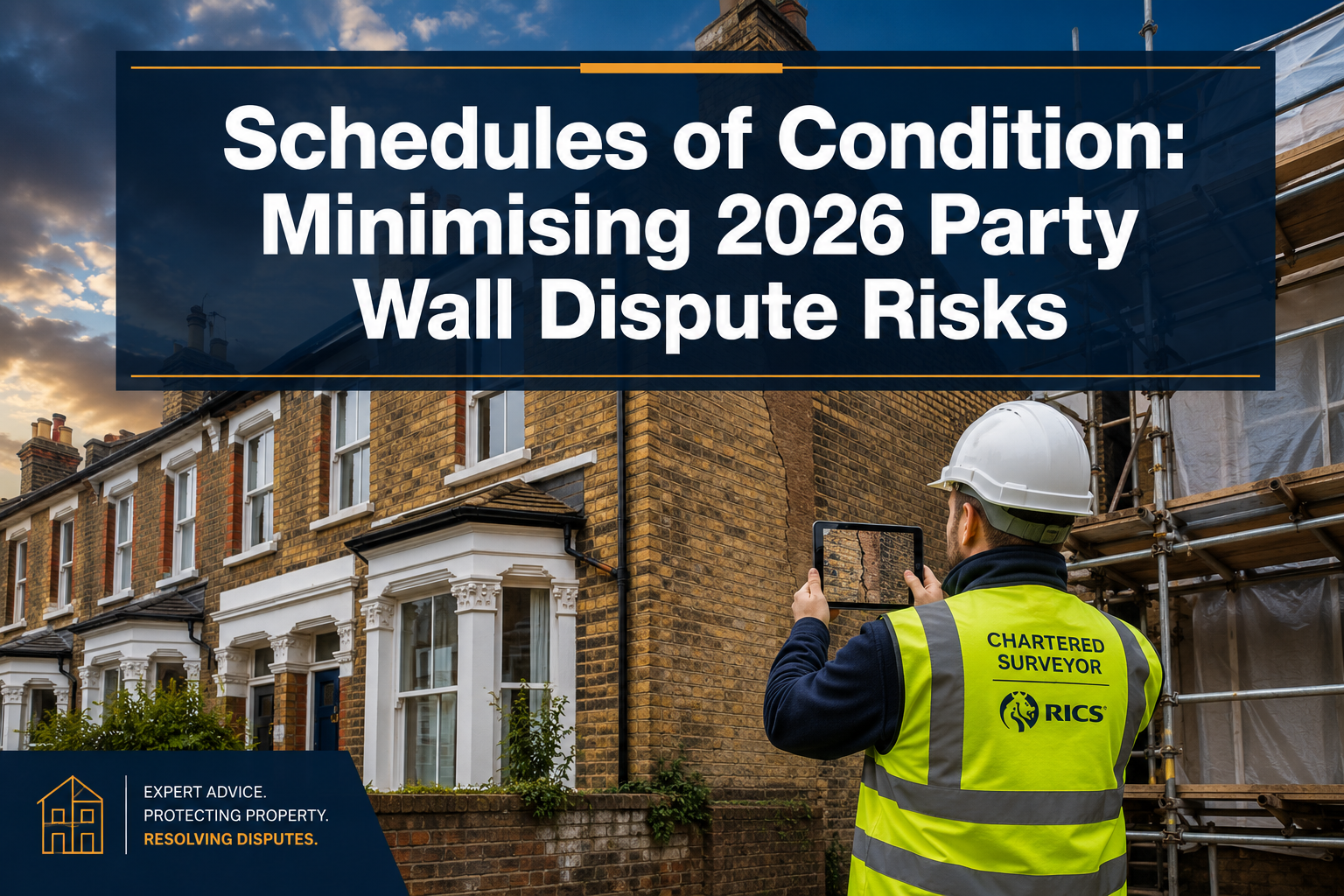
Nearly one in three party wall disputes that reach formal determination could have been avoided with a properly prepared schedule of condition — yet this document remains one of the most underused protective tools in construction. For anyone planning building works in 2026, understanding the Schedules of Condition Best Practices for Party Wall Works: Minimising 2026 Dispute Risks Pre-Construction is not optional; it is the single most cost-effective step a building owner or adjoining owner can take before a spade enters the ground. [1]
This guide walks through exactly how to photograph and document a neighbouring property, what RICS protocols demand for high-risk projects such as excavations, how surveyor fees are structured, and — critically — how real-world claims have been prevented through rigorous pre-construction documentation.
Key Takeaways 📋
- A schedule of condition is not legally required under the Party Wall Act 1996, but it is the primary defence against unfounded damage claims and can save thousands in surveyor fees.
- Professional guidance recommends 150–300 photographs per property to create a robust, dated baseline of condition.
- The schedule gains full legal force only when incorporated into a Party Wall Award — it cannot stand alone as a binding document.
- High-risk works such as excavations and basement conversions demand more detailed documentation, including crack monitoring, damp readings, and structural annotations.
- In 2026, updated RICS 8th Edition guidance and new planning authority frameworks make thorough pre-construction documentation more important than ever.
What Is a Schedule of Condition and Why Does It Matter in 2026?
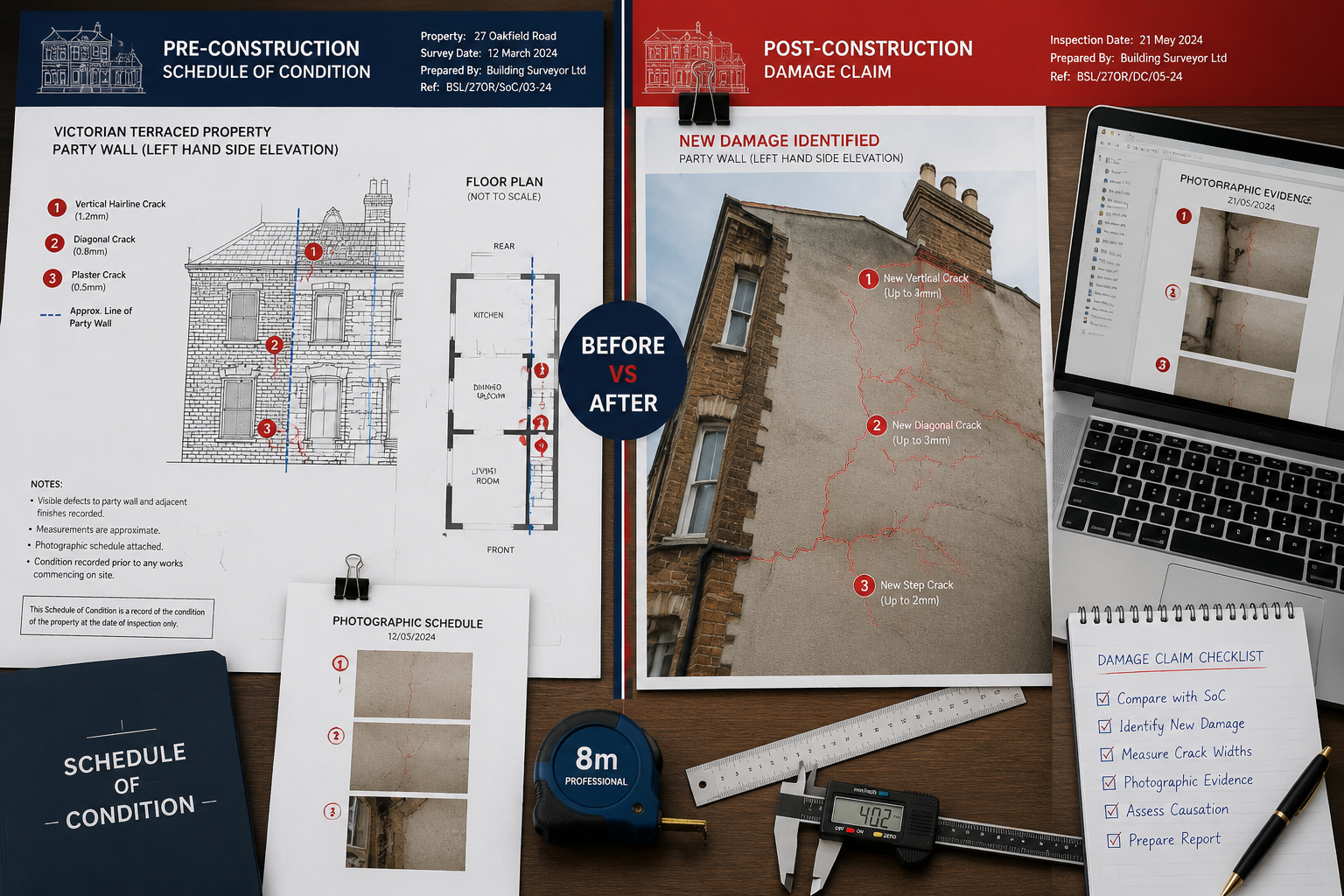
A schedule of condition is a detailed written and photographic record of a property's state immediately before construction begins. Its core purpose is simple: to distinguish pre-existing damage from any new damage that may occur during building works. [1]
Under the Party Wall Act 1996, the legislation itself does not mandate a schedule of condition. However, the Act tasks party wall surveyors with resolving disputes over damage claims — and without a pre-construction baseline, those disputes become expensive, protracted, and deeply subjective. [1]
💬 Pull Quote: "The schedule of condition provides the evidence; the Party Wall Award provides the legal protection. Neither works as well without the other." [3]
The 2026 Context: Why This Year Demands Extra Vigilance
The 2026 property market has seen a notable uptick in renovation activity as buyer confidence returns. Planning authorities and building control departments across London and the wider UK are implementing new compliance frameworks for managing party wall notices and construction oversight. [7] Simultaneously, the RICS 8th Edition Party Wall Guidance has introduced updated standards for appointment procedures, award drafting, and dispute prevention — standards that place greater weight on pre-construction documentation. [6]
The result: any project beginning in 2026 without a comprehensive schedule of condition is operating in a higher-risk environment than ever before.
Legal Status: What a Schedule of Condition Can and Cannot Do
| Document | Standalone Legal Force | Role in Dispute |
|---|---|---|
| Schedule of Condition alone | ❌ None | Evidence only |
| Party Wall Award alone | ✅ Binding | Legal framework |
| Schedule + Party Wall Award | ✅ Full protection | Evidence + enforcement |
A schedule of condition does not offer legal protection on its own. When combined with a Party Wall Agreement, however, it becomes the evidentiary backbone that allows surveyors — and courts — to determine whether any post-construction damage is genuinely attributable to the works. [3] In most cases, the schedule is incorporated directly into the Party Wall Award itself. [3]
Step-by-Step Guide to Photographing and Documenting Neighbour Properties
This is where preparation separates professional practice from guesswork. The following process reflects current best practice for party wall surveyor responsibilities and RICS-aligned documentation standards.
Step 1: Agree Access in Writing
Before entering an adjoining owner's property, written consent must be obtained. This is typically arranged through the party wall surveyor and referenced within the Party Wall Award. Access refusal does not remove the adjoining owner's right to claim damages later — but it does shift the evidential burden significantly.
Step 2: Conduct a Room-by-Room Inspection
The inspection should cover all rooms and areas in close proximity to the proposed works. For a rear extension, this typically means:
- 🏠 The rear reception room and kitchen
- 🪟 All windows and door frames adjacent to the party wall
- 🧱 The party wall itself (both faces where accessible)
- 🏗️ The garden, outbuildings, and boundary structures
- 🚿 Any bathrooms or utility rooms on shared walls
For excavation or basement projects, the scope must extend to foundations, floor slabs, and any areas showing existing subsidence indicators. If there is any concern about tree-related movement, a subsidence assessment should be considered alongside the schedule.
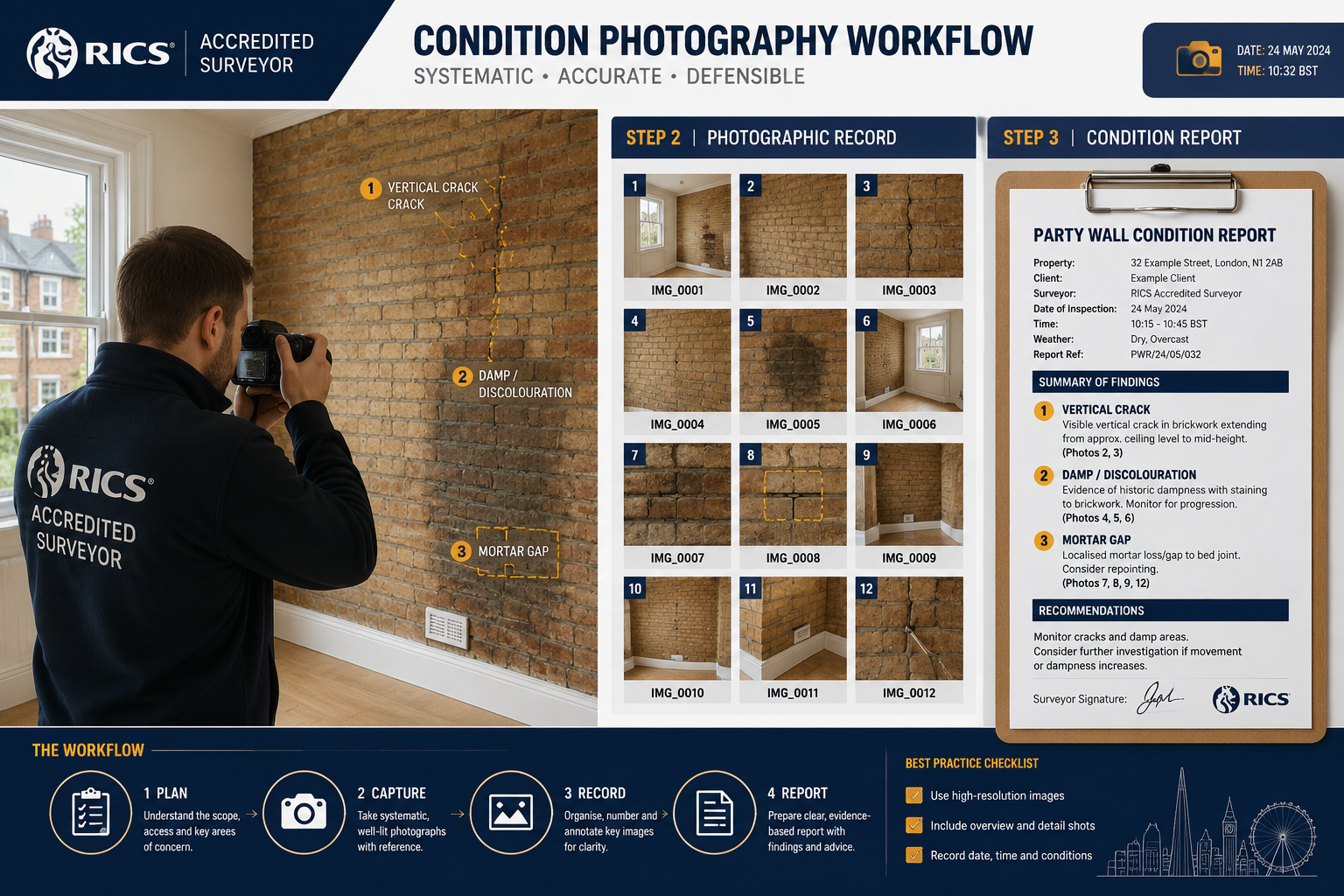
Step 3: The Photography Protocol — 150 to 300 Images
Professional guidance is clear: 150–300 photographs should be taken per property. [1] This figure may seem excessive until the first dispute arises. Each photograph should:
- ✅ Be date and time stamped (camera metadata, not manual overlay)
- ✅ Include a scale reference (ruler, coin, or tape measure) for cracks and defects
- ✅ Show context shots (wide angle) followed by detail shots (close-up)
- ✅ Cover all four compass orientations of the party wall
- ✅ Document existing cracks, staining, damp patches, and settlement marks with annotation
💡 Pro Tip: Use a systematic grid approach — photograph each wall in thirds, overlapping slightly, so no area is missed. Number each photograph and cross-reference it to a floor plan sketch.
Step 4: Written Condition Descriptions
Photographs alone are insufficient. Each defect must be accompanied by a written description covering:
- Location (e.g., "hairline crack, 320mm long, running diagonally from window head, south elevation, first floor rear bedroom")
- Type of defect (crack, staining, spalling, settlement, damp)
- Severity (hairline, minor, moderate, significant)
- Existing or historic status (fresh plaster over old crack vs. active movement)
The written record and photographic record together form the condition survey report that will be referenced if any dispute arises. [2]
Step 5: Authentication and Dating
The completed schedule must be:
- Signed by the surveyor preparing it
- Dated on the day of inspection
- Served on both parties before works commence
- Incorporated into the Party Wall Award where possible [3]
Some surveyors now use cloud-based timestamping and geotagged photography to add an additional layer of authentication — a practice increasingly recommended for high-value or contentious projects.
RICS Protocols and Surveyor Fees for High-Risk Projects
Not all party wall works carry equal risk. A simple loft conversion on a mid-terrace property is very different from a deep basement excavation in a London terrace where foundations may be as shallow as 600mm. The schedule of condition must reflect the risk profile of the specific works.

High-Risk Work Categories Requiring Enhanced Documentation
| Work Type | Key Documentation Additions |
|---|---|
| Basement/excavation | Foundation depth records, crack monitoring gauges, damp readings |
| Underpinning | Structural engineer's pre-works assessment, settlement monitoring |
| Demolition adjacent to boundary | Full structural survey of adjoining property |
| Large rear extensions | Drainage inspection, subsoil assessment |
| Loft conversions | Roof structure condition, chimney stack records |
For excavation projects in particular, the Schedules of Condition Best Practices for Party Wall Works: Minimising 2026 Dispute Risks Pre-Construction framework recommends installing Demec crack monitoring studs or tell-tales across existing cracks before works begin. These provide objective, measurable evidence of whether movement has occurred during construction — far more persuasive than photographic evidence alone.
Understanding Surveyor Fees in 2026
Costs vary depending on project complexity, property size, and the surveyor's RICS accreditation level. Typical 2026 fee ranges:
- Basic schedule of condition (small terraced property, low-risk works): £300–£600
- Standard schedule (semi-detached, moderate works): £500–£900
- Enhanced schedule (large property, excavation, high-risk works): £800–£1,500+
- Third surveyor determination (where disputes arise): £1,500–£3,000+
The financial logic is compelling: spending £600 on a thorough schedule of condition upfront can prevent a £3,000+ third surveyor determination later, not to mention legal costs if a dispute escalates to county court. [1] Without proper condition records, disputes can result in multiple expensive surveyor visits throughout the construction phase. [1]
For projects in London, working with RICS-accredited chartered surveyors ensures the schedule meets the evidentiary standards required under the updated 2026 guidance framework.
The Dispute Resolution Framework: How Schedules Are Used in Practice
When a damage claim arises, the process works as follows:
- Adjoining owner reports damage to their party wall surveyor
- Surveyor inspects and photographs the alleged new damage
- Schedule of condition is cross-referenced — is the damage recorded pre-construction?
- If damage is not in the schedule, it is presumed new and the building owner may be liable
- If damage is in the schedule, the claim is rejected or significantly reduced
- Where surveyors disagree, a third surveyor is appointed to determine liability [1]
This framework underscores why the photography protocol matters so much. A crack that was not photographed before works began will almost certainly be attributed to those works — regardless of its actual origin.
Case Examples: How Thorough Documentation Prevented Costly Claims
Case Example 1: The Basement Conversion Dispute That Never Happened
A homeowner in South London undertook a full basement conversion beneath a Victorian terrace. The adjoining owner had pre-existing diagonal cracking above the rear bay window — classic long-term settlement cracking, decades old.
The party wall surveyor prepared a 240-photograph schedule of condition, with written annotations and Demec crack monitoring studs installed across four existing cracks. Six months into construction, the adjoining owner reported "new cracking" and threatened a formal claim.
The schedule was produced. Every reported crack was documented in pre-construction photographs, with scale references and written descriptions. The Demec readings showed zero measurable movement since installation. The claim was withdrawn within two weeks, saving an estimated £4,200 in third surveyor and legal costs.
Case Example 2: The Loft Conversion That Revealed Pre-Existing Damp
During a schedule of condition for a loft conversion in North London, the surveyor identified significant penetrating damp to the chimney breast of the adjoining property — undisclosed and apparently unknown to the adjoining owner.
By documenting this pre-construction, the building owner was protected from any future claim that the loft works had caused damp damage. The adjoining owner was also alerted to a maintenance issue they needed to address. Both parties benefited from the thorough condition survey process.
Case Example 3: Excavation Works and a Disputed Floor Crack
A rear extension with strip foundation excavation to 1.2m depth prompted a claim from the adjoining owner that a crack in their kitchen floor tiles was caused by the works. The schedule of condition included close-up photographs of the kitchen floor, clearly showing the crack with a 5p coin for scale — dated three weeks before works commenced.
The claim was resolved at the surveyor-to-surveyor stage without third surveyor involvement, saving both parties significant time and cost. [4]
Implementing Schedules of Condition Best Practices for Party Wall Works: Minimising 2026 Dispute Risks Pre-Construction — A Summary Checklist
Before any party wall works commence in 2026, use this checklist to confirm full compliance with best practice:
- Party wall notice served within the correct statutory timeframe
- Party wall surveyor appointed (agreed or separate surveyors)
- Written access consent obtained from adjoining owner
- Room-by-room inspection completed and documented
- 150–300 photographs taken, date-stamped and geotagged
- Written condition descriptions prepared for all defects
- Crack monitoring devices installed for high-risk works
- Schedule authenticated and signed by surveyor
- Schedule served on both parties before works begin
- Schedule incorporated into the Party Wall Award
For London-based projects, understanding how the Party Wall Act 1996 applies to specific works — including what constitutes notifiable works and the correct notice periods — is an essential first step before any documentation process begins.
Conclusion: Actionable Next Steps for 2026 Projects
The evidence is clear: the Schedules of Condition Best Practices for Party Wall Works: Minimising 2026 Dispute Risks Pre-Construction framework is not bureaucratic box-ticking — it is a financially and legally rational investment that protects both building owners and their neighbours.
Here are the immediate next steps for anyone planning works in 2026:
- Engage a RICS-accredited party wall surveyor early — ideally two to three months before works begin, to allow time for notices, responses, and schedule preparation.
- Do not rely on the adjoining owner's goodwill — even amicable neighbours can become adversarial when cracks appear during construction.
- Commission an enhanced schedule for any excavation, basement, or underpinning work — the additional cost is minimal compared to the risk exposure.
- Ensure the schedule is incorporated into the Party Wall Award — a standalone document offers no binding legal protection.
- Retain all photographic and written records for a minimum of six years post-completion — the limitation period for property damage claims.
The 2026 construction landscape rewards preparation. A thorough schedule of condition, prepared by a qualified surveyor following RICS protocols, is the most reliable way to ensure that disputes are resolved quickly, fairly, and without the financial damage that unprotected claims can cause.
References
[1] Party Wall Schedule Of Condition – https://onlinearchitecturalservices.com/party-wall-schedule-of-condition/
[2] Schedule Of Condition – https://westvilleassociates.com/party-wall-surveyor/schedule-of-condition
[3] Watch – https://www.youtube.com/watch?v=x0aoxlCmF8Y
[4] Stop Party Wall Conflicts Early Preemptive Surveyor Strategies And Notice Best Practices For 2026 Builds – https://partywallsurveyorlondon.uk/blogs/stop-party-wall-conflicts-early-preemptive-surveyor-strategies-and-notice-best-practices-for-2026-builds/
[5] Party Wall Surveys And Neighbour Disputes During 2026s Construction Uptick Rics Compliance Framework – https://nottinghillsurveyors.com/blog/party-wall-surveys-and-neighbour-disputes-during-2026s-construction-uptick-rics-compliance-framework
[6] Rics 8th Edition Party Wall Guidance 2026 Whats Changed And How Surveyors Must Adapt – https://wimbledonsurveyors.com/rics-8th-edition-party-wall-guidance-2026-whats-changed-and-how-surveyors-must-adapt/
[7] Party Wall Agreements For 2026 Renovation Surge Managing Notices As Buyer Confidence Returns – https://princesurveyors.co.uk/blog/party-wall-agreements-for-2026-renovation-surge-managing-notices-as-buyer-confidence-returns/
[9] Drafting Enforceable Party Wall Awards Essential Clauses For 2026 Building Works And Safeguards – https://partywallsurveyorlondon.uk/blogs/drafting-enforceable-party-wall-awards-essential-clauses-for-2026-building-works-and-safeguards/









