
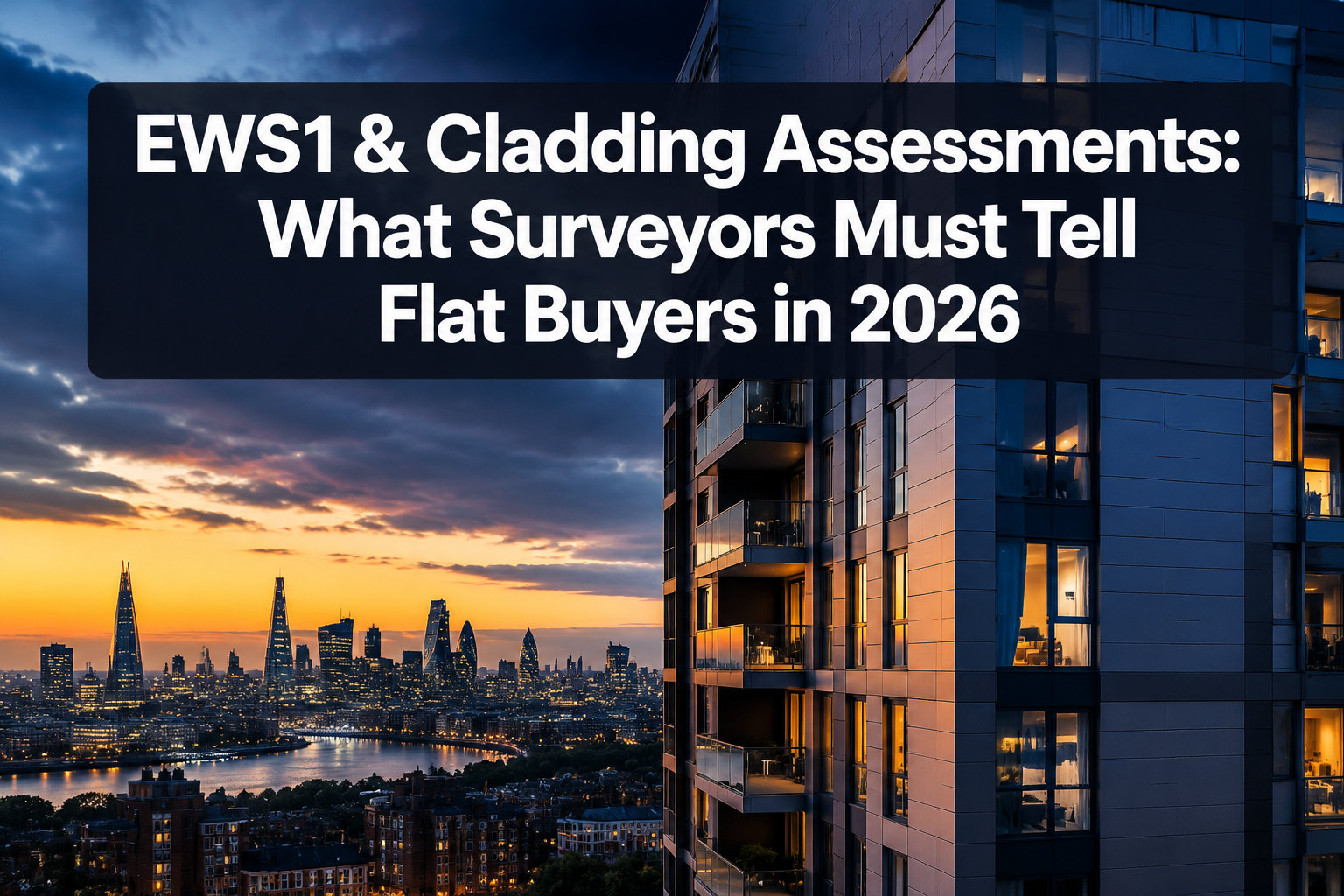
Nearly 3,000 residential buildings in England alone still have unsafe cladding systems requiring remediation as of early 2026 — and every one of those buildings represents a flat buyer who could unknowingly purchase an unmortgageable, unsaleable property without proper surveyor guidance [1]. The stakes could not be higher. Understanding EWS1, cladding and external wall assessments: what UK valuation and building surveyors need to explain to flat buyers in 2026 is no longer a niche specialism — it is a core professional obligation.
This guide cuts through the jargon to give surveyors practical, plain-English frameworks for explaining EWS1 forms, PAS 9980 appraisals, and external wall system assessments to clients — and what those assessments mean for valuation, mortgageability, and the survey report itself.
Key Takeaways 📌
- EWS1 is a valuation tool, not fire safety legislation — it exists to support mortgage lending, not to certify a building as safe.
- Height thresholds matter: EWS1 is generally required for buildings over 18 metres, and for those over 11 metres where specific risk factors exist.
- One certificate covers the whole building — not each individual flat — and remains valid for five years.
- PAS 9980 is now the recognised technical standard for fire risk appraisal of external walls, and surveyors must understand how it underpins EWS1 outcomes.
- Surveyors must communicate EWS1 outcomes clearly in Level 2 and Level 3 reports, including what each outcome means for property value and lender appetite.
Understanding the EWS1 Framework: What It Is and What It Is Not
The Origins and Purpose of the EWS1 Form
The EWS1 (External Wall System) form was introduced in December 2019 — a direct response to the Grenfell Tower tragedy — as a standardised statement created specifically for the mortgage lending market. It is not legislation, and critically, it is not a fire risk assessment [4]. Surveyors must make this distinction crystal clear to every flat buyer client.
The form's sole purpose is to enable valuations to proceed for mortgages and remortgages on properties with external wall cladding systems of uncertain composition [2]. Without a valid EWS1 certificate where one is required, many lenders will simply refuse to lend — leaving buyers unable to complete a purchase or owners unable to remortgage.
💬 Suggested wording for survey reports: "The EWS1 form is a market-led tool designed to support mortgage lending decisions. It is not a statutory fire safety certificate and does not replace the building's fire risk assessment."
How EWS1 Fits Within the Wider Regulatory Landscape
The EWS1 process sits alongside — but is distinct from — the broader building safety framework introduced by the Building Safety Act 2022. RICS published its second edition of EWS1 guidance in May 2026, with an implementation date of 1 November 2026, representing the most current authoritative framework for surveyors [5].
Since January 2022, PAS 9980 ("Fire Risk Appraisal of External Walls" — FRAEW) has been the recognised technical standard for conducting these assessments [4]. Unlike older approaches that focused solely on cladding material type, PAS 9980 uses a risk-based methodology assessing the entire wall build-up: combustibility, cavity barriers, fixings, interfaces, and fire spread potential. Surveyors reviewing an EWS1 certificate should confirm it was produced in accordance with PAS 9980 methodology.
Which Buildings Need an EWS1? Height Thresholds Explained
The 18-Metre Rule and the 11-Metre Threshold
Not every flat purchase triggers an EWS1 requirement. Surveyors must apply the correct height thresholds when advising clients:
| Building Height | EWS1 Required? |
|---|---|
| Over 18 metres (typically 6+ storeys) | Yes — mandatory for lenders [7] |
| 11–18 metres (typically 4–6 storeys) with specific risk factors | Yes — where risk factors present [7] |
| 5–6 storeys with significant cladding (≥25% of elevation) | Yes — RICS "significance test" applies [2] |
| No cladding whatsoever | No — exempted since November 2020 [6] |
The "significant amount of cladding" test for lower-rise buildings is particularly important for surveyors to communicate. RICS guidance defines "significant" as approximately one quarter of the whole elevation, estimated from ground level [2]. This gives surveyors a specific visual benchmark to apply and explain to clients.
The November 2020 No-Cladding Exemption
A critical development that many flat buyers are unaware of: since 21 November 2020, following a joint agreement between RICS, UK Finance, the Building Societies Association, and Government, EWS1 forms are no longer required for sales or remortgages on flats in blocks with no cladding whatsoever [6].
Surveyors should confirm cladding presence before recommending an EWS1 assessment. Recommending an unnecessary assessment wastes time and money — and undermines client trust.
Scotland: A Different Regime
It is worth noting that Scotland operates differently. In Scotland, separate EWS1 forms can be required on a flat-by-flat basis, rather than a single building-wide certificate. Surveyors advising clients on Scottish properties must account for this distinction when setting expectations.
EWS1 Outcomes: What Each Result Means for Valuation and Mortgageability
The Binary Outcome Structure
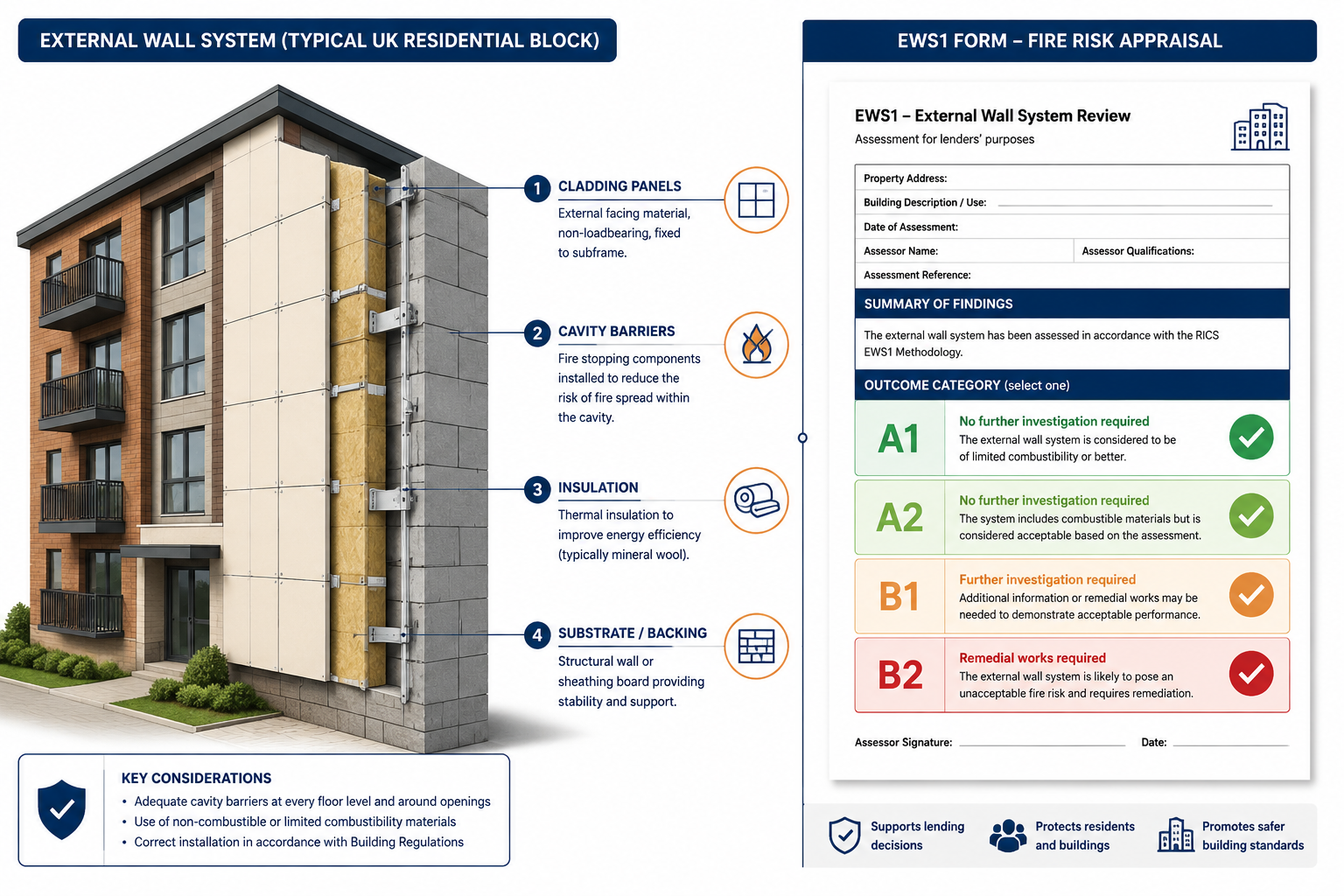
An EWS1 assessment produces one of two main outcomes, each with sub-options [2]:
Outcome A — External wall materials are unlikely to support combustion:
- A1: No cladding or attachments present that require further assessment
- A2: Cladding/attachments present but unlikely to support combustion
Outcome B — Combustible materials are present:
- B1: Fire risk is sufficiently low — no remedial works required
- B2: Fire risk is high enough — remedial works are required ⚠️
Valuation Implications of Each Outcome
Surveyors must translate these outcomes into clear valuation language for clients:
| EWS1 Outcome | Mortgageability | Valuation Impact |
|---|---|---|
| A1 | Generally mortgageable | Minimal/no impact |
| A2 | Generally mortgageable | Minimal/no impact |
| B1 | Generally mortgageable | May have minor impact |
| B2 | Often unmortgageable until remediated | Significant negative impact on value |
A B2 outcome is the most serious. It signals that combustible materials are present and remediation is required before the property can typically be mortgaged or resold [3]. Surveyors must flag this prominently in Level 2 and Level 3 reports, and recommend specialist legal and financial advice.
💬 Suggested wording for a B2 outcome in a survey report: "The EWS1 certificate for this building records a B2 outcome, indicating that combustible materials are present in the external wall system and that remedial works are required. This is likely to affect mortgageability and market value. Prospective purchasers should seek specialist advice on remediation costs, leaseholder protections under the Building Safety Act 2022, and the status of any developer or government remediation funding before proceeding."
One Certificate Per Building — Not Per Flat
A point of frequent confusion for flat buyers: one EWS1 certificate covers the entire building, not each individual flat [3]. The certificate remains valid for five years from the date of assessment. Surveyors should check the certificate date and confirm it remains current. Where a certificate is approaching expiry or was issued before PAS 9980 came into effect (January 2022), a fresh assessment may be advisable.
For buyers considering flats in buildings where an EWS1 has not yet been commissioned, surveyors should advise on who is responsible for arranging and funding the assessment — typically the building owner or freeholder — and the likely timeline implications for the transaction.
What Qualified Assessors Must Demonstrate — and Why Surveyors Should Verify Credentials
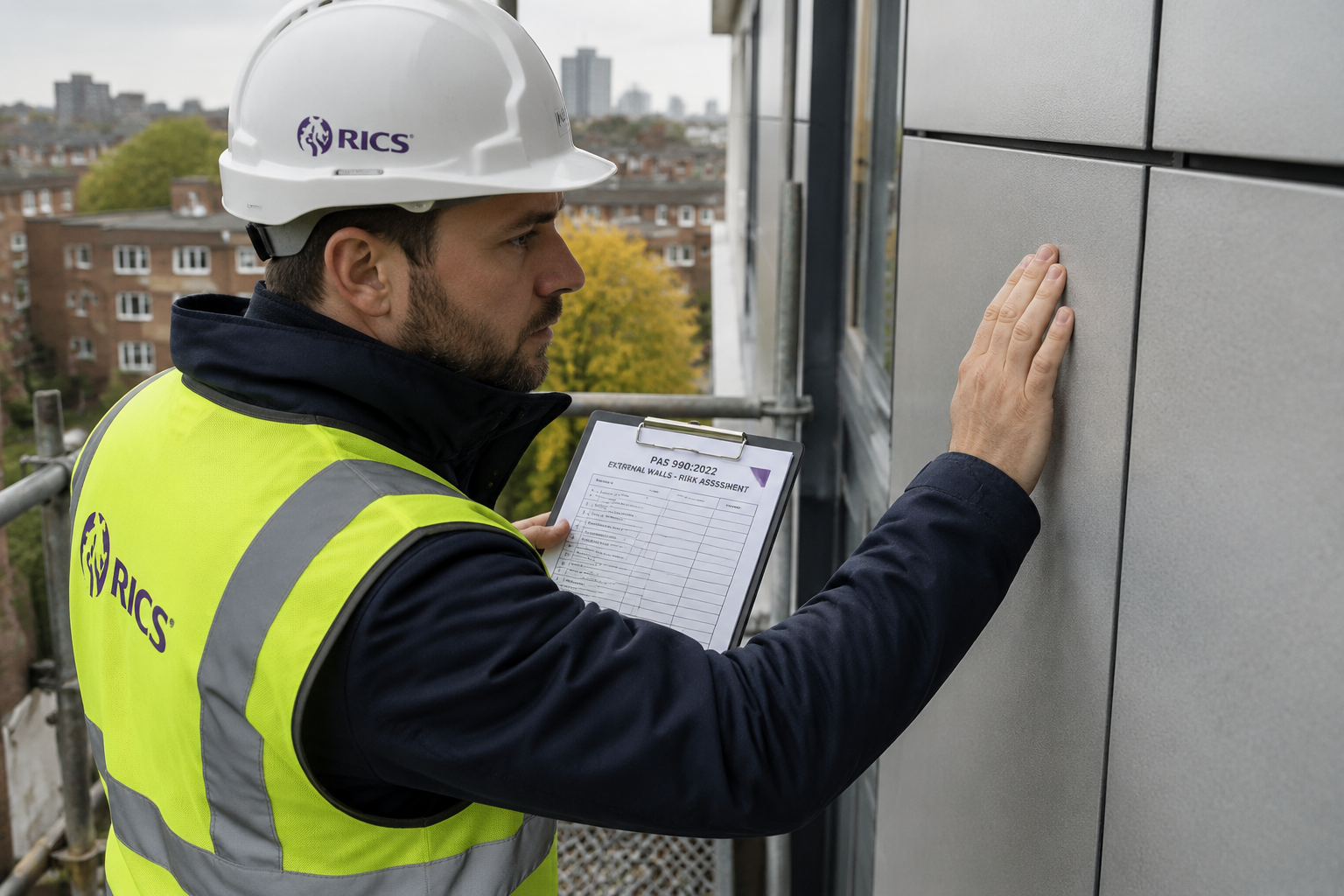
EWS1 assessments must be completed by fully qualified members of relevant professional bodies, following PAS 9980 methodology [5]. The assessor must have sufficient expertise to:
- Identify materials present in external wall cladding and attachments 🔍
- Determine whether fire-resisting cavity barriers and fire stopping have been correctly installed
- Apply the risk-based methodology of PAS 9980 to the whole wall build-up
- Produce a report that supports the EWS1 form completion
When reviewing an EWS1 certificate on behalf of a client, surveyors should verify:
- ✅ The assessor's professional qualifications and body membership
- ✅ That the assessment references PAS 9980 methodology
- ✅ The date of assessment (within five-year validity window)
- ✅ That the certificate relates to the specific building being purchased
- ✅ The outcome category and any conditions attached
If a certificate cannot be verified or appears incomplete, surveyors should recommend the client seek a fresh assessment and notify their solicitor and mortgage lender accordingly.
Integrating EWS1 into Level 2 and Level 3 Survey Reports
What Must Appear in a Homebuyer Report (Level 2)
For flat buyers commissioning a homebuyers survey, surveyors must address external wall systems as a distinct section. The RICS 2nd Edition guidance (May 2026) reinforces that EWS1 status should be clearly reported wherever relevant. Key elements to include:
- Confirmation of whether the building falls within EWS1 height/risk thresholds
- Whether an EWS1 certificate exists, its date, outcome, and assessor credentials
- Plain-English explanation of what the outcome means for mortgageability
- Clear signposting to specialist advice where a B2 outcome or no certificate is present
For a practical example of how these elements appear in a professional report, reviewing a homebuyers report example can help surveyors structure their own reporting approach.
Level 3 Building Surveys: Greater Depth Required
A full structural building survey demands a more detailed treatment of external wall systems. At Level 3, surveyors should:
- Comment on visible external wall materials and any observable cladding systems
- Note any signs of remediation works, scaffold, or building notices
- Flag where the external wall system cannot be fully assessed visually and specialist inspection is required
- Reference the applicable PAS 9980 framework and explain its significance
- Provide specific advice on how a B1 or B2 outcome would affect the client's intended use and financial planning
Where a building survey reveals concerns about external wall systems but no EWS1 certificate exists, a specific defect survey focused on the external wall may be recommended as an intermediate step.
Handling a Bad EWS1 Outcome: Advising Clients Post-Report
Receiving a B2 outcome — or discovering no valid EWS1 certificate exists — can be deeply distressing for flat buyers. Surveyors play a vital role in helping clients understand their options. Practical guidance on what to do after a bad building survey report applies equally here: the situation is serious but not necessarily a transaction-stopper, particularly where developer or government remediation funding is available under the Building Safety Act 2022.

Practical Wording for Lender Discussions and Client Communications
Explaining EWS1 to Mortgage Lenders
When surveyors submit valuation reports to lenders, clarity on EWS1 status is essential. Recommended language for valuation reports:
"This property is located in a residential block that [falls within / does not fall within] the EWS1 assessment threshold. An EWS1 certificate [has been provided, dated [DATE], recording outcome [OUTCOME] / has not been provided at the time of inspection]. [Where applicable: The B2 outcome indicates that remedial works are required, and this has been reflected in the valuation. Lenders should be aware that mortgageability may be restricted until remediation is completed and a revised EWS1 certificate issued.]"
Explaining EWS1 to Flat Buyers Without Jargon
Many flat buyers have never encountered the term "EWS1" before. A useful plain-English explanation:
"The EWS1 form is a document that tells your mortgage lender whether the outside walls of your building have been checked for fire safety risks. It was introduced after the Grenfell Tower fire in 2017. If the form shows there's a problem with the cladding on the building, your lender may not be willing to lend until the problem is fixed. This doesn't mean the building is necessarily dangerous to live in right now — but it does affect your ability to get a mortgage or sell the flat in future."
This kind of accessible explanation is exactly what distinguishes a RICS-qualified surveyor from a basic property inspection service.
Lease Extension Implications
Flat buyers should also be aware that EWS1 status can affect lease extension valuations. A B2 outcome may depress the premium payable for a lease extension, but it can also complicate the process if lenders are unwilling to fund the purchase of an extended lease until remediation is complete. Surveyors should flag this interaction where relevant.
London-Specific Considerations for Surveyors in 2026
London's high density of tall residential buildings — particularly in areas such as Southwark, Newham, Islington, and Battersea — means that EWS1 issues arise with far greater frequency in the capital than elsewhere in England. Surveyors operating across London must maintain up-to-date knowledge of:
- Local authority remediation schemes and building registers
- Developer-specific remediation commitments under the Building Safety Act 2022
- Southwark Council's published guidance on external wall safety and EWS1 forms [9]
- The Government's Building Safety Remediation monthly data releases tracking progress [1]
As of January 2026, government data confirms that remediation progress continues across the highest-risk buildings, but thousands of mid-rise buildings remain in assessment or remediation pipelines [1]. This means EWS1 issues will remain a live concern for London flat buyers throughout 2026 and beyond.
Conclusion: Actionable Next Steps for Surveyors and Flat Buyers
EWS1, cladding and external wall assessments: what UK valuation and building surveyors need to explain to flat buyers in 2026 comes down to one core obligation — clarity. The EWS1 framework is complex, but its impact on buyers is simple and profound: it determines whether a flat can be mortgaged, valued, and resold.
For Surveyors — Immediate Action Points:
- Update report templates to reflect RICS 2nd Edition EWS1 guidance (effective November 2026) 📋
- Apply the correct height thresholds — 18 metres, 11 metres with risk factors, and the 25% cladding significance test for lower-rise buildings
- Verify assessor credentials and PAS 9980 compliance on every EWS1 certificate reviewed
- Use plain-English wording in both survey reports and client conversations — avoid acronym overload
- Flag B2 outcomes prominently and signpost clients to specialist legal, financial, and remediation advice
- Check certificate validity — five-year window from assessment date
For Flat Buyers — Key Questions to Ask:
- Does this building need an EWS1 certificate? 🏢
- Has one been completed, and what is the outcome?
- When was it done, and is it still within the five-year validity period?
- Was it completed by a PAS 9980-qualified assessor?
- If the outcome is B2, who is responsible for remediation costs?
The cladding crisis is not over. But with expert surveyor guidance, flat buyers can navigate it with confidence — and make informed decisions that protect both their safety and their financial future.
References
[1] Building Safety Remediation Technical Note January 2026 – https://www.gov.uk/government/publications/building-safety-remediation-monthly-data-release-january-2026/building-safety-remediation-technical-note-january-2026
[2] External Wall Fire Review EWS1 – https://karibu.org.uk/your-home/your-safety/external-wall-fire-review-ews1
[3] EWS1 Surveys UK – https://ews1surveys.co.uk
[4] EWS1 Form Services – https://mafassociates.co.uk/services/external-wall-safety/ews1-form-services/
[5] Cladding External Wall System EWS FAQs – https://www.rics.org/news-insights/current-topics-campaigns/fire-safety/cladding-external-wall-system-ews-faqs
[6] The External Wall Fire Review Process EWS – https://commonslibrary.parliament.uk/the-external-wall-fire-review-process-ews/
[7] Fire Safety and Cladding Remediation: Updated Building Survey Protocols Post-Grenfell for 2026 Buyers – https://princesurveyors.co.uk/blog/fire-safety-and-cladding-remediation-updated-building-survey-protocols-post-grenfell-for-2026-buyers/
[9] External Wall Safety and EWS1 Forms – https://www.southwark.gov.uk/housing/repairs-maintenance-and-home-safety/home-safety/external-wall-safety-and-ews1-forms