

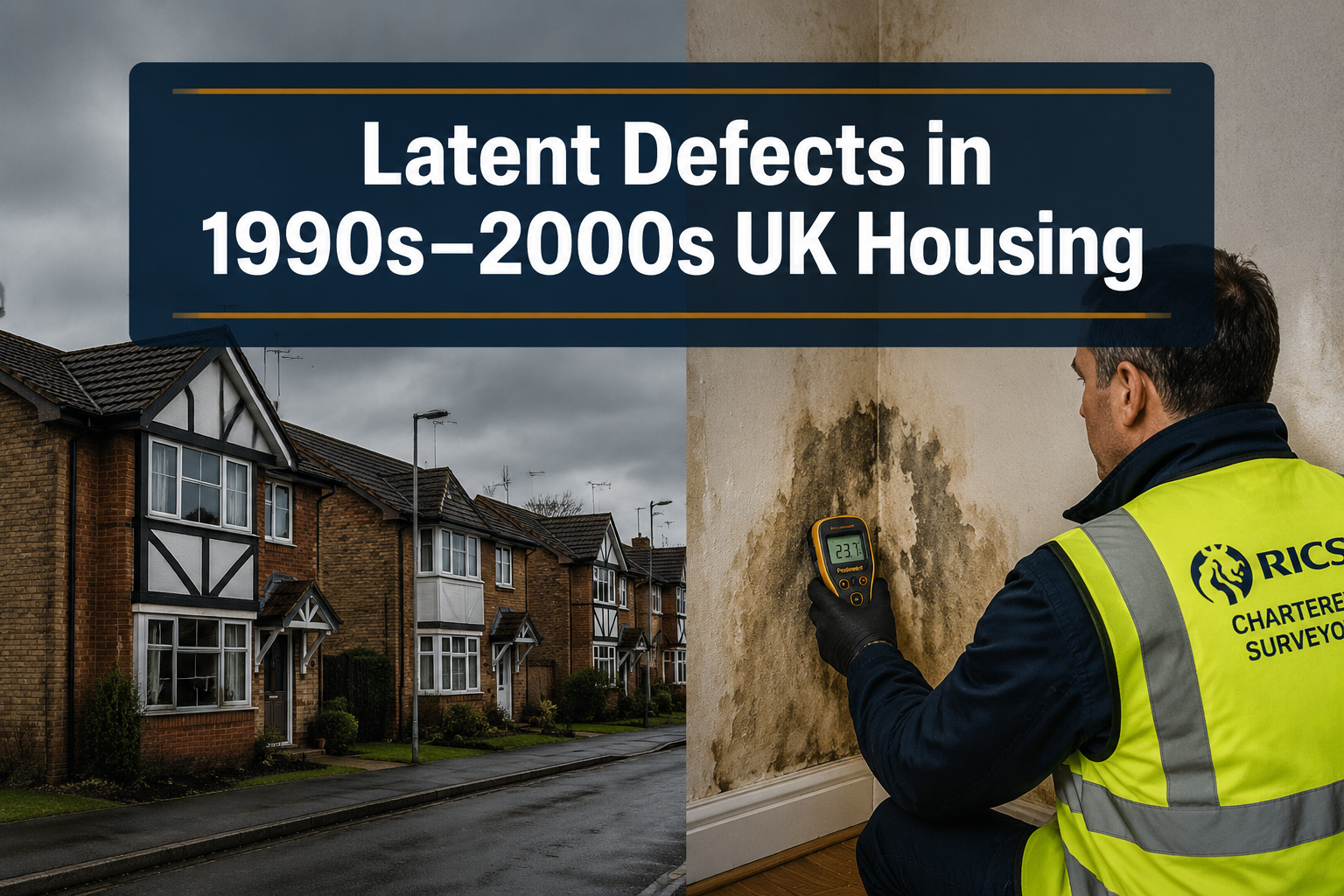
More than 2,500 residential buildings in England have been identified with life-critical fire safety defects as of early 2026 — the majority constructed during the very era that defines today's most active resale market [2]. Yet fire safety is only the most visible tip of a much larger iceberg. Latent defects in 1990s–2000s UK housing represent one of the most complex challenges facing buyers, surveyors, and the property sector today, and understanding what Level 3 Building Surveys should be picking up in 2026 has never been more urgent.
Properties built between roughly 1990 and 2009 sit in a regulatory grey zone. They were constructed after the post-war system building era — so buyers often assume they are "modern enough" to be safe — yet they predate the tightened building regulations and oversight that followed high-profile failures like Grenfell. The result is a generation of homes carrying hidden problems that are only now reaching the age at which they become expensive, dangerous, and legally contentious.
Key Takeaways 📋
- 1990s–2000s housing sits in a regulatory blind spot: self-certification by developers was widespread, and workmanship quality was inconsistent [1].
- Latent defects from this era are now maturing: cavity insulation, plastic plumbing, flat roof membranes, and timber frame details are all reaching critical failure ages.
- Level 3 Building Surveys in 2026 must go beyond the visible: thermal imaging, moisture mapping, and specialist sub-reports are increasingly essential tools.
- Fire safety and cladding defects affect thousands of buildings from this period, with remediation still ongoing [2].
- Buyers can renegotiate or withdraw when a Level 3 survey uncovers significant latent defects — but only if the survey is thorough enough to find them.
Why the 1990s–2000s Construction Era Demands Extra Scrutiny
The regulatory environment that shaped UK housebuilding in the 1990s and 2000s was, to put it plainly, permissive to the point of negligence. Following deregulation in the 1980s, private developers were permitted to self-certify much of their own work, eliminating the independent quality inspections that had previously acted as a check on workmanship [1]. The consequences were predictable.
High staff turnover on building sites, the routine substitution of apprentices for experienced tradespeople, and a chronic shortage of inspections created conditions in which defects could be built in, plastered over, and handed to buyers with a ten-year NHBC warranty that rarely covered what it appeared to [1]. Academic research published in 2026 confirms that decades of dependence on private builders operating under inadequate oversight fundamentally compromised the quality of UK housing stock — a legacy that is now maturing into costly repair bills [3].
💬 "The problem with latent defects is that they are, by definition, invisible at the point of purchase. By the time they become visible, the warranty has expired and the original developer is long gone."
This is precisely why latent defects in 1990s–2000s UK housing demand a different, more forensic approach from Level 3 Building Surveys in 2026 than would be applied to a Victorian terrace or a 1960s semi.
Understanding what a surveyor does — and the limits of each survey level — is the essential starting point for any buyer approaching this era of property.
The Defect Watchlist: What Level 3 Surveys Must Prioritise
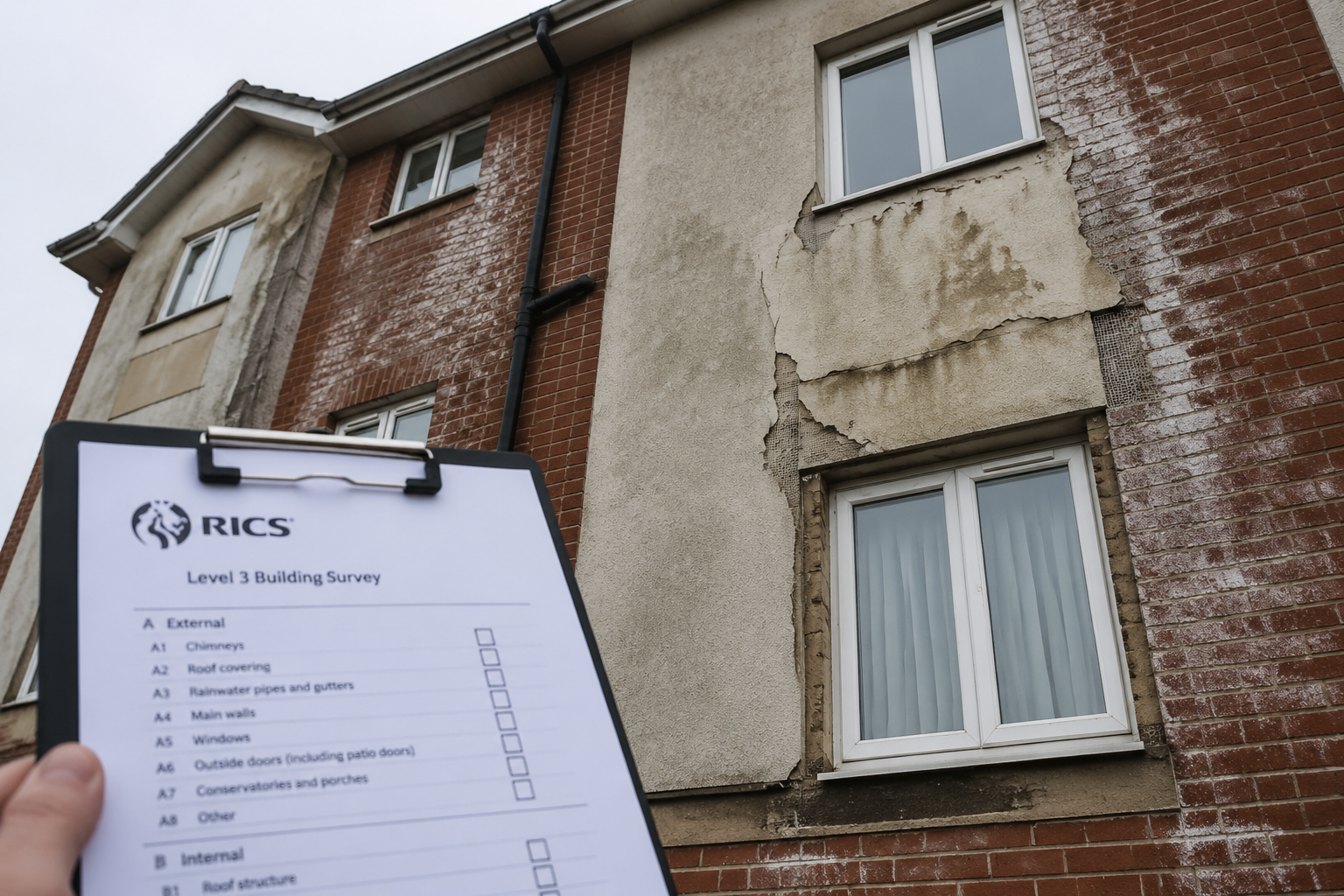
A properly scoped Level 3 Building Survey of a 1990s–2000s property should work through a systematic checklist of era-specific vulnerabilities. The following categories represent the highest-risk areas, ranked by frequency of occurrence and potential remediation cost.
1. 🏗️ Cavity Wall Insulation (CWI) Failure
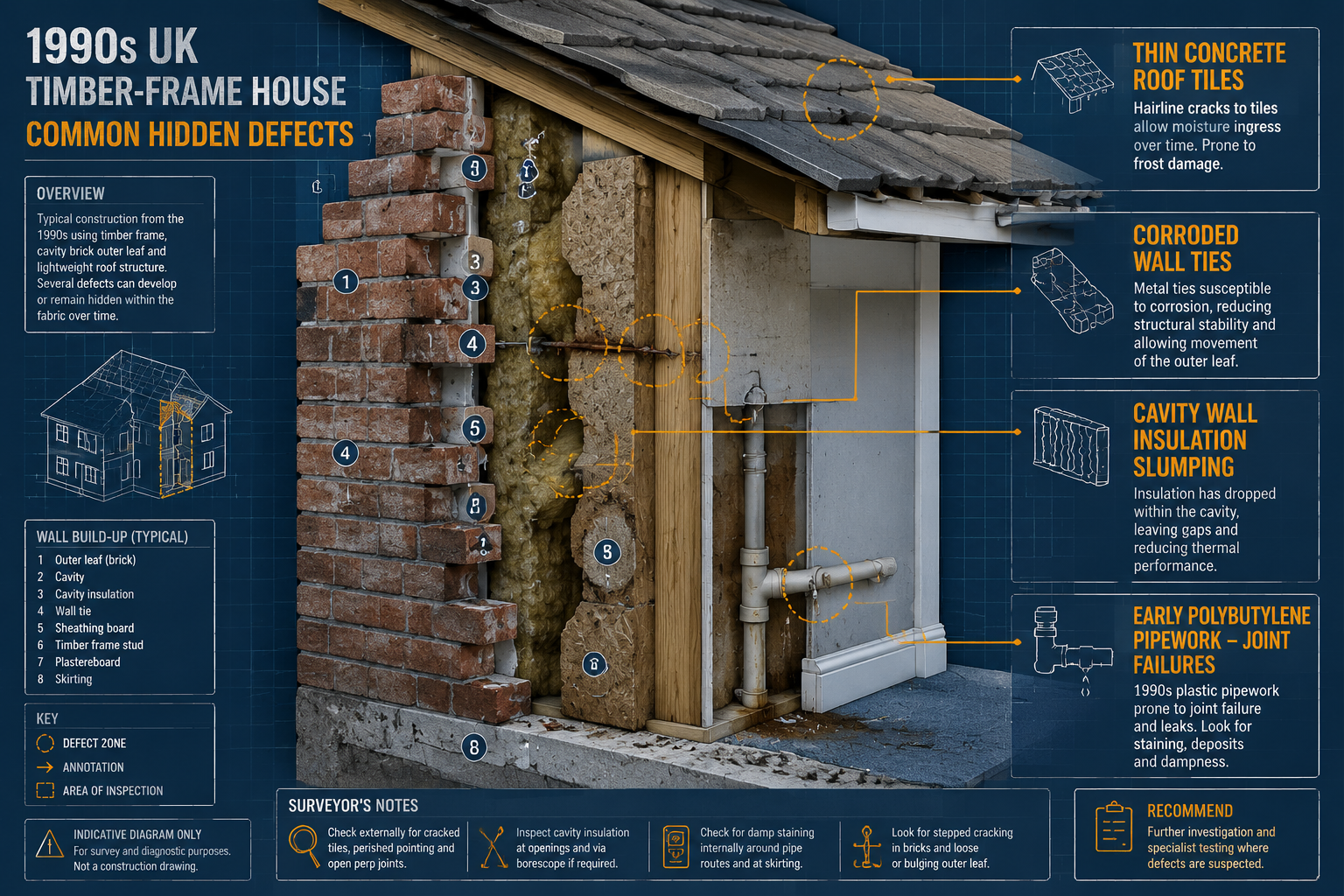
Blown fibre, polystyrene bead, and urea-formaldehyde foam insulation were installed in millions of homes during this period, often under government-backed schemes. In properties with partial exposure, high rainfall zones, or inadequate cavity trays, this insulation has migrated, slumped, or become saturated — bridging the cavity and driving persistent damp into internal walls.
What to look for:
- Horizontal damp bands at mid-wall height
- Efflorescence (white salt deposits) on external brickwork
- Cold spots on thermal imaging scans
- Evidence of retrospective CWI installation (drill holes in mortar joints)
A property damp assessment is frequently necessary as a specialist sub-report when CWI failure is suspected.
2. 🪵 Timber Frame Construction Details
Timber frame housing expanded rapidly in the 1990s, particularly in Scotland and parts of England. The details — breather membranes, sheathing boards, head binder connections — were not always executed correctly, and some early systems used sheathing materials that have since been found to trap moisture.
Key failure points:
- Missing or incorrectly lapped breather membranes
- Wet timber framing concealed behind render or cladding
- Inadequate head restraint straps
- Interstitial condensation within the panel build-up
Thermal imaging is particularly valuable here, as moisture within the frame will often show as a cold anomaly before any visible sign appears on internal finishes.
3. 🚿 Early Plastic Plumbing Systems (Polybutylene)
Polybutylene (PB) pipework was widely used in UK housing from the late 1970s through to the mid-1990s. It degrades over time when exposed to chlorinated water, becoming brittle and prone to sudden joint failure. By 2026, many of these systems are 25–35 years old — well into their failure window.
Survey actions:
- Identify pipe colour and material under sinks, in airing cupboards, and at boiler connections
- Check for evidence of previous leaks (staining, swollen flooring, replaced sections)
- Advise clients that full repipe may be required within 5–10 years
4. 🏠 Flat Roof and Warm Roof Failures
The 1990s and 2000s saw widespread use of felt-over-timber flat roof constructions on extensions, garages, and some main roof sections. Felt systems have a typical lifespan of 15–20 years — meaning virtually all original felt roofs from this era are now overdue for replacement.
| Roof Type | Typical Lifespan | Current Status (2026) |
|---|---|---|
| Mineral felt (3-layer) | 15–20 years | Expired for all 1990s builds |
| Single-ply membrane | 20–25 years | Approaching end of life |
| Mastic asphalt | 30–50 years | Still serviceable if maintained |
| GRP fibreglass | 25–30 years | Mid-life for early 2000s installs |
Survey focus: ponding water, cracked upstand flashings, failed solar reflective coating, and any evidence of internal water ingress directly below flat roof sections.
5. 🧱 Thin Concrete Interlocking Roof Tiles
Many 1990s–2000s properties used concrete interlocking tiles as a cheaper alternative to clay or slate. These tiles are now showing characteristic age-related problems: lamination (surface layers flaking), algae growth causing water retention, and cracked nibs that cause tiles to slip.
A Level 3 survey should include a close inspection of the roof covering — ideally with binoculars or drone imagery where access is limited — and should assess the condition of the underlay, which in many cases will be a non-breathable black felt now approaching brittleness.
6. 🔥 Fire Safety and Cladding Defects
This is the most serious category for multi-storey residential buildings from this era. As of February 2026, 4,310 residential buildings of 11 metres or over have been identified with unsafe cladding, and 2,553 have life-critical fire safety defects requiring urgent remediation [2]. A significant proportion of these were built during the 1990s and 2000s under the permissive self-certification regime.
For flat buyers specifically, a Level 3 survey must address:
- External wall system composition (EWS1 form status)
- Presence of ACM, HPE, or other combustible cladding
- Fire stopping within the cavity and around penetrations
- Balcony construction materials
Understanding the full structural survey versus homebuyer report distinction is critical here — a Level 2 Homebuyer Report will not provide the depth of investigation this issue demands.
7. ⚡ Electrical Installations (Pre-17th Edition Wiring)
Properties from this era may still contain wiring installed to the 16th Edition IEE Wiring Regulations (pre-2008). Common issues include:
- Absence of RCD protection on socket circuits
- Single-core aluminium wiring in some properties
- Consumer units without surge protection
- Lack of bonding to gas and water services
A Level 3 survey should recommend an EICR (Electrical Installation Condition Report) as a matter of course for any 1990s–2000s property.
8. 🪟 UPVC Window and Door Frame Degradation
UPVC frames installed in the 1990s are now 25–35 years old. While the frames themselves often survive, the sealed double-glazed units have typically failed (misting between panes), gaskets have hardened and shrunk, and multipoint locking mechanisms are increasingly unreliable.
Less obvious issue: early UPVC frames were sometimes installed without adequate cavity closers, creating cold bridges and potential moisture pathways into the wall construction.
How Level 3 Surveys Should Be Structured for This Era in 2026
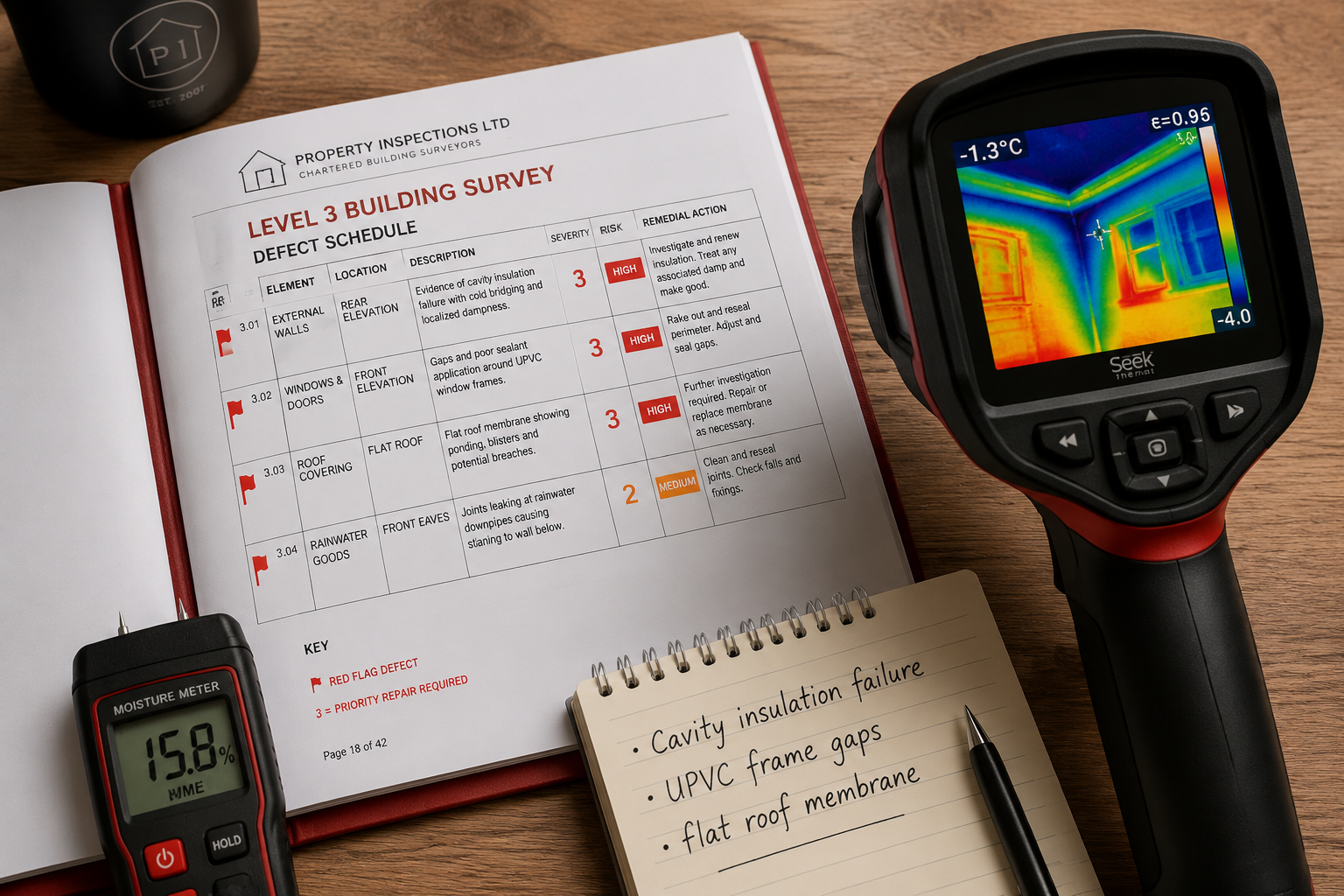
A standard Level 3 Building Survey checklist, applied without era-specific knowledge, will miss many of the defects described above. In 2026, best practice for latent defects in 1990s–2000s UK housing requires surveyors to adapt their methodology in several key ways.
Use Technology as Standard, Not Optional
Thermal imaging cameras and calibrated moisture meters should be considered standard equipment for any Level 3 survey of a 1990s–2000s property — not optional extras. Thermal imaging can reveal:
- CWI voids and saturation
- Timber frame moisture pockets
- Flat roof delamination
- Cold bridges around UPVC frames
Recommend Specialist Sub-Reports Proactively
A good Level 3 report will not only describe what was found — it will clearly identify where specialist investigation is required. Common sub-reports for this era include:
- Drainage CCTV survey (early plastic drainage systems are prone to root ingress and joint failure)
- Structural engineer's report (for any signs of movement or subsidence — see the guide to subsidence and why it matters)
- Asbestos survey (asbestos-containing materials were still present in some construction products into the early 2000s, including textured coatings, floor tiles, and roof sheets) [5]
- EWS1 assessment (for flats and apartments)
Communicate Defects Clearly to Clients
One of the most common complaints about building surveys is that technical language obscures the practical implications of defects. In 2026, RICS guidance increasingly emphasises plain-English reporting. A Level 3 report on a 1990s–2000s property should clearly state:
- The likely cause of each defect
- The probable remediation cost range
- The urgency (immediate safety risk, short-term repair, or monitor)
- The impact on insurability or mortgage eligibility
Buyers who receive a report with significant findings should understand their options — including the right to renegotiate after a poor building survey result.
Don't Overlook the Legal and Boundary Dimension
1990s–2000s housing estates were often built rapidly, and boundary demarcations, shared drainage, and party wall positions were not always accurately recorded. A Level 3 survey should flag any ambiguity in these areas, particularly where extensions or outbuildings sit close to the assumed boundary line.
For properties in London and the South East, professional surveyor services with specific knowledge of local estate layouts and planning history add significant value.
Choosing the Right Survey for a 1990s–2000s Property
Not all surveys are equal, and the choice matters enormously for this era of housing. The table below summarises the key differences:
| Survey Level | Depth of Inspection | Era-Specific Defect Coverage | Recommended For |
|---|---|---|---|
| Level 1 (Condition Report) | Surface only | ❌ Inadequate | Low-risk new builds only |
| Level 2 (Homebuyer Report) | Standard visual | ⚠️ Partial | Lower-risk 1990s–2000s properties |
| Level 3 (Building Survey) | Comprehensive + specialist | ✅ Essential | All 1990s–2000s properties with any complexity |
For anyone buying a 1990s–2000s property — particularly one with extensions, flat sections, timber frame construction, or any multi-storey element — a Level 3 survey is not a luxury. It is the minimum appropriate standard. The RICS surveys overview provides a clear breakdown of what each level covers.
Buyers who have already had an offer accepted should ensure the survey is commissioned promptly — defects of the type described in this article can affect both mortgage valuations and insurance terms. The next steps after a property offer is accepted guide covers the full sequence of actions required at this stage.
The Bigger Picture: A Housing Stock in Transition
The scale of the challenge is significant. Research published in 2026 highlights that 8.5 million people in the UK have unmet housing needs, with poor quality housing a major contributing factor [3]. The 1990s–2000s housing stock — now entering its third decade — represents a substantial proportion of the UK's owner-occupied and private rented sector.
As these properties age, the latent defects built in during a period of inadequate oversight are becoming patent defects: visible, costly, and increasingly affecting property values and insurability. The buildings that escape scrutiny today will generate the housing disrepair claims, mortgage refusals, and safety incidents of tomorrow.
For buyers, the message is clear: a Level 3 Building Survey is not a bureaucratic formality — it is the primary tool for identifying latent defects in 1990s–2000s UK housing before they become the buyer's problem.
Conclusion: Actionable Next Steps for Buyers and Surveyors in 2026
The convergence of ageing building fabric, a complex regulatory legacy, and rising remediation costs makes latent defects in 1990s–2000s UK housing one of the defining property challenges of 2026. Level 3 Building Surveys have a critical role to play — but only when they are scoped, executed, and reported to a standard that matches the era-specific risks involved.
For buyers:
- ✅ Commission a Level 3 Building Survey — not a Level 2 — for any 1990s–2000s property.
- ✅ Ask the surveyor explicitly about era-specific risks: CWI, plastic plumbing, flat roofs, and fire safety.
- ✅ Budget for specialist sub-reports (drainage, structural, asbestos, EWS1) as part of the due diligence cost.
- ✅ Use survey findings to renegotiate the purchase price or request remediation before exchange.
- ✅ Do not rely on the NHBC warranty — for most 1990s–2000s properties, it has long since expired.
For surveyors:
- ✅ Adopt thermal imaging and moisture mapping as standard practice for this era.
- ✅ Build era-specific defect checklists into your Level 3 methodology.
- ✅ Write reports in plain English with clear cost implications and urgency ratings.
- ✅ Proactively recommend specialist sub-reports rather than leaving clients to discover the need later.
The homes built in the 1990s and 2000s were sold as modern, safe, and low-maintenance. In 2026, the evidence tells a more complicated story — and a thorough Level 3 Building Survey is the most powerful tool available to uncover it.
References
[1] Whats The Major Pushback On New Build Properties – https://www.reddit.com/r/HousingUK/comments/1hu795t/whats_the_major_pushback_on_new_build_properties/
[2] Building Safety Remediation Monthly Data Release February 2026 – https://www.gov.uk/government/publications/building-safety-remediation-monthly-data-release-february-2026/building-safety-remediation-monthly-data-release-february-2026
[3] 19491247.2026 – https://www.tandfonline.com/doi/full/10.1080/19491247.2026.2630075
[4] Housing Defects By Decade – https://brianmedia.co.uk/housing-defects-by-decade/
[5] Dwvhzunjzta – https://www.instagram.com/p/DWvhzUnjZta/









