

The abolition of Section 21 "no-fault" evictions on 1 May 2026 did not just reshape landlord-tenant relationships — it fundamentally changed the evidentiary battleground on which Private Rented Sector (PRS) disputes are now fought. With tribunals and courts demanding harder, more structured proof than ever before, the quality of an expert witness valuation report can determine whether a landlord recovers possession, whether a tenant wins a rent repayment order, or whether a disputed rent review stands or falls.
Expert Witness Valuations in PRS Disputes: Building Evidence Under Renters' Rights Act 2026 sits at the intersection of property surveying, legal procedure, and market analysis. This article equips valuers, solicitors, and landlords with a clear framework for preparing robust, CPR-compliant expert witness reports that will withstand scrutiny in rent review disputes, possession hearings, and landlord-tenant conflicts under the new legislative regime. [1][6]
Key Takeaways 📌
- The Renters' Rights Act 2026 (in force from May 2026) creates new dispute categories that depend heavily on independent expert valuation evidence.
- Expert witness reports in PRS disputes must comply with Civil Procedure Rules (CPR) Part 35 and the associated Practice Direction.
- Quantum assessment methodology — the structured calculation of financial loss or rent value — must be transparent, repeatable, and grounded in comparable market evidence.
- A mandatory PRS database and Landlord Ombudsman (both expected late 2026) will generate new documentary evidence streams that expert witnesses must know how to use. [8]
- RICS-accredited surveyors remain the gold standard for expert witness credibility in UK property tribunals.

The New Dispute Landscape Under the Renters' Rights Act 2026
What Changed on 1 May 2026?
The primary provisions of the Renters' Rights Act came into force on 1 May 2026, ending assured shorthold tenancies and replacing them with a single system of periodic tenancies. [8] The practical consequences for dispute resolution are significant:
- Section 21 abolished: Landlords must now rely on specified grounds under Schedule 2 of the Housing Act 1988 (as amended) to recover possession.
- Rent increase restrictions: Landlords can only raise rent once per year and must use a prescribed notice. Tenants can challenge increases at the First-tier Tribunal (Property Chamber).
- Awaab's Law extended to PRS: Landlords face strict timelines for repairing hazards, with non-compliance creating financial liability.
- Decent Homes Standard: Enhanced property standards are planned for rollout between 2035 and 2037, but interim compliance expectations are already influencing tribunal decisions. [8]
💬 "The shift from a no-fault possession regime to a grounds-based system means every disputed possession case now requires evidence. That evidence increasingly comes from expert witnesses."
New Dispute Categories Requiring Valuation Evidence
| Dispute Type | Valuation Evidence Required | Typical Forum |
|---|---|---|
| Rent increase challenge | Market rent comparables | First-tier Tribunal |
| Rent Repayment Order (RRO) | Quantum of rent paid vs. habitable value | First-tier Tribunal |
| Possession on Ground 1 (landlord occupation) | Market value, alternative accommodation costs | County Court |
| Dilapidations at end of tenancy | Schedule of condition, reinstatement costs | County Court / Arbitration |
| Unlawful eviction damages | Loss of accommodation value, distress | County Court |
Each of these dispute types demands a different flavour of expert evidence — but all share a common requirement: CPR Part 35 compliance.
Building CPR-Compliant Expert Witness Reports for PRS Disputes
Understanding the Expert Witness Duty
Under CPR Part 35, an expert witness owes their primary duty to the court, not to the party instructing them. This is non-negotiable. A valuation report that reads as an advocate's document — rather than an independent professional opinion — will be challenged, discounted, or excluded entirely.
Key CPR Part 35 requirements include:
- ✅ A statement that the expert understands their duty to the court
- ✅ Confirmation that the report is complete and accurate to the best of the expert's knowledge
- ✅ Disclosure of any facts or matters that might affect the opinion
- ✅ A clear statement of the expert's qualifications and experience
- ✅ Identification of the instructions received
For PRS disputes specifically, RICS-accredited surveyors carry significant credibility. Understanding why RICS surveyors are the preferred choice for tribunal proceedings helps both solicitors and landlords select the right expert from the outset.
Structuring the Report: A Practical Framework
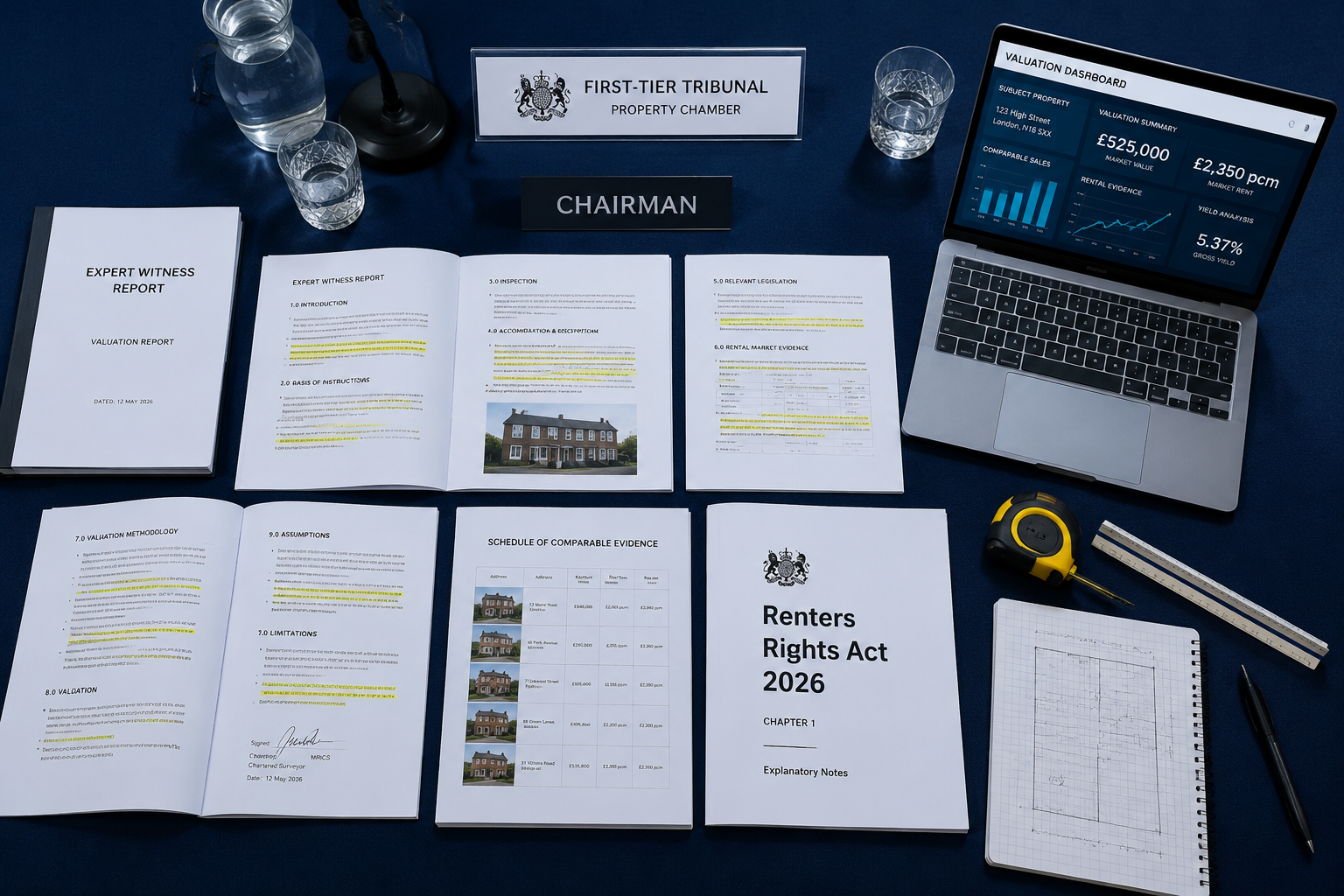
A well-structured expert witness valuation report for a PRS dispute should follow this hierarchy:
1. Executive Summary
A concise statement of the expert's opinion, the basis for it, and the key figure (rent, damages quantum, reinstatement cost).
2. Instructions and Scope
Verbatim or paraphrased instructions, clearly distinguishing what the expert was and was not asked to consider.
3. Property Description and Condition
A factual account of the property's physical state at the relevant date. For disputes involving habitability or disrepair, a building condition assessment provides the evidential backbone here.
4. Market Analysis
Comparable rental evidence, transaction data, and market commentary relevant to the dispute date.
5. Methodology
A transparent explanation of the valuation approach used (see quantum methodology below).
6. Opinion and Quantum
The expert's concluded opinion, expressed as a specific figure or range, with sensitivity analysis where appropriate.
7. Statement of Truth
The mandatory CPR Part 35 declaration.
Using the PRS Database as Evidence
The mandatory PRS digital database — expected to launch in late 2026 — will require landlords to register themselves and their properties. [8] Failure to register may result in fines, marketing restrictions, and difficulties obtaining possession orders. [8]
For expert witnesses, this database will become a powerful evidential tool:
- Registration status can confirm whether a landlord was compliant at the time of a dispute
- Property records may reveal historical rent levels, tenancy durations, and compliance history
- Cross-referencing with the database can expose discrepancies in a landlord's or tenant's account
Experts should flag in their reports whether database records were consulted and what they revealed.
Quantum Assessment Methodologies for PRS Rent Review Disputes
Expert Witness Valuations in PRS Disputes: Building Evidence Under Renters' Rights Act 2026 — The Methodological Core
Quantum — the financial value of a claim — is often the most contested element in PRS disputes. Whether the question is "what is the open market rent?" or "how much did the tenant lose because of an uninhabitable property?", the methodology must be transparent, repeatable, and grounded in evidence.
The Three Primary Methodologies
1. Comparable Market Rent Analysis
This is the most common approach for rent review challenges at the First-tier Tribunal. The expert:
- Identifies genuinely comparable lettings (same area, similar size, specification, and condition)
- Adjusts for material differences (floor level, condition, amenities, lease terms)
- Weights comparables by recency and similarity
- Arrives at a concluded market rent
⚠️ Critical point: Comparables must be from the open market and reflect arm's-length transactions. Managed portfolio rents, related-party lettings, or distressed transactions should be excluded or heavily caveated.
For properties in specific London markets, local expertise matters enormously. Surveyors familiar with areas such as Kensington or Chelsea will have access to hyper-local comparable evidence that generalist valuers may lack.
2. Diminution in Value / Habitability Discount
Used in Rent Repayment Order applications and disrepair claims, this methodology quantifies the reduction in rental value caused by a defect or hazard. The steps are:
- Establish the full open market rent (using comparable analysis)
- Assess the nature and severity of the defect (damp, structural failure, fire safety breach)
- Apply a percentage discount to reflect the impact on habitability
- Calculate the financial quantum over the relevant period
For damp-related disputes — increasingly common under Awaab's Law — a specialist damp survey provides the technical foundation for the habitability discount. The expert witness then translates that technical finding into a financial figure.
3. Reinstatement and Dilapidations Costing
At the end of a tenancy, disputes over the condition of the property require a schedule of dilapidations and a costed schedule of works. The expert must:
- Inspect the property at the relevant date (or as close to it as possible)
- Prepare a dilapidations report identifying breaches of the tenant's repairing obligations
- Cost each item of reinstatement at current market rates
- Apply the diminution cap — the landlord can only recover the lesser of reinstatement cost or diminution in the property's value
Sensitivity Analysis and Ranges
Tribunals and courts increasingly expect expert witnesses to present sensitivity analysis — showing how the quantum changes if key assumptions are varied. For example:
| Assumption | Base Case | Low Case | High Case |
|---|---|---|---|
| Market rent (pcm) | £2,100 | £1,950 | £2,250 |
| Habitability discount | 25% | 15% | 35% |
| RRO quantum (12 months) | £6,300 | £3,510 | £9,450 |
This approach demonstrates intellectual honesty and significantly strengthens the report's credibility with the tribunal.
Preparing for the Landlord Ombudsman and New Dispute Forums
Expert Witness Valuations in PRS Disputes: Building Evidence Under Renters' Rights Act 2026 — The Ombudsman Dimension
The Landlord Ombudsman — a new dispute resolution mechanism — is scheduled for implementation in late 2026. [8] Unlike court proceedings, ombudsman schemes typically operate on a documents-only basis, making the quality of written evidence even more critical.
Key differences from tribunal proceedings:
- No oral evidence: The expert's written report must stand entirely on its own
- Lower formality: But CPR-style rigour is still expected for credibility
- Faster timelines: Reports may need to be prepared and submitted more quickly
- Broader remedies: The Ombudsman can award compensation, require apologies, and mandate remedial action
Expert witnesses preparing reports for Ombudsman referrals should ensure their reports are self-contained — explaining technical concepts in plain language without assuming the reader has legal or surveying expertise. Understanding which type of survey is right for the specific dispute context is a practical starting point for scoping the instruction correctly.
Documentary Evidence Checklist for PRS Disputes
Before finalising any expert witness report, the following documentary evidence should be assembled and referenced:
- 📋 Tenancy agreement (original and any variations)
- 📋 Inventory and schedule of condition at commencement
- 📋 Rent payment records
- 📋 Correspondence regarding repairs, rent increases, or complaints
- 📋 Section 13 notices (rent increase notices)
- 📋 PRS database registration records (from late 2026)
- 📋 Energy Performance Certificate
- 📋 Gas safety and electrical certificates
- 📋 Photographs with metadata (date and time stamps)
- 📋 Comparable lettings evidence (Rightmove, Zoopla, Land Registry data)
The strength of an expert witness report is only as good as the underlying evidence. Gaps in documentation will be exploited by the opposing party.
Working with Legal Teams
Expert witnesses do not operate in isolation. Effective collaboration with the instructing solicitor is essential, but the expert must maintain independence. Practical guidance:
- Agree the scope of instructions in writing before commencing the report
- Flag conflicts of interest immediately — prior involvement with the property, landlord, or tenant must be disclosed
- Do not accept instructions that require the expert to reach a predetermined conclusion
- Attend joint expert meetings where directed by the tribunal — these often narrow the issues significantly
- Be prepared to revise the report if new evidence emerges, but only on a principled basis
For disputes involving property boundary or structural issues, the expert witness may need to collaborate with additional specialists — structural engineers, boundary surveyors, or planning consultants — to produce a complete evidential picture.
Practical Steps for Landlords and Tenants in 2026
The Renters' Rights Act 2026 has shifted the balance of power in PRS disputes, but both landlords and tenants benefit from early, high-quality expert evidence. Here is a practical action plan:
For Landlords:
- Register on the PRS database as soon as it launches (expected late 2026) [8]
- Commission a building condition assessment at the start of each tenancy
- Instruct a RICS-accredited surveyor immediately when a dispute arises
- Preserve all documentary evidence — correspondence, receipts, inspection records
- Engage a solicitor experienced in PRS matters before the First-tier Tribunal deadline
For Tenants:
- Document all repair requests in writing with dates
- Photograph defects with timestamped images
- Seek independent valuation evidence if challenging a rent increase
- Apply for a Rent Repayment Order promptly — there are strict time limits
- Use the Landlord Ombudsman (from late 2026) for lower-value disputes before escalating to tribunal
Conclusion: Evidence Wins Disputes
The Renters' Rights Act 2026 has made the PRS a more regulated, more contested, and more evidence-driven environment. Expert Witness Valuations in PRS Disputes: Building Evidence Under Renters' Rights Act 2026 is not merely a technical exercise — it is the difference between a claim that succeeds and one that fails at the first evidential hurdle.
Valuers and surveyors operating in this space must invest in understanding the new legislative framework, master CPR Part 35 compliance, and develop robust quantum methodologies that can withstand cross-examination. The forthcoming PRS database and Landlord Ombudsman will add new evidential layers that forward-thinking experts should already be preparing for.
Actionable next steps:
- ✅ Review CPR Part 35 and the RICS Expert Witness Practice Statement
- ✅ Build a library of local comparable rental evidence for your practice area
- ✅ Commission condition surveys at the start of every tenancy to create a defensible baseline
- ✅ Register for the PRS database when it launches and advise landlord clients to do the same
- ✅ Engage a RICS-accredited surveyor early — before disputes escalate to formal proceedings
The landlords and tenants who invest in quality expert evidence from the outset will navigate the new PRS landscape with far greater confidence than those who wait until a hearing date is looming.
References
[1] The Renters Rights Act 2025 Through A Lending Lens – https://www.taylorwessing.com/en/insights-and-events/insights/2026/03/lf/the-renters-rights-act-2025-through-a-lending-lens
[2] Navigating The Renters Rights Act 2025 Key Changes And Practical Implications – https://www.bclplaw.com/en-US/events-insights-news/navigating-the-renters-rights-act-2025-key-changes-and-practical-implications.html
[4] Reforming The PRS Letting Agent Views Of The Renters Reform Bill – https://www.propertymark.co.uk/resource/reforming-the-prs-letting-agent-views-of-the-renters-reform-bill.html
[5] Ensuring The Renters Rights Act Raises Standards TDS Charitable Foundation Evidence To The HCLG Co – https://www.tdsgroup.uk/post/ensuring-the-renters-rights-act-raises-standards-tds-charitable-foundation-evidence-to-the-hclg-co
[6] Implementing The Renters Rights Act 2025 Our Roadmap For Reforming The Private Rented Sector – https://www.gov.uk/government/publications/renters-rights-act-2025-implementation-roadmap/implementing-the-renters-rights-act-2025-our-roadmap-for-reforming-the-private-rented-sector
[8] Renters Rights Act FAQs For Insolvency Practitioners And Receivers – https://www.jmw.co.uk/blog/commercial-litigation-dispute-resolution/renters-rights-act-faqs-for-insolvency-practitioners-and-receivers
[9] Renters Rights Act 2025 Guide Private Landlords England – https://www.pinsentmasons.com/out-law/guides/renters-rights-act-2025-guide-private-landlords-england









