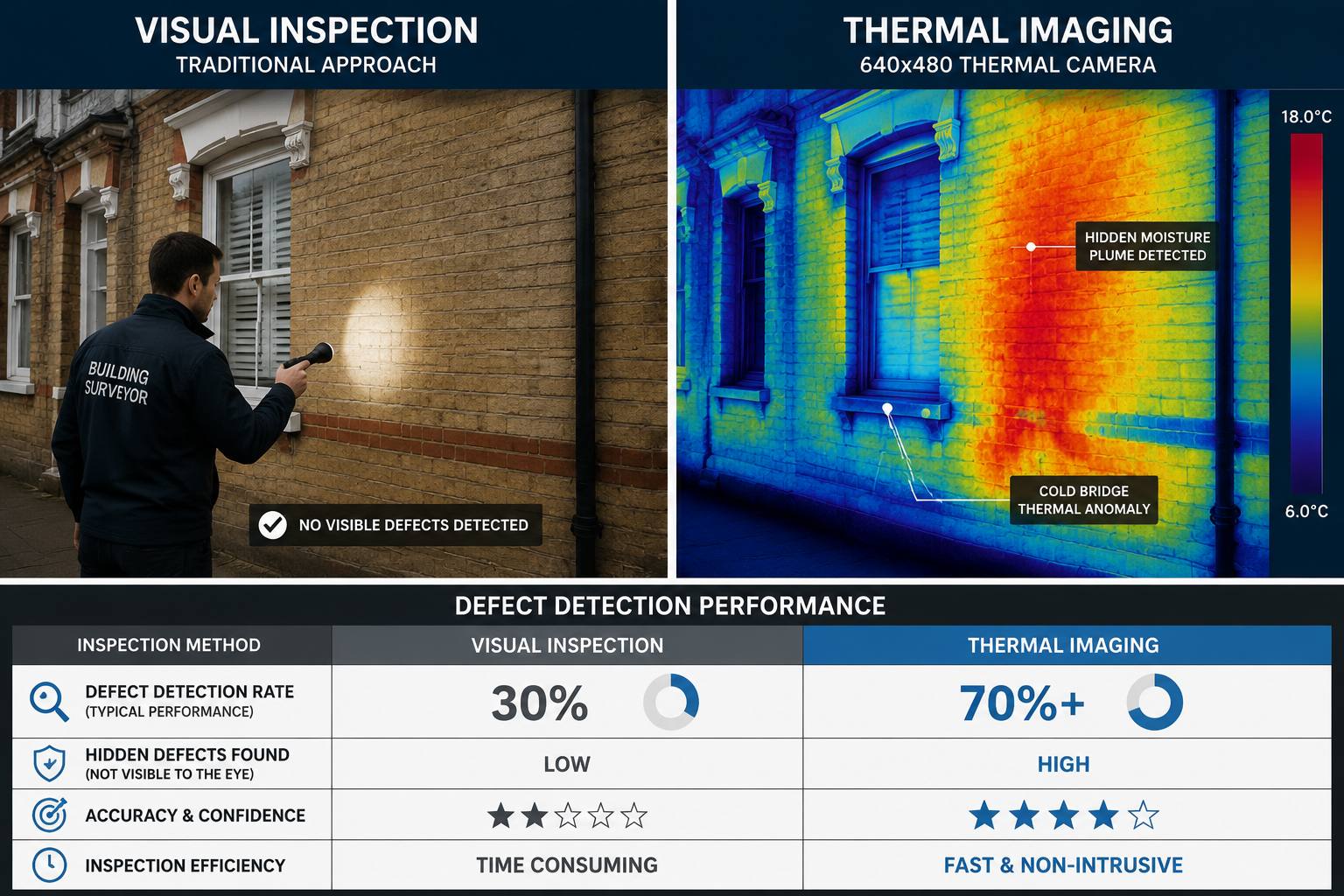
Over 70% of hidden building defects go completely undetected by traditional visual inspection alone — and many of those defects are silently escalating into costly structural failures right now [1]. That single statistic has transformed how professional surveyors approach their work in 2026. Building Survey Defect Detection: Thermal Imaging and Advanced Diagnostics for Hidden Structural Issues is no longer a niche specialty; it is the new standard of care for anyone buying, selling, or maintaining a property.
Modern thermal imaging technology, combined with digital moisture sensors and precision measurement tools, gives surveyors a powerful window into what lies beneath the surface of walls, roofs, and floors. The result is faster, more accurate, and more defensible survey reports — and buyers and owners who are far better protected from expensive surprises.
Key Takeaways 🔑
- Thermal imaging detects up to 70% more hidden defects than traditional visual inspection methods [1]
- Five critical defect categories — missing insulation, air leaks, cold bridging, hidden damp, and underfloor heating faults — are routinely identified through thermal diagnostics [1]
- Professional thermographers must meet PCN Category 3 certification standards for credible building survey work [6]
- Non-destructive thermal scanning allows large building areas to be assessed quickly without causing damage [2]
- Advanced diagnostics, including drone-based thermal surveys, are now revealing defects that even experienced surveyors miss on foot [4]
Why Traditional Visual Inspection Is No Longer Enough
For decades, building surveys relied almost entirely on what a surveyor could see, touch, and measure with basic tools. A trained eye could spot cracked render, sagging ceilings, and rising damp staining — but only what was already visible. The real danger always lurked behind plasterboard, inside cavity walls, and beneath concrete slabs.
"The most expensive defects are the ones you cannot see until it is too late."
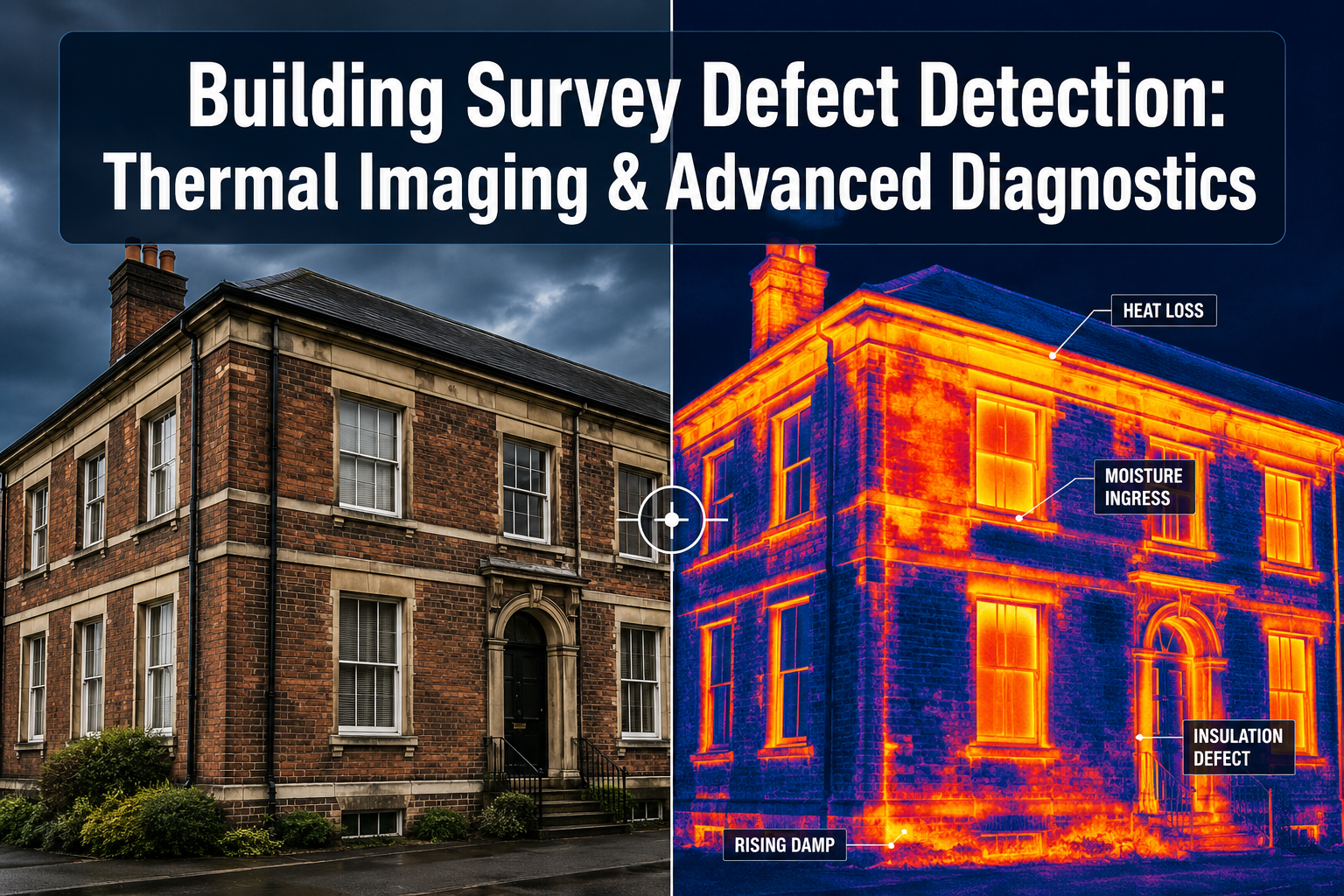
This is precisely why Building Survey Defect Detection: Thermal Imaging and Advanced Diagnostics for Hidden Structural Issues has become the cornerstone of professional practice. Infrared thermography works by detecting differences in surface temperature. Where insulation is missing, where moisture has infiltrated, or where cold air is bypassing the building envelope, the thermal camera reveals a vivid colour map of anomalies that are completely invisible to the naked eye [3].
The Limitations of Visual-Only Surveys
| Inspection Method | Defects Detected | Invasive? | Time Required |
|---|---|---|---|
| Traditional visual inspection | ~30% of hidden defects | Sometimes | Moderate |
| Thermal imaging survey | Up to 70% more defects | No | Faster |
| Combined thermal + moisture sensors | Highest detection rate | No | Moderate |
A homebuyers survey or full structural survey using only visual methods may satisfy minimum professional standards — but it leaves a significant gap in defect coverage. For older properties, complex structures, or high-value transactions, that gap represents real financial risk.
What Thermal Imaging Actually Reveals
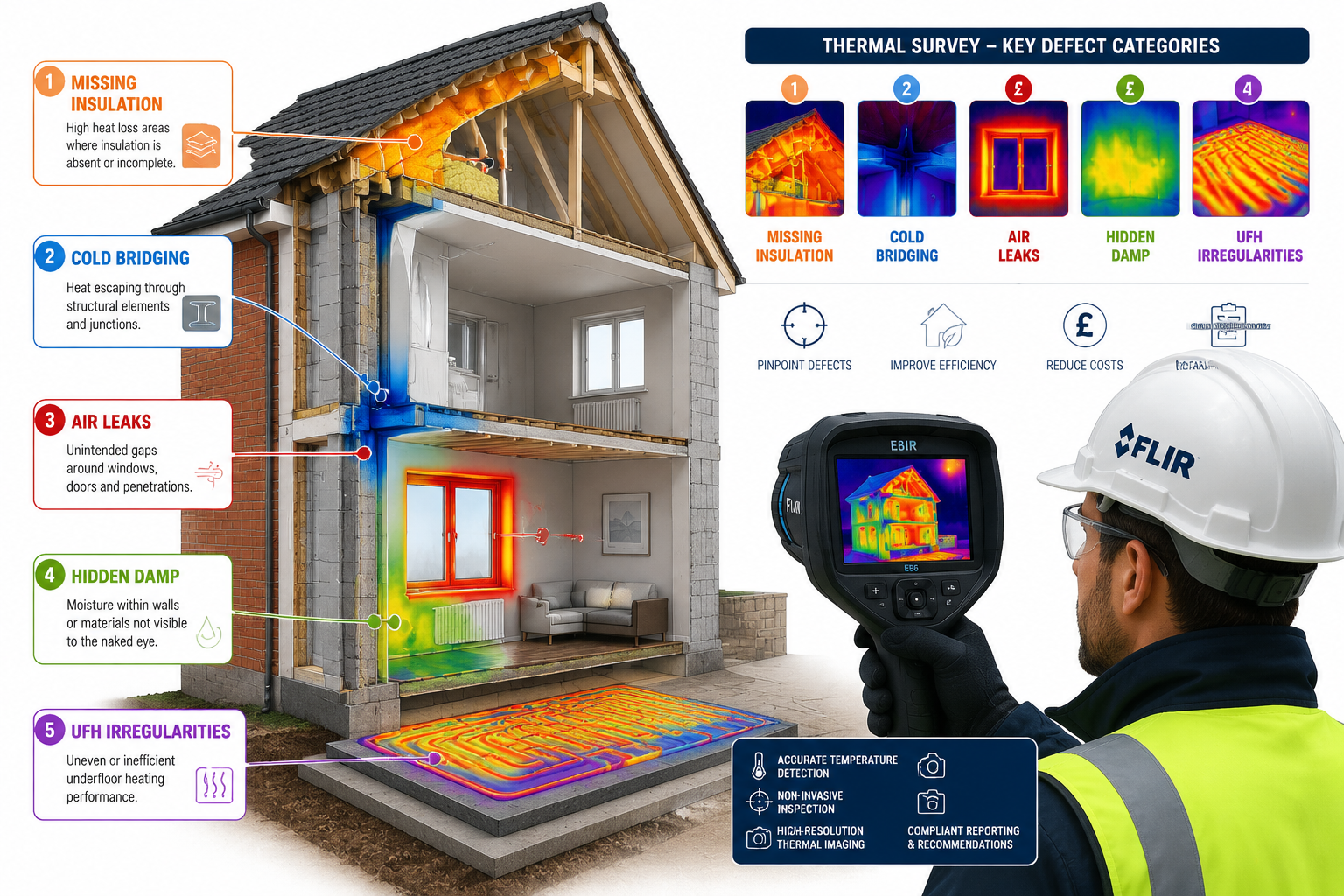
Thermal diagnostics consistently identifies five key defect categories [1]:
- 🧱 Missing or compressed insulation — visible as cold zones in walls and roofs
- 🌬️ Air leaks around windows and doors — shown as temperature differentials at frames and seals
- ❄️ Cold bridging at structural junctions — where steel lintels or concrete elements bypass insulation
- 💧 Hidden damp and water ingress — moisture appears as distinctive cool patches on thermal images
- 🔥 Uneven underfloor heating performance — pipe blockages and system failures mapped in real time
Understanding diagnosis of damp and timber issues is particularly critical in older UK housing stock, where moisture-related defects are among the most common — and most damaging — problems surveyors encounter.
How Advanced Thermal Diagnostics Work in Practice
Camera Specifications and Professional Standards
Not all thermal cameras are equal. The UK Thermography Association (UKTA) sets minimum specification standards for building inspection work. For standard residential surveys, cameras must achieve at least 320 × 240 pixel detector resolution. For larger commercial buildings, a 640 × 480 or 1024 × 786 pixel camera with thermal sensitivity of 40 mK or better is recommended for the image detail required to identify subtle anomalies [2].
These specifications matter enormously. A low-resolution thermal image may show a temperature difference but fail to pinpoint its exact location or extent — leading to misdiagnosis or missed defects entirely.
Professional thermographers conducting Building Survey Defect Detection: Thermal Imaging and Advanced Diagnostics for Hidden Structural Issues are expected to hold PCN (Professional Certification Network) Category 3 credentials [6]. This certification confirms that the operator understands not just how to use the camera, but how to interpret what they see in the context of building physics, construction methods, and failure mechanisms.
Non-Destructive Assessment: A Game Changer 🚀
One of the most significant advantages of building thermography is that it is entirely non-destructive and non-contact [2]. A surveyor can scan an entire building envelope — walls, roof, floor slab, window reveals — without drilling, cutting, or disturbing any finishes. This is particularly valuable in:
- Historic and listed buildings where physical investigation could cause damage
- Occupied properties where minimal disruption is essential
- Pre-purchase surveys where the owner has not consented to invasive testing
- New build snagging where defects must be documented before handover
For anyone considering a Level 2 or Level 3 building survey, asking specifically whether thermal imaging is included is a straightforward way to assess the quality of the service on offer.
Drone-Based Thermal Surveys: The Next Frontier
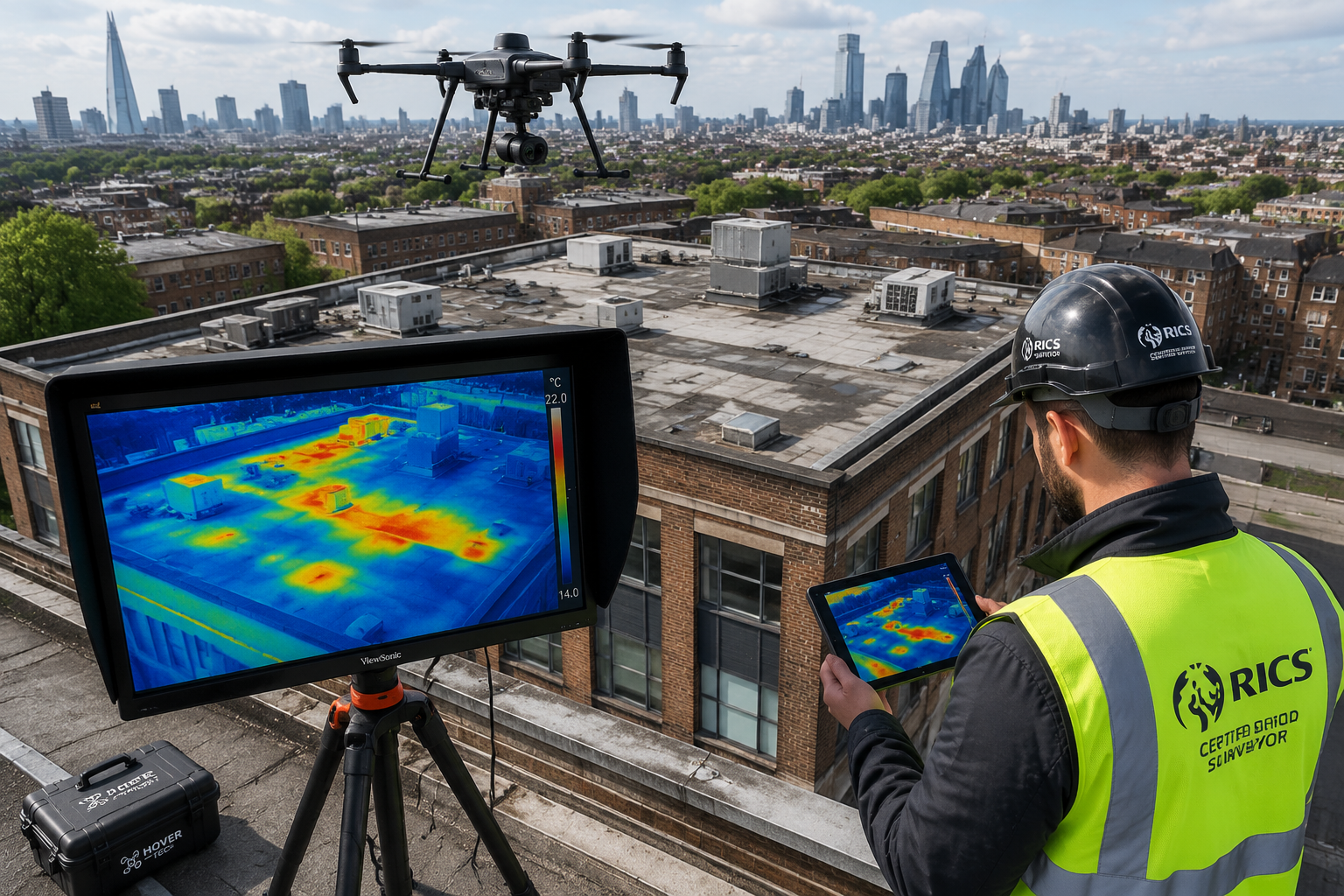
Drone-mounted thermal cameras have added a powerful new dimension to defect detection. Rooftop inspections that once required scaffolding or cherry pickers can now be completed safely from ground level, with the drone capturing high-resolution thermal data across the entire roof plane in minutes [4].
Drone surveys are particularly effective for identifying:
- Flat roof membrane failures and ponding water beneath waterproofing layers
- Insulation voids in inaccessible roof spaces
- Facade moisture intrusion on multi-storey buildings
- Photovoltaic panel performance issues on solar installations
This technology is increasingly being deployed by London building inspections teams working on commercial and mixed-use properties where access is restricted.
Time-Lapse Thermography: Monitoring Over Time
Standard thermal surveys capture a single snapshot in time. Time-lapse thermography goes further, recording thermal data at intervals over hours or days to track how defects behave as temperatures change [5]. This technique is particularly useful for:
- Identifying intermittent moisture ingress that only appears after rainfall
- Mapping thermal bridging that becomes more pronounced in cold weather
- Monitoring active structural movement that affects building envelope performance
Integrating Thermal Imaging Into a Comprehensive Building Survey
Combining Technologies for Maximum Accuracy
Thermal imaging is most powerful when combined with complementary diagnostic tools. A comprehensive building survey defect detection approach in 2026 typically integrates:
- 📡 Digital moisture meters — confirm damp readings suggested by thermal anomalies
- 🔊 Acoustic emission testing — detects micro-cracking and structural stress
- 🧪 Borescope cameras — visual inspection of cavities and voids without opening walls
- 📐 Precision levelling instruments — quantify floor and wall deformation
The combination of thermal imaging with digital moisture sensors provides the highest defect detection rates currently achievable in non-destructive building assessment [1]. When a thermal image suggests moisture in a wall cavity, a moisture meter reading at the same location either confirms or rules out active damp — giving the surveyor a defensible, evidence-based conclusion.
Practical Conditions for Reliable Thermal Surveys
Thermal imaging is not effective in all conditions. For accurate results, surveyors require:
- A minimum 10°C temperature differential between inside and outside the building
- Stable conditions for at least two hours before the survey
- No direct sunlight on the surfaces being scanned (which creates false thermal readings)
- Heating systems running normally to create the thermal gradient needed
These requirements mean that thermal building surveys are most effective in autumn and winter in the UK — a fact worth considering when timing a pre-purchase survey. A full structural inspection conducted in midsummer may miss thermal defects that would be clearly visible in cooler conditions.
What Happens When Defects Are Found?
Discovering hidden defects through thermal imaging does not automatically derail a property transaction. In many cases, it creates a significant opportunity. Understanding the average price reduction after a survey is important — documented thermal evidence of defects gives buyers a concrete basis for renegotiation that a vague visual report simply cannot provide.
Equally, sellers and their agents benefit from commissioning pre-sale thermal surveys. Identifying and rectifying defects before listing avoids the disruption of failed transactions and last-minute price reductions. It also demonstrates transparency that builds buyer confidence.
For buyers who have already received a concerning report, it is worth knowing that renegotiating after a poor building survey result is a well-established and legitimate part of the conveyancing process — particularly when thermal imaging has produced clear, quantified evidence of the problem.
Choosing the Right Surveyor for Advanced Diagnostic Work
Qualifications to Look For ✅
Not every surveyor offering thermal imaging has the expertise to interpret what the camera reveals. When selecting a professional for advanced diagnostic building surveys, look for:
| Qualification | What It Means |
|---|---|
| RICS Chartered Surveyor | Regulated professional standards and accountability |
| PCN Category 3 Thermographer | Specialist thermal imaging competence [6] |
| UKTA Member | Adherence to UK thermography guidelines [2] |
| Experience with building type | Historic, new build, and commercial require different expertise |
A RICS surveyor brings not only technical skill but also professional indemnity insurance and regulatory oversight — critical protections when survey findings influence significant financial decisions.
Questions to Ask Before Commissioning a Survey
Before booking, ask the surveyor directly:
- What camera specification do they use, and does it meet UKTA minimum standards?
- Are they PCN Category 3 certified for thermography?
- Will thermal imaging be integrated into the main survey report or provided as a separate document?
- What conditions will the survey be conducted in, and how will they ensure thermal accuracy?
- Can they provide sample thermal reports from previous surveys?
For properties in specific London areas, specialist local knowledge adds further value. Surveyors covering Knightsbridge and Ealing bring familiarity with the construction methods, materials, and common defect patterns specific to those areas.
The Cost-Benefit Case for Advanced Diagnostics
The additional cost of a thermal imaging survey — typically a few hundred pounds on top of a standard survey fee — is almost always justified by the financial exposure it protects against. A single missed damp defect behind a wall can cost thousands of pounds to remediate once plasterwork, insulation, and structural timbers are affected.
For anyone considering a damp survey as a standalone investigation, thermal imaging provides a far more comprehensive picture of moisture distribution throughout the building — often identifying multiple problem areas that a point-measurement damp survey would miss entirely.
Conclusion: Act Before the Defect Acts First
Building Survey Defect Detection: Thermal Imaging and Advanced Diagnostics for Hidden Structural Issues represents one of the most significant advances in property assessment of the past decade. The technology is proven, the professional standards are established, and the financial case for using it is overwhelming.
The key message for property buyers, owners, and investors in 2026 is straightforward: do not accept a survey that only shows you what is already visible. Hidden defects are, by definition, the ones that cause the most damage — because they are the ones that go unaddressed the longest.
Actionable Next Steps 🎯
- Always ask whether thermal imaging is included when commissioning a building survey
- Time surveys carefully — autumn and winter conditions produce the most reliable thermal data in the UK
- Verify credentials — insist on PCN Category 3 thermography certification and RICS membership
- Use thermal evidence to support price renegotiation when defects are found
- Consider a pre-sale thermal survey to identify and address issues before they become a transaction risk
- Combine technologies — thermal imaging paired with moisture meters and borescopes delivers the highest defect detection accuracy available today
The buildings that hide their problems longest are the ones that cost their owners the most. Advanced thermal diagnostics take away that hiding place.
References
[1] Thermal Imaging Hidden Defects The Science Behind Modern Snagging Surveys New Build Snagging Specialists – https://newbuildsnaggingspecialists.co.uk/thermal-imaging-hidden-defects-the-science-behind-modern-snagging-surveys-new-build-snagging-specialists/
[2] Building Thermography Ukta – https://ukta.org/wp-content/uploads/2023/02/building-thermography-ukta.pdf
[3] MDPI Building Research – https://www.mdpi.com/2075-5309/15/15/2672
[4] Thermal Imaging Construction Detecting Building Defects – https://www.flybyguys.com/blog/thermal-imaging-construction-detecting-building-defects
[5] S0378778815000274 – https://www.sciencedirect.com/science/article/abs/pii/S0378778815000274
[6] Thermal Surveys – https://build-ir.com/thermal-surveys/
[7] Thermal Imaging For Building Envelope Health – https://anvil.so/post/thermal-imaging-for-building-envelope-health/