

Just over half the homes that came off the market in October did not sell. They were pulled. That single fact, buried in a national data release this week, tells sellers in Wimbledon more about pricing reality than any amount of agent optimism.
PropertyWire reported on 6 November 2026 that of all the homes leaving estate agents' books in October 2026, only 49.2% did so because they exchanged and completed. The remaining 50.8% were withdrawn unsold. The analysis draws on UK-wide figures. There is no Wimbledon-specific breakdown in this data, and none should be assumed.
For Wimbledon sellers, the message is plain: a listing going live is no longer a reliable predictor of a sale happening at all, let alone at the asking price.
Key Takeaways
- Nationally, more homes left the market unsold in October 2026 than sold, reversing the usual pattern where exchanges dominate.
- Price reductions, sell-through rates and stock levels all point to a market with more choice for buyers and tighter discipline needed from sellers.
- The Bank of England raised Bank Rate to 4% on 5 November 2026, the first rise since August 2023, adding to buyer caution.
- Prices by square foot were broadly flat in September 2026, described in the report as stability rather than decline.
- An independent RICS valuation before listing, and a proper survey before buying, matter more in a market like this, not less.
What the National Figures Show
The seven-year average share of homes exchanging when they leave the market is 57.6%. October 2026's figure of 49.2% sits well below that. The gap is made up of properties coming off agents' books unsold, through withdrawal rather than completion.
This is a UK-wide statistic, not a measurement of the Wimbledon postcode specifically. But the mechanics behind it apply everywhere houses are marketed against a backdrop of economic uncertainty and more choice for buyers.
Three supporting figures explain the pattern. First, 13.7% of homes on the market had an asking price reduction in October 2026, up from the 11% seven-year average, though slightly down from September's 14.7%. Second, the sell-through rate, the share of listed homes going sale-agreed each month, was 13.4% in October, below the pre-Covid average of 15.5%. Third, stock on the market reached 758,000 UK homes at 1 November 2026, up from 742,000 a year earlier and 664,000 two years earlier.
Put simply: there are more homes for sale, a smaller proportion are finding buyers each month, and a larger share of asking prices are being cut after listing. Withdrawal, rather than sale, has become the more common exit route from the market.
The Wider Sales Picture Is Not as Bleak as the Headline Number Suggests
It would be easy to read the withdrawal figure as a sign of collapse. The rest of the data does not support that.
Sales agreed so far in 2026 stand at 1.032 million UK homes. That is 7.5% below 2025 and 3.6% below 2024, but 10.6% above 2023 and 4.1% above the 2017-19 pre-Covid average. Net sales after fall-throughs reach 795,000, down 6.5% on 2025 but up 13.7% on 2023. New listings for the year total 1.529 million, only marginally behind 2025's 1.532 million.
Prices, measured by sales agreed in September 2026, averaged £338.98 per square foot, up just 0.2% year on year. The report frames this as price stability rather than growth or decline. Fall-throughs in September ran at 5.2% of the sales pipeline, slightly better than the ten-year average of 5.7%.
Negative sentiment following the recent Budget sits in the background, yet sales volumes are holding steady. The Bank of England's decision to raise Bank Rate from 3.75% to 4% on 5 November 2026, the first increase since August 2023, adds a fresh layer of caution for anyone currently negotiating a mortgage offer.
| Measure | October/September 2026 | Long-run average | Direction |
|---|---|---|---|
| Share of homes exchanging on exit | 49.2% | 57.6% (7-yr average) | Below average |
| Homes withdrawn unsold | 50.8% | 42.4% (implied 7-yr average) | Above average |
| Asking price reductions | 13.7% | 11% (7-yr average) | Above average |
| Sell-through rate | 13.4% | 15.5% (pre-Covid average) | Below average |
| Fall-through rate (Sept 2026) | 5.2% | 5.7% (10-yr average) | Slightly better |
| Price per sq ft (Sept 2026) | £338.98 | +0.2% year on year | Broadly flat |
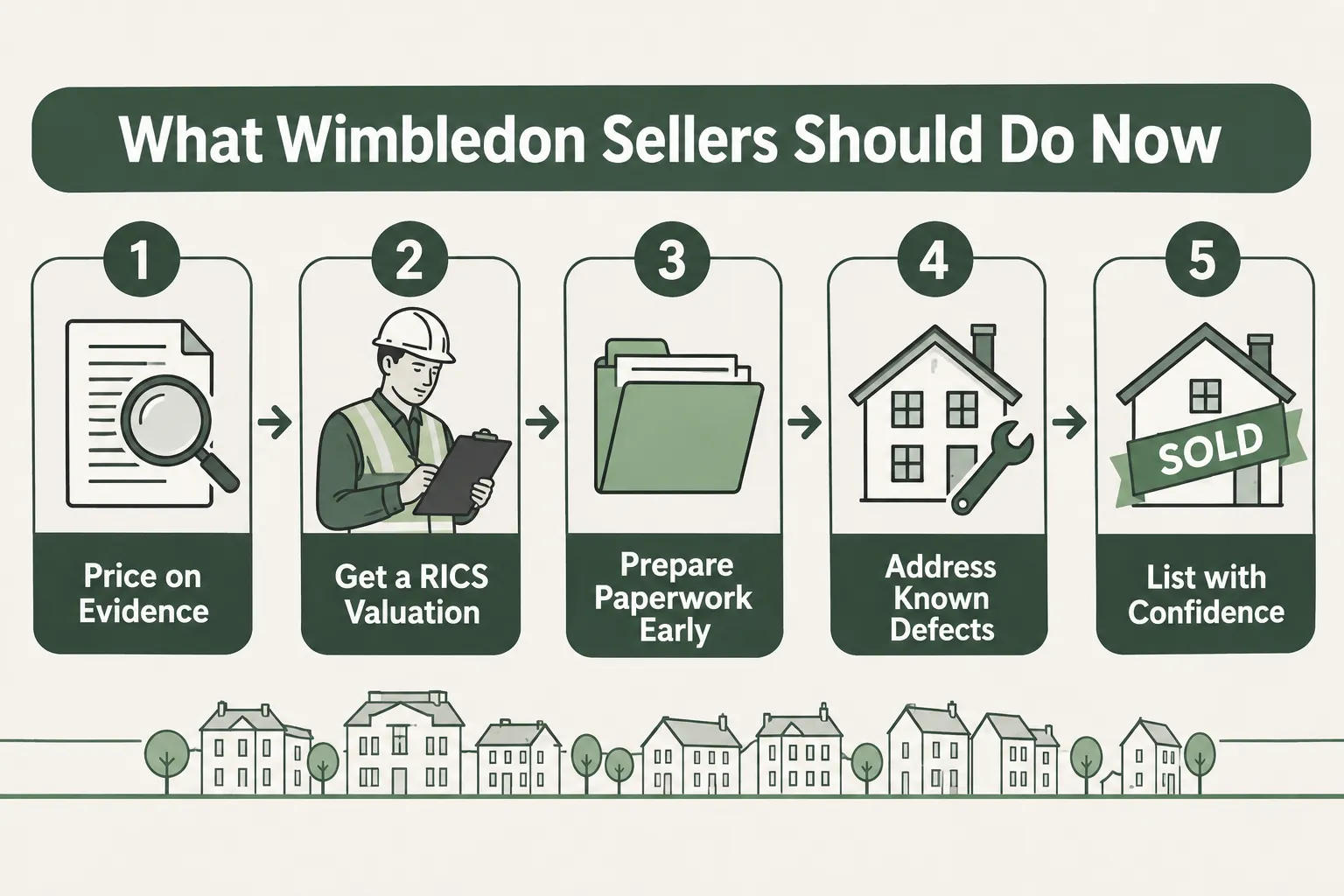
What Wimbledon Sellers Should Do Now
A listing that sits unsold for months, then gets withdrawn, costs a seller time, momentum and sometimes credibility with buyers who have watched the price drift down. The national pattern this autumn gives sellers in Wimbledon good reason to tighten their approach before going to market, not after.
Price on evidence, not ambition. With 13.7% of homes on the market nationally having their asking price reduced in October, starting too high invites the same fate. An asking price built on recent comparable sales, rather than on what a neighbour's home was marketed at, is far more likely to hold.
Consider an independent RICS valuation before listing. Estate agents provide a marketing appraisal, which is not the same as a formal valuation. A RICS-qualified valuer assesses the property against evidence and professional standards, without a commission incentive attached to the figure. That independence can be useful when deciding where to pitch a price in a market where withdrawals are running above average.
Prepare the property and the paperwork early. Buyers with more choice on the market will move on quickly if a property looks unready, or if leasehold information, building regulations certificates or planning consents are not available when asked for. Gathering these documents before marketing begins removes a common cause of delay.
Deal with known defects up front. If there is a damp patch, a cracked wall, or ageing wiring that a surveyor is likely to flag, addressing it, or at least being transparent about it and reflecting it in the price, reduces the chance of a buyer renegotiating or walking away after their own survey.
What Buyers Can Do With More Choice and More Negotiating Room
Stock levels above both the 2025 and 2023 figures for this time of year mean buyers currently have more homes to choose from than they did two years ago. That shifts some leverage toward buyers, particularly on properties that have already seen a price reduction.
That does not mean skipping due diligence. A slower, more cautious market is exactly when a proper survey earns its keep. A RICS Home Survey Level 2 suits conventional homes in reasonable condition, while a RICS Home Survey Level 3 is generally more appropriate for older, altered or larger properties, including many of Wimbledon's period houses. Either report gives a buyer a factual basis to negotiate on price or to request remedial works, rather than relying on impressions formed at a viewing.
With a Bank Rate rise just confirmed, buyers also have a reason to firm up mortgage arrangements early. A survey that flags unexpected repair costs can affect a lender's view of the property as well as the buyer's own budget.
Valuations for Remortgage, Probate and Matrimonial Purposes
The same national data has a bearing on anyone needing a valuation for reasons unconnected to an open-market sale. A RICS valuation for remortgage, probate or matrimonial proceedings is based on evidence and professional judgement at a specific valuation date, not on an asking price that may or may not attract a buyer in the current climate.
Given that asking prices are being reduced more often than the long-run average, and that price per square foot is broadly flat rather than rising, a formal valuation anchored in comparable evidence is arguably more useful now than during periods of rapid price growth, when almost any figure could be justified by the pace of the market.
FAQ
Are these figures specific to Wimbledon?
No. The data reported by PropertyWire is UK-wide. There is no Wimbledon-specific breakdown in this release, and the figures should be read as national context rather than a local forecast.
Does a home being withdrawn mean it was unsellable?
Not necessarily. Withdrawal can reflect overpricing, a change in the seller's circumstances, or a decision to wait for conditions to shift, rather than a fundamental problem with the property itself.
Should a seller skip a formal valuation if the market feels slow?
A formal RICS valuation becomes more useful, not less, when asking prices are being cut more often than usual, since it anchors a price to evidence rather than hope.
Is now a bad time to buy because of the Bank Rate rise?
The rise from 3.75% to 4% on 5 November 2026 is the first since August 2023 and will affect mortgage costs for some buyers. It does not, on its own, say whether buying now suits an individual's circumstances, and that decision depends on personal financial advice.
Does a slower sell-through rate mean surveys matter less?
The opposite applies. With more stock and more negotiating room, a RICS Home Survey Level 2 or Level 3 gives a buyer concrete grounds to negotiate repairs or price, rather than guessing at condition.
Conclusion
The headline figure is stark: more homes left the UK market unsold in October 2026 than sold. Behind it sits a market with more stock, more price reductions, a softer sell-through rate, and a fresh Bank Rate rise shaping buyer sentiment. None of this is Wimbledon-specific, but it describes the conditions any seller or buyer in the area is operating within this autumn.
Sellers who price against solid comparable evidence, prepare their paperwork, and address known defects before marketing stand a better chance of avoiding the withdrawal pile. Buyers with more choice should use it, while still commissioning a proper survey rather than assuming a quieter market means fewer risks.
Wimbledon Surveyors provides RICS Home Surveys and valuations across Wimbledon and south-west London, for sellers pricing a listing, buyers assessing a purchase, and anyone needing a valuation for remortgage, probate or matrimonial purposes.