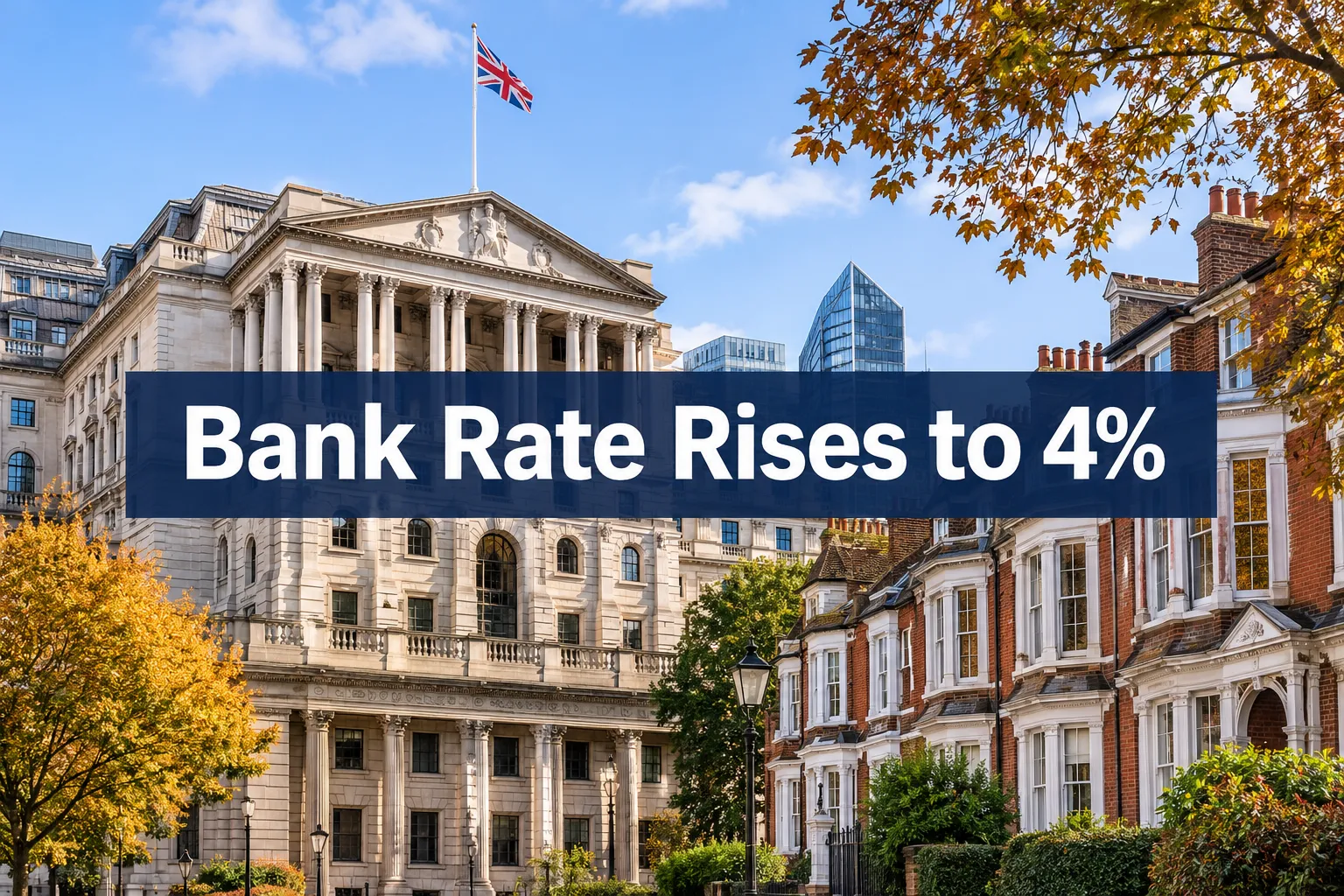
Eight votes to one. That single number tells you almost everything about yesterday's decision. The Bank of England has raised Bank Rate for the first time since August 2023, and the scale of agreement among policymakers suggests this is not a one-off wobble. For anyone buying, selling or remortgaging a home in Wimbledon, the Bank of England Bank Rate rise to 4% in Wimbledon's property market changes the maths on affordability almost overnight.
The Monetary Policy Committee's meeting ended on 4 November 2026, with the announcement made on Thursday 5 November 2026. Bank Rate moves from 3.75% to 4%, reversing the cut made back in December 2025. This article, published Friday 6 November 2026, sets out what happened, why, and what it means practically for people with property interests in Wimbledon and south-west London.
Key Takeaways
- Bank Rate rose by 0.25 percentage points to 4% on 5 November 2026, the first increase since August 2023, decided by an 8-1 MPC vote.
- CPI inflation stood at 3.5% in September 2026 and the Bank expects it to climb toward 5% by the second quarter of 2027, driven largely by energy costs.
- Average two-year fixed mortgage rates now stand at 5.97% and five-year fixes at 6.00%, according to Moneyfacts, both up sharply on a year ago.
- Around 87% of existing mortgages are fixed-rate, so most homeowners are insulated for now, but roughly 2.3 million fixed deals expire during 2027.
- London house prices fell 3.1% annually according to the Lloyds House Price Index published 6 November 2026, raising the risk of lender down-valuations on Wimbledon purchases.
Why the Bank of England Raised Bank Rate to 4%
The decision was driven primarily by inflation concerns rather than a cooling economy. CPI inflation reached 3.5% in September 2026, up from 3.1% in August. The Bank's own projections are more striking still: it expects CPI to hit around 4.5% in the first quarter of 2027 and approach 5% by the second quarter, with energy prices doing most of the damage. Direct energy effects alone contributed around 1 percentage point to September's inflation reading.
Behind the energy story sits a geopolitical one. The Bank noted that the conflict in the Middle East has now stretched into its ninth month, with Brent crude averaging $108 a barrel over the period. That combination of a long-running conflict and elevated oil prices left the MPC little choice but to act, even with growth concerns lingering in the background.
The vote itself was telling. Andrew Bailey, Sarah Breeden, Swati Dhingra, Megan Greene, Clare Lombardelli, Huw Pill, Dave Ramsden and Alan Taylor all backed the 0.25 point increase. Catherine L Mann pushed for a larger 0.5 point rise to 4.25%, arguing the Committee should move more decisively. No member voted to hold rates steady, which signals a shared view that inaction was not an option.
Importantly, the Committee was careful not to commit to a sustained run of increases. The MPC described policy as "not on a pre-set path." Bailey went further, stating that "today's increase shouldn't be seen as the first in an inevitable long sequence of hikes," while also suggesting there is an argument for a further rise unless energy-price risks fade. Alan Taylor called the move "not the start of a hiking cycle," broadly aligned with Bailey's caution. By contrast, Megan Greene expects additional hikes will be required, and Clare Lombardelli sees a case for another rise in the near term. The split in tone, even among those who voted the same way, suggests December's decision is genuinely open.
What Happens Next: Dates and Forecasts to Watch
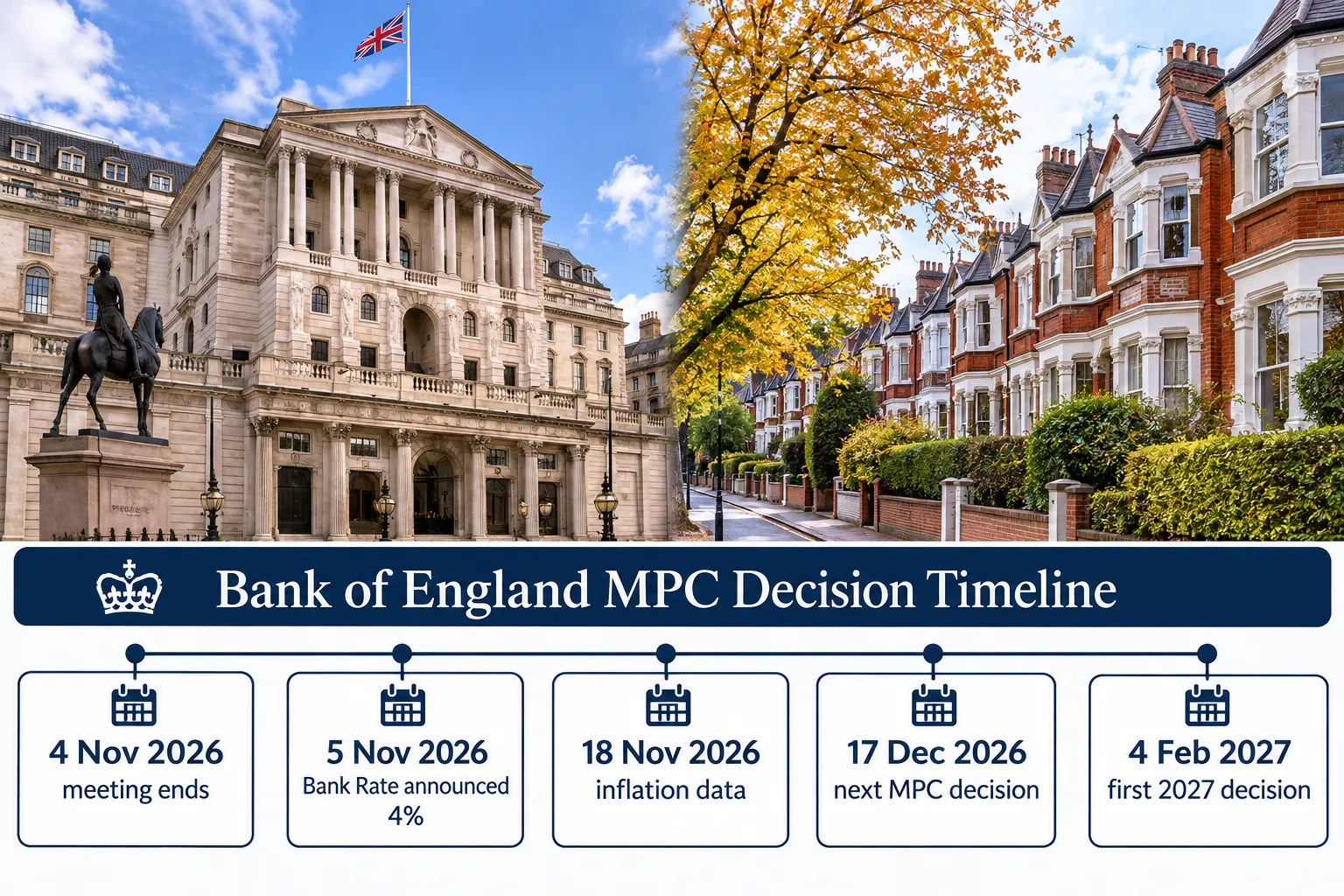
Three dates matter most for anyone watching this story unfold. Inflation data lands on 18 November 2026, giving an early signal ahead of the next MPC decision on 17 December 2026. The first meeting of 2027 follows on 4 February 2027.
City forecasters are already pencilling in further tightening. Sanjay Raja at Deutsche Bank expects one more rise, to 4.25%, landing either in December or February. Alexander Harvey at Oxford Economics also forecasts a move to 4.25%, but specifically in February 2027. Neither is calling for a pause lasting much beyond the turn of the year.
Mortgage Rates After the Bank of England Bank Rate Rise to 4%: Wimbledon Borrowers Face Higher Costs
Lenders had largely priced in this rise before it was confirmed. According to Nick Mendes at broker John Charcol, fixed mortgage pricing already reflected the increase, and several lenders had trimmed rates in the days before the announcement in anticipation. Even so, the cost of borrowing has moved noticeably over the past year.
| Mortgage measure | Current rate | Comparison |
|---|---|---|
| Average 2-year fixed | 5.97% | Up from 4.94% in November 2025 |
| Average 5-year fixed | 6.00% | Up from 5.01% in November 2025 |
| Overall average new mortgage rate | 5.89% | Highest since November 2023 |
Rachel Springall of Moneyfacts points out that the lowest rates on offer from lenders are now priced 0.44 percentage points higher than at the start of September, and she does not expect most of that increase to unwind quickly. The Bank's own minutes echo this, noting that two-year benchmark mortgage rates have risen by nearly 50 basis points since early September.
For tracker mortgage holders, the impact is immediate. MoneyWeek calculates that a 0.25 point rise adds around £37 a month to a £250,000 tracker mortgage over 25 years. UK Finance puts the average tracker customer's increase slightly lower, at £30.72 a month. The good news for most homeowners is that around 87% of outstanding mortgages are fixed-rate, meaning they are shielded until their current deal ends. The less comfortable news is that roughly 2.3 million fixed-rate deals are due to expire during 2027, according to UK Finance, meaning a large wave of borrowers will meet today's higher rates sooner rather than later.
The Housing Market Backdrop: London Prices Soften
The timing of this rate rise coincides with a cooling housing market. The Lloyds House Price Index, published on 6 November 2026, showed UK prices down 0.6% in October and 1.2% lower than a year earlier. London was the weakest region, down 3.1% annually, with an average price of £524,892. It is worth being clear that this is a London-wide figure, not a Wimbledon-specific one, and local conditions in SW19 may differ from the capital's average.
Still, the direction of travel matters. Softer prices combined with higher borrowing costs create a less forgiving environment for anyone relying on strong valuations to secure the loan-to-value band they were hoping for.
What to Do Now: Buyers, Sellers and Remortgagers
Whatever stage of the property journey someone is at, the valuation placed on a home has become more consequential, not less.
For buyers:
- The lender's valuation, not the agreed purchase price, determines the loan-to-value band and therefore the mortgage rate offered. A cautious valuer in a softening market can push a buyer into a higher-rate tier.
- Commissioning an independent RICS valuation alongside the lender's own assessment gives a clearer, evidence-based picture before exchange.
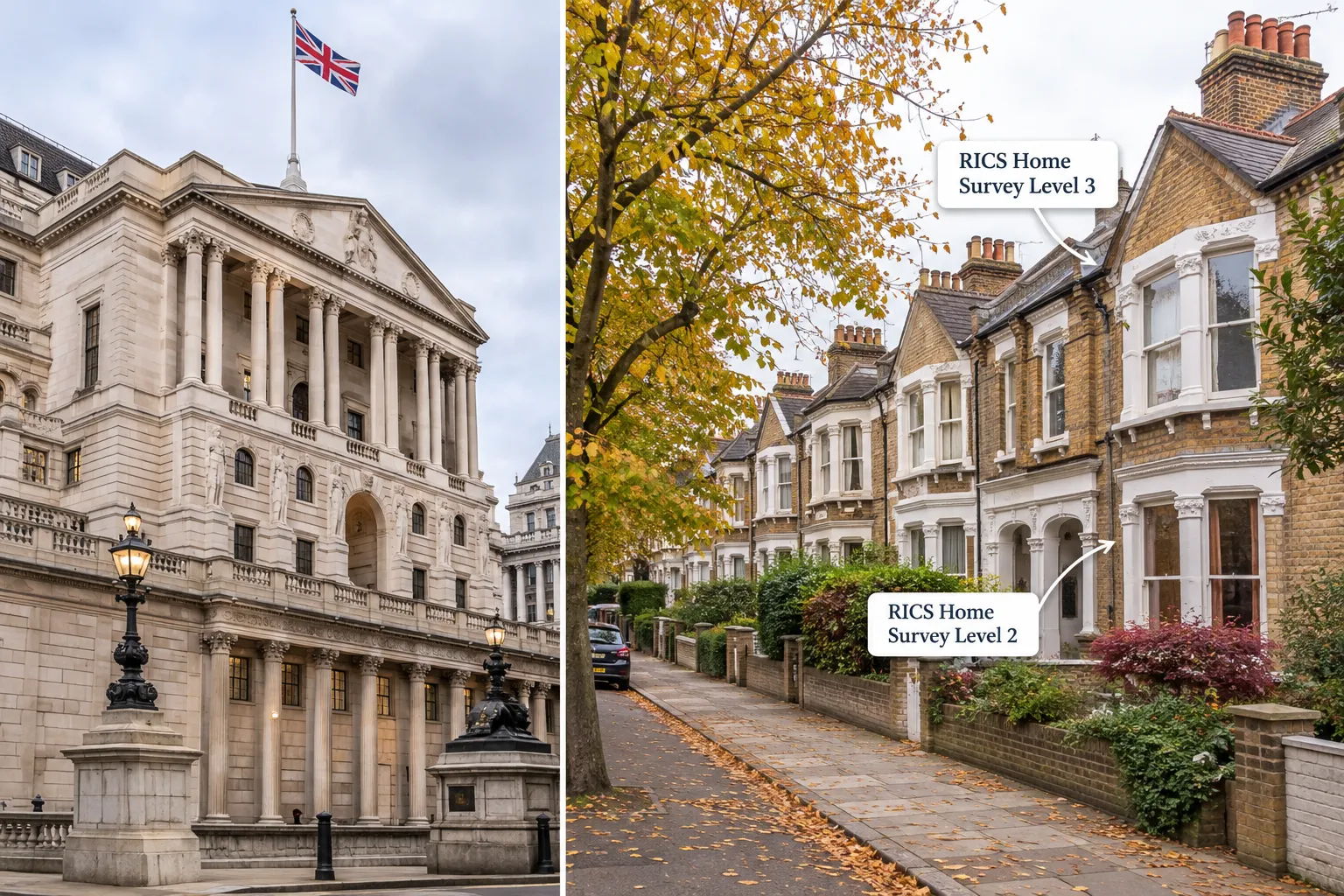
- Do not skip a proper survey to save money at this stage. A RICS Home Survey Level 2 suits most conventional homes, while a RICS Home Survey Level 3 is worth considering for older or altered Wimbledon properties. Unexpected repair costs are far harder to absorb when monthly mortgage costs have already risen.
For sellers:
- Homeowners who have extended, converted or significantly improved their property should be ready to evidence that added value independently, rather than relying solely on an estate agent's asking price or a lender's desktop valuation.
- Be realistic about pricing given the London-wide softening reported by Lloyds, even though Wimbledon-specific figures were not part of this release.
For remortgagers:
- Anyone with a fixed deal ending during 2027 should start reviewing options well ahead of the renewal date, given that both two-year and five-year average fixed rates have risen substantially over the past year.
- A down-valuation at remortgage stage can affect which rate tier is available, so an independent RICS valuation can help homeowners challenge a disappointing lender figure with solid evidence.
- Speaking to a mortgage broker is strongly recommended before committing to a new deal, since product pricing and lender appetite are moving quickly.
Frequently Asked Questions
Why did the Bank of England raise rates to 4% now?
Rising inflation was the main driver. CPI hit 3.5% in September 2026 and the Bank expects it to climb further toward 5% by mid-2027, largely because of energy costs linked to the ongoing conflict in the Middle East and elevated Brent crude prices.
Will rates rise again in December 2026?
It is uncertain. The MPC says policy is "not on a pre-set path," and members are divided. Some, like Megan Greene and Clare Lombardelli, see a case for another rise soon, while Alan Taylor and Bailey's comments suggest caution. Forecasters at Deutsche Bank and Oxford Economics both expect a further move to 4.25%, though they differ on timing between December 2026 and February 2027.
How does this affect Wimbledon mortgage holders specifically?
There is no Wimbledon-specific data in this release, but the trend is clear: average fixed mortgage rates have risen sharply over the past year, and London house prices have softened by 3.1% annually, increasing down-valuation risk for local buyers and remortgagers.
Should I get a RICS survey if I am already stretching my budget?
Yes. A RICS Home Survey Level 2 or Level 3 identifies problems before you commit, which matters more when borrowing costs are higher and there is less financial headroom to cover surprise repairs.
Is this the start of a long run of rate rises?
Policymakers are split. Bailey and Taylor both pushed back against the idea of an inevitable hiking cycle, while Greene and Lombardelli expect further increases may be needed. The next clear signal comes with inflation data on 18 November 2026 and the MPC decision on 17 December 2026.
Conclusion
The Bank of England's move to 4% marks a genuine turning point after more than two years without an increase, and the 8-1 vote shows broad, though not unanimous, agreement on the need to act. For Wimbledon's buyers, sellers and remortgagers, the practical implications are clear: mortgage rates have moved higher, London valuations have softened, and the gap between a hopeful asking price and a lender's actual valuation has widened. Before making any decision, speak to a qualified mortgage broker about your options, and consider commissioning an independent RICS valuation or a RICS Home Survey Level 2 or Level 3 to protect your position. This article is general information, not financial advice.
Bank of England, Bank Rate rise, Wimbledon property market, mortgage rates 2026, RICS valuation, remortgaging, UK inflation, London house prices, chartered surveyors, Monetary Policy Committee, fixed rate mortgages, home buying advice