
Nearly one in three UK homebuyers who skip an independent building survey later discover defects they wish they had known about before exchanging contracts. Yet many property owners remain unsure whether they need a full structural inspection, a lender's valuation, or a party wall specialist, and choosing the wrong service can cost thousands. Understanding how to choose between a building survey, valuation and party wall advice in the UK is not just a matter of preference; it is a practical decision with real financial and legal consequences.
This guide provides a decision-focused framework for homeowners, buyers, and anyone planning building works near a shared boundary. It covers all three instruction types in plain language, explains when each one is legally required or strongly advisable, and reflects the latest 2026 changes to RICS standards and practice.
Key Takeaways
- A building survey assesses physical condition; a valuation assesses monetary worth; party wall advice addresses legal obligations to neighbours, they serve three distinct purposes.
- From late 2026, RICS-compliant surveys at all levels may include an optional valuation figure, but this does not replace a standalone Red Book valuation for mortgage or legal purposes.
- The Party Wall etc. Act 1996 is unchanged in 2026, but surveyor shortages mean earlier instruction is essential.
- Level 3 building surveys are strongly recommended for pre-1970s properties, unusual construction types, or any home where significant defects are suspected.
- Always verify that your surveyor holds RICS accreditation and specialises in the service you actually need.
Understanding the Three Types of Surveyor Instruction
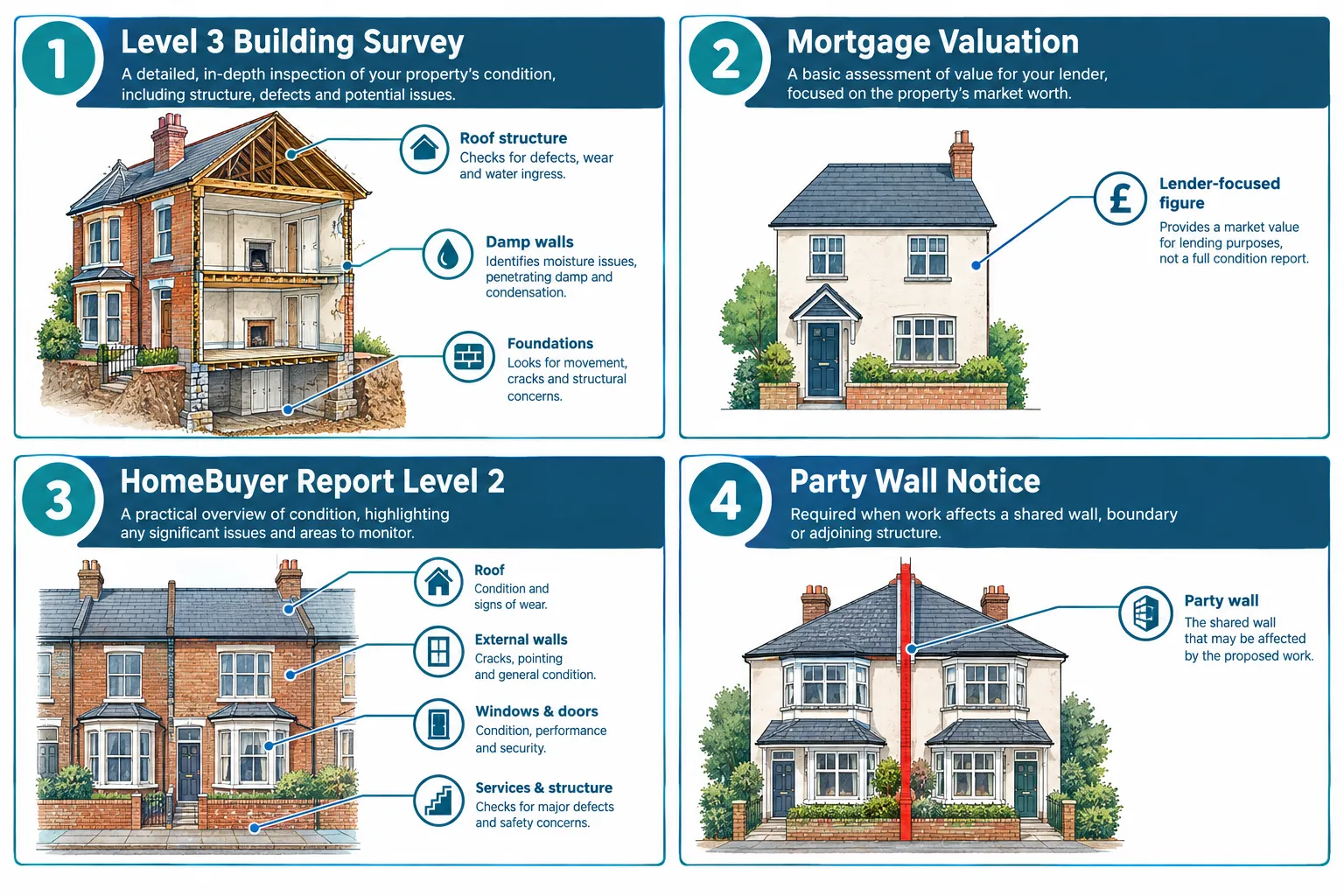
Before exploring how to choose between a building survey, valuation and party wall advice in the UK, it helps to understand what each service actually delivers, and what it does not.
Building Surveys: Assessing Physical Condition
A building survey (also called a structural survey or, in RICS terminology, a Level 3 Home Survey) is the most thorough inspection available for residential properties. A qualified surveyor physically examines the property's structure, fabric, and services, then produces a detailed written report identifying defects, their likely causes, and recommended remedial action.
RICS currently offers three home survey levels [6]:
| Survey Level | Scope | Best For |
|---|---|---|
| Level 1 (Condition Report) | Basic traffic-light ratings only | New-build or recently renovated homes |
| Level 2 (HomeBuyer Report) | Condition ratings plus advice on defects | Conventional properties in reasonable condition |
| Level 3 (Building Survey) | Full structural inspection with detailed defect analysis | Older, unusual, or potentially defective properties |
The proposed RICS Home Survey Standard 2nd Edition, expected to take effect in late 2026, introduces optional valuation figures at all three levels [2]. This is a significant change: buyers will be able to receive a condition assessment and a market opinion in a single report. However, this optional figure is not a Red Book valuation and cannot be used for mortgage lending or legal proceedings. Understanding that distinction is central to knowing how to choose between a building survey, valuation and party wall advice in the UK.
For properties built before 1970, particularly those with non-standard construction, suspected damp, or visible cracking, a Level 3 survey is strongly advisable. See the detailed guide on hidden defects in 1930s-1970s UK houses for a thorough breakdown of what these inspections should reveal. When comparing your options, the article on Home Survey Level 2 vs Level 3 also provides clear guidance on which depth of inspection suits different property types.
Property Valuations: Assessing Monetary Worth
A valuation is a formal opinion of a property's market value at a specific date. It is produced by a RICS Registered Valuer and, when issued under the RICS Red Book Global Standards, carries legal weight for mortgage lending, probate, litigation, and tax purposes [3].
Key valuation types in 2026 include:
- Mortgage valuation, commissioned by the lender, not the buyer; protects the lender's security only.
- Red Book market valuation, a formal, fully evidenced report for legal or financial purposes.
- Desktop valuation, a data-driven assessment without a physical inspection; valid for lower-risk remortgage cases. Learn more in the guide on desktop house valuations.
- Help-to-Buy / shared ownership valuation, a specialist instruction with specific RICS requirements.
Two important 2026 developments affect valuations. First, updated RICS measurement standards now require surveyors to state explicitly which measurement standard has been applied in any survey or valuation report [1]. Second, for residential flats with external cladding, a new secured-lending valuation standard applies from 1 November 2026, reflecting the ongoing post-Grenfell regulatory environment [8]. Buyers of flats in buildings with cladding should confirm that their valuer is aware of and compliant with this updated standard.
For commercial property, RICS has also published an updated global standard on ESG and sustainability, which now materially affects how commercial valuations are conducted and reported [5]. This is less relevant to most residential buyers but critical for investors and business owners.
Important distinction: A mortgage valuation is not a survey. It tells the lender whether the property is adequate security for the loan, nothing more. It will not identify hidden defects, and the buyer has no automatic right to rely on it.
Party Wall Advice: Managing Legal Obligations to Neighbours
Party wall advice sits in a different category entirely. It is not about the condition or value of a property, it is about legal compliance under the Party Wall etc. Act 1996 when carrying out certain types of building work near or on a shared boundary.
The Act requires property owners to serve formal notice on adjoining neighbours before undertaking [4]:
- Work on or to a party wall or party fence wall
- New building at or astride the boundary line
- Excavations within 3 or 6 metres of a neighbour's structure (depending on depth)
Party wall law itself is unchanged in 2026. However, current practice strongly emphasises early engagement with neighbours and realistic budgeting for surveyor fees, particularly in London where disputes are more frequent [7]. Understanding how the Party Wall Act 1996 applies to you is the essential first step before any notifiable works begin.
A Practical Decision Framework: Which Service Do You Actually Need?
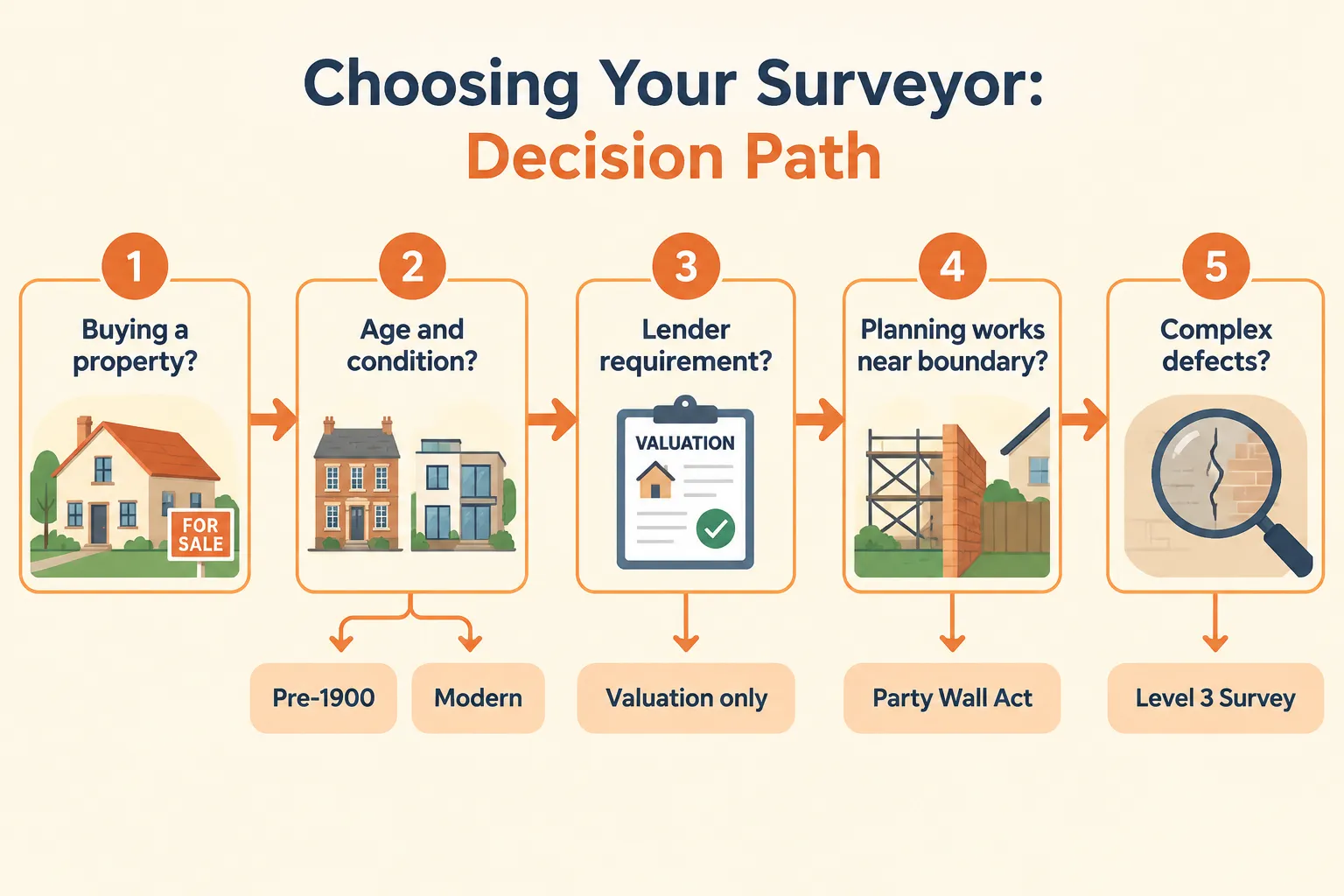
The most practical way to approach how to choose between a building survey, valuation and party wall advice in the UK is to match the service to the specific situation. The three common scenarios are: buying a property, planning building works, and resolving a boundary or neighbour dispute.
Scenario 1, You Are Buying a Property
Step 1: Does your mortgage lender require a valuation?
Yes, in almost every case. The lender will arrange this independently. You will usually pay the fee, but the report belongs to the lender. Do not rely on it as a substitute for your own survey.
Step 2: Do you also need an independent survey?
Almost certainly. The type depends on the property:
- New-build or post-2000 property in good condition, a Level 1 or Level 2 survey may suffice.
- Pre-1970s property, unusual construction, or any visible concerns, commission a Level 3 building survey.
- Leasehold flat, check the leasehold buying checklist before instructing a surveyor, as additional due diligence is required.
Step 3: Can survey findings reduce the purchase price?
Yes. A detailed defect report from a Level 3 survey is one of the most effective negotiating tools available to a buyer. The guide on negotiating the purchase price after a building survey explains how to use survey findings to renegotiate effectively.
Do you need party wall advice at this stage?
Generally no, unless you are buying a property where the seller has already received a party wall notice, or where you intend to carry out notifiable works shortly after purchase.
Scenario 2, You Are Planning Building Works
This is where party wall obligations most commonly arise. Ask the following questions:
- Will the works affect a shared wall, floor, or ceiling? If yes, the Act almost certainly applies.
- Will you excavate within 3 or 6 metres of a neighbouring structure? If yes, a notice is required.
- Are you building at or near the boundary line? If yes, a boundary notice may be required.
If the Act applies, you must serve the correct party wall notices on all adjoining owners before works begin. Failure to do so does not invalidate the work but can expose you to injunctions and civil liability.
In 2026, a surveyor shortage in London and the South East means that party wall surveyors are booking up faster than in previous years [7]. Instruction should ideally happen at least 2 to 3 months before the planned start date to allow time for notices, the statutory waiting period, and, if consent is withheld, the appointment of surveyors and preparation of a Party Wall Award.
Do you also need a building survey for planned works?
Not as a legal requirement, but it is often advisable. A pre-works condition survey of the neighbouring property, known as a Schedule of Condition, protects both parties by recording the state of the adjoining structure before works begin. This document is frequently attached to a Party Wall Award and can prevent costly disputes about who caused what damage.
Scenario 3, You Have a Boundary or Neighbour Dispute
Here, the appropriate instruction depends on the nature of the dispute:
- Dispute about physical damage to a shared wall, a building surveyor can assess the extent and cause of the damage.
- Dispute about whether the Party Wall Act applies, a specialist party wall surveyor should be consulted.
- Dispute about where the boundary line falls, a boundary surveyor or measured survey specialist is required; this is a distinct discipline from both building surveying and party wall work.
The key point is that not all surveyors are equally qualified for all tasks. A general RICS-accredited surveyor may be excellent at building surveys but have limited experience of party wall procedure. Always check that the surveyor you instruct has direct, recent experience in the specific service you need. For more on this, see the article on why choosing RICS surveyors matters.
2026 Updates and Practical Considerations
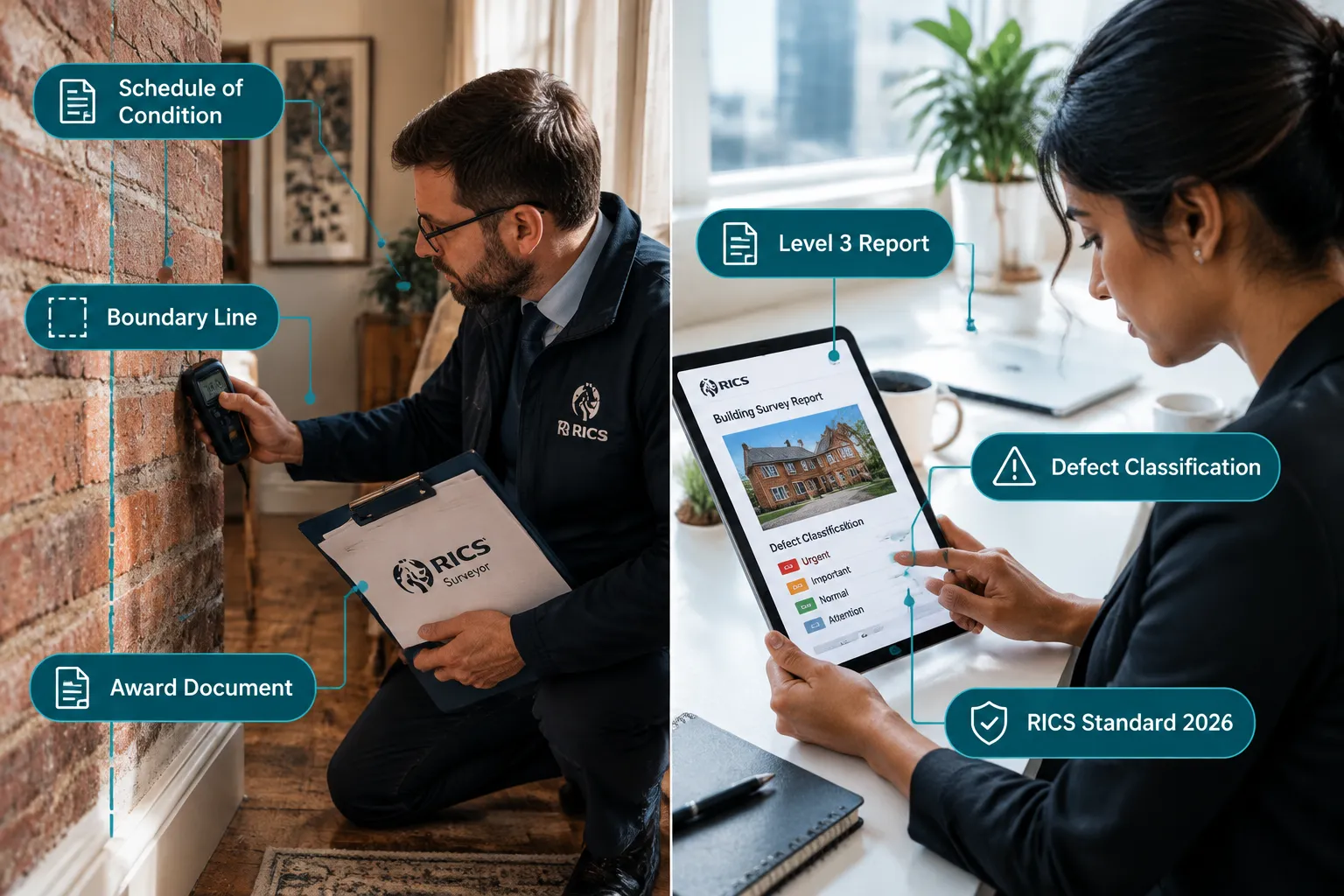
Several developments in 2026 affect how each of these services is delivered and priced. Being aware of them helps avoid surprises when instructing a surveyor.
Changes to Survey and Valuation Standards
The revised RICS property measurement guidance, which came into effect in Q2 2026, requires all survey and valuation reports to state explicitly which measurement standard has been applied [1]. This affects both building surveys (where floor area measurements may inform reinstatement cost assessments) and valuations (where gross internal area figures directly influence comparable analysis). When reviewing a report, check that this declaration is present.
The proposed RICS Home Survey Standard 2nd Edition also introduces clearer language distinguishing between a surveyor's informal opinion of value and a formal Red Book valuation [2]. This matters because buyers sometimes assume that a figure mentioned in a survey report carries the same weight as a lender's valuation, it does not.
For complex or unusual buildings, Level 3 surveys in 2026 increasingly use technology such as thermal imaging, drone inspection, and 3D scanning to supplement traditional visual inspection. These tools can identify defects, particularly in rooflines and cladding, that would be missed in a standard walkthrough. If the property is large, multi-storey, or has a complex roof structure, ask the surveyor whether these methods will be used.
RICS has also issued formal guidance on the use of artificial intelligence in valuations [3]. AI-assisted desktop valuations are now a recognised tool, but RICS requires that any AI use be disclosed in the report and that a Registered Valuer takes professional responsibility for the final figure. This is particularly relevant for remortgage and equity release cases where desktop valuations are common.
Party Wall Practice in 2026
The Party Wall etc. Act 1996 remains the governing legislation, and no substantive amendments were made in 2026 [4]. However, practitioners note several practical shifts:
- Earlier instruction is essential. Surveyor availability has tightened across London and the Home Counties. Booking a party wall surveyor 10 to 12 weeks before works begin is now considered minimum best practice [7].
- Agreed surveyor appointments are gaining popularity. Where both the building owner and the adjoining owner consent, a single agreed surveyor can act for both parties, reducing cost and delay. The complete guide to the agreed surveyor party wall process explains how this works in practice.
- Budgeting realistically is critical. Party wall surveyor fees in London vary considerably depending on the complexity of the works and whether a dispute arises. See the detailed breakdown of party wall surveyor costs in 2026 before committing to a project budget.
- Building regulations updates in September 2026 introduced new energy-performance requirements for certain types of wall construction. These affect compliance with building regulations, not the neighbour-rights provisions of the Party Wall Act, but they may influence how notifiable works are designed and specified.
When Professional Advice May Be Optional
Not every situation requires a paid surveyor instruction. Informal advice from a RICS member, a pre-instruction consultation, or a review of published RICS guidance [6] can sometimes clarify whether a formal instruction is needed. However, the following situations always warrant professional instruction:
- Any mortgage application (valuation required by lender)
- Any notifiable works under the Party Wall etc. Act (notice required; surveyor required if consent is withheld)
- Any property purchase where defects are suspected or the property is pre-1970s (Level 3 survey strongly advisable)
- Any legal or financial transaction requiring a formal opinion of value (Red Book valuation required)
Conclusion
Knowing how to choose between a building survey, valuation and party wall advice in the UK comes down to matching the right professional service to the specific question being asked. A building survey answers: "What is the physical condition of this property, and what will it cost to put right?" A valuation answers: "What is this property worth in the current market?" Party wall advice answers: "What are my legal obligations to my neighbours, and how do I fulfil them?"
Actionable next steps:
- Identify your primary need, buying, building, or boundary, before contacting any surveyor.
- Check RICS accreditation for every professional you instruct, and confirm they specialise in the relevant discipline.
- Book early in 2026. Surveyor availability is constrained; leaving instruction until the last moment risks delays to your purchase or project.
- Do not rely on a mortgage valuation as a substitute for an independent building survey. They serve different purposes.
- If planning works near a boundary, serve party wall notices before works begin, not after, and budget for surveyor fees from the outset.
- Request explicit measurement standard declarations in any survey or valuation report you commission, in line with the 2026 RICS guidance updates.
Taking these steps in the right order, with the right professionals, protects both your investment and your legal position.
References
[1] Revised Rics Property Measurement Guidance Impacts On Building Surveys And Valuations In Q2 2026 – princesurveyors.co.uk
[2] Proposed Rics Home Survey Standard 2nd Edition Level 3 Building Survey Updates For 2026 Residential Valuations – princesurveyors.co.uk
[3] Profession Standards – rics.org
[4] The Party Wall Act 1996 Key Updates And 2026 Case Studies For Surveyors And Builders – partywallsurveyorlondon.uk
[5] Rics Publishes Updated Global Standard Esg Sustainability Commercial Property Valuation – rics.org
[6] Building Surveying Standards – rics.org
[7] 2026 Party Wall Surveyor Tips – simplesurvey.co.uk
[8] Residential Valuations – rics.org
[10] Do I Really Need A Party Wall Surveyor In 2026 – simplesurvey.co.uk