
{"cover":"Professional landscape format (1536×1024) hero image with bold text overlay 'Asbestos Survey Before Renovation?' in crisp white sans-serif on a dark semi-transparent panel, centered with 8% safe margins from every edge. Background: editorial daylight photograph of a Victorian-era brick terraced house in London undergoing renovation, scaffolding visible on the facade, a surveyor in a hard hat and hi-vis vest holding a clipboard examining the exterior wall. Warm natural daylight, slight depth of field blur on the house background, sharp foreground surveyor. Professional magazine-cover aesthetic, teal and charcoal color palette, high contrast, editorial quality.","content":["Numbered step-by-step process flow diagram (landscape 1536×1024) titled 'Survey Sequencing for Older UK Properties' with four numbered stages arranged left to right: Stage 1 labeled 'Building Survey Commissioned' showing a clipboard icon with callout 'Structural condition check'; Stage 2 labeled 'Pre-2000 Property Flagged' with callout 'Asbestos risk identified'; Stage 3 labeled 'R&D Asbestos Survey Ordered' with callout 'Fully intrusive sampling'; Stage 4 labeled 'Renovation Work Begins' with callout 'Legally compliant start'. Clean white background, teal-and-navy palette, thin connecting arrows between stages, short callout labels 1-5 words each, editorial infographic polish, no pricing or checkmark grids.","Four-panel labelled comparison guide (landscape 1536×1024) titled 'Management vs Refurbishment Survey' with two large side-by-side panels: Left panel headed 'Management Survey' showing an annotated cross-section illustration of a building interior with callout labels: 'Non-intrusive inspection', 'Occupied buildings', 'Asbestos register', 'Ongoing monitoring'. Right panel headed 'Refurbishment & Demolition Survey' showing a more invasive cross-section with callout labels: 'Fully intrusive sampling', 'Required before works', 'Destructive access', 'Statutory compliance'. Teal and amber color scheme, clean white background, thin callout lines, short 1-5 word labels, editorial diagram quality, no pricing tables.","Annotated documentary editorial photograph (landscape 1536×1024) of a professional asbestos surveyor, South Asian woman in her 40s wearing full white Tyvek protective suit, respirator mask pushed up, holding a sample collection kit, standing inside a partially stripped older UK building interior showing exposed ceiling tiles and pipe lagging. Three callout labels with thin lines pointing to: 'Pipe lagging, common ACM', 'Ceiling tiles, pre-2000 risk', 'Sample collection kit'. Bright interior work-light illumination, realistic construction site environment, high-contrast editorial photography style, charcoal and white palette with teal accent callout lines, magazine-quality composition."]
Roughly half of all UK homes were built before 1980, and asbestos-containing materials (ACMs) were used in construction until a full ban came into force in 1999. That single fact means millions of buyers, landlords, and developers face a practical sequencing question every year: do you need an asbestos survey before a building survey or renovation, and if so, which type, and when? Getting the order wrong is not just a procedural inconvenience. Under the Control of Asbestos Regulations 2012 (CAR 2012), carrying out refurbishment or demolition work without a prior asbestos survey can result in criminal prosecution, unlimited fines, and serious harm to workers and occupants [1].
This guide cuts through the confusion by explaining exactly when an asbestos survey is legally required, how it fits alongside a standard building survey, and what the correct sequence looks like for buyers and renovators in 2026.
Key Takeaways
- Buildings constructed before 2000 carry a presumed asbestos risk; a refurbishment and demolition (R&D) survey is legally required before any intrusive work begins.
- A standard building survey or homebuyer report does not replace an asbestos survey, the two serve entirely different purposes.
- The R&D survey must be fully intrusive and completed before construction work starts, not during or after.
- Management surveys are appropriate for occupied buildings where no structural work is planned; R&D surveys are required the moment any demolition or refurbishment is on the table.
- HSE enforcement activity in 2026 is specifically targeting refurbishment and demolition projects where asbestos obligations have not been met.
Why the Sequencing Question Matters for Older UK Properties
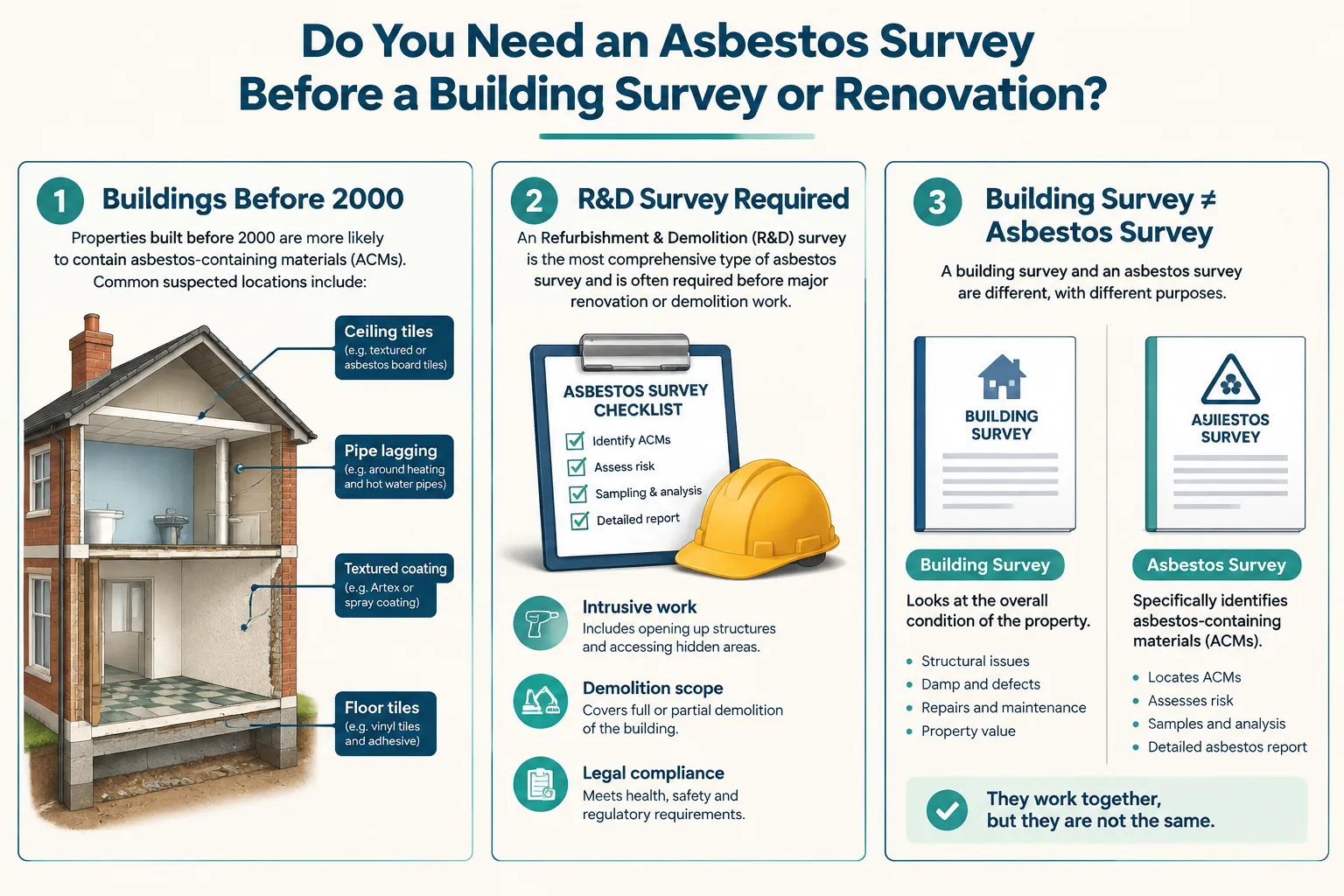
When a buyer commissions a building survey on an older property, the report will typically note the presence of suspected ACMs and recommend further specialist investigation. What it will not do is confirm whether asbestos is actually present, identify its exact location and condition, or satisfy the legal duty to assess risk before refurbishment begins. These are two separate professional processes with two separate legal frameworks.
The question of whether you need an asbestos survey before a building survey or renovation therefore has a nuanced answer: the building survey usually comes first as part of due diligence, but if the property pre-dates 2000 and any form of structural, refurbishment, or demolition work is planned, an asbestos survey is not optional, it is a statutory requirement [2].
The practical trigger is simple: if the building was constructed or significantly refurbished before the year 2000, assume asbestos is present until proven otherwise.
What a Standard Building Survey Does and Does Not Cover
A building survey (formerly known as a structural survey) is a comprehensive inspection of a property's condition. It covers structural integrity, damp, drainage, roofing, and general defects. A competent surveyor will flag materials that visually appear to contain asbestos, textured coatings, insulating board, pipe lagging, floor tiles, but they will not take samples, test materials, or produce the legally compliant asbestos register that CAR 2012 demands.
Similarly, a homebuyer report operates at a less intrusive level and will not identify ACMs with any certainty. For first-time buyers considering older properties, understanding this gap is critical. You can read more about what different inspection levels cover in our guide to survey levels.
"A building survey is a health check for the property's condition. An asbestos survey is a legal compliance document. Confusing the two can expose buyers and contractors to serious regulatory and safety risk."
Management Survey vs Refurbishment and Demolition Survey, Understanding the Difference
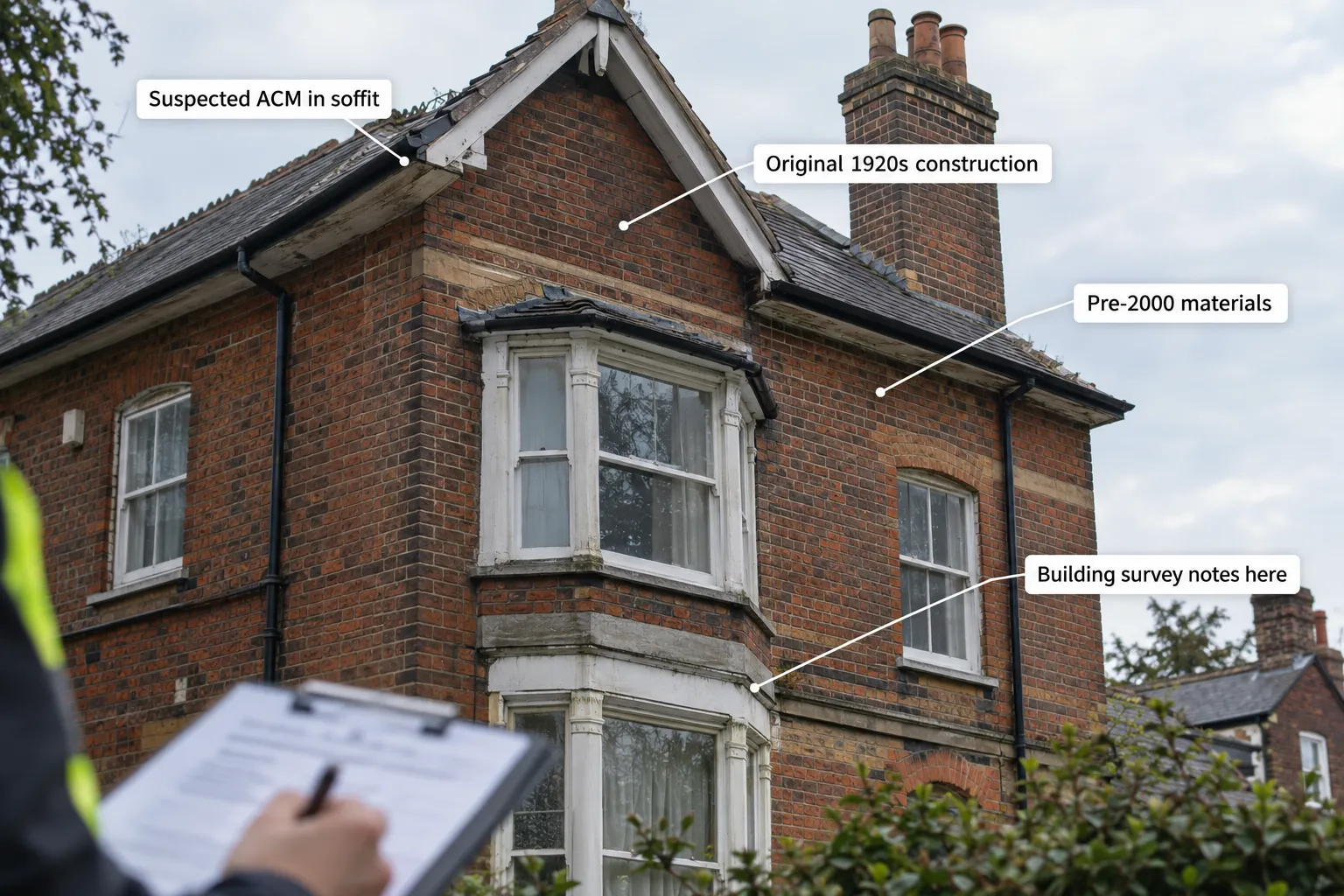
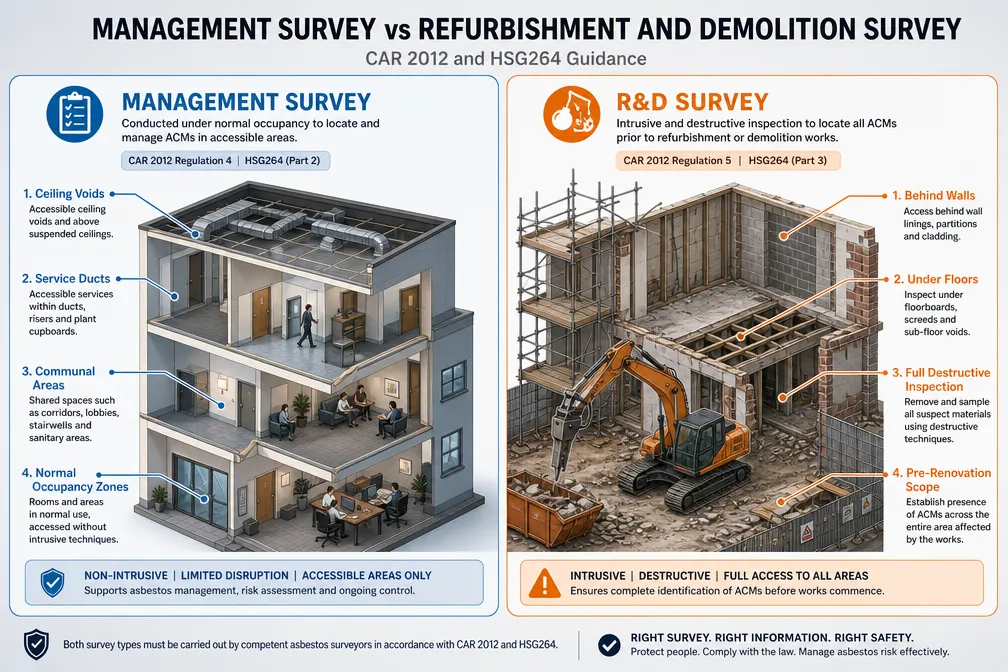
Not all asbestos surveys are the same. CAR 2012 and the HSE guidance document HSG264 define two primary survey types, each designed for a different set of circumstances [1][5].
Management Survey
A management survey is the standard survey for an occupied building where no major structural work is planned. Its purpose is to locate and assess ACMs that could be disturbed during normal occupation, minor maintenance, or day-to-day activities. It is non-destructive, the surveyor will not break into walls, lift floors, or open ceiling voids beyond what is reasonably accessible.
When it applies:
- Ongoing management of a commercial or residential property
- Landlord compliance obligations under CAR 2012
- Where no refurbishment or demolition is planned
Refurbishment and Demolition (R&D) Survey
A refurbishment and demolition survey is a fully intrusive inspection. The surveyor must access all areas that will be disturbed by the planned works, which means breaking into walls, lifting floor coverings, opening ceiling voids, and sampling materials that are not visible during a standard walkthrough [4][8].
When it is legally required:
- Before any refurbishment work that will disturb the building fabric
- Before full or partial demolition
- Before any structural alterations, extensions, or fit-out works
The R&D survey must be completed before work starts, not commissioned at the same time as the contractor mobilises, and certainly not after work has begun [2]. This is a hard legal requirement, not a best-practice recommendation.
| Survey Type | Intrusive? | Legal Trigger | Typical Use |
|---|---|---|---|
| Management Survey | No | Ongoing occupation | Landlord/dutyholder compliance |
| R&D Survey | Yes, fully | Before refurbishment or demolition | Renovation, extension, fit-out, demolition |
The Demolition Scenario
For full demolition projects, the requirements are even more stringent. A demolition asbestos survey is a statutory pre-demolition step under both CAR 2012 and the Construction (Design and Management) Regulations 2015 (CDM 2015) [6][10]. The survey must cover every part of the structure, and all identified ACMs must be removed by a licensed contractor before demolition begins. Failing to complete this step before site clearance is one of the most common enforcement actions taken by the HSE.
When Do You Need an Asbestos Survey Before a Building Survey or Renovation? The Legal Framework Explained
The legal framework governing this question rests on three interlocking pieces of regulation: CAR 2012, CDM 2015, and the Health and Safety at Work etc. Act 1974. Together, they place a clear duty on anyone who manages, owns, or commissions work on non-domestic premises, and, in practice, on residential landlords and developers too.
The Dutyholder Obligation Under CAR 2012
Under Regulation 4 of CAR 2012, the dutyholder, typically the owner, employer, or person in control of the premises, must manage the risk from asbestos. This includes:
- Identifying whether asbestos is present
- Assessing the condition of any ACMs
- Maintaining an up-to-date asbestos register
- Ensuring that anyone who might disturb ACMs is informed of their location [1]
For refurbishment projects, Regulation 7 of CAR 2012 goes further: no work that is liable to disturb asbestos can begin until an adequate R&D survey has been carried out and the results have been communicated to all relevant contractors [2][8].
CDM 2015 and the Principal Designer's Role
Under CDM 2015, the principal designer on a construction project has a specific duty to gather pre-construction information, and asbestos survey results form a core part of that information pack. Contractors cannot be expected to manage asbestos risk if they have not been provided with a compliant survey before they begin work. This integration between asbestos compliance and construction health and safety is an area of active HSE focus in 2026 [7].
2026 HSE Enforcement Focus
The HSE has confirmed that its 2026 inspection programme specifically targets refurbishment and demolition sites where asbestos obligations have not been fulfilled before work commenced [7]. Inspectors are looking for evidence that:
- An R&D survey was completed before the project start date
- The survey was carried out by a competent, UKAS-accredited surveyor
- The results were shared with contractors in writing
- Any ACMs were removed or managed before intrusive work began
Penalties for non-compliance include improvement notices, prohibition notices, and prosecution under the Health and Safety at Work etc. Act 1974, which carries unlimited fines and potential custodial sentences for individuals.
Competence and Accreditation Standards
HSG264 sets out the competence requirements for asbestos surveyors. In practice, buyers and developers should only commission surveys from organisations holding UKAS accreditation to ISO 17020 for asbestos surveying. Using an unaccredited surveyor may not satisfy the legal duty, leaving the dutyholder exposed even if a survey was technically completed [3][8].
The Correct Sequence for Buyers and Renovators in 2026
Understanding the right order of steps prevents costly delays, legal exposure, and safety incidents. The sequence varies slightly depending on whether the property is being purchased or already owned.
For Property Buyers
- Commission a building survey to assess the overall condition of the property and identify any suspected ACMs.
- If the property pre-dates 2000 and renovation is planned, commission an R&D asbestos survey before exchange of contracts where possible, or make the results a condition of the purchase.
- Use the asbestos survey results to inform renovation planning, contractor selection, and cost estimates. Unexpected ACM removal can add significantly to project budgets.
- Ensure all contractors are provided with the survey results before work begins.
For first-time buyers navigating this process, our first-time buyer building survey guide explains how to commission the right level of inspection for older properties.
For Existing Owners Planning Renovation
- Review any existing asbestos management survey or register. If none exists, commission one.
- Before any refurbishment or demolition work is scoped, commission a full R&D survey covering all areas to be disturbed.
- Share the completed survey with your principal designer and all contractors as part of the pre-construction information pack under CDM 2015.
- Arrange licensed removal of any ACMs identified before work begins.
- Retain all survey documentation, it forms part of the building's health and safety file.
A renovation needs analysis at the planning stage can help identify all the specialist surveys and consents required before work starts, including asbestos, damp, structural, and party wall obligations.
When an Asbestos Survey May Not Be Required
There are limited circumstances where a full R&D survey may not be strictly necessary:
- Post-2000 buildings: Properties constructed entirely after November 1999 are unlikely to contain ACMs, though a risk assessment is still advisable if the construction date cannot be confirmed.
- Purely external works: Work that does not disturb the building fabric, such as external painting or landscaping, may not trigger the R&D survey requirement, though a risk assessment should still be documented.
- Demolition of a structure with a confirmed asbestos-free certificate: If a previous compliant survey has already confirmed no ACMs are present, a new survey may not be needed, provided the scope of works has not changed.
Even in these scenarios, the dutyholder should document the rationale for not commissioning a survey. An undocumented assumption is not a defence in the event of an enforcement action [9].
Practical Implications for Renovation Budgets and Timelines
Asbestos surveys and any subsequent removal work have real cost and programme implications that buyers and developers frequently underestimate. A management survey for a standard residential property typically costs between £200 and £500. An R&D survey, which requires more time, access, and laboratory analysis, typically costs between £400 and £1,500 depending on property size and complexity [3][4].
If ACMs are identified, removal costs vary widely:
- Non-licensed removal (e.g., asbestos cement sheets in good condition): from approximately £300
- Licensed removal (e.g., pipe lagging, sprayed coatings, insulating board): from approximately £1,000 to well over £10,000 for large-scale works
Building these costs into the pre-purchase or pre-renovation budget, rather than discovering them once contractors are on site, is one of the most effective ways to protect against cost overruns. Our article on saving money with building surveys explores how early professional advice reduces financial risk across the whole project lifecycle.
For projects involving shared walls or structures, the asbestos survey process may also intersect with party wall obligations. Our guide on when you need a party wall agreement covers the parallel consents that renovation projects in older terraced or semi-detached properties often require.
Conclusion
The answer to whether you need an asbestos survey before a building survey or renovation is clear: for any property built before 2000 where refurbishment or demolition is planned, a refurbishment and demolition asbestos survey is a legal requirement under CAR 2012, and it must be completed before work begins, not during or after. A standard building survey is an essential first step in understanding a property's condition, but it does not fulfil this statutory obligation.
Actionable next steps for buyers and renovators in 2026:
- If the property pre-dates 2000, treat an asbestos survey as a non-negotiable part of the pre-purchase or pre-renovation checklist.
- Commission a UKAS-accredited surveyor for the R&D survey, accreditation is the minimum standard the HSE expects.
- Obtain the survey results before contractors are appointed and ensure the results are included in the CDM pre-construction information pack.
- Budget for potential ACM removal at the planning stage, not after works have started.
- Retain all survey documentation as part of the building's permanent health and safety file.
Getting the sequence right protects workers, occupants, and the dutyholder from serious legal and financial consequences, and it starts with understanding that a building survey and an asbestos survey are complementary, not interchangeable.
References
[1] Arrange Asbestos Survey – hse.gov.uk
[2] Asbestos Guidance Refurbishment – hse.gov.uk
[3] Why You Need An Asbestos Survey Before Renovation Or Demolition – malrod.co.uk
[4] Asbestos Refurbishment Surveys – acmcontracts.co.uk
[5] Asbestos Survey Types Management Refurbishment Demolition – thetestinglab.eu
[6] Demolition Asbestos Survey Requirements Uk – thetestinglab.eu
[7] Hse Asbestos Inspections 2026 Dutyholder Update – theinfinitygroups.com
[8] Asbestos Refurbishment Survey The Definitive Guide To Uk Compliance 2026 – oxford-ec.co.uk
[9] Management Vs Refurbishment Survey – asbestossurveyquotes.co.uk
[10] Asbestos Demolition Survey A Comprehensive Guide To Uk Compliance 2026 – oxford-ec.co.uk