A full structural building survey on a Victorian terraced house can uncover more than 40 individual defects. Compressing the time available to find, analyse, and report those defects does not make them disappear, it simply makes them easier to miss. Understanding how shorter timelines affect UK building survey quality, from a surveyor's perspective, is one of the most practically important things a buyer, seller, or property professional can do before commissioning any survey work in 2026.
Key Takeaways
- The end-to-end survey process typically spans two to three and a half weeks; anything faster is treated as an express service carrying higher risk [1][5]
- On-site inspection time is relatively fixed, quality losses from rushed timelines concentrate in the analysis, report drafting, and quality assurance stages
- Report turnarounds below three to five working days are considered accelerated and command a price premium, signalling that surveyors themselves view speed as exceptional [7]
- Party wall reporting, damp assessment, and structural defect detection are the three areas most vulnerable to quality erosion under time pressure
- Buyers who prioritise speed over thoroughness risk missing defects that could cost tens of thousands of pounds to remediate
The Standard Survey Timeline and Why It Exists
Before examining how shorter timelines affect UK building survey quality from a surveyor's perspective, it helps to understand what a standard timeline actually looks like and why each stage exists.
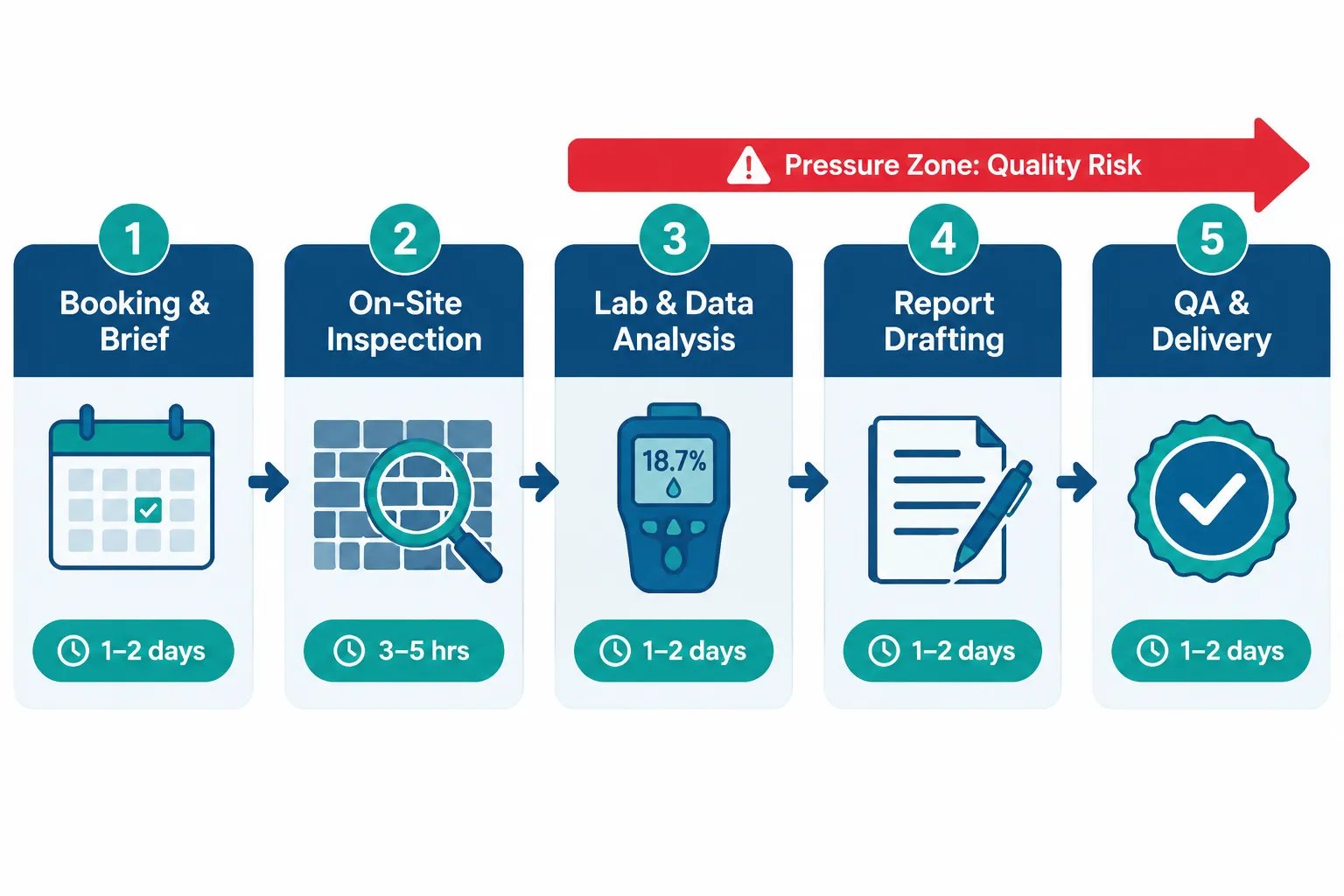
A residential building survey, particularly a Level 3 Home Survey, typically involves five distinct phases:
| Phase | Typical Duration | Quality-Critical Activity |
|---|---|---|
| Booking and brief | 1-2 days | Scoping, access arrangements |
| On-site inspection | 3-8 hours | Physical examination of fabric |
| Data analysis and research | 1-2 days | Cross-referencing findings, title checks |
| Report drafting | 1-3 days | Structured narrative, risk grading |
| Quality assurance and delivery | 1-2 days | Peer review, client communication |
End to end, this process commonly spans two to three and a half weeks when access, scheduling, and report preparation are all factored in [1]. For commercial properties, the window extends further, a large commercial building survey can take four to eight weeks to complete properly [6].
Any turnaround below three to five working days is widely treated as an express or accelerated service [2][9]. That distinction matters. When surveyors charge a premium for faster delivery, they are signalling that accelerated work is an exceptional mode of operation, not a routine upgrade.
Why the timeline is not simply a matter of convenience:
- The on-site inspection itself is relatively inelastic. A thorough inspection of a three-bedroom semi-detached property takes three to five hours regardless of how quickly the client wants the report [5]. Cutting corners on-site is where the most serious quality failures begin.
- Post-inspection analysis requires time to cross-reference observations, consult specialist databases (such as coal mining or flood risk records), and sequence findings into a coherent risk narrative.
- Quality assurance, often a peer review by a second chartered surveyor, is the first stage to be dropped when deadlines tighten.
Where Quality Breaks Down: The Pressure Points
Understanding how shorter timelines affect UK building survey quality from a surveyor's perspective requires identifying precisely which parts of the process are most vulnerable to compression.
Analysis and Contextualisation
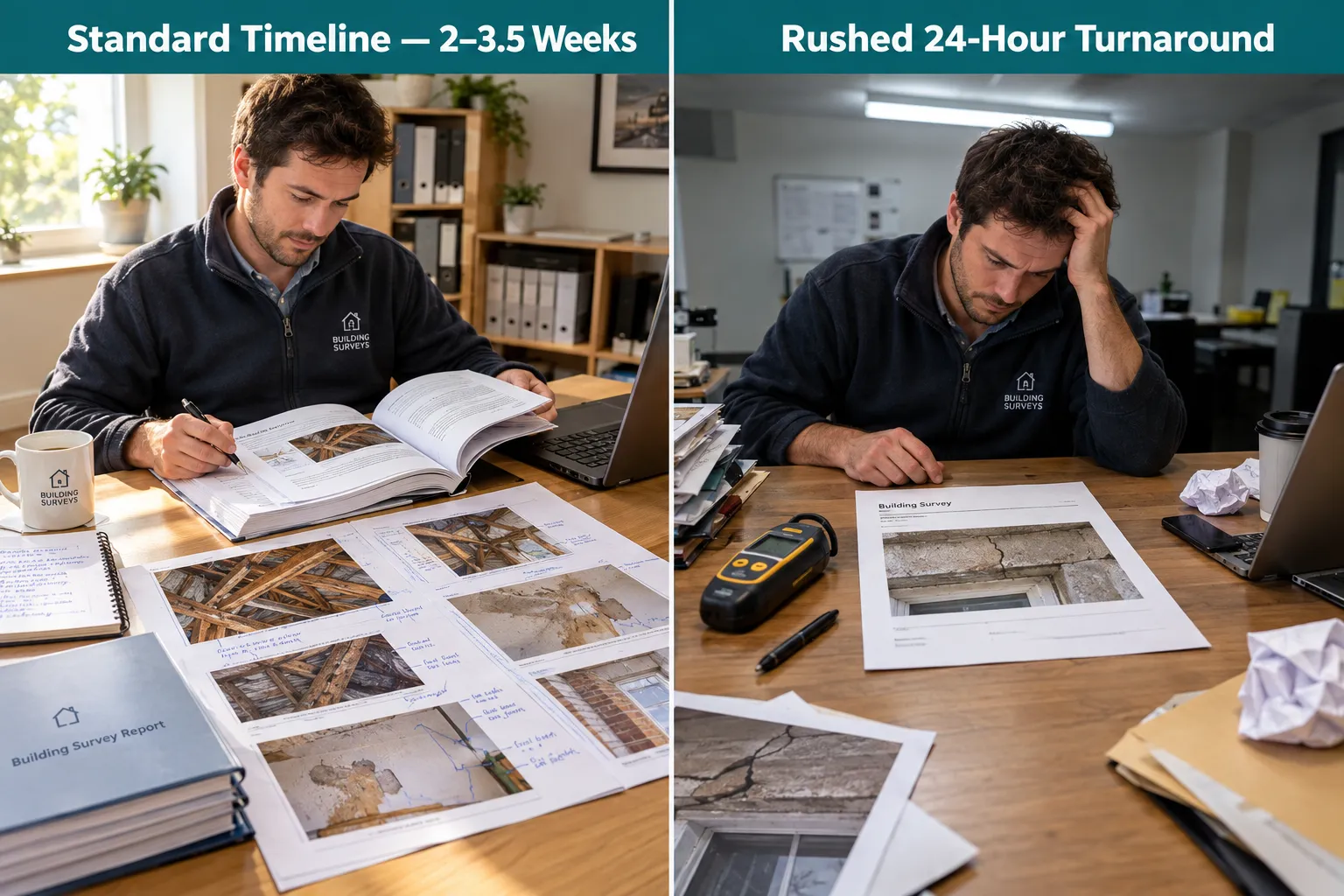
The on-site inspection generates raw observations. Converting those observations into actionable advice requires contextualisation: comparing findings against building age, construction type, local geology, and planning history. A surveyor working under a 24-hour turnaround has little time to consult local authority records, check for historic subsidence claims, or research whether a particular roof construction is prone to cold-bridging.
"Speed is the enemy of nuance. A crack in a wall can mean nothing or everything, and the difference takes time to establish."
This is especially relevant for older housing stock. Properties built between the 1930s and 1970s carry a specific set of hidden defects, including non-standard construction, asbestos-containing materials, and aluminium wiring, that require careful identification and contextualisation rather than a rapid visual sweep.
Report Drafting Quality
A well-drafted survey report is not simply a list of defects. It grades risk, provides remediation guidance, flags items requiring specialist investigation, and communicates uncertainty honestly. Under time pressure, reports tend to become shorter, more generic, and less specific to the individual property. Condition ratings may default to the middle of the scale to avoid the follow-up questions that a more definitive assessment would generate.
RICS-aligned guidance is explicit that thoroughness takes precedence over speed. There is no fixed turnaround standard in RICS guidance precisely because the time required varies with property complexity. A surveyor who commits to a 24-hour report on a 1900s terraced house with a cellar, bay extensions, and a rear addition is making a promise that the guidance framework does not support.
Quality Assurance
Peer review is the professional backstop that catches errors before a report reaches the client. When timelines compress, QA is typically the first stage to be abbreviated or removed entirely. The consequences are not always visible immediately, a missed damp issue or an under-reported roof defect may only become apparent after exchange of contracts.
Communication and Follow-Up
A survey report is the beginning of a conversation, not the end of one. Surveyors who are operating under volume pressure, a growing problem as caseloads increase across the sector, have less time to speak with clients after delivery, answer follow-up questions, or clarify ambiguous findings. This communication gap is a quality failure that rarely appears in formal complaints data but has a material effect on how well buyers understand what they have purchased.
Party Wall, Damp, and Structural Surveys Under Time Pressure
The quality risks associated with compressed timelines are not evenly distributed across survey types. Three areas are particularly vulnerable.
Party Wall Reporting
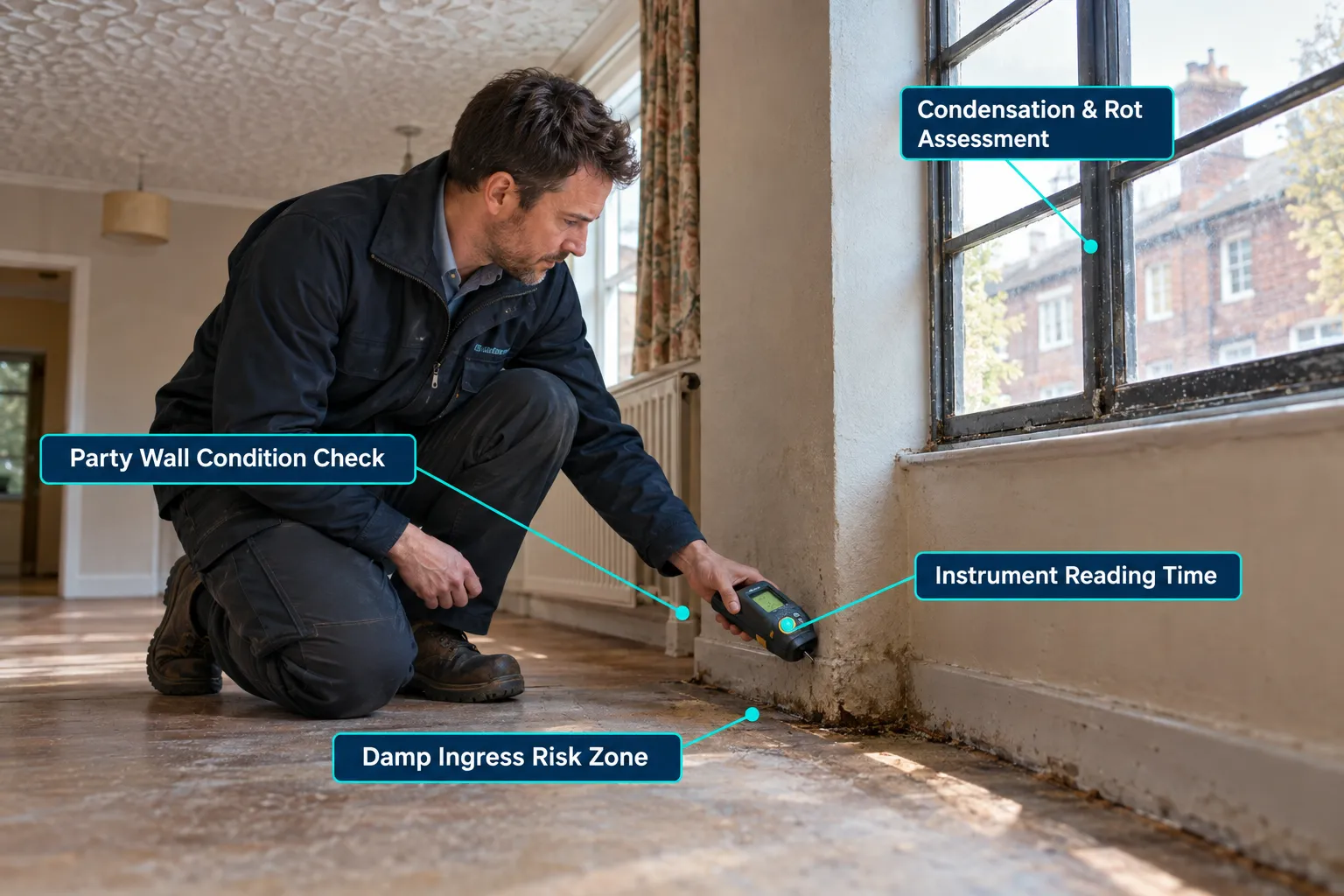
Party wall surveys operate under the Party Wall etc. Act 1996 and carry legal consequences for both building owners and adjoining owners. A schedule of condition, the document that records the pre-works state of an adjoining property, must be thorough enough to serve as evidence in a dispute. Rushed schedules that omit existing cracks, settlement patterns, or drainage details create significant legal exposure.
Understanding party wall surveyor responsibilities is essential context here. The role is quasi-judicial; the surveyor acts in the interests of the process rather than either party. That independence requires careful, unhurried documentation. A 24-hour party wall schedule is not simply a faster version of a thorough one, it is a structurally different product.
Damp Assessment
Damp diagnosis is one of the most technically demanding aspects of residential surveying. Distinguishing between rising damp, penetrating damp, condensation, and plumbing-related moisture requires a combination of instrument readings, visual assessment, and contextual analysis. Each of these takes time. A surveyor under pressure to deliver quickly may rely on a single moisture meter reading rather than the matrix of readings, observations, and seasonal context that a reliable diagnosis requires.
The financial consequences of a missed or misdiagnosed damp issue can be severe. Remediation costs for significant rising damp or penetrating damp in a period property can run into five figures. Understanding damp surveyor fees in context, and recognising that a lower fee for faster delivery may represent a false economy, is important for any buyer commissioning this type of work.
Structural Defect Detection
Structural issues, including subsidence, lintel failure, roof spread, and foundation movement, are the defects with the highest remediation costs and the greatest impact on mortgage valuations. They are also the defects most likely to be missed under time pressure, because many require the surveyor to spend time in roof voids, under floors, and in outbuildings that a rushed inspection may not reach.
Wall cracks are a classic example. A diagonal crack running from a window corner to a floor junction can indicate thermal movement, differential settlement, or active subsidence. Distinguishing between these requires time: time to measure crack width, assess crack pattern, check for associated distortion, and consider the building's history. A surveyor with 45 minutes allocated to a property rather than four hours will not have that time.
Technology, Speed, and the Shifting Quality Risk Profile
Laser scanning and photogrammetry have changed the speed equation for measured surveys. A laser scan of a building can capture millions of data points in a fraction of the time that traditional measured survey methods would require [3][8]. This has genuinely compressed on-site time without proportionally reducing quality.
However, the quality risk does not disappear, it migrates. Rapid scan data still requires skilled office-based processing, interpretation, and quality checking. The surveying technology accelerates data capture but does not automate professional judgement. A firm that uses laser scanning to cut costs while also cutting processing time has simply moved the quality risk from the field to the office.
For residential building surveys, as opposed to measured surveys, technology adoption has been slower. Thermal imaging cameras, drones for roof inspection, and digital reporting platforms all offer genuine quality improvements. But they require investment, training, and time to use properly. They are tools that support thoroughness, not substitutes for it.
Key distinctions between survey types and technology impact:
- Measured surveys: Technology meaningfully reduces on-site time; quality risk shifts to processing [3]
- Level 2 Homebuyer Reports: Technology adds value but inspection time remains the binding constraint [4]
- Level 3 Building Surveys: Complexity means technology assists but cannot substitute for extended on-site time [5]
- Valuation surveys: Volume pressure from lenders creates the most acute speed-versus-quality tension [7]
What Buyers and Clients Should Realistically Expect
The growing expectation among buyers for faster survey delivery is understandable in a competitive market. Chains move quickly, mortgage offers have expiry dates, and sellers are impatient. But advisory guidance consistently warns against prioritising speed over thoroughness, and the evidence from the sector supports that warning.
When considering which survey type is right for a given property, the timeline question is inseparable from the quality question. A Level 2 Homebuyer Report on a modern flat may genuinely be deliverable in three to four working days without material quality loss. A Level 3 Building Survey on a 1920s detached house with extensions, a cellar, and a flat-roof section cannot be, not to the standard that RICS guidance envisages.
Practical questions to ask before commissioning a survey:
- What is the surveyor's realistic on-site time for this specific property?
- Is the quoted turnaround the delivery date or the inspection date?
- Does the fee include a post-report telephone consultation?
- Will the report be peer-reviewed before delivery?
- Is the surveyor familiar with the local area and its specific construction types?
A London-based surveyor consultancy with genuine local knowledge, understanding, for example, the prevalence of London stock brick construction, clay shrinkage subsidence, or basement conversion risks in specific boroughs, will add more value than a national volume provider offering a 48-hour turnaround.
The Forward Outlook: Timeline Pressure Is Likely to Intensify
The structural pressures driving shorter timelines are not easing. Surveyor caseloads have increased as the housing market has remained active, and the pipeline of newly qualified surveyors has not kept pace with demand. This means that the average surveyor is managing more instructions simultaneously, which creates implicit pressure to move each one through the system faster.
Lender expectations compound this. Mortgage valuations, a different product from a building survey but often confused with one, are subject to volume-driven turnaround expectations that have historically favoured speed over depth. As automated valuation models (AVMs) take on more of the routine valuation work, human surveyors are increasingly deployed on the more complex cases, which are precisely the cases where rushed timelines cause the most damage.
The professional response, supported by RICS guidance, is to resist timeline compression that cannot be delivered without quality compromise, and to be transparent with clients when a requested turnaround is not compatible with a thorough survey. Surveyors who accept every instruction regardless of the timeline are not serving their clients well, and in some cases, they may be exposing themselves to professional liability.
Conclusion
How shorter timelines affect UK building survey quality, from a surveyor's perspective, comes down to a straightforward principle: the time required to do a thorough job is determined by the property, not the client's schedule. Compressing the analysis, drafting, and quality assurance stages of a survey does not produce a faster version of the same product, it produces a different, lower-quality product that carries greater risk for everyone involved.
Actionable next steps for buyers and property professionals in 2026:
- Allow a minimum of two to three weeks between survey instruction and exchange when commissioning a Level 3 Building Survey
- Treat any quote promising a full structural survey report within 24-48 hours with caution, and ask specific questions about on-site time and QA processes
- Understand the difference between a Homebuyer Report and a full structural survey before deciding which product to commission
- If timeline pressure is unavoidable, commission the most appropriate survey level for the property rather than accepting a rushed Level 3
- Work with a chartered surveyor who is transparent about what can and cannot be delivered within the available time
The cost of a thorough survey is fixed and known. The cost of a missed defect is neither.
References
[1] How Long Does A Building Survey Take – measuredsurvey365.co.uk
[2] How Long Does Survey Take – corinthiansurveyorslondon.co.uk
[3] As Built Survey Surveyors Uk And London Guide – icelabz.co.uk
[4] How Long Does The Technical Property Survey Usually Take – promisemoney.co.uk
[5] How Long Does House Survey Take – hoa.org.uk
[6] How Long Does A Commercial Building Survey Take – eddisons.com
[7] Rics Survey Cost – surveymatch.co.uk
[8] Measured Survey Costs – ths-concepts.co.uk
[9] How Long Does It Take To Receive A Property Survey Report – lloyddixongroup.com
[10] Cost Of Measured Building Survey – princesurveyors.co.uk