

Only 1 in 3 property dispute claimants in England and Wales instruct an expert witness who holds formal RICS accreditation — yet courts consistently give greater weight to evidence from those who do. Whether a boundary disagreement has turned adversarial or a commercial lease renewal has stalled over contested figures, finding RICS-registered expert witnesses for valuation and party wall disputes: UK Directory Guide 2026 is the practical starting point every property owner, solicitor, and developer needs in the current landscape.
This guide cuts through the complexity of registers, credentials, and cost structures so that the right expert can be appointed with confidence — and without overpaying.
Key Takeaways
- 🏛️ RICS accreditation matters in court: The RICS Expert Witness Accreditation Service (EWAS) is the gold standard for assessing competence, and courts treat EWAS-certified evidence with greater credibility.
- 📋 2026 brings major regulatory updates: The RICS 8th Edition Party Wall Guidance and the 5th Edition Expert Witness Standards are both being implemented this year, changing how surveyors must operate.
- 🔍 Multiple registers exist: RICS Find a Surveyor, the Expert Witness Institute, and specialist firm directories are all valid search routes — each with different filtering tools.
- ⚖️ Civil Procedure Rules Part 35 compliance is non-negotiable: Any expert witness report submitted to a UK court must meet CPR Part 35 and Practice Direction 35 requirements.
- 💷 Cost-effective hiring is achievable: Knowing how fee structures work — and when a single joint expert is appropriate — can reduce costs significantly without sacrificing quality.
Why 2026 Is a Pivotal Year for RICS Expert Witnesses
Two significant regulatory shifts are reshaping the expert witness landscape in 2026, making it more important than ever to understand what credentials actually mean before instructing anyone.
The RICS 8th Edition Party Wall Guidance
In April 2026, RICS launched an eight-week consultation on the draft 8th edition of its Party Wall Legislation and Procedure guidance [1]. This overhaul — the most comprehensive update in over a decade — introduces:
- Revised letters of appointment clarifying the statutory and personal nature of a party wall surveyor's role
- Updated draft awards with clearer procedural frameworks
- Strengthened conduct guidance addressing cases where awards have been challenged because surveyors acted without proper jurisdiction [1]
A critical point in the new guidance is the explicit reminder that a party wall surveyor's appointment is personal and statutory, not subject to client instruction. This distinction has direct implications for expert witnesses: an expert who conflates their advisory role with their statutory duty risks having their evidence discredited.
Following the consultation period, the 8th Edition is set for immediate implementation in 2026 [5], meaning any surveyor instructed from this point forward should already be operating under the new framework.
The RICS 5th Edition Expert Witness Standards
Running in parallel, the 5th edition of RICS's Surveyors Acting as Expert Witnesses professional standard has also been implemented in 2026 [7]. This edition applies globally while recognising local legal differences — reflecting the increasingly international nature of property investment and cross-border dispute resolution. For UK practitioners, it reinforces the primacy of CPR Part 35 compliance and impartiality obligations.
"The credibility of expert witness reports is crucial in party wall disputes that escalate to litigation. Surveyors must adhere to Practice Direction 35, ensuring impartiality, methodical evidence gathering, and regulatory compliance." [6]
Understanding these changes is essential context before searching any directory. An expert who has not updated their practice to reflect 2026 standards may produce reports that are challenged — or worse, excluded — at tribunal.
For a grounding in the statutory framework that underpins most party wall disputes, the Party Wall Act 1996 guide by a party wall agreement surveyor provides an accessible overview of how the legislation operates in practice.
How to Use UK Directories When Finding RICS-Registered Expert Witnesses for Valuation and Party Wall Disputes: UK Directory Guide 2026
There is no single definitive register. Instead, several overlapping directories serve different purposes. The table below summarises the main options:
| Directory | Best For | Filter Options | Cost to Search |
|---|---|---|---|
| RICS Find a Surveyor | Verified RICS members | Specialism, location, accreditation | Free |
| RICS Expert Witness Accreditation Service (EWAS) | Court-ready experts | EWAS badge, subject area | Free |
| Expert Witness Institute (EWI) | Cross-discipline experts | Profession, region, court experience | Free |
| Academy of Experts | Mediation and arbitration | Specialism, ADR experience | Free |
| Specialist firm directories (e.g., expertwitnessrics.com) | Niche RICS surveyors | Party wall, valuation, dilapidations | Free |
Step 1: Start With RICS EWAS
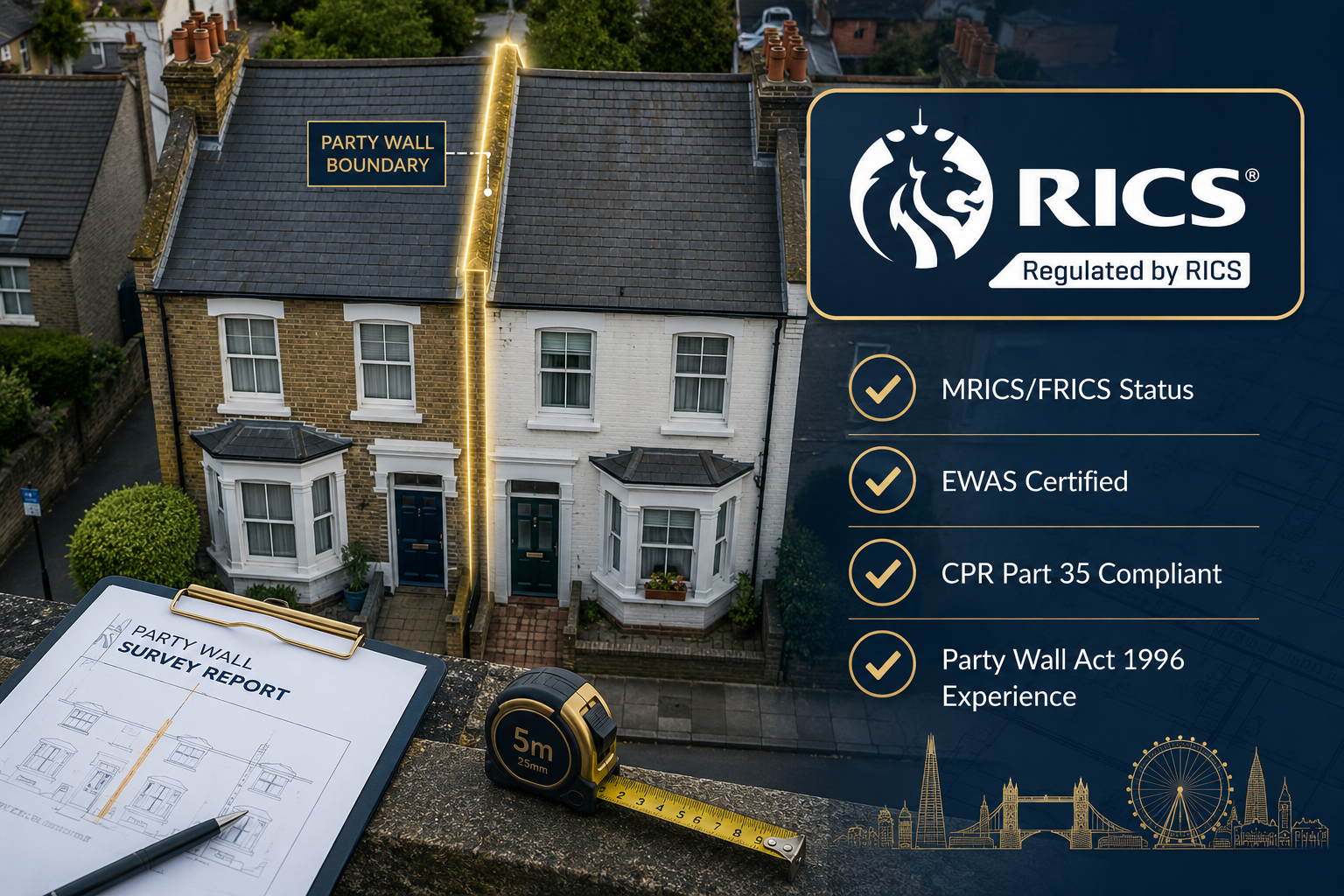
The RICS Expert Witness Accreditation Service is the most rigorous entry point [2]. To hold EWAS accreditation, a professional must:
- ✅ Demonstrate relevant subject matter experience in their specialism
- ✅ Complete the RICS Certificate in Expert Witness
- ✅ Pass a comprehensive quality control regime managed by the RICS Dispute Resolution Service [2]
This three-stage process means an EWAS badge is not merely decorative — it signals that the expert has been assessed on both technical knowledge and court-room competence. When instructing for high-value or complex matters, filtering by EWAS status first is strongly recommended.
Step 2: Filter by Specialism
Party wall disputes and valuation disputes require different expertise. Be precise:
For party wall matters, look for surveyors with:
- Experience acting as agreed surveyor or third surveyor under the Party Wall Act 1996
- Familiarity with the new RICS 8th Edition guidance [5]
- A track record of producing party wall awards that have withstood challenge
For valuation disputes, look for:
- MRICS or FRICS status with a valuation pathway
- Experience in the specific asset class (residential, commercial, leasehold)
- Knowledge of the RICS Red Book (Global Valuation Standards)
Firms specialising in RICS expert witness services typically cover construction disputes, boundary disputes, party wall matters, dilapidations, professional negligence, and valuation disputes — with all surveyors RICS accredited and offering impartial evidence compliant with Civil Procedure Rules Part 35 [3].
For disputes involving property valuation or legal disputes more broadly, confirming that the expert's specific experience matches the subject matter of the claim is essential before shortlisting.
Step 3: Check Court and Tribunal Experience
Not all surveyors who hold RICS membership have appeared in court. Ask directly:
- Have they given oral evidence in the County Court, Upper Tribunal, or First-tier Tribunal (Property Chamber)?
- Have they been cross-examined on a report?
- Can they provide anonymised case references or a CV listing relevant proceedings?
An expert who has only produced desktop reports — without ever being tested under cross-examination — carries greater risk in contested litigation.
Credentials, Cost, and Court Suitability: A Practical Checklist

The Credential Hierarchy
When evaluating candidates, the following hierarchy applies in most UK property dispute contexts:
- FRICS + EWAS accreditation — highest credibility, appropriate for High Court or complex Upper Tribunal matters
- MRICS + EWAS accreditation — strong credibility, suitable for County Court and First-tier Tribunal
- MRICS without EWAS — acceptable for lower-value disputes or where the expert has demonstrable court experience
- AssocRICS — generally insufficient for expert witness roles; more appropriate for advisory work
Impartiality: The Non-Negotiable Standard
Regardless of technical expertise, an expert witness's primary duty is to the court, not to the instructing party. This principle — enshrined in CPR Part 35 — means that any surveyor who appears to advocate for their client rather than provide objective analysis risks having their report disregarded [4].
Key question to ask at interview: "Can you describe a case where your expert opinion was unfavourable to the instructing party, and how you handled that?"
A confident, specific answer to this question is a reliable indicator of genuine impartiality. Evasion is a warning sign.
For disputes that have reached the stage where a party wall notice has been received and formal proceedings are being considered, understanding the expert's approach to impartiality early in the process can prevent costly mid-case complications.
Understanding Fee Structures
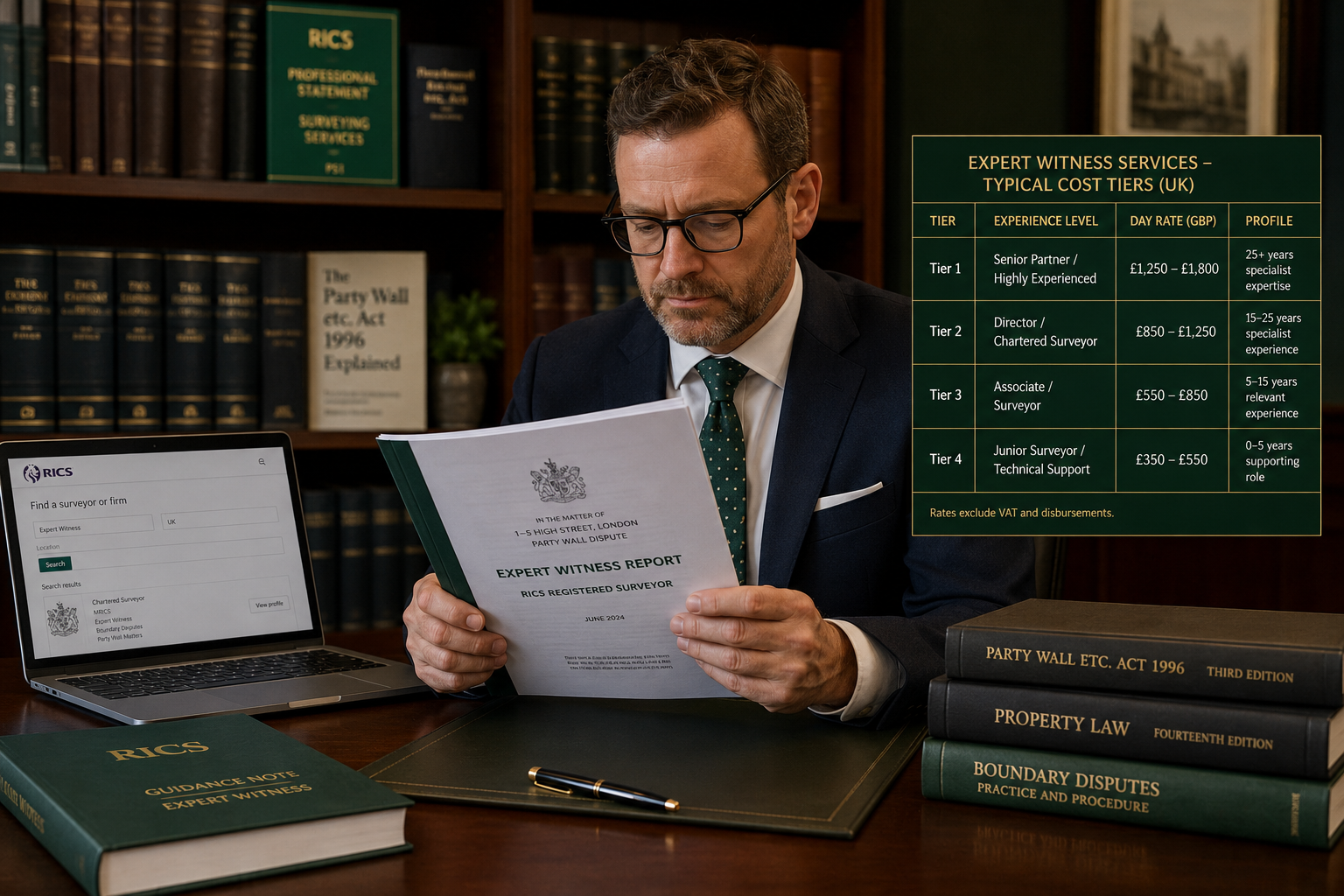
Expert witness fees in the UK vary considerably. The table below provides indicative 2026 ranges:
| Service | Typical Fee Range (2026) |
|---|---|
| Initial consultation (1 hour) | £150 – £350 |
| Desktop expert report (standard) | £1,500 – £4,000 |
| Full expert witness report (court-ready) | £3,500 – £12,000+ |
| Attendance at hearing (per day) | £1,500 – £5,000 |
| Joint statement / without-prejudice meeting | £500 – £2,000 |
💡 Cost-saving tip: Consider a Single Joint Expert (SJE)
In lower-value disputes, courts often encourage or direct parties to instruct a Single Joint Expert rather than each party appointing their own. This can halve the expert costs while still providing the court with independent, credible evidence. SJEs are particularly common in residential valuation disputes and straightforward party wall damage claims.
For matters involving legal fees and court costs, factoring in the full cost of expert evidence from the outset — including potential hearing attendance — prevents budget surprises later.
Red Flags to Watch For
Avoid instructing an expert witness who:
- ❌ Offers to produce a report before reviewing all relevant documents
- ❌ Cannot clearly explain their methodology for reaching conclusions
- ❌ Has no experience of the specific dispute type (e.g., has never dealt with a party wall award)
- ❌ Is unwilling to meet the opposing expert for a without-prejudice discussion
- ❌ Uses vague or hedged language in their CV about court appearances
Specialist Registers for Party Wall and Valuation Disputes
Party Wall Surveyors as Expert Witnesses
Party wall surveyors occupy a unique dual role. Under the Party Wall Act 1996, they act as quasi-arbitrators in resolving disputes between building and adjoining owners. When those disputes escalate to litigation — typically where a party challenges the validity of an award or claims damages — the same surveyor may be asked to provide expert evidence.
This dual role creates a potential conflict of interest that the RICS 8th Edition guidance directly addresses [1]. The key principle: a surveyor who made the original award should not then act as an expert witness commenting on its validity. Separate instruction is required.
For complex party wall matters, particularly those involving expert party wall advice or disputes about party wall agreements, instructing a surveyor who was not involved in the original award process is the cleanest approach.
Valuation Expert Witnesses
Valuation disputes arise in multiple contexts:
- Lease extension premiums under the Leasehold Reform Act
- Compulsory purchase compensation
- Matrimonial asset division
- Professional negligence claims against valuers
- Rent review arbitrations
For lease-related valuation disputes, surveyors with specific experience in lease extension valuation are better placed to provide credible expert evidence than generalist valuers.
The RICS Red Book compliance requirement means that any valuation produced for court purposes must follow prescribed methodology — an expert who cannot demonstrate Red Book compliance in their report is immediately vulnerable to challenge.
Dilapidations and Boundary Disputes
Two further categories regularly require RICS-registered expert witnesses:
Dilapidations: Commercial lease-end disputes over the condition of premises. Experts need experience of Scott Schedules and the interaction between dilapidations claims and diminution in value arguments.
Boundary disputes: These often require a combination of surveying expertise and knowledge of property boundary guidelines and title plan interpretation. Experts with GIS experience and land registry mapping skills are particularly valuable here.
Practical Steps for Instructing an Expert Witness in 2026
A streamlined instruction process reduces delays and cost overruns. Follow this sequence:
- Define the issues in dispute — produce a brief summary of the key questions the expert needs to address
- Search RICS EWAS — filter by specialism and location; create a shortlist of three candidates
- Request CVs and fee proposals — ask each candidate to confirm EWAS status, relevant case experience, and availability
- Conduct a brief interview — 20–30 minutes is sufficient to assess communication style and impartiality
- Check for conflicts of interest — confirm the expert has no prior involvement with the property, parties, or related proceedings
- Issue a formal letter of instruction — this should define the scope, the questions to be addressed, the documents provided, and the deadline
- Agree a timetable — align with court directions or tribunal deadlines from the outset
Practical note: Courts are increasingly critical of expert evidence that is produced late or that exceeds the scope of the letter of instruction. A clear, well-drafted instruction letter protects both the client and the expert.
For those working with professional surveyor services in London and the South East, confirming that the expert is familiar with local market conditions — particularly relevant in valuation disputes — adds an additional layer of credibility to the evidence.
Conclusion: Actionable Next Steps for 2026
Finding RICS-registered expert witnesses for valuation and party wall disputes: UK Directory Guide 2026 is not simply about locating a name on a register. It is about matching the right credentials, the right experience, and the right temperament to the specific demands of a dispute.
The 2026 regulatory changes — the RICS 8th Edition Party Wall Guidance and the 5th Edition Expert Witness Standards — have raised the bar for what courts and tribunals expect from expert evidence. Instructing parties who understand these changes will be better positioned to build credible, cost-effective cases.
Actionable next steps:
- 🔎 Search RICS EWAS first at rics.org — filter by specialism before widening the search
- 📄 Confirm 2026 standards compliance — ask candidates directly whether they have updated their practice to reflect the 8th Edition and 5th Edition guidance
- 💬 Interview before instructing — a short conversation reveals far more than a CV about impartiality and communication
- 💷 Explore SJE options — for lower-value disputes, a single joint expert is often the most cost-effective and court-friendly approach
- 📋 Draft a clear letter of instruction — define the questions, scope, and deadline before any work begins
The difference between a well-chosen expert witness and a poorly chosen one can determine the outcome of a dispute. In 2026, with standards higher than ever, the selection process deserves the same rigour as the case itself.
References
[1] Rics Launches Consultation On Updated Party Wall Practice Guidance – https://www.rics.org/news-insights/rics-launches-consultation-on-updated-party-wall-practice-guidance?utm_source=openai
[2] Expert Witness Accreditation Service – https://www.rics.org/dispute-resolution-service/panel-of-experts/expert-witness-accreditation-service?utm_source=openai
[3] expertwitnessrics – https://www.expertwitnessrics.com/?utm_source=openai
[4] Surveyors Expert Witness Telecoms Disputes – https://ww3.rics.org/uk/en/journals/land-journal/surveyors-expert-witness-telecoms-disputes.html?utm_source=openai
[5] Rics 8th Edition Party Wall Guidance Post Consultation Changes And Immediate 2026 Implementation For Surveyors – https://www.canterburysurveyors.com/blog/rics-8th-edition-party-wall-guidance-post-consultation-changes-and-immediate-2026-implementation-for-surveyors/?utm_source=openai
[6] Expert Witness Valuations In Party Wall Disputes Building Credible Cases Under Practice Direction 35 – https://www.canterburysurveyors.com/blog/expert-witness-valuations-in-party-wall-disputes-building-credible-cases-under-practice-direction-35/?utm_source=openai
[7] Expert Witness Valuations In Stabilising Markets Rics Evidence Standards For 2026 Price Recovery Disputes – https://www.canterburysurveyors.com/blog/expert-witness-valuations-in-stabilising-markets-rics-evidence-standards-for-2026-price-recovery-disputes/?utm_source=openai