
Nearly one in five UK property transactions that proceed to survey stage result in a renegotiation or withdrawal — yet most buyers admit they do not fully understand the report sitting in their inbox. Knowing how to read a building survey is one of the most financially consequential skills a homebuyer can develop. This UK homebuyer guide to Level 2 and Level 3 reports cuts through the RICS jargon, translates condition ratings into plain English, and shows exactly what to focus on, what to ignore, and when to act.
Key Takeaways
- RICS surveys come in three levels; Level 2 (HomeBuyer Report) and Level 3 (Building Survey) are the most relevant for most buyers.
- Both report types use a traffic-light condition rating system — Condition Rating 3 (red) demands immediate attention and often justifies renegotiation.
- The depth of inspection differs significantly: Level 2 covers visible and accessible areas, while Level 3 investigates concealed areas, materials, and long-term maintenance risks.
- Not every defect flagged in a report is a deal-breaker; understanding severity, cost, and urgency is the key to a proportionate response.
- Buyers can use survey findings to renegotiate the purchase price, request repairs, commission specialist reports, or, in serious cases, walk away.
Understanding the Three RICS Survey Levels
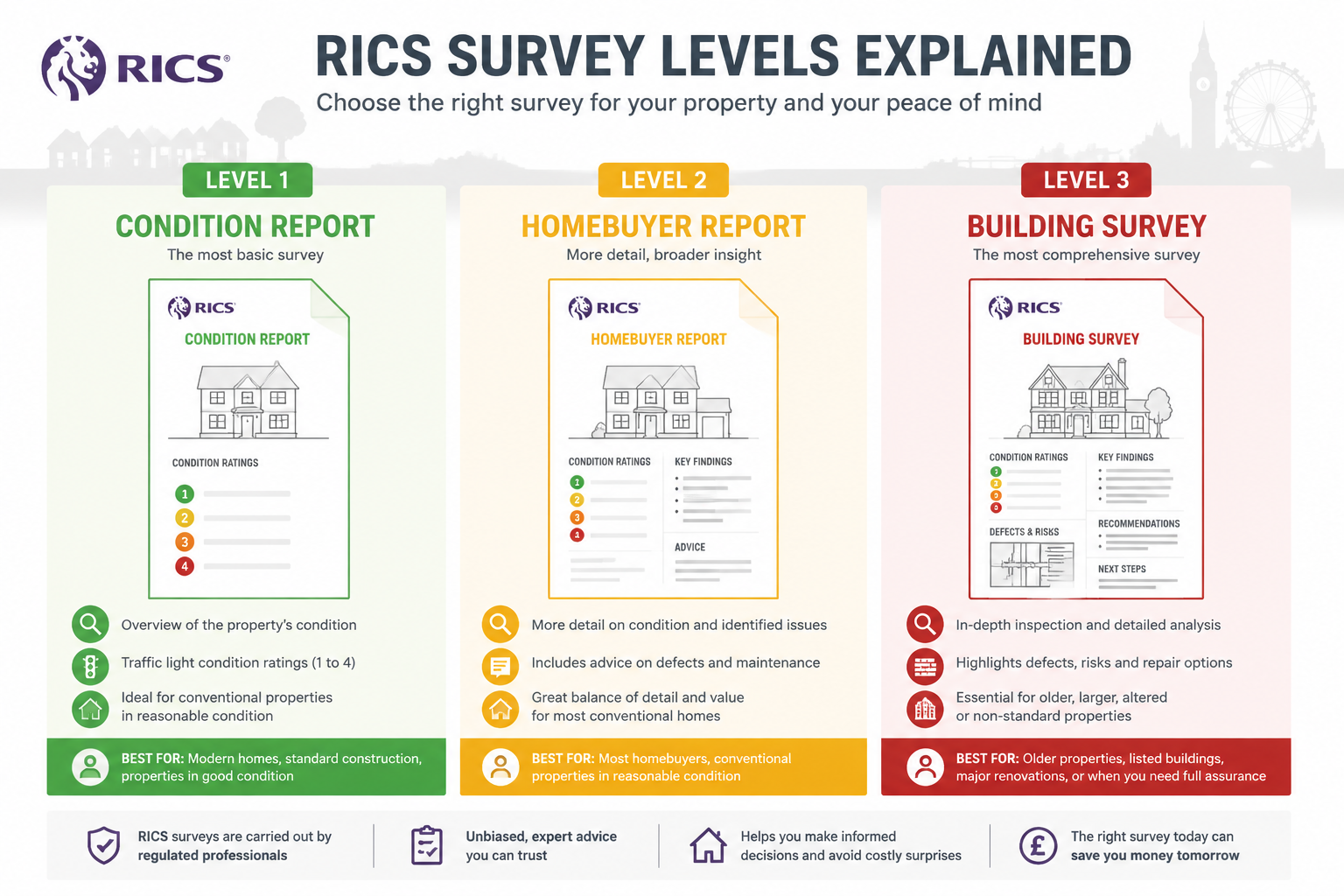
Before diving into how to read a building survey, it helps to understand where Level 2 and Level 3 sit within the RICS framework. The Royal Institution of Chartered Surveyors (RICS) standardises home surveys into three tiers [1]:
| Survey Level | Common Name | Best Suited For |
|---|---|---|
| Level 1 | Condition Report | New builds, conventional properties in good condition |
| Level 2 | HomeBuyer Report | Standard properties in reasonable condition |
| Level 3 | Building Survey | Older, altered, non-standard, or complex properties |
Level 1 provides only a basic snapshot — useful for peace of mind on a near-new home but offering little analytical depth.
Level 2 (the HomeBuyer Report) is the most commonly commissioned survey in England and Wales. It covers visible and accessible areas, giving a concise overview of the property's condition. Costs typically range from £400 to £800 depending on property size and location [1].
Level 3 (the Building Survey, formerly called a Full Structural Survey) is a comprehensive analysis. It examines concealed areas where access is reasonably possible, identifies materials used in construction, and flags potential future maintenance issues [3]. It is the appropriate choice for properties built before 1900, those with extensions or significant alterations, or any home where the buyer suspects underlying problems.
If you are unsure which type suits your purchase, the guide on choosing between a HomeBuyer Report or structural survey provides a practical framework for making that decision.
Decoding the Condition Rating System
Both Level 2 and Level 3 reports use a traffic-light condition rating system that assigns every inspected element a numerical score [2]. Understanding these ratings is the single most important skill when learning how to read a building survey.
Condition Rating 1 — Green
No repair needed. The element is performing as expected for its age and type. Buyers can note these sections and move on. A green rating does not mean the element is new or perfect — it means no action is required at present.
Condition Rating 2 — Amber
Defects that need attention but are not serious or urgent. These are the most common entries in any report. Typical examples include minor roof tile slippage, hairline cracks in render, or slightly worn window seals. Amber items should be budgeted for in the medium term, but they rarely justify renegotiation on their own.
Condition Rating 3 — Red
Serious and/or urgent defects requiring immediate repair or further investigation. A Condition Rating 3 entry is the surveyor's clearest signal that something is wrong. Examples include active damp penetration, significant structural movement, defective drainage, or a roof nearing the end of its serviceable life [2].
"A single Condition Rating 3 entry does not automatically mean the property is uninhabitable — but it does mean the buyer needs a cost estimate before proceeding."
A useful resource for seeing how these ratings appear in practice is this example of a HomeBuyer report and complete property survey guide, which shows a real-world report layout with annotations.
How to Read a Level 2 HomeBuyer Report Section by Section
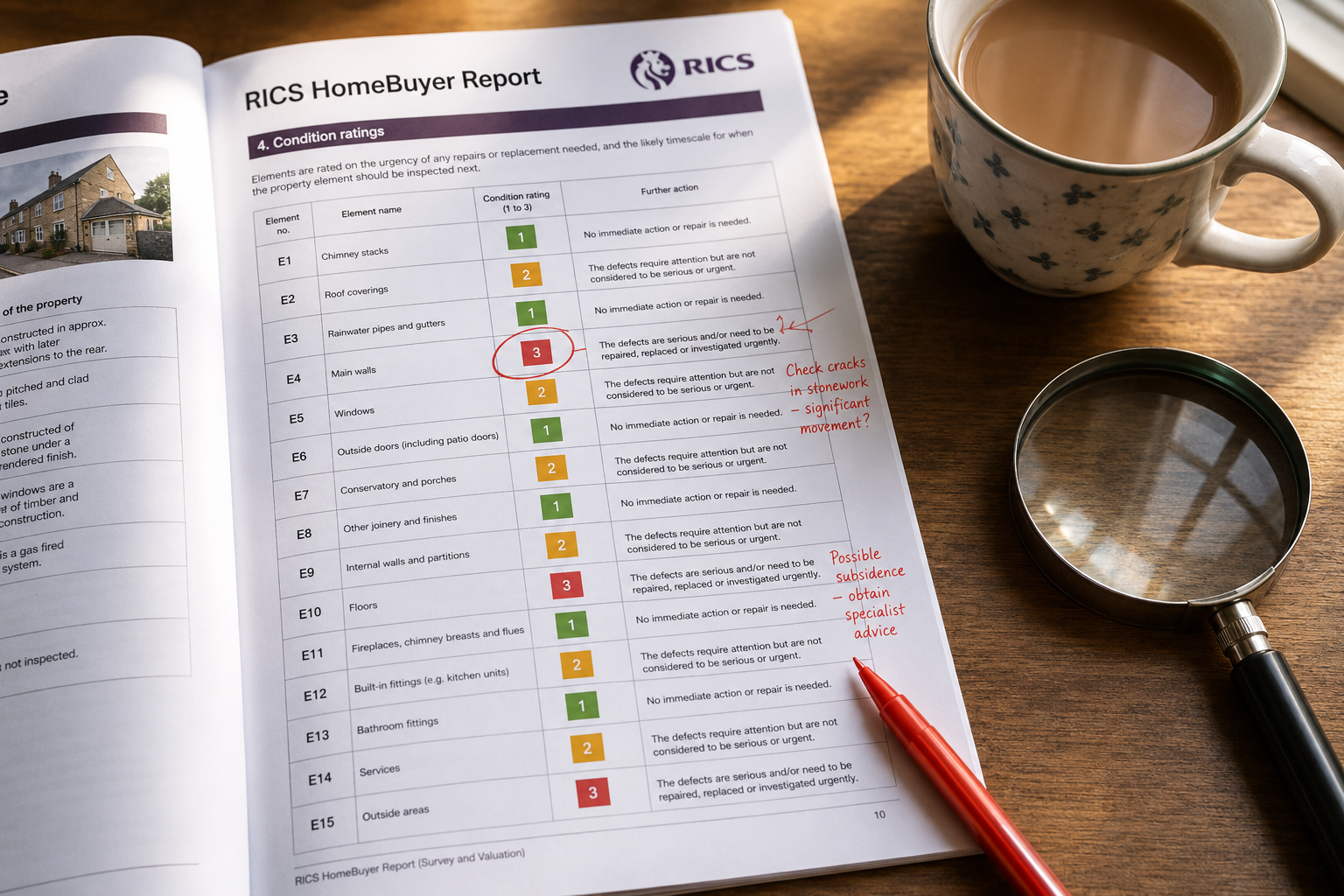
A standard Level 2 report follows a structured format. Here is how to navigate it efficiently.
The Summary of Condition Ratings
Most Level 2 reports open with a summary table listing every inspected element alongside its condition rating. Start here. Count the Condition Rating 3 entries first. If there are none, the property is likely in reasonable shape. If there are several, read each corresponding section in full before doing anything else.
The Sections Covering the Property
The report is divided into sections covering the exterior, interior, services, and grounds. Each section describes what the surveyor observed, assigns a condition rating, and may include a brief explanation. Key sections to scrutinise include:
- Roof structure and covering — Roof repairs are among the most expensive defects. Any Rating 3 here warrants a specialist roofer's quote.
- Walls and chimney stacks — Look for references to cracking patterns, bulging, or repointing needs.
- Damp and timber — The surveyor will note any elevated moisture readings. Distinguish between condensation (often manageable) and rising or penetrating damp (more serious).
- Services — Electrical, gas, and drainage systems are typically described as "not tested" in a Level 2 report. A Rating 3 here usually means the surveyor observed visible evidence of a problem, not that they tested the system.
The "Risks" and "Considerations" Sections
Level 2 reports often include a section on legal issues to consider (such as rights of way or planning history) and a risks section covering environmental matters like flooding or subsidence potential. These are not defect ratings but contextual flags that the buyer's solicitor should investigate.
What a Level 2 Report Does Not Cover
A Level 2 survey does not lift floorboards, inspect behind wall linings, or assess concealed roof timbers. If the surveyor notes that they were unable to inspect a particular area and recommends further investigation, treat that recommendation seriously. For properties with suspected hidden problems, a RICS Level 3 Building Survey provides the deeper analysis that a Level 2 cannot offer.
How to Read a Level 3 Building Survey
A Level 3 report is substantially longer — often 50 to 80 pages — and far more technical in its language. The same condition rating system applies, but the scope of inspection is considerably wider [3].
What the Level 3 Covers That Level 2 Does Not
| Inspection Element | Level 2 | Level 3 |
|---|---|---|
| Visible roof structure | Limited | Detailed |
| Concealed areas (where accessible) | No | Yes |
| Construction materials and methods | Brief | In depth |
| Future maintenance projections | Rarely | Routinely |
| Structural movement analysis | Basic | Comprehensive |
The Level 3 report will typically include the surveyor's opinion on the cause of any defect, not just its presence. This is significant: knowing that cracking is caused by thermal movement rather than subsidence changes the cost and urgency of the response entirely [6].
Reading the Executive Summary
Most Level 3 reports include an executive summary or priority items section at the front. Read this first to understand the overall picture, then work through the full report to understand the context behind each flagged item.
Interpreting Structural Movement Findings
Structural movement is one of the most alarming phrases a buyer can encounter in a survey. However, context is everything. Surveyors distinguish between:
- Historic movement — Has occurred and stabilised. May require monitoring but not immediate intervention.
- Active movement — Is ongoing. Requires specialist investigation, typically by a structural engineer.
If the report recommends a structural engineer's assessment, commission one before exchange of contracts. The specific defect survey service can provide targeted analysis of individual concerns flagged in a Level 3 report.
Damp, Timber, and Drainage in a Level 3 Report
A Level 3 report will include moisture meter readings and, where accessible, inspection of roof timbers for rot or woodworm. Drainage is assessed visually; a separate CCTV drain survey is often recommended and is worth commissioning — drain repairs can run into thousands of pounds.
What to Do After Reading the Survey
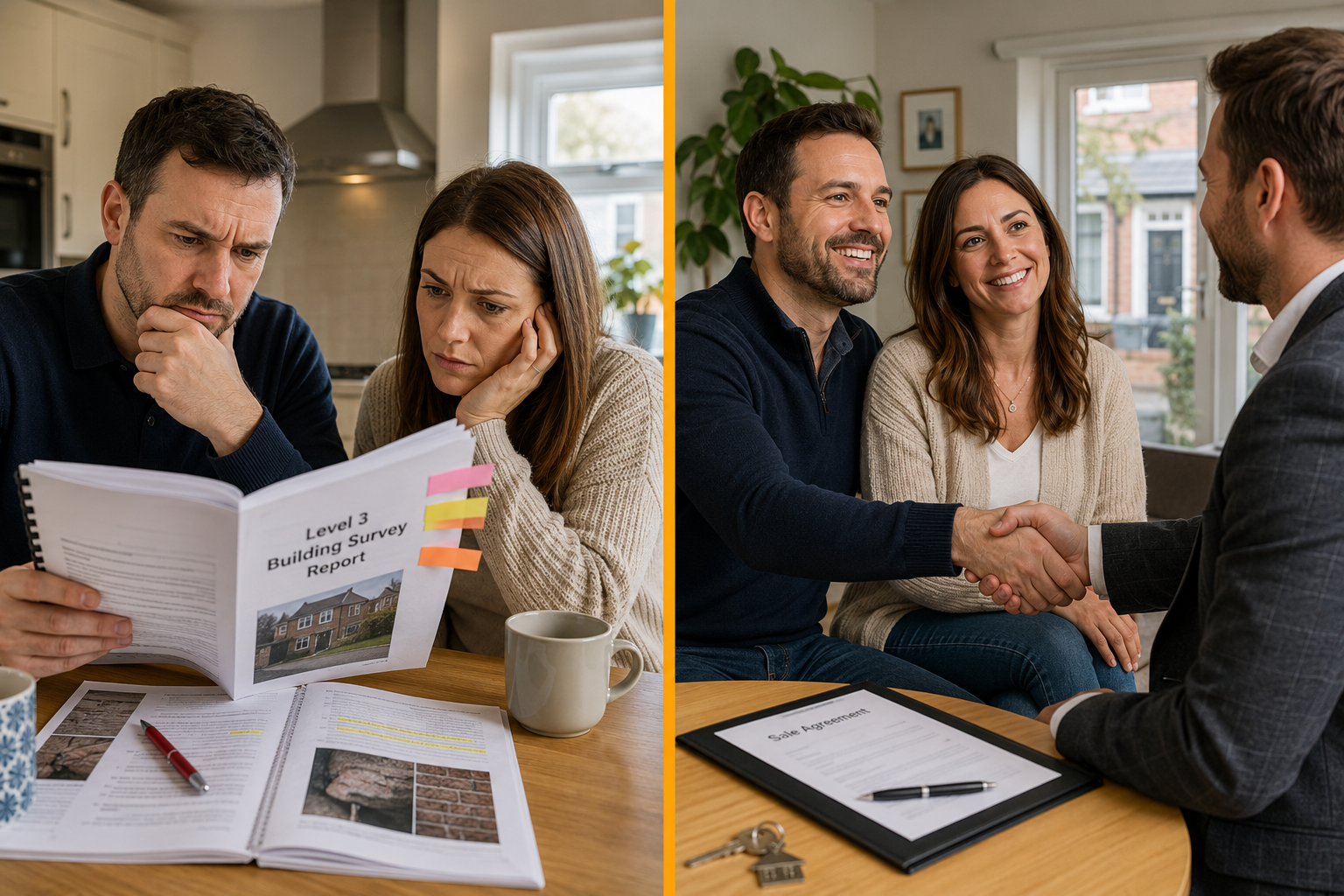
Understanding how to read a building survey is only half the task. The other half is knowing how to act on what the report says.
Prioritise by Severity and Cost
Create a simple list of all Condition Rating 3 items and any specialist investigations recommended. For each one, obtain a cost estimate from a relevant tradesperson or specialist. This gives a financial figure to work with rather than an abstract concern.
When to Renegotiate
A survey revealing significant defects is a legitimate basis for renegotiating the agreed purchase price. Buyers who renegotiate after a poor building survey result often achieve meaningful reductions, particularly when they can present written cost estimates from qualified contractors. The strongest negotiating positions are built on specific numbers, not general concern.
Common grounds for renegotiation include:
- Roof replacement required
- Active damp or timber decay
- Outdated or unsafe electrical installation
- Structural movement requiring investigation
- Drainage defects confirmed by CCTV survey
When to Commission a Specialist Report
Some defects fall outside the scope of a building surveyor's expertise. The Level 3 report will flag these and recommend specialists. Common specialist reports include:
- Structural engineer's report — For movement, cracking, or foundation concerns
- Electrical installation condition report (EICR) — For older or visibly poor wiring
- CCTV drain survey — For drainage concerns
- Asbestos survey — For properties built before 2000 with suspected asbestos-containing materials
When to Walk Away
Walking away is the right decision when the cost of remediation approaches or exceeds the value of the property, when the seller refuses to negotiate despite clear evidence of serious defects, or when specialist reports reveal problems of unknown or unlimited scope. Understanding how building surveys can save money means recognising that the survey fee is an investment in avoiding a far larger financial mistake.
Common Misconceptions About Building Survey Reports
"A survey protects me legally." A survey is not a warranty. It reflects the surveyor's professional opinion on the visible condition of the property at the time of inspection. It does not guarantee that no defects exist beyond those observed.
"Condition Rating 2 items are not worth reading." Amber items can accumulate into significant expenditure. A property with fifteen Condition Rating 2 entries may require more maintenance spend over five years than one with a single Condition Rating 3 item.
"The surveyor will find everything." Surveyors are bound by what is visible and accessible on the day of inspection. Furniture, fitted carpets, and locked rooms all limit the inspection. This is why the Level 3 report's broader scope matters for older properties [3].
"I can skip the survey on a new build." Even new builds can have defects. A building survey for a new build — or at minimum a snagging survey — is worth considering before legal completion.
Choosing the Right Surveyor
The quality of a building survey depends heavily on the surveyor's experience with the property type and location. Always verify that the surveyor is RICS-qualified and, for older or complex properties, has specific experience with that building type. For guidance on selecting a qualified professional, the resource on how to find the best local surveyor near you outlines the key questions to ask before instructing.
Conclusion
Learning how to read a building survey — whether a Level 2 HomeBuyer Report or a Level 3 Building Survey — is not about becoming a construction expert. It is about understanding the condition rating system, identifying which defects are urgent, and translating technical language into financial decisions. In 2026, with UK property prices remaining high and buyers under pressure to move quickly, a thorough reading of the survey report is one of the most valuable hours a buyer can invest.
Actionable next steps:
- Read the summary section first — count the Condition Rating 3 entries before reading anything else.
- For every red-rated item, obtain a written cost estimate from a qualified tradesperson.
- Commission any specialist reports recommended by the surveyor before exchange of contracts.
- Use documented cost estimates as the basis for any price renegotiation.
- If the scope of defects is unclear or alarming, instruct a RICS-qualified surveyor for a second opinion or a targeted specific defect assessment.
A survey is not the end of a property transaction — it is the point where informed buyers gain the advantage.
References
[1] House Surveys UK The Costs Types And Benefits Of An RICS Home Survey – https://www.rics.org/consumer-guides/house-surveys-uk-the-costs-types-and-benefits-of-an-rics-home-survey?utm_source=openai
[2] Survey Condition Ratings Explained – https://anslow-building-surveyors.co.uk/guides/survey-condition-ratings-explained?utm_source=openai
[3] Scope Of Inspection Home Survey Level Three – https://www.rics.org/profession-standards/rics-standards-and-guidance/sector-standards/building-surveying-standards/home-surveys/scope-of-inspection-home-survey-level-three?utm_source=openai
[4] What Survey Do I Need L1 L2 L3 – https://www.propertypassport.uk/guides/what-survey-do-i-need-l1-l2-l3?utm_source=openai
[6] Level 2 Vs Level 3 Survey – https://anslow-building-surveyors.co.uk/guides/level-2-vs-level-3-survey?utm_source=openai
[8] Home Surveys – https://www.rics.org/profession-standards/rics-standards-and-guidance/sector-standards/building-surveying-standards/home-surveys?utm_source=openai