Around one in five homes in the UK shows some form of structural movement — yet the majority of buyers who receive a building survey report are left confused about what the findings actually mean. Terms like "historic settlement," "monitor for change," and "refer to a structural engineer" appear regularly in survey reports, but without context, they can either cause unnecessary panic or lead buyers to dismiss genuinely serious problems.
Understanding what your building survey really covers on structural movement — including how surveyors classify cracks, distinguish subsidence from ordinary settlement, and decide when to escalate concern — is essential knowledge for anyone buying, selling, or managing a property in 2026.
Key Takeaways
- Not all cracks are dangerous. Surveyors use size, pattern, and location to classify cracks and assess risk.
- "Historic settlement" typically means past movement that has stabilised, but it still requires professional interpretation.
- Subsidence and settlement are different conditions with very different implications for cost, insurance, and negotiation.
- A building survey will identify signs of structural movement, but a structural engineer's report may be needed to confirm cause and severity.
- Survey findings on structural movement can directly influence purchase price negotiations and mortgage approvals.
Understanding Structural Movement: What Surveyors Are Actually Looking For
Structural movement refers to the shifting or displacement of a building's components, which can manifest as cracks, subsidence, or settlement [1]. When a chartered surveyor inspects a property, they are not simply noting the presence of cracks — they are reading a story told by the building's fabric about how it has moved, when it moved, and whether that movement is ongoing or finished.
Surveyors assess structural movement through a combination of visual inspection, measurement, and professional judgment. The key questions they ask are:
- Where is the crack located? (foundation level, upper floors, around openings)
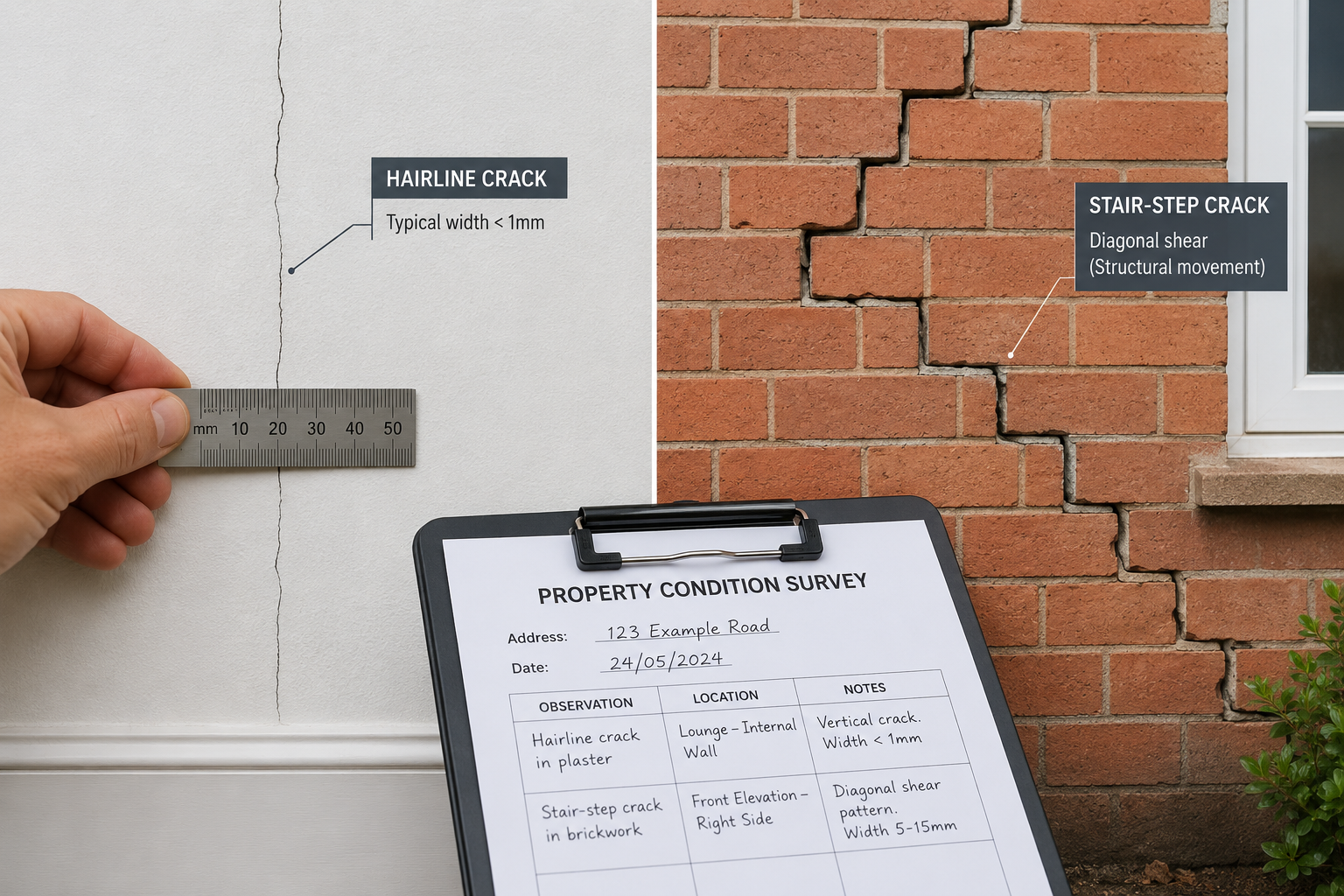
- What direction does it run? (vertical, horizontal, diagonal, stair-step)
- How wide is it? (hairline, fine, medium, wide, very wide)
- Is it tapered or uniform? (tapered suggests rotation; uniform suggests more even settlement)
- Are there secondary signs? (sticking doors, sloping floors, displaced window frames)
The BRE Crack Classification System
The Building Research Establishment (BRE) provides a widely used framework for categorising crack severity. Surveyors typically reference this system when writing reports:
| Category | Width | Description | Action Required |
|---|---|---|---|
| 0 | Hairline (< 0.1mm) | Negligible | None |
| 1 | Up to 1mm | Very slight | Monitor |
| 2 | 1–5mm | Slight | Repair and monitor |
| 3 | 5–15mm | Moderate | Investigation needed |
| 4 | 15–25mm | Severe | Structural engineer required |
| 5 | > 25mm | Very severe | Immediate action |
Categories 0 to 2 are extremely common in older properties and rarely indicate serious structural problems. Categories 3 and above require professional investigation before proceeding with a purchase.
What Crack Patterns Reveal
The pattern of a crack is often more informative than its width alone. Diagonal cracks over doors or windows typically indicate movement at the openings, where lintels may be failing or differential settlement is occurring [3]. Stair-step cracks running through mortar joints in brickwork are a classic sign of foundation movement, as the weaker mortar gives way before the brick itself [3].
Horizontal cracks in external walls, particularly at mid-height, can indicate lateral pressure from soil or a failing wall tie — a different problem entirely from settlement. Vertical cracks running straight down a wall may suggest thermal movement or a lack of movement joints rather than foundation issues.
Internal signs such as sticking doors and windows, sloping floors, or cracks radiating from corners of door frames can all be indicators of structural movement [4]. A thorough survey will cross-reference internal and external evidence to build a complete picture.
If you are preparing for a survey on an older property, reviewing what to do before an RICS home survey can help you gather useful background information about the building's history.
Settlement vs. Subsidence: The Distinction That Changes Everything
One of the most important — and most misunderstood — aspects of what your building survey really covers on structural movement is the difference between settlement and subsidence. These two terms are often used interchangeably in everyday conversation, but they describe fundamentally different processes with very different consequences.
What Is Settlement?
Settlement is the natural downward movement of a building as the soil beneath it compresses under the weight of the structure [2]. Almost every building settles to some degree after construction. In most cases, this process completes within the first few years of a building's life and causes no ongoing problems.
Historic settlement — the phrase that appears so frequently in survey reports — refers to movement that occurred in the past and has since stabilised. A surveyor who describes cracking as "consistent with historic settlement" is typically communicating that:
- The movement has stopped
- The cracks are old and have not widened recently
- There is no active cause driving further movement
- The condition is cosmetic rather than structural in its current state
This is generally reassuring news, though it does not mean the cracks should be ignored. Cosmetic repairs are still needed to prevent water ingress, and the surveyor may recommend monitoring to confirm stability over time.
What Is Subsidence?
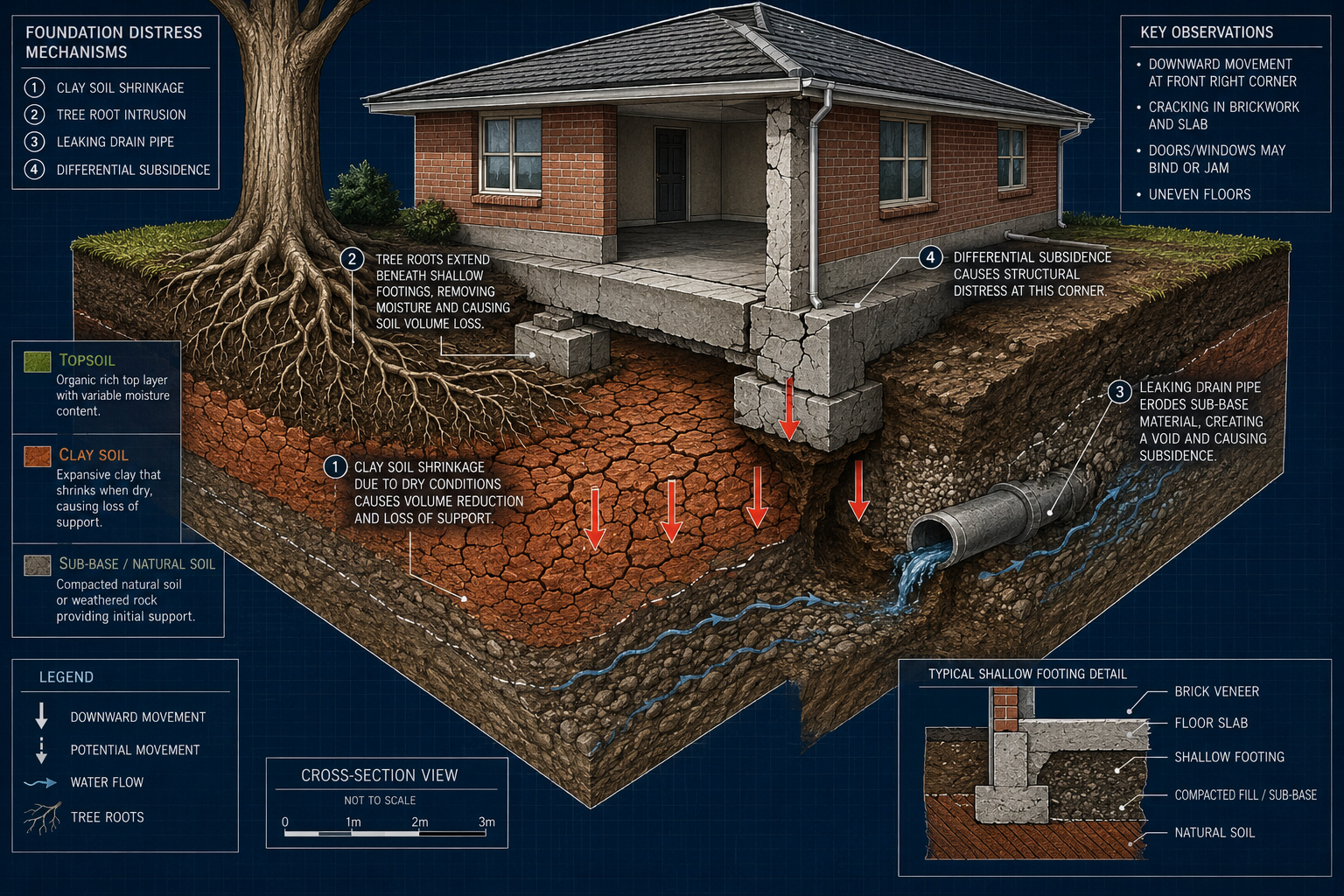
Subsidence is a more serious condition. It involves the downward movement of the ground beneath a building's foundations, often due to external factors that are still active [2]. Unlike settlement, subsidence can be progressive — meaning it continues to worsen if the underlying cause is not addressed.
Common causes of subsidence include:
- Clay soil shrinkage: Clay soils expand when wet and contract when dry. During prolonged dry periods, clay shrinks significantly, pulling away from foundations and causing the building to drop [2].
- Tree root activity: Large trees near a property extract moisture from the soil, accelerating clay shrinkage. Roots can also physically displace soil or grow beneath shallow foundations [2].
- Leaking drains: Water escaping from a broken drain can wash away fine soil particles from beneath foundations — a process called erosion or "wash-out" — leaving voids that cause sudden or progressive movement [2].
- Mining or geological activity: In areas with a history of mining, old workings can collapse, causing ground movement at the surface.
"The distinction between historic settlement and active subsidence is not always immediately obvious from visual inspection alone. A surveyor's job is to weigh the evidence and advise on whether further investigation is warranted."
Active subsidence is a serious concern for several reasons. It affects property insurance — many standard policies exclude subsidence cover or impose significant excesses once a claim has been made. It can affect mortgage approvals, as lenders may decline or restrict lending on properties with known subsidence. And it can be expensive to remediate, with underpinning costs running into tens of thousands of pounds.
For a detailed breakdown of why subsidence is such a significant issue for property buyers, the guide to subsidence and why it is a big problem provides essential context.
How Surveyors Distinguish Between the Two
A surveyor will look for several indicators when trying to determine whether movement is historic settlement or active subsidence:
- Crack edges: Fresh cracks have sharp, clean edges. Old cracks have rounded, weathered, or painted-over edges.
- Symmetry of movement: Settlement tends to be more uniform; subsidence is often localised to one corner or side of a building.
- Proximity to trees: A large tree within 5–10 metres of a property on clay soil significantly increases subsidence risk.
- Drain condition: Evidence of damp, staining, or vegetation growth near drain runs can suggest leakage.
- Monitoring history: If previous owners have installed crack monitors, the readings provide direct evidence of ongoing or stable movement.
Crack monitoring involves placing precise measurement devices across a crack and recording readings over time [7]. A surveyor may recommend this approach when the evidence is ambiguous — it is a low-cost way to determine whether movement is active before committing to expensive remediation.
How Structural Movement Findings Affect Negotiations, Insurance, and Next Steps

Understanding what your building survey really covers on structural movement matters most at the point where findings translate into real-world decisions. A survey report that flags structural movement does not automatically mean a purchase should be abandoned — but it does require a structured response.
When to Commission a Structural Engineer's Report
A building survey is a visual inspection carried out by a chartered surveyor. It is not a structural engineer's assessment. When a surveyor identifies Category 3 or above cracking, active subsidence indicators, or ambiguous evidence that requires specialist interpretation, the appropriate next step is a structural engineer's report [5].
A structural engineer can:
- Confirm the cause of movement through more detailed investigation (including drain surveys and trial pits)
- Assess whether remediation is needed and specify the appropriate solution
- Provide a formal opinion that satisfies mortgage lenders and insurers
- Recommend a monitoring programme if the situation is not yet clear
The cost of a structural engineer's report is typically several hundred pounds — a modest investment relative to the cost of purchasing a property with an unresolved structural problem.
Using Survey Findings in Price Negotiations
Structural movement findings — even where the surveyor concludes the issue is historic and stable — can be used as a legitimate basis for renegotiating the purchase price. Remediation costs, monitoring costs, and the reduced pool of mortgage lenders willing to lend on the property all represent genuine financial impacts on the buyer.
Understanding how an RICS survey can help negotiate the price of a property is a practical skill that can save buyers significant sums. A surveyor's written findings provide objective, professional evidence to support a price reduction request.
If the survey report contains findings that are serious enough to give pause, the guidance on what to do after a bad building survey report sets out a clear process for evaluating options and deciding how to proceed.
Insurance Implications of Structural Movement
Properties with a history of subsidence present particular challenges for insurance. Once a subsidence claim has been made on a property, it is recorded and can affect the availability and cost of future cover. Buyers should:
- Ask the seller directly whether any subsidence claims have been made
- Request details of any remediation work carried out, including guarantees
- Check whether the current insurer will continue cover after sale
- Obtain independent insurance quotes before exchange of contracts
Where a property has been underpinned, insurers will want to know the method used, the depth of the underpinning, and whether a structural warranty exists. Traditional mass concrete underpinning carries a different risk profile from more modern techniques such as resin injection or mini-piled underpinning.
Choosing the Right Level of Survey
Not all surveys provide the same depth of analysis on structural movement. A Level 2 HomeBuyer Report provides a condition rating and flags concerns, but does not include the detailed narrative and investigation that a Level 3 Building Survey offers. For older properties, properties showing visible signs of movement, or properties in areas with known subsidence risk, a full building survey is strongly recommended.
The comparison between Level 2 and Level 3 surveys explains the practical differences in scope and how to choose the right assessment for a specific property. For first-time buyers in particular, understanding the value of commissioning the appropriate level of survey is covered in detail in the guide to booking a building survey as a first-time buyer.
Monitoring as a Middle Ground
When a surveyor cannot definitively classify movement as historic or active from a single inspection, crack monitoring is a proportionate and cost-effective response [6]. Modern monitoring systems can detect movement of fractions of a millimetre, providing objective data over weeks or months.
If a seller is unwilling to allow a monitoring programme before exchange, buyers can negotiate a price reduction that accounts for the uncertainty, or include a contractual obligation for the seller to address any confirmed active movement before completion.
For properties where adjacent construction work may be contributing to movement, understanding the role of a party wall surveyor is relevant, as party wall awards can include provisions for monitoring and damage schedules.
Conclusion
Structural movement is one of the most nuanced areas of any building survey, and the language used in reports — "historic settlement," "monitor for change," "refer to a structural engineer" — carries specific meaning that buyers need to understand. The core distinction between benign historic settlement and active subsidence determines whether a property is a sound investment, a negotiation opportunity, or a serious risk.
Actionable next steps for property buyers in 2026:
- Read the crack classification carefully. BRE Categories 0–2 are common and usually manageable. Categories 3 and above require specialist input before proceeding.
- Ask the surveyor directly. If a report is unclear about whether movement is active or historic, request clarification in writing.
- Commission a structural engineer's report where the surveyor recommends one — do not skip this step to save money.
- Check the insurance position before exchange, particularly for properties with any subsidence history.
- Use the findings to negotiate. Even stable historic movement has a cost implication that can support a price reduction.
- Choose the right survey level. Older properties and those showing visible cracking warrant a Level 3 Building Survey.
Structural movement findings are not a reason to walk away from a property automatically — but they are a reason to proceed with full information, professional advice, and a clear understanding of the financial implications.
References
[1] Newsletter – https://www.propertysurveying.co.uk/newsletter/?page_id=26533&utm_source=openai
[2] Settlement And Subsidence What You Need To Know – https://www.structuralengineersreports.org/settlement-and-subsidence-what-you-need-to-know/?utm_source=openai
[3] Settlement Cracks – https://www.architecturecourses.org/renovation/settlement-cracks?utm_source=openai
[4] Structural Defects – https://aspectsurveying.com/property-defects/structural-defects/?utm_source=openai
[5] Subsidence Structural Movement – https://www.dunhamhale.co.uk/subsidence-structural-movement?utm_source=openai
[6] Deformation Settlement Monitoring – https://www.govargo.com/solutions/deformation-settlement-monitoring?utm_source=openai
[7] Crack And Movement Structural Assessment – https://www.structural-inspections.co.uk/services/crack-and-movement-structural-assessment?utm_source=openai