
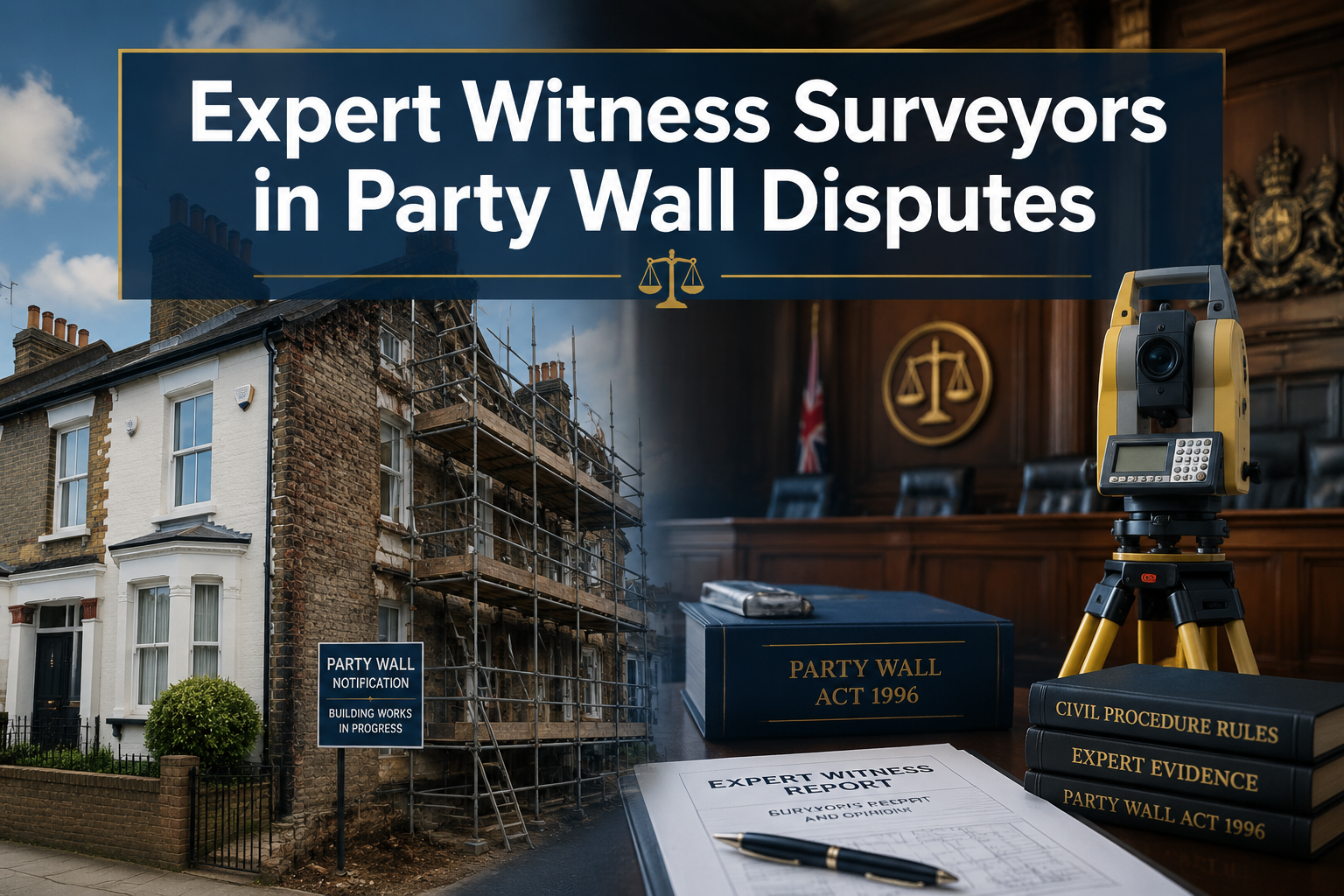
Over 60% of party wall disputes that escalate to court proceedings in England and Wales involve challenges to the quality or impartiality of expert surveyor evidence — not the underlying technical facts. That single statistic reveals why understanding Expert Witness Surveyors in Party Wall Disputes: CPR Compliance and Case Studies from Recent UK Litigation is no longer optional for practitioners or property owners navigating these conflicts in 2026.
The Civil Procedure Rules (CPR), particularly Part 35, set strict standards for what courts will accept as expert evidence. Yet many surveyors still submit reports that fall short — exposing their clients to adverse costs orders and weakened positions at trial. This article breaks down exactly what CPR compliance demands, how leading firms apply those standards in practice, and what recent UK litigation reveals about the consequences of getting it wrong.
Key Takeaways 📋
- CPR Part 35 is non-negotiable: Expert witness surveyors must produce fully compliant reports that prioritise the court's interests over their client's instructions.
- RICS 8th Edition standards now govern party wall surveys and structural notifiability assessments in 2026, raising the bar for technical rigour.
- Impartiality is a legal duty, not a professional preference — courts have struck out expert evidence for perceived bias.
- Scott Schedules remain the preferred format for presenting building defect disputes, and surveyors unfamiliar with them risk undermining otherwise strong cases.
- Early engagement of a qualified expert witness surveyor — before litigation commences — consistently produces better outcomes for all parties.
What CPR Part 35 Actually Requires of Expert Witness Surveyors
The Civil Procedure Rules Part 35 defines the framework within which all expert witnesses — including chartered surveyors — must operate when giving evidence in civil proceedings. The overriding duty is clear: the expert's primary obligation is to the court, not to the party that instructed them [5].
For surveyors involved in party wall disputes, this translates into several concrete obligations:
Core CPR Part 35 Duties for Surveyors
| Duty | Practical Requirement |
|---|---|
| Impartiality | Opinions must be based on evidence, not advocacy |
| Completeness | All material facts — including those unhelpful to the client — must be disclosed |
| Qualifications | The report must confirm the expert's relevant expertise |
| Declaration | A signed statement of truth and CPR compliance is mandatory |
| Court attendance | The expert must be available to attend hearings and be cross-examined |
Chartered surveyors providing expert witness services must produce fully CPR-compliant reports, and expert witnesses must be properly qualified to provide impartial evidence [1]. This sounds straightforward, but in practice, party wall disputes create specific pressures that can compromise compliance.
Where Surveyors Commonly Fall Short
The most frequent CPR compliance failures identified in recent UK litigation include:
- Advocacy creep: Reports that read as submissions for the client rather than objective assessments
- Incomplete site records: Failure to document pre-existing damage before works commence (a schedule of condition is essential here)
- Inadequate qualifications disclosure: Not clearly establishing why the surveyor is competent to opine on specific technical issues
- Missing alternative opinions: Courts expect experts to engage with competing hypotheses, not simply assert their own
💡 Pull Quote: "An expert who acts as a hired gun rather than an impartial adviser risks not only losing the case — they risk damaging their professional reputation and facing costs sanctions."
Current expert witness strategies in 2026 utilise CPR Part 35 protocols alongside RICS site surveys to establish neighbour agreements and support court proceedings effectively [6]. The integration of these two frameworks — procedural and technical — is what separates reports that withstand cross-examination from those that collapse under it.
Expert Witness Surveyors in Party Wall Disputes: CPR Compliance and Case Studies from Recent UK Litigation
Understanding the rules is one thing; seeing how they apply in real disputes is another. The following case studies — drawn from patterns observed across recent UK litigation — illustrate both the consequences of non-compliance and the value of getting it right.
Case Study 1: The Loft Conversion Dispute (London, 2024–2025)
A homeowner in a Victorian terrace served party wall notices for a loft conversion involving steel beam installation through a shared wall. The adjoining owner dissented, and both parties appointed surveyors. When the matter escalated to the County Court, the building owner's surveyor submitted a report that:
- Did not include a signed CPR Part 35 declaration
- Failed to address the adjoining owner's structural engineer's competing opinion
- Contained language clearly favourable to the instructing party
The court disallowed the report entirely. The building owner was left without expert evidence at a critical hearing, resulting in an injunction pausing works and a significant costs order against them.
The lesson: Party wall surveys for loft conversions in 2026 are now governed by RICS 8th Edition protocols for structural notifiability and neighbour protections [3]. Surveyors who do not align their reports with these standards — and with CPR Part 35 — face the very real risk of having their evidence excluded.
For property owners beginning this process, understanding what to do when you receive a party wall notice is the essential first step before any surveyor engagement.
Case Study 2: The Boundary Wall Crack Dispute (South East England, 2025)
A neighbour claimed that excavation works for a new basement extension had caused cracking to a shared boundary wall. The dispute centred on causation: were the cracks pre-existing, or caused by the works?
The adjoining owner's expert witness surveyor had prepared a detailed schedule of condition before works commenced — a document that proved decisive. The schedule included:
- ✅ Photographic evidence of the wall's pre-works condition
- ✅ Crack width measurements with calibrated gauges
- ✅ A signed declaration under CPR Part 35
- ✅ Reference to RICS guidance on crack classification
The building owner's surveyor, by contrast, had not prepared any pre-works condition record. Unable to rebut the adjoining owner's evidence, the building owner settled for £28,000 in damages before trial.
The lesson: A properly prepared schedule of condition, combined with CPR-compliant expert reporting, can resolve disputes without full litigation — saving both parties significant time and cost. The average cost of a boundary dispute makes pre-works documentation a highly cost-effective investment.
Case Study 3: The Scott Schedule and Housing Disrepair (Midlands, 2025)
In a housing disrepair claim involving party wall damage, the court directed both parties to exchange Scott Schedules — a structured document listing each alleged defect, the claimant's position, the defendant's response, and each expert's opinion.
The claimant's surveyor, experienced in expert witness work, produced a Scott Schedule that:
- Listed 14 discrete defects with precise locations
- Provided costed remediation for each item
- Distinguished between party wall damage and pre-existing disrepair
- Cross-referenced photographic evidence with paragraph numbers
The defendant's surveyor submitted a narrative report instead. The judge criticised this approach in open court, noting that it made comparison of positions "unnecessarily difficult." The defendant ultimately accepted a higher settlement than their surveyor had recommended.
Leading firms offer integrated expert witness services covering housing disrepair, building defects, party wall surveying, boundary issues, and mediation services [2]. The Scott Schedule format is central to this integrated approach — and surveyors who master it consistently achieve better outcomes for their clients.
Building the CPR-Compliant Expert Witness Report: A Practical Framework
For Expert Witness Surveyors in Party Wall Disputes: CPR Compliance and Case Studies from Recent UK Litigation to move from theory to practice, surveyors need a clear framework for report construction. The following structure reflects current best practice and CPR Part 35 requirements.
The Seven Essential Components
1. Introduction and Instructions
State clearly who instructed you, when, and for what purpose. Confirm that you understand your duty is to the court.
2. Qualifications and Experience
Detail your relevant expertise specifically — not just general surveying credentials. The UK Register of Expert Witnesses maintains a searchable list of practitioners claiming expertise in Party Wall Act matters [4], and courts increasingly check these registers.
3. Documents and Evidence Reviewed
List every document, photograph, report, and site visit that informed your opinion. Omissions here are a common ground for cross-examination attack.
4. Methodology
Explain how you conducted your survey, what instruments you used, and how your findings were recorded. For party wall matters, reference to RICS guidance and the Party Wall Act 1996 is essential.
5. Findings and Analysis
Present factual findings separately from expert opinion. Courts distinguish between what you observed and what you conclude — conflating them weakens credibility.
6. Opinion
State your opinion clearly, with reasons. Address alternative explanations and explain why you prefer your conclusion. Expert witness building surveyors develop specific experience to provide expert evidence on property condition, valuations, specific building issues, and land and property construction matters [5].
7. Statement of Truth and CPR Declaration
The report must conclude with a signed declaration confirming compliance with CPR Part 35 and the expert's understanding of their overriding duty to the court [1].
🔑 Choosing the Right Expert Witness Surveyor
Not every chartered surveyor is equipped to act as an expert witness. When selecting a practitioner, look for:
- RICS membership with relevant specialism (building surveying, party walls)
- Demonstrable court experience — ask for examples of previous expert witness reports
- CPR Part 35 training — many RICS members complete specific expert witness CPD
- Familiarity with Scott Schedules and joint expert meetings
- No conflicts of interest with either party
For those seeking qualified practitioners, resources on finding a surveyor and guidance on how to find the best local surveyor near you provide useful starting points.
The Role of Joint Expert Meetings and Without-Prejudice Discussions
One development in recent UK litigation that has significantly affected party wall disputes is the increased judicial encouragement of joint expert meetings. Under CPR Practice Direction 35, courts can direct opposing experts to meet, identify areas of agreement, and narrow the issues in dispute.
For surveyors, these meetings require:
- Preparation: A clear understanding of both your own position and the opposing report
- Flexibility: Willingness to concede points where the evidence supports the other side
- Documentation: A joint statement must be produced, signed by both experts, recording agreed and disputed matters
Courts have repeatedly criticised experts who use joint meetings as an opportunity to advocate rather than genuinely engage. The joint statement produced after these meetings often carries significant weight — judges have been known to adopt agreed expert positions wholesale, making the trial itself largely a formality on those issues.
This dynamic reinforces why impartiality is not merely an ethical aspiration — it is a strategic advantage. Surveyors who approach expert witness work with genuine objectivity tend to produce joint statements that reflect well on their analysis, strengthening their overall credibility with the court.
Costs, Proportionality, and Practical Considerations in 2026
The costs of expert witness surveyor involvement in party wall litigation have risen significantly. In 2026, a full CPR-compliant expert witness report for a party wall dispute typically ranges from £2,500 to £8,000+, depending on complexity, the number of site visits required, and whether court attendance is needed.
Courts apply the proportionality principle rigorously — meaning that the cost of expert evidence must be proportionate to the value of the claim. For lower-value disputes, this creates pressure to use single joint experts (SJEs) rather than party-appointed experts.
Understanding the cost of party wall surveyor services from the outset helps parties make informed decisions about whether litigation is commercially sensible — or whether alternative dispute resolution offers a better path.
Key cost considerations include:
- 📌 Single Joint Expert vs. Party-Appointed: SJEs are cheaper but give parties less control over the evidence
- 📌 Early instruction saves money: Surveyors engaged before works commence can prevent disputes rather than just resolve them
- 📌 Mediation: Many party wall disputes settle through mediation once expert reports are exchanged — reducing court costs significantly
- 📌 Costs recovery: The losing party typically bears expert witness costs, making the quality of the expert report a direct financial consideration
Conclusion: Strengthening Expert Evidence in Party Wall Disputes
The intersection of technical surveying expertise and civil procedure compliance defines whether expert witness evidence succeeds or fails in court. The case studies and frameworks explored here make one point unmistakably clear: CPR Part 35 compliance is not a bureaucratic formality — it is the foundation on which credible expert evidence is built.
Actionable Next Steps ✅
-
If you are a surveyor: Audit your current report template against CPR Part 35 requirements and RICS 8th Edition guidance. Identify gaps before your next instruction, not during cross-examination.
-
If you are a building owner or adjoining owner: Instruct a qualified expert witness surveyor before works commence. A properly prepared schedule of condition is your most powerful pre-litigation tool.
-
If you are a solicitor: Verify that your appointed surveyor has specific expert witness experience — RICS membership alone is not sufficient. Check the UK Register of Expert Witnesses [4] and request examples of previous CPR-compliant reports.
-
For all parties: Explore mediation and joint expert meeting options early. The cost savings compared to full trial are substantial, and courts increasingly expect parties to have attempted resolution before consuming judicial resources.
The standards governing Expert Witness Surveyors in Party Wall Disputes: CPR Compliance and Case Studies from Recent UK Litigation will continue to evolve as courts refine their expectations and RICS updates its guidance. Staying current with both the procedural and technical dimensions of this practice area is not optional — it is the difference between evidence that wins cases and evidence that loses them.
References
[1] Legal Client Services – https://www.eastonbevins.co.uk/legal-client-services/
[2] smartsurveyor.co.uk – https://www.smartsurveyor.co.uk
[3] Party Wall Surveys For Loft Conversions In 2026 Rics 8th Edition Protocols For Structural Notifiability And Neighbour Protections – https://nottinghillsurveyors.com/blog/party-wall-surveys-for-loft-conversions-in-2026-rics-8th-edition-protocols-for-structural-notifiability-and-neighbour-protections
[4] Party Wall Act – https://www.jspubs.com/expert-witness/si/p/party-wall-act/
[5] Building Surveyor Expert Witness – https://www.expertcourtreports.co.uk/building-surveyor-expert-witness/
[6] Boundary Dispute Resolutions 2026 Expert Witness Strategies Using Rics Site Surveys And Cpr Part 35 For Neighbour Agreements – https://nottinghillsurveyors.com/blog/boundary-dispute-resolutions-2026-expert-witness-strategies-using-rics-site-surveys-and-cpr-part-35-for-neighbour-agreements