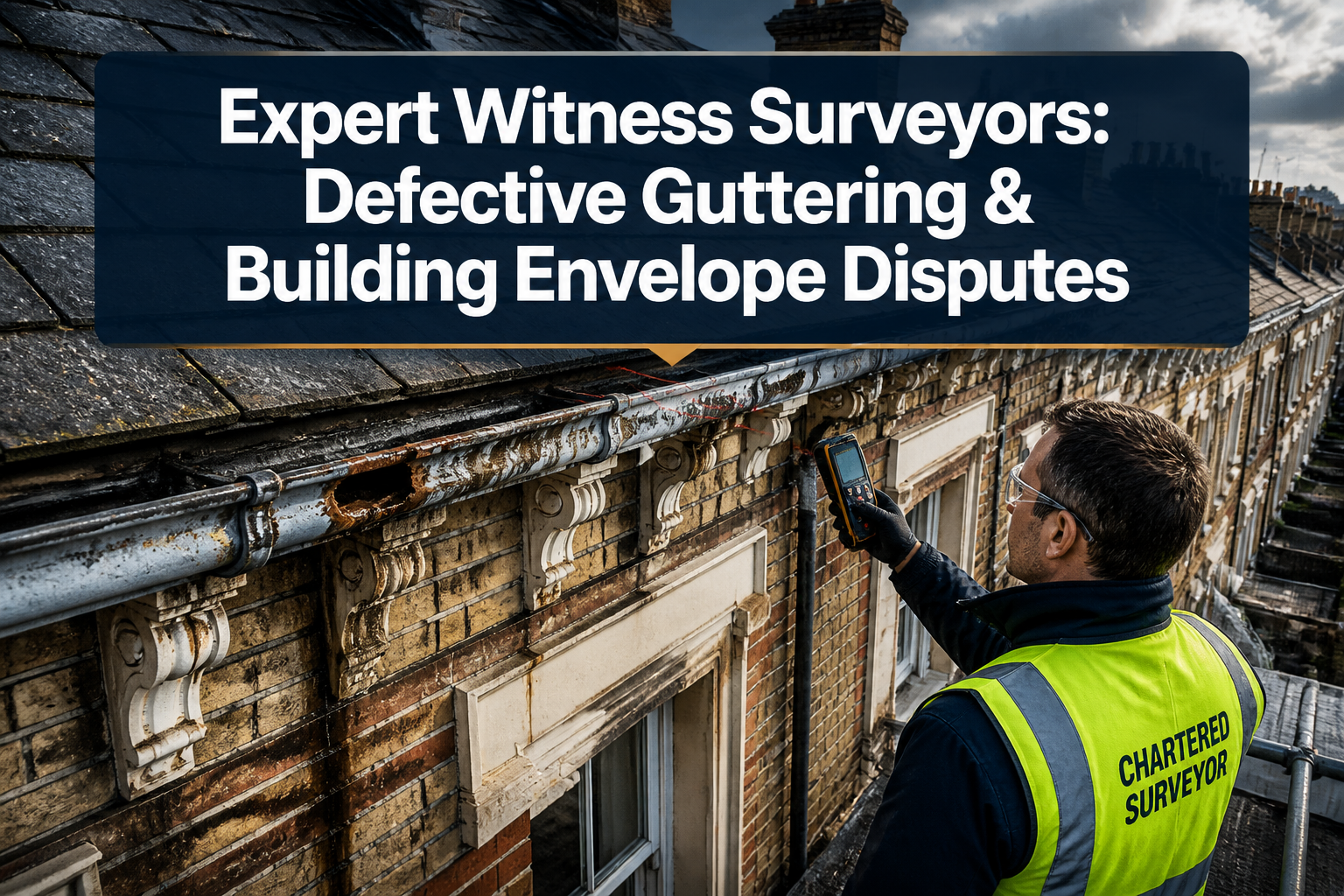
Defective guttering is responsible for more hidden building damage than most property owners realise — water ingress from failed drainage systems accounts for a significant proportion of all construction defect litigation in England and Wales, yet the technical complexity of attributing fault makes these disputes among the hardest to resolve without specialist input. When a claim reaches court, Expert Witness Surveyors for Defective Guttering and Building Envelope Disputes: CPR-Compliant Reporting Protocols become the critical framework separating a persuasive, court-ready case from one that collapses under cross-examination.
This article provides a practical, authoritative guide to how qualified surveyors prepare and deliver expert evidence in guttering and building envelope disputes, covering everything from site investigation templates to the mandatory compliance statements required under Civil Procedure Rules (CPR) Part 35.
Key Takeaways
- 🏗️ Expert witness surveyors must hold relevant RICS credentials and demonstrable experience in building envelope pathology to be credible in court.
- 📋 CPR Part 35 governs all expert evidence in England and Wales — non-compliance can result in evidence being excluded entirely.
- 🔍 Site investigation protocols must be structured, repeatable, and documented with photographic and instrumental evidence.
- ⚖️ Fault attribution — distinguishing design failure from workmanship defects — is the central technical question in most guttering disputes.
- 📝 Every compliant expert report must include a formal compliance statement confirming the expert's overriding duty to the court, not to the instructing party.
Understanding the Role of Expert Witness Surveyors in Building Envelope Disputes
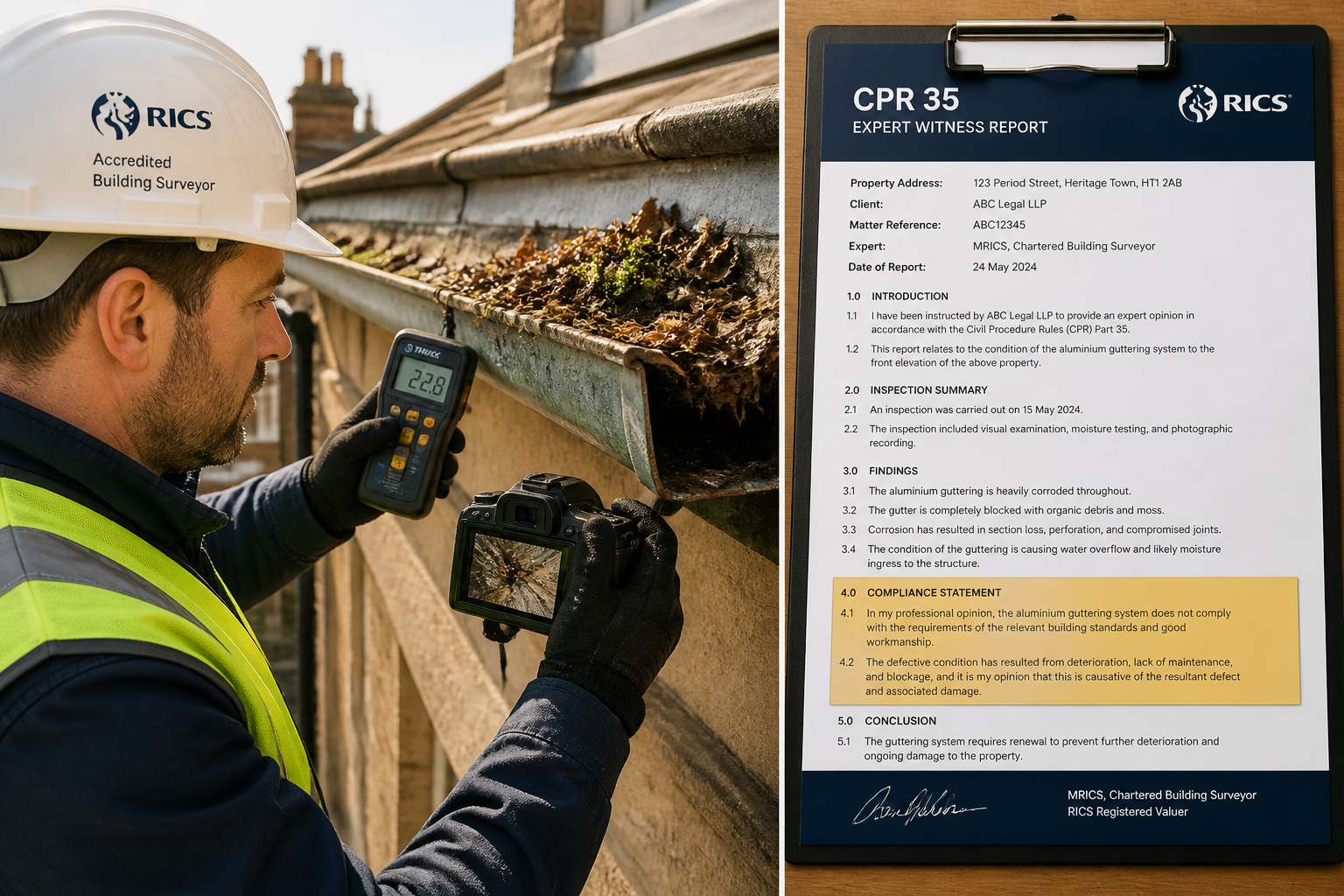
Building envelope failures — including defective guttering, failed flashings, faulty siding, and compromised roof drainage — are among the most contested categories in construction defect litigation [2]. Water seepage through roofs, windows, doors, and drainage components creates damage that is often cumulative, hidden, and expensive to remediate, making expert testimony essential for courts to understand both causation and quantum.
What Qualifies a Surveyor as an Expert Witness?
Not every qualified surveyor is suitable for the expert witness role. Courts expect appointees to meet a high bar across several dimensions [3]:
| Qualification Criterion | Why It Matters |
|---|---|
| Relevant professional credentials (RICS, CIOB) | Establishes technical authority |
| Track record in similar dispute types | Demonstrates applied expertise |
| Ability to communicate clearly | Reports must be understood by non-specialists |
| Professional reputation and independence | Credibility under cross-examination |
| Familiarity with CPR Part 35 | Ensures procedural compliance |
For guttering and building envelope disputes specifically, the ideal expert will have hands-on experience with water management systems, drainage design standards, and the pathology of moisture ingress. Surveyors who have conducted specific defect surveys are particularly well-placed, as this work directly mirrors the investigative methodology required in litigation.
The Scope of Building Envelope Expert Work
Expert witnesses in this field routinely address [2][4]:
- Water seepage through guttering, downpipes, soffits, and fascias
- Stucco and render deficiencies affecting moisture exclusion
- Roof drainage design inadequacies versus installation failures
- Mould and timber decay resulting from prolonged water ingress
- Insurance claim disputes where the cause of water damage is contested
💬 "The expert's role is not to advocate for a party — it is to assist the court in understanding technical matters that fall outside the knowledge of a judge or jury." — CPR Part 35.3
For property owners or solicitors seeking a starting point, understanding what to do after a bad building survey report can clarify whether a dispute warrants formal expert witness involvement.
CPR-Compliant Reporting Protocols: The Framework Every Expert Must Follow
The Civil Procedure Rules Part 35 sets the legal standard for all expert evidence in civil proceedings in England and Wales. For Expert Witness Surveyors for Defective Guttering and Building Envelope Disputes: CPR-Compliant Reporting Protocols, adherence to this framework is non-negotiable — failure to comply can result in the report being inadmissible [1].
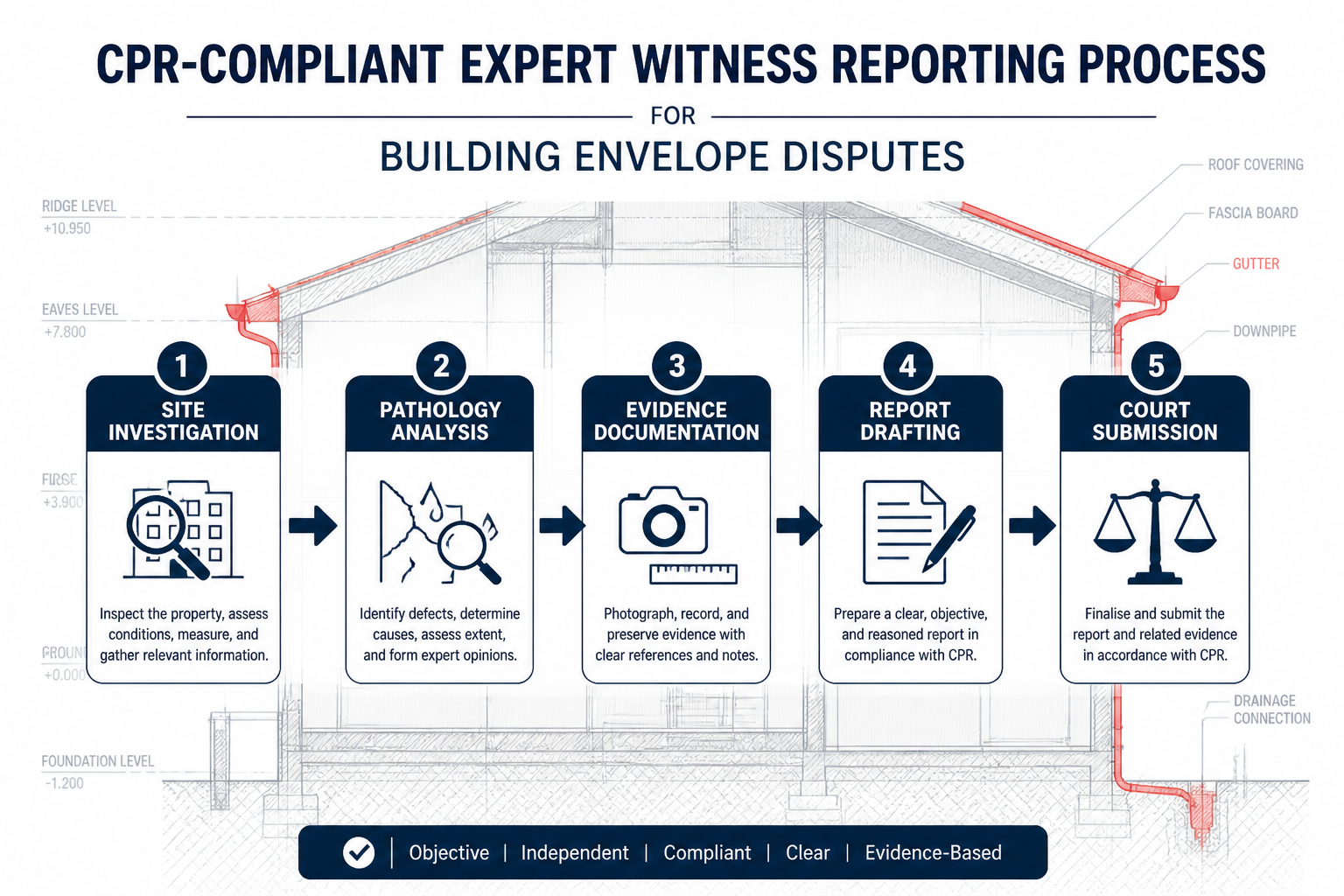
The Five Core Requirements of CPR Part 35
1. The Expert's Overriding Duty
The expert's primary duty is to the court, not to the instructing party. This must be explicitly acknowledged in every report [1].
2. Full Disclosure of Instructions
All material instructions — written and oral — must be transparently disclosed. Courts need to understand the exact scope of investigation requested to assess whether the expert has been constrained or directed inappropriately [1].
3. Evidence-Based Opinions
Experts cannot state bare conclusions. Every opinion must be supported by:
- Technical analysis of observed conditions
- Reference to recognised industry standards (e.g., BS EN 12056, BS 6367 for drainage)
- Clear statements of assumptions and limitations
- Confidence levels where uncertainty exists [1]
4. Statement of Truth
The report must include a signed statement of truth confirming that the expert believes the facts stated are true and the opinions expressed are genuinely held.
5. Compliance Statement ⚠️
Every expert report must conclude with a formal compliance statement confirming the expert's understanding of and adherence to their duty to the court. Absence of this statement is a critical red flag indicating non-compliance with CPR 35 standards [1].
Mandatory Report Structure for Guttering Disputes
A CPR-compliant expert report for a building envelope or guttering dispute should follow this structure:
- Cover page — case reference, parties, expert details, date
- Executive summary — key findings in plain English
- Instructions received — verbatim or summarised, including oral instructions
- Methodology — how the investigation was conducted
- Site inspection findings — with annotated photographs
- Technical analysis — pathology, causation, and fault attribution
- Opinion — clearly separated from facts, with reasoning
- Assumptions and limitations
- Statement of truth
- Compliance statement (CPR 35.10)
Site Investigation Templates and Pathology Analysis for Guttering Defects
Structured site investigation is the backbone of any credible expert witness report. For guttering and building envelope disputes, the investigation must be systematic enough to withstand scrutiny from opposing experts and legal counsel [3][4].
Pre-Site Preparation
Before attending the property, the expert should review [3]:
- ✅ Original construction drawings and specifications
- ✅ Building contracts and variation orders
- ✅ Maintenance records and previous survey reports
- ✅ Photographic evidence submitted by the parties
- ✅ Any previous insurance assessments or loss adjuster reports
This document review phase is critical. It allows the expert to form hypotheses before site attendance and ensures the inspection is targeted rather than exploratory.
On-Site Investigation Protocol
Stage 1: Visual Survey
A systematic walk-around of the building envelope, recording:
- Gutter alignment, fall, and joint condition
- Evidence of overflow staining on external walls
- Fascia and soffit condition
- Downpipe connections and discharge points
Stage 2: Instrumental Testing
- Moisture meter readings at affected internal surfaces
- Thermal imaging (where appropriate) to identify cold bridges and moisture pathways
- Water flow testing of guttering under simulated rainfall conditions
Stage 3: Intrusive Investigation (where permitted)
- Opening up of junction details at eaves level
- Inspection of gutter brackets and fixings
- Sampling of failed sealant or jointing compound for analysis
Stage 4: Photographic Documentation
Every defect must be photographed with:
- A scale reference in frame
- Location reference (elevation and grid reference)
- Before and after any probing or opening up
For properties in London and surrounding areas, London property surveyors with expert witness experience can provide this structured investigation service. Similarly, those in south-west London may benefit from Wandsworth property surveyors or Merton property surveyors with relevant specialist credentials.
Pathology Analysis: Attributing Fault in Guttering Disputes
The central technical question in most guttering disputes is whether the defect stems from design inadequacy or contractor workmanship failure [4]. This distinction has significant legal and financial consequences.
| Defect Type | Likely Cause | Evidence Required |
|---|---|---|
| Inadequate gutter capacity | Design failure | Hydraulic calculations vs. specification |
| Poor fall causing standing water | Installation error | Level survey of installed guttering |
| Joint failures at connections | Workmanship defect | Inspection of jointing technique and materials |
| Incorrect bracket spacing | Installation error | Measurement against manufacturer's guidance |
| Incompatible materials causing corrosion | Design or specification failure | Material analysis and product data sheets |
💡 Key insight: Where both design and workmanship failures are present, the expert must apportion responsibility clearly and explain the methodology used to reach that apportionment.
The Renters' Rights Act 2026 has also introduced new obligations around defect documentation, requiring landlords to produce professional defect reports when challenged — a development that is increasing demand for expert-quality building envelope assessments in residential dispute contexts [6].
Preparing Court-Ready Evidence: From Deposition to Trial
The expert's work does not end with the written report. In contested cases, Expert Witness Surveyors for Defective Guttering and Building Envelope Disputes: CPR-Compliant Reporting Protocols extend to sworn deposition testimony and, potentially, oral evidence at trial [3].
Deposition and Cross-Examination Preparation
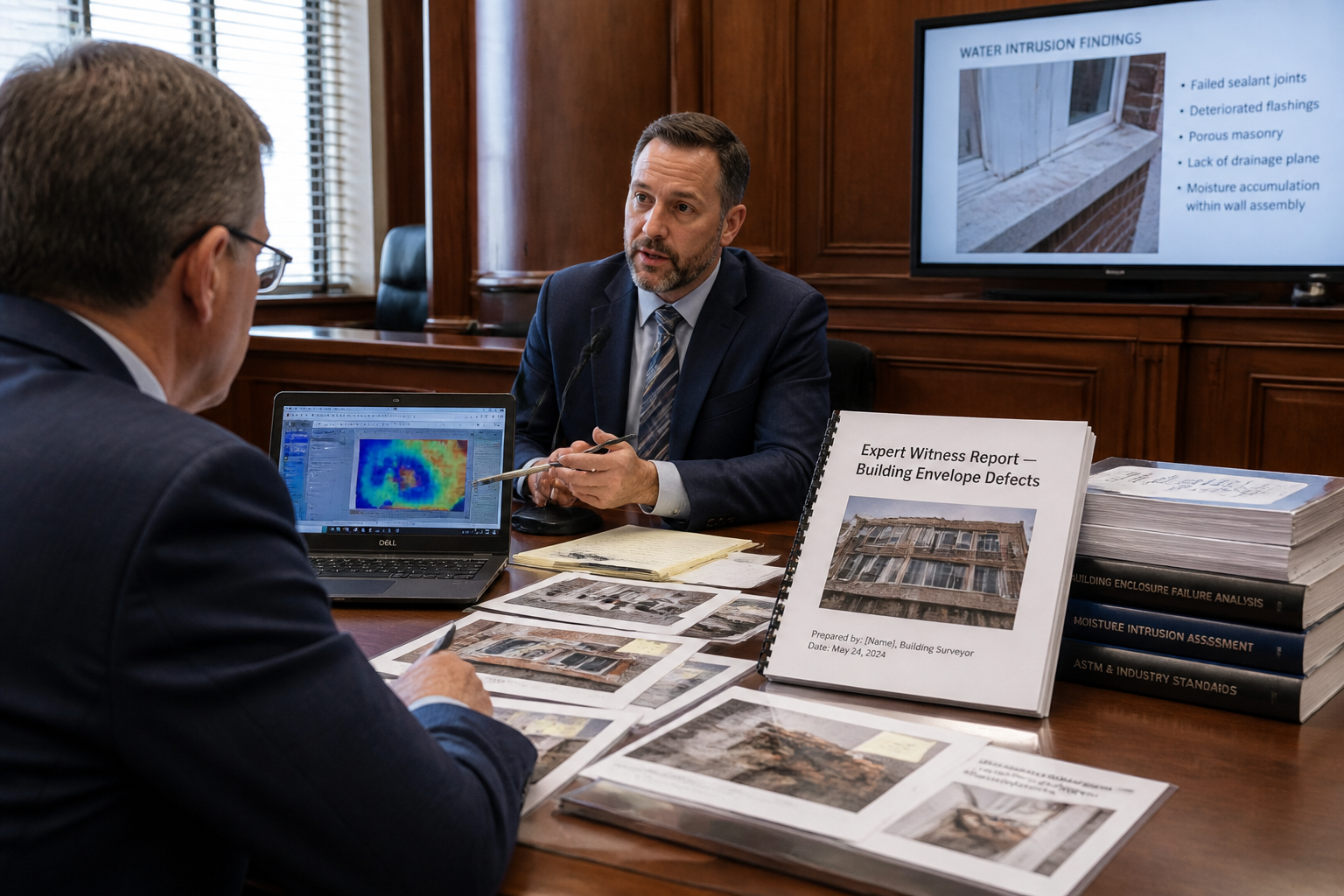
Experts provide sworn testimony during depositions, presenting findings under oath and defending methodologies and conclusions to opposing counsel [3]. Preparation for this stage should include:
- Reviewing the report in full — the expert must be able to speak to every paragraph without hesitation
- Anticipating counter-arguments — particularly where a joint statement with the opposing expert has identified areas of disagreement
- Preparing visual aids — annotated photographs, moisture maps, and drainage calculations presented clearly
- Understanding the legal framework — knowing how CPR 35 governs the expert's conduct in proceedings
The Joint Expert Statement
Where both parties have appointed experts, the court will typically direct a without prejudice meeting to produce a joint statement identifying:
- Points of agreement
- Points of disagreement and the reasons for each
This document is often the most influential piece of evidence in the case. A well-prepared expert who has followed rigorous investigation protocols will be in a stronger position to defend their opinions at this stage.
Selecting the Right Expert: A Checklist for Solicitors
When instructing an expert witness for a guttering or building envelope dispute, solicitors should verify [3][4]:
- RICS or equivalent professional membership
- Demonstrable experience in building envelope pathology
- Previous expert witness appointments in similar cases
- Familiarity with CPR Part 35 requirements
- Ability to produce reports in plain, accessible English
- Professional indemnity insurance
- No conflict of interest with any party
Solicitors and property professionals in south London may find relevant expertise through Croydon property surveyors or Lewisham property surveyors, while those in central London may prefer Kensington property surveyors with specialist litigation support experience.
Common Pitfalls in Expert Witness Reports for Building Envelope Cases
Even experienced surveyors make procedural errors that undermine the credibility of their reports. The most common failures include:
🚫 Missing compliance statement — the single most common reason for CPR 35 non-compliance [1]
🚫 Undisclosed instructions — failing to reveal the full scope of what the expert was asked to investigate [1]
🚫 Bare opinions without reasoning — stating conclusions without technical analysis or reference to industry standards [1]
🚫 Advocacy language — using language that suggests the expert is arguing for a party rather than assisting the court
🚫 Inadequate site documentation — insufficient photographs or failure to record instrumental readings contemporaneously
🚫 Failure to address alternative causes — a robust report must consider and rule out competing explanations for the defect
For those wanting to understand the broader context of building defect surveys before reaching the litigation stage, resources on building surveys and specific defect surveys provide a useful foundation.
Conclusion: Actionable Next Steps for Guttering and Building Envelope Disputes in 2026
The intersection of technical building pathology and legal procedure makes Expert Witness Surveyors for Defective Guttering and Building Envelope Disputes: CPR-Compliant Reporting Protocols one of the most demanding — and most consequential — specialisms in property surveying. A report that fails on procedural grounds can destroy an otherwise strong case; one that is technically rigorous but poorly structured will struggle to persuade a court.
Actionable Steps for Property Owners and Solicitors
- Identify defects early — commission a specific defect survey as soon as guttering or water ingress problems are suspected, before litigation becomes necessary.
- Choose credentials carefully — verify RICS membership, relevant experience, and CPR familiarity before instructing an expert.
- Preserve evidence — do not carry out remedial works before the expert has inspected, as this destroys the evidence base.
- Insist on a compliant report structure — check that the draft report includes a compliance statement, disclosed instructions, and evidence-based opinions before it is served.
- Prepare for joint statements — brief the expert thoroughly on areas of likely disagreement with the opposing expert.
- Stay current with regulatory changes — the Renters' Rights Act 2026 and evolving building standards continue to shift the compliance landscape for defect documentation [6].
The stakes in building envelope disputes are high — remediation costs, consequential water damage, and legal fees can quickly reach six figures. A properly instructed, CPR-compliant expert witness surveyor is not a luxury; it is the foundation of a credible, court-ready case.
References
[1] Construction Dispute Resolution 101 – https://www.oseimc.com/construction-dispute-resolution-101
[2] Construction Defects – https://www.lexvisio.com/expert-witnesses/construction-defects
[3] The Role Of Expert Witnesses In Colorado Construction Defect Litigation – https://hollingtonlawfirm.com/articles/the-role-of-expert-witnesses-in-colorado-construction-defect-litigation
[4] Expert Witness Reports – https://westernbuildingconsultants.com/wbc-services/expert-witness-reports/
[6] Building Survey Defect Documentation Under New Renters Rights Act 2026 Landlord Compliance Evidence For Section 8 Eviction Grounds – https://nottinghillsurveyors.com/blog/building-survey-defect-documentation-under-new-renters-rights-act-2026-landlord-compliance-evidence-for-section-8-eviction-grounds