Boundary disputes alone cost UK property owners an estimated £300 million annually in legal fees and lost time, yet many claimants enter tribunal proceedings without the one professional most likely to determine the outcome: a qualified expert witness surveyor. Understanding Expert Witness Surveying in UK Property Disputes: When You Need One and What They Do is not just useful background knowledge; it can be the difference between a well-evidenced case and an expensive failure. This article explains the role in full, from the legal framework governing surveyors to the practical steps involved in instructing one.
Key Takeaways
- An expert witness surveyor's primary duty is to the court or tribunal, not to the instructing party, this independence is non-negotiable under RICS professional standards.
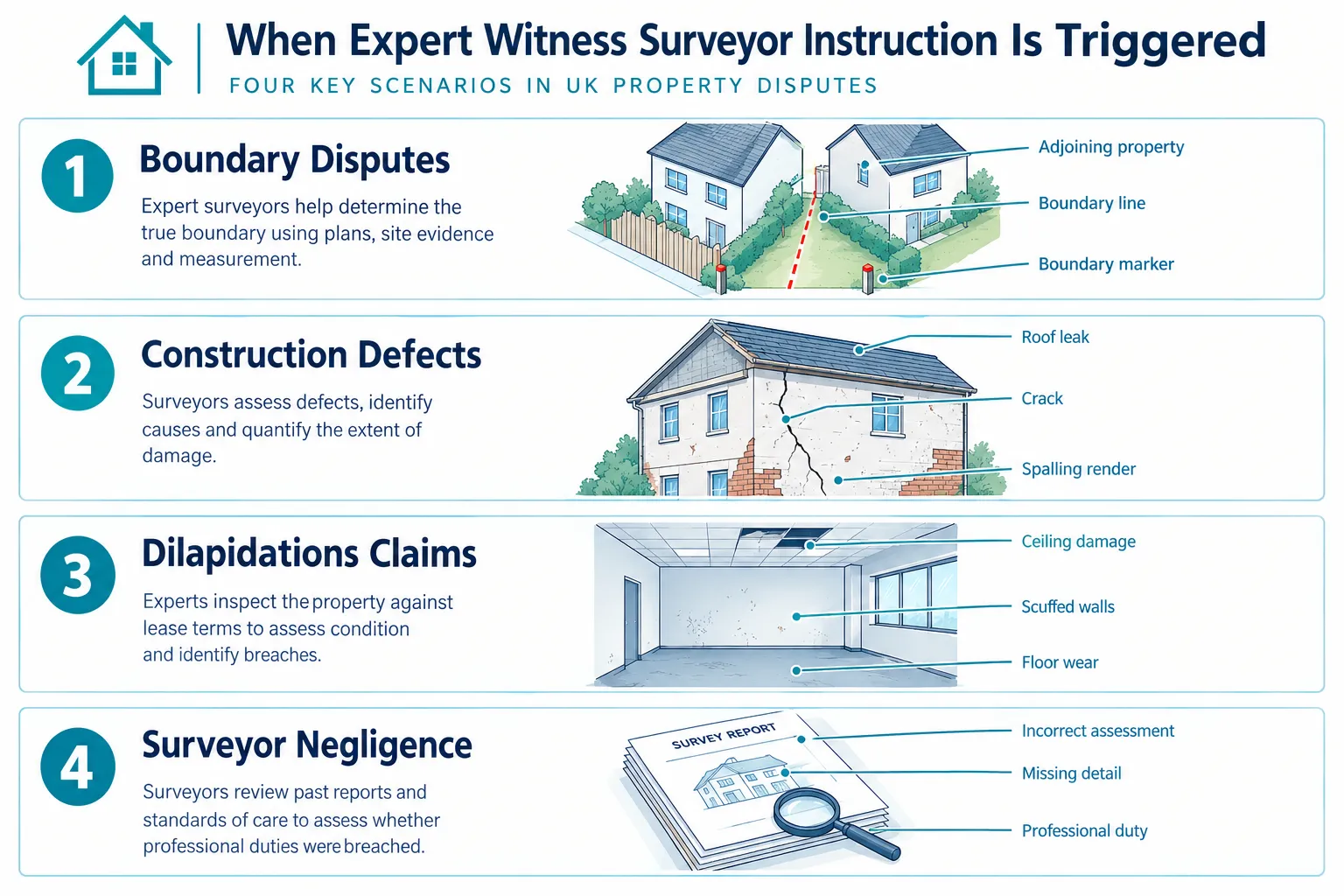
- Expert witness surveyors are most commonly needed in boundary disputes, construction defect claims, dilapidations, and surveyor negligence cases.
- The RICS is publishing a new 5th edition Professional Standard in July 2026, effective 30 November 2026, which introduces updated guidance on AI tools, single joint experts, and tribunal procedures.
- Instructing an expert witness surveyor early, before proceedings begin, can significantly shape litigation strategy and reduce overall costs.
- Fees typically range from £1,500 to £10,000+ depending on case complexity, with hourly rates between £150 and £400 for RICS-accredited practitioners.
What an Expert Witness Surveyor Actually Does
An expert witness surveyor is a chartered surveyor appointed to provide independent, impartial technical opinion to a court, tribunal, or arbitration panel. Unlike a surveyor acting as an advocate for a client, the expert witness owes an overriding duty to the tribunal, not to the party that pays their fee [1].
This distinction matters enormously. RICS professional standards make clear that an expert witness must not act as a hired gun. Their written reports and oral evidence must represent their genuine professional opinion, even if that opinion is unfavourable to the instructing party [1]. The RICS 4th edition standard, currently in force alongside a February 2024 Practice Alert, reinforces that any failure to maintain independence can result in regulatory action against the surveyor [9].
In practical terms, the day-to-day work of an expert witness surveyor includes:
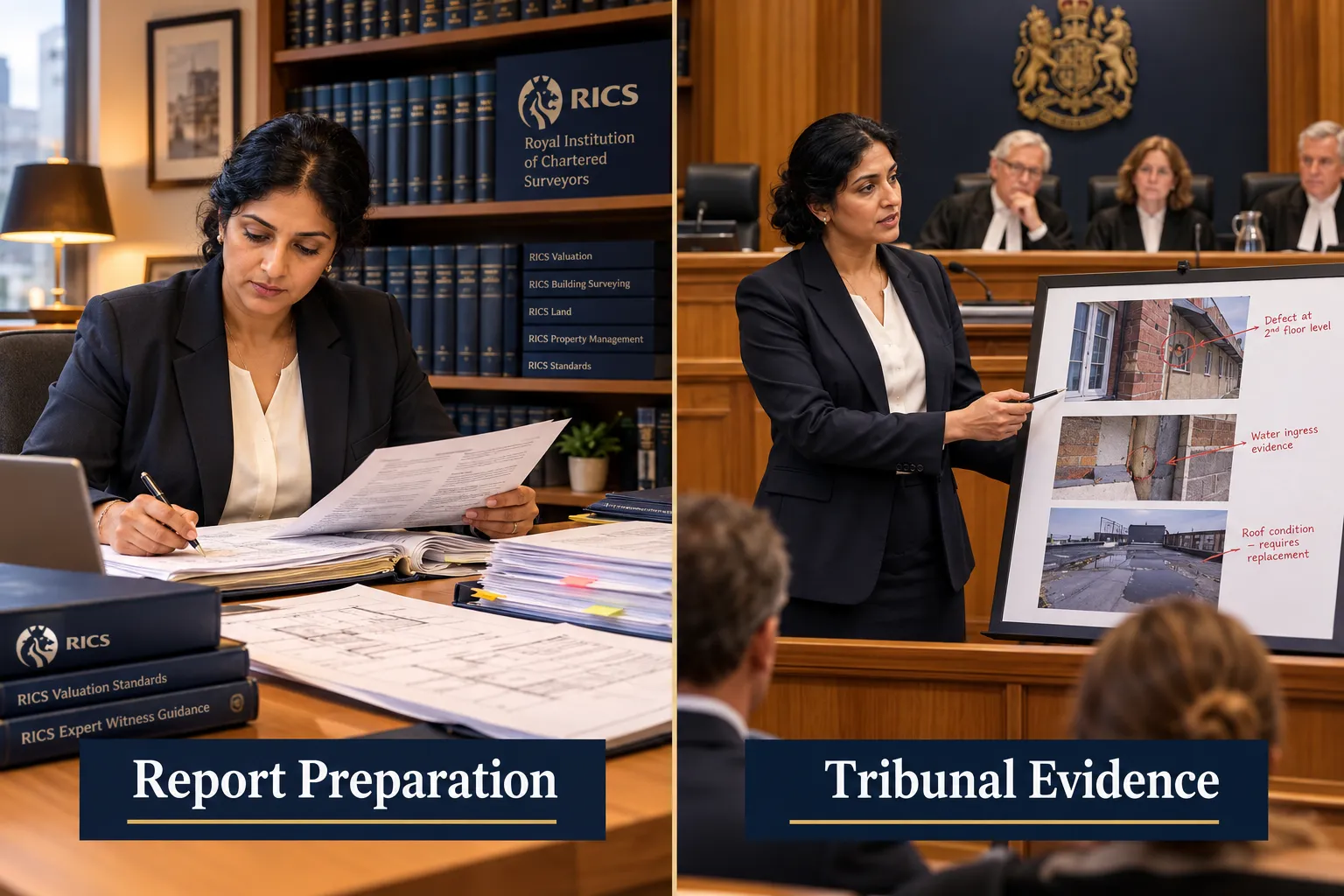
- Inspecting the property or site in dispute, taking measurements, photographs, and contemporaneous notes.
- Reviewing documentation, including title deeds, lease agreements, planning records, previous surveys, and correspondence.
- Preparing a written expert report that sets out findings, methodology, and reasoned opinion in a format acceptable to the relevant court or tribunal.
- Attending without-prejudice meetings with the opposing expert to identify areas of agreement and disagreement (known as "hot-tubbing" or joint statement preparation).
- Giving oral evidence under cross-examination, defending conclusions with reference to professional standards and site evidence.
The scope of work varies considerably depending on the type of dispute. A dilapidations expert witness will focus on lease-end obligations and the condition of a commercial property, while a construction expert witness will analyse building defects, contract compliance, and causation of damage.
Expert Witness Surveying in UK Property Disputes: When You Need One
Not every property disagreement requires expert witness involvement. Many disputes are resolved through negotiation, mediation, or a standard RICS dispute resolution process. However, certain situations almost always require a formally appointed expert witness surveyor.
Boundary and Land Disputes
Boundary disputes are among the most litigated property matters in England and Wales. When neighbours disagree about the precise location of a boundary, the First-tier Tribunal (Property Chamber) or the County Court will typically require expert surveying evidence. An expert witness surveyor will examine the original title plan, historic Ordnance Survey maps, physical features on the ground, and any conveyancing history to form a professional opinion on the true boundary line.
Issues relating to property boundaries are rarely straightforward. Title plans are drawn to small scales and are not intended to define boundaries precisely, which means expert interpretation is essential. The boundary dispute costs involved in contested proceedings make early expert input particularly valuable, a well-reasoned report can prompt settlement before the case reaches a full hearing.
Construction Defects and Building Failures
When a building develops serious defects, structural movement, water ingress, subsidence, or fire safety failures, and the cause is disputed between a contractor, developer, architect, and property owner, expert witness surveyors are routinely instructed by all parties. Their role is to establish what went wrong, why it went wrong, and who bears responsibility.
For context on what constitutes a serious defect worth pursuing, see the guide to cracks in walls: when to worry, which sets out the technical thresholds that surveyors use to assess structural risk.
Dilapidations Claims
At the end of a commercial lease, landlords and tenants frequently dispute the extent of disrepair and the cost of reinstatement. These dilapidations claims can run into hundreds of thousands of pounds for larger premises. An expert witness surveyor will assess the property's condition against the lease covenants, prepare a schedule of dilapidations, and, if the matter proceeds to court, provide evidence on the reasonable cost of remedial works.
For more background, the article on what a delap survey involves and what a dilapidations report covers provides useful context on how these assessments are structured.
Surveyor Negligence Claims
When a homebuyer or investor suffers financial loss because a surveyor failed to identify a material defect, a surveyor negligence claim may follow. In these cases, the claimant's legal team will instruct an expert witness surveyor to opine on what a competent surveyor should have identified and reported, and whether the original surveyor's conduct fell below the standard of a reasonably competent practitioner.
Party Wall Disputes
Where a party wall dispute cannot be resolved through the statutory award process, it may proceed to the County Court. Expert witness surveyors with party wall expertise are frequently instructed in these cases. Understanding when a party wall agreement is required is a useful starting point for property owners facing this type of dispute.
The RICS Professional Standards Framework: What Governs Expert Witnesses
Expert witness surveyors in the UK operate within a tightly regulated framework. The primary source of professional obligations is the RICS Professional Standard "Surveyors Acting as Expert Witnesses," currently in its 4th edition [1]. This standard is mandatory for all RICS members acting in an expert witness capacity, and non-compliance can result in disciplinary proceedings.
The 5th Edition: What Is Changing in 2026
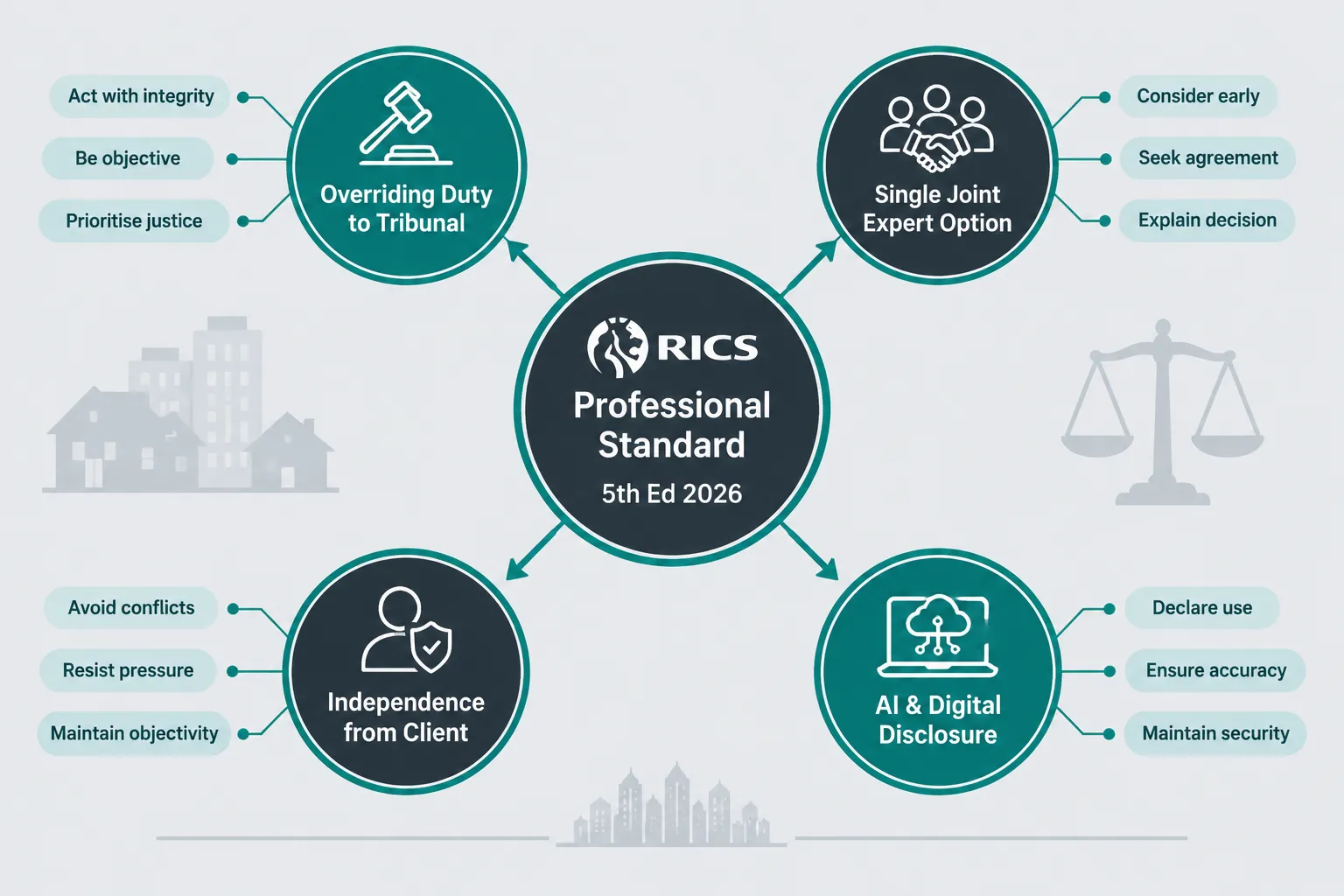
The RICS published the 5th edition of the standard in July 2026, with an effective date of 30 November 2026 [3]. The new edition introduces several significant changes that practitioners and instructing solicitors should be aware of:
| Area of Change | 4th Edition Position | 5th Edition Update |
|---|---|---|
| AI and digital tools | No specific guidance | Explicit requirements for disclosure of AI use in report preparation |
| Single Joint Experts | Addressed briefly | Expanded guidance on SJE appointment and conduct |
| Tribunal-specific procedures | General guidance | Separate tribunal-combined edition with jurisdiction-specific rules |
| Overriding duty | Established principle | Reinforced with clearer examples of conflicts |
The February 2024 Practice Alert issued by RICS already signalled the direction of travel, reminding members that their duty to the tribunal "overrides any obligation to the person from whom the expert has received instructions or by whom the expert is paid" [9].
The RICS Register of Accredited Expert Witnesses
As of March 2026, RICS operates a Register of Accredited Expert Witnesses, providing legal teams with a searchable database of surveyors who have demonstrated the competency and training required for expert witness work [6]. Accreditation requires completion of specialist training, evidence of relevant experience, and ongoing CPD. When instructing an expert witness surveyor, verifying their presence on this register is a practical due diligence step.
Independence vs Advocacy: A Critical Distinction
One of the most common misunderstandings among property owners is the belief that an expert witness surveyor will "fight their corner." This is not the role. The expert witness must be independent of the outcome and must disclose any conflict of interest before accepting instructions [1].
A surveyor cannot act simultaneously as an expert witness and as a party wall surveyor or advocate in the same dispute. The RICS standards are explicit: dual roles that compromise independence are prohibited [1]. This is not merely a professional nicety, courts have struck out expert evidence where independence was found to be compromised.
Expert Witness Surveying in UK Property Disputes: Costs, Instruction, and Practical Strategy
What Does an Expert Witness Surveyor Cost?
Fees for expert witness surveyors in the UK vary according to the complexity of the case, the seniority of the expert, and the volume of work required. Based on 2026 market data [8]:
- Hourly rates: typically £150,£400 for RICS-accredited expert witness surveyors
- Initial report preparation: £1,500,£5,000 for a straightforward residential dispute; £5,000,£15,000+ for complex commercial or multi-party cases
- Court attendance: £1,000,£3,000 per day, depending on the expert's seniority and travel requirements
- Joint statement preparation: typically 3-8 hours of billable time per expert
These figures represent professional fees only and do not include disbursements such as travel, specialist testing, or access to historic records. In lower-value disputes, parties may consider a Single Joint Expert (SJE), one expert appointed by both sides, which reduces overall costs while still providing the tribunal with independent technical opinion [3].
When to Instruct: Earlier Is Almost Always Better
Many solicitors and property owners make the mistake of instructing an expert witness surveyor only after proceedings have commenced. In practice, early instruction provides several strategic advantages:
- Case assessment: An expert can advise on the technical merits of a claim before significant legal costs are incurred.
- Evidence preservation: Physical evidence, crack patterns, drainage failures, boundary features, can deteriorate or be altered. Early inspection preserves the evidential record.
- Settlement leverage: A well-prepared preliminary report often prompts the opposing party to negotiate rather than litigate.
- Pleadings support: Expert input at the drafting stage ensures that technical claims are accurately framed in the particulars of claim or defence.
For those navigating property disputes of any kind, the principle is consistent: technical expert input at the earliest possible stage shapes the entire trajectory of a case.
Scotland-Specific Considerations
In Scotland, the court system differs from England and Wales. Expert witness surveyors appearing before the Court of Session or Sheriff Court must comply with Scottish procedural rules, including Chapter 12A of the Rules of the Court of Session for expert witnesses. The RICS 5th edition standard acknowledges these jurisdictional differences and provides supplementary guidance for Scottish practitioners [3]. The Lands Tribunal for Scotland handles many property valuation and boundary disputes, and expert surveyors appearing there must be familiar with its specific procedural requirements.
AI and Digital Tools: The 2026 Frontier
The integration of AI into surveying practice has accelerated rapidly, and the 5th edition standard addresses this directly [4]. Expert witness surveyors using AI-assisted analysis, whether for comparable evidence searches, defect pattern recognition, or report drafting, are now expected to disclose this use in their reports and confirm that all outputs have been reviewed and verified by the expert personally [3].
This matters because courts are increasingly alert to the risk of AI-generated content being presented as independent professional opinion. The expert's overriding duty to the tribunal requires that every opinion in a report is genuinely the expert's own, regardless of the tools used to compile supporting data [4].
How to Choose and Instruct the Right Expert Witness Surveyor
Selecting the right expert is as important as deciding to instruct one. The following criteria should guide the selection process:
Relevant specialism: A residential valuation surveyor is not the right choice for a complex construction defect claim. Match the expert's core practice area to the nature of the dispute.
RICS accreditation and register listing: Verify the surveyor's current RICS membership and check the Register of Accredited Expert Witnesses [6].
Tribunal experience: An expert who has given oral evidence in the relevant tribunal or court, whether the First-tier Tribunal (Property Chamber), the County Court, or the Upper Tribunal (Lands Chamber), will be better prepared for cross-examination.
Availability and capacity: Expert witness work is time-sensitive. Confirm that the expert can meet the court's timetabling directions before formally instructing them.
Absence of conflicts: The expert must confirm in writing that they have no conflict of interest with any party to the dispute before accepting instructions [1].
Once instructed, the expert should be provided with a clear letter of instruction setting out the questions they are asked to address, the relevant documents, and the applicable procedural rules. The expert's report must comply with the relevant court's practice direction, in England and Wales, this is Civil Procedure Rule Part 35 and its accompanying Practice Direction.
Conclusion
Expert Witness Surveying in UK Property Disputes: When You Need One and What They Do is a subject that every property owner, developer, and legal practitioner involved in contested property matters should understand clearly. The expert witness surveyor occupies a unique and powerful position: they are the professional whose technical opinion a court or tribunal will rely upon to resolve disputes that laypeople, and often lawyers, cannot resolve alone.
The key principles to carry forward are straightforward. The expert's duty runs to the tribunal, not the client. Independence is non-negotiable. Early instruction consistently produces better outcomes than late engagement. And with the RICS 5th edition standard taking effect in November 2026, the framework governing this work is becoming more rigorous, not less.
Actionable next steps for property owners and legal teams:
- If a property dispute is escalating beyond negotiation, seek a preliminary opinion from a RICS-accredited expert witness surveyor before issuing proceedings.
- Use the RICS Register of Accredited Expert Witnesses to identify appropriately qualified practitioners in the relevant specialism.
- Provide the expert with a clear, written letter of instruction from the outset, specifying the questions to be addressed and the relevant procedural rules.
- Budget realistically for expert witness fees as a core litigation cost, not an optional extra.
- If cost is a concern in a lower-value dispute, discuss the Single Joint Expert option with the opposing party's solicitors at an early stage.
The right expert witness surveyor, instructed at the right time, does not just strengthen a case, they can resolve it before it ever reaches a hearing.
References
[1] Surveyors acting as expert witnesses (4th edition, Feb 2023 amendment) – rics.org
[2] Surveyors Acting As Expert Witnesses Client Guide – rics.org
[3] Surveyors Acting As Expert Witnesses 5th Edition Tribunal Combined – rics.org
[4] RICS 2026 Expert Witness Guidance: Key Changes For Surveyors – rimkus.com
[6] Surveyors Acting As Expert Witnesses (RICS profession standards page) – rics.org
[8] Expert Witness Cost UK – surveymerchant.com
[9] Practice Alert: Expert Witnesses (February 2024) – rics.org