
One in five UK homebuyers still skip a property survey in 2026, yet those who commission one save an average of £2,600 through post-survey renegotiation, and that figure only captures the deals that complete [4]. The ones that collapse entirely, or drag buyers into years of boundary litigation, rarely make the statistics. Understanding the relationship between defective title and property surveys: what surveyors can reveal before you buy is one of the most valuable pieces of knowledge any buyer can carry into a transaction.
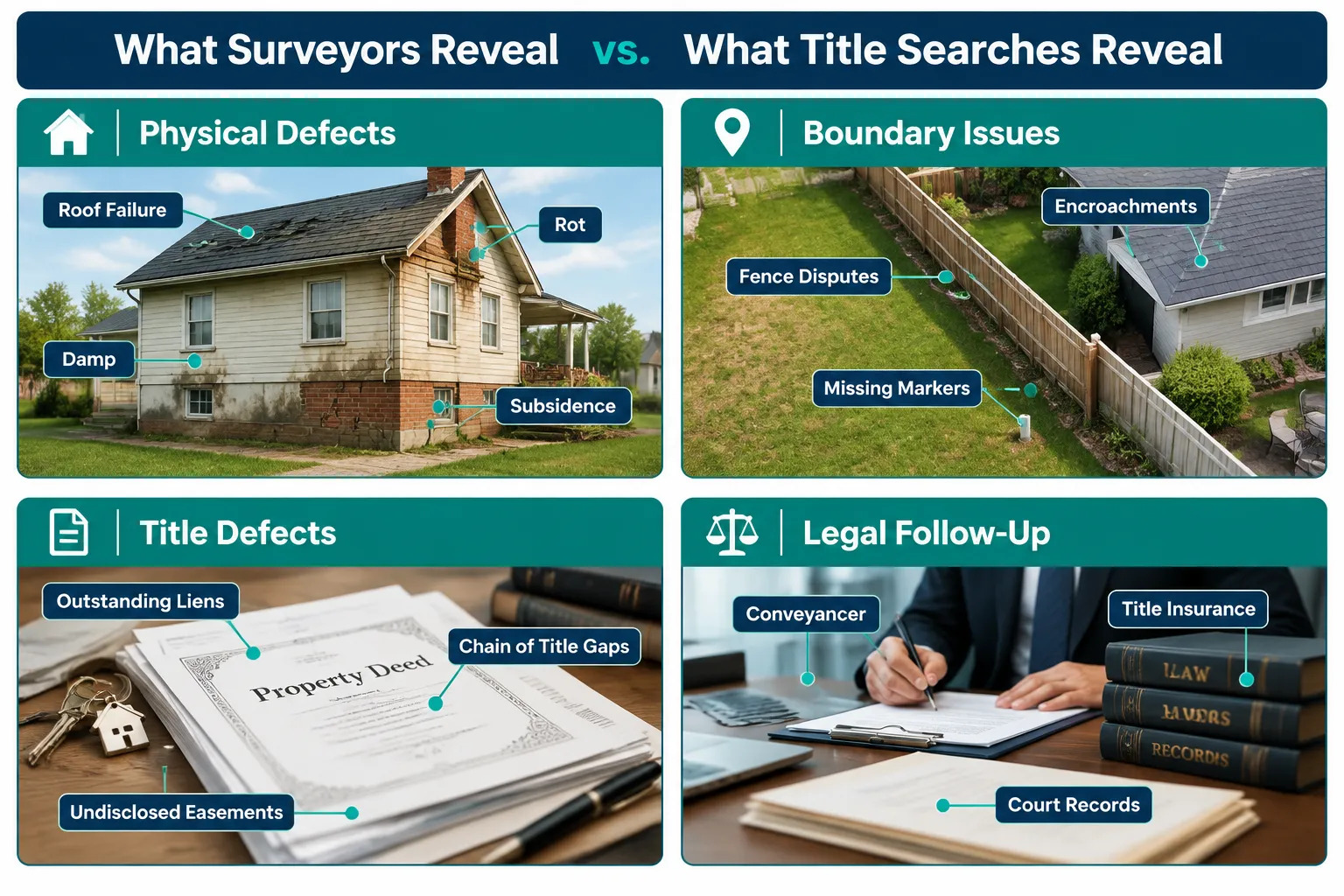
A survey and a title search are not the same thing, but they are deeply connected. A surveyor inspects what is physically on and around the land. A conveyancer investigates who legally owns it and what rights or burdens are attached to it. When a surveyor flags a boundary discrepancy, an unapproved extension, or a shared access route, that finding is often the first visible sign of a legal problem that the title register has not yet caught up with. This article explains how those two disciplines interact, what surveyors commonly uncover, and when buyers need to escalate findings to their legal team.
Key Takeaways
- Structural issues appear in 35% of surveyed properties, yet one in five buyers still skip surveys entirely [4].
- A survey reveals physical and boundary defects; a title search reveals legal and financial encumbrances, both are essential.
- Physical findings such as unapproved extensions, boundary encroachments, and shared access routes are often early signals of defective title.
- Sellers in the UK are now legally required to disclose defects identified by a survey under updated material information rules [3].
- Buyers should treat a surveyor's report as a checklist for their conveyancer, not just a negotiating tool.
What Is a Defective Title and Why Does It Matter?
A defective title exists when the seller cannot demonstrate clear, unencumbered ownership of the property, meaning their right to sell, mortgage, alter, or occupy it is impaired in some way [6][7]. The defect may be minor and easily resolved, or it may make the property unmortgageable and effectively unsaleable until a court or specialist insurer steps in.
Common causes of defective title include:
- Gaps in the chain of title, missing deeds or unregistered transfers from past decades
- Outstanding liens or charges, unpaid mortgages, contractor debts, or tax arrears secured against the land [6]
- Recording errors, misspelled names on deeds or incorrect boundary descriptions in the legal register [7][8]
- Undisclosed easements or covenants, rights of way, restrictive covenants, or drainage easements that were never formally registered
- Competing ownership claims, unresolved inheritance disputes or adverse possession claims by neighbours
- Unapproved alterations, works carried out without planning permission or building regulations approval, which can invalidate insurance and create enforcement liability
None of these problems are visible to the naked eye during a property viewing. Most require a formal title search by a qualified conveyancer. However, and this is the critical point, a surveyor's physical inspection frequently uncovers evidence that points directly toward these legal problems.
How Defective Title and Property Surveys Intersect: What Surveyors Can Reveal Before You Buy
Surveyors are trained to observe the physical condition of a property, but experienced practitioners also recognise when something they see on site should trigger a legal enquiry. The bridge between surveying and conveyancing is more important than most buyers realise.
Boundary Discrepancies and Encroachments
A surveyor measuring the site will often identify that a fence, wall, driveway, or outbuilding does not sit where the title plan suggests it should. This matters enormously. A 2025 Kentucky Court of Appeals decision reaffirmed that a boundary survey provides important evidence of where lines lie but does not itself determine legal ownership, that still depends on recorded legal instruments and, where disputed, court determination [5]. A 2025 Andhra Pradesh High Court case similarly highlighted that describing property only by survey numbers can be ambiguous, and that physical boundary descriptions are often more reliable identifiers [10].
In practical terms, this means a surveyor who identifies a boundary discrepancy is flagging something that requires immediate legal investigation. The conveyancer must check whether the title plan matches the physical reality, whether any adverse possession claims are registered, and whether a neighbour has any formal or informal rights over the disputed land. For guidance on how property boundaries are defined and recorded, understanding the legal framework is essential before any purchase proceeds.
Unapproved Extensions and Alterations
Structural additions, a rear extension, a loft conversion, a garage conversion, are among the most common defects surveyors identify. When a surveyor notes that an extension appears to have been built without the appropriate approvals, this is not merely a building quality concern. It signals a potential title defect: the seller may not have obtained planning permission, building regulations sign-off, or both.
Under updated UK material information rules introduced through the Digital Markets, Competition and Consumers Act, once a seller commissions a survey and defects are identified, those defects become "known" and must be disclosed in the TA6 Property Information Form and to the estate agent [3]. Sellers cannot legally ignore or conceal survey findings. This means buyers who discover an unapproved extension through their survey are entitled to demand documentary evidence, or a significant price reduction.
Shared Access, Rights of Way, and Easements
A surveyor inspecting a property with a shared driveway, a pathway running through the garden, or a utility access point will note these in their report. What they cannot determine is whether those access arrangements are formally registered as easements, whether they are protected by a deed of grant, or whether they could be challenged or revoked.
Buyers who see these physical features flagged in a survey report should instruct their conveyancer to investigate the title register for any corresponding easements or covenants. Missing documentation for access rights is a classic cause of defective title, and one that can make a property difficult to insure or mortgage [7][8].
"A surveyor's report is not the end of the due diligence process. For buyers, it is the beginning of a targeted legal investigation."
The Most Common Physical Defects That Signal Deeper Title Problems
Research published in 2026 shows that structural issues are found in 35% of surveyed properties, Japanese knotweed in 32%, asbestos in 31%, rot in 27%, and woodworm in 25% [4]. Each of these has both a physical dimension and a potential legal dimension.
Subsidence and Structural Movement
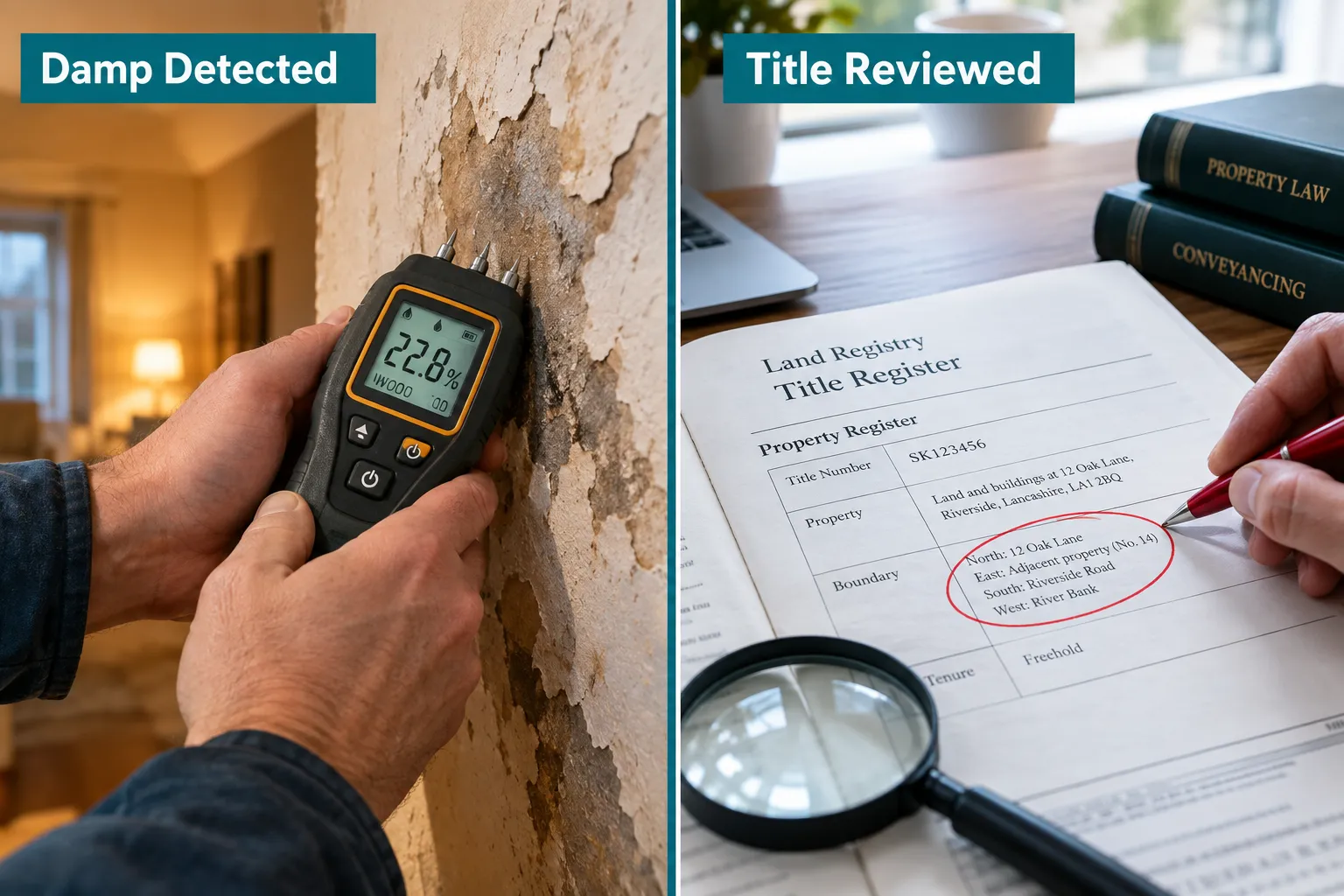
Subsidence, the gradual sinking of a building's foundations, is one of the most serious defects a surveyor can identify. It affects insurability, mortgageability, and value. For a detailed explanation of how this issue develops, the guide on what subsidence is, its signs and causes provides essential background.
From a title perspective, subsidence can indicate that the seller has made insurance claims that were never disclosed, or that remediation works were carried out without proper documentation. Either scenario can impair title.
Damp and Drainage Defects
Major damp, whether rising damp, penetrating damp, or condensation, is found regularly in UK properties. A professional damp survey in London can quantify the extent of moisture ingress and identify its source. Defective drainage is a related concern: a surveyor who identifies signs of drainage failure should prompt the conveyancer to check whether the drainage system is adopted by the local authority or privately maintained, and whether any drainage easements are registered on the title.
Japanese Knotweed and Invasive Plants
Japanese knotweed is present in 32% of surveyed properties [4]. Its presence is a material fact that must be disclosed and can affect mortgage lending. Lenders typically require a professionally managed treatment plan before they will lend. If a seller has known about knotweed and failed to disclose it, this may constitute misrepresentation, a legal matter that goes beyond the survey itself.
Unapproved Works and Missing Certificates
When a surveyor identifies that electrical systems appear to have been upgraded without a Part P certificate, or that a boiler has been installed without a Gas Safe certificate, these findings signal potential building regulations breaches. Missing certificates can make a property unmortgageable until indemnity insurance is obtained. The conveyancer must investigate and, where necessary, obtain specialist indemnity cover as part of the transaction.
| Defect Type | Typical Price Reduction | Legal Follow-Up Required? |
|---|---|---|
| Minor cosmetic issues | £1,000, £3,000 | Rarely |
| Damp / drainage defects | £5,000, £20,000+ | Sometimes |
| Structural problems / subsidence | £20,000, £50,000+ | Almost always |
| Unapproved extensions | Variable / deal-breaker | Yes, indemnity or regularisation |
| Boundary disputes / encroachments | Variable / deal-breaker | Yes, title investigation essential |
Choosing the Right Survey and Acting on Its Findings
Not all surveys provide the same depth of information. A basic valuation report commissioned by a mortgage lender is designed to protect the lender, not the buyer. A homebuyers report is suitable for conventional properties in reasonable condition, while a full building survey is recommended for older, larger, or structurally complex properties. For buyers considering a new-build, the question of whether a survey on a new build is necessary deserves careful consideration, defects do occur even in newly constructed homes.
Leasehold properties carry additional complexity. The leasehold buying checklist covers the specific issues that arise with service charges, ground rent, and lease length, all of which can affect title quality and mortgageability independently of any physical survey findings.
What to Do When a Survey Flags a Problem
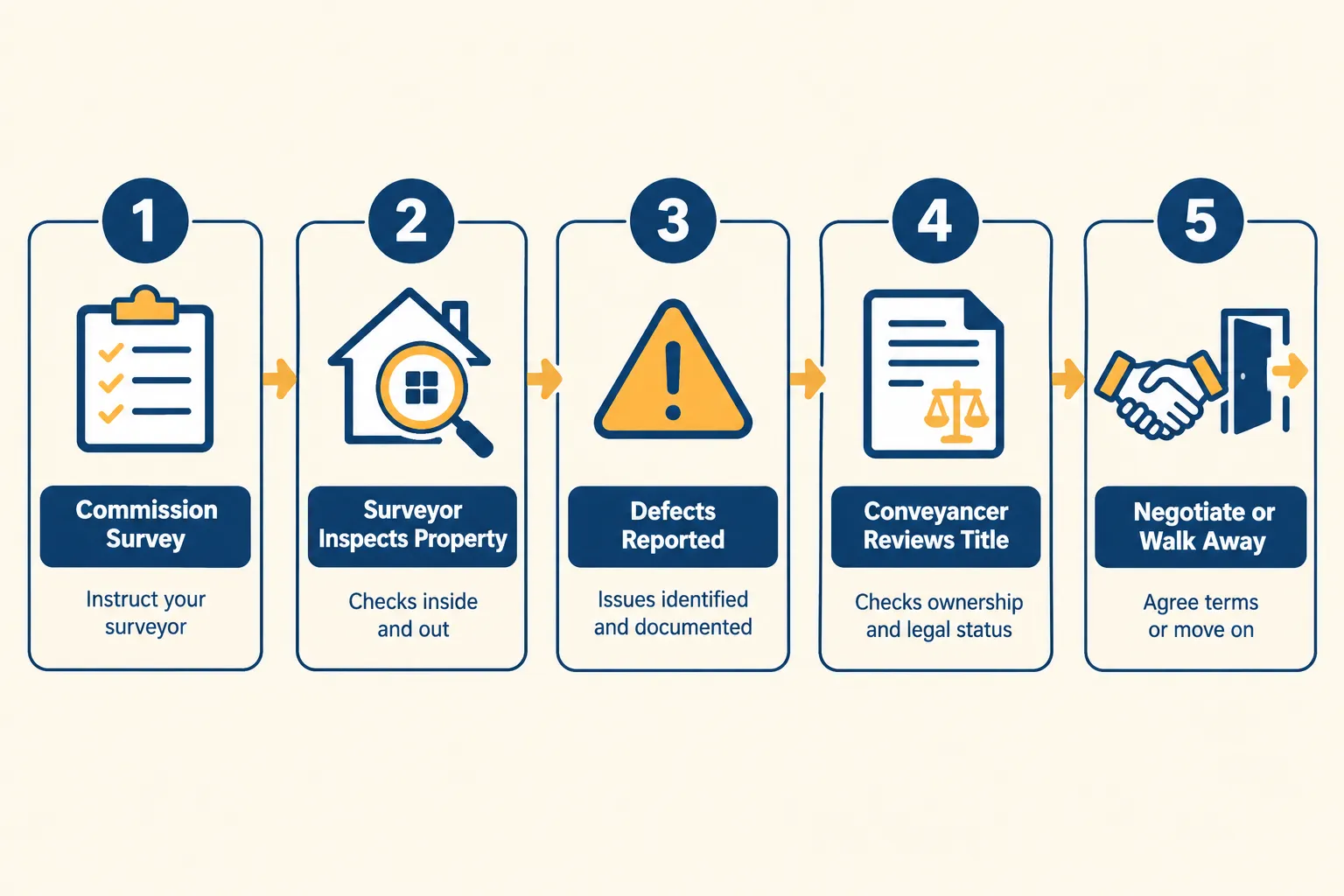
The process from survey finding to legal resolution follows a clear sequence:
- Receive and read the full survey report, do not rely on a verbal summary from the estate agent.
- Identify which findings have legal implications, boundary issues, unapproved works, shared access, and drainage are the most common triggers.
- Share the report with your conveyancer, instruct them to raise specific enquiries with the seller's solicitor based on the survey findings.
- Request documentary evidence, planning permissions, building regulations completion certificates, Gas Safe certificates, and any previous survey reports held by the seller.
- Obtain specialist advice where needed, a structural engineer for subsidence, a drainage surveyor for drainage defects, or a planning consultant for unapproved works.
- Negotiate or reconsider, defects needing repairs exceeding 10-15% of the property's value are often treated as deal-breakers or make a property unmortgageable [13]. Buyers should be prepared to renegotiate or withdraw.
If a dispute later arises about whether a surveyor should have identified a defect, buyers should preserve the original survey report, all correspondence, and photographic evidence of when issues were discovered. Claims against surveyors typically hinge on whether a reasonably competent professional should have identified a material defect visible at the time of inspection.
When Surveys Reveal Active Legal Disputes
Case law from 2025-2026 has established that authorities should not carry out land survey or demarcation work where a civil suit over that land is pending, because a recent survey can be vulnerable if it conflicts with unresolved court proceedings [12]. For buyers, this means that if a surveyor identifies signs of an ongoing boundary dispute, contested fencing, recent earth movement along a boundary, or evidence of a neighbour's encroachment, the conveyancer must search for any pending litigation before exchange of contracts.
Buyers purchasing in areas with active property boundary disputes should be especially cautious. A chartered surveyor with experience in boundary matters can provide a measured survey and an expert opinion, but the legal resolution of any dispute remains with the courts and the conveyancing process.
The Role of Title Insurance
Where a title defect is identified but cannot be resolved before completion, for example, because a planning permission from 1987 cannot be located, title insurance is often used as a practical solution. Title insurers assess the risk that the defect will be enforced against the buyer and issue a policy that covers legal costs and any resulting loss in value. This is not a substitute for proper due diligence, but it is a recognised mechanism for managing residual risk in transactions where the defect is historic and the likelihood of enforcement is low.
Conclusion
The relationship between defective title and property surveys is not incidental, it is structural. Surveyors are the first professionals to examine a property in detail, and their findings routinely uncover the physical evidence of legal problems that a title search alone might miss. An unapproved extension, a boundary wall in the wrong place, a shared driveway with no formal easement: each of these is simultaneously a physical defect and a potential title defect.
Actionable next steps for buyers in 2026:
- Commission a full building survey or homebuyers report before exchange, not after.
- Share the survey report with your conveyancer immediately and ask them to raise specific legal enquiries based on its findings.
- Do not treat a clean survey as confirmation of clean title, always run both processes in parallel.
- If the survey identifies boundary issues, unapproved works, or shared access arrangements, instruct your conveyancer to investigate the title register and request all relevant certificates and permissions from the seller.
- Where defects exceed 10-15% of the property value, take independent legal and structural advice before proceeding.
- Retain all survey documentation, correspondence, and photographs throughout the transaction and beyond completion.
Buying property is one of the largest financial commitments most people make. The combination of a rigorous survey and a thorough title investigation is not a luxury, it is the minimum standard of due diligence that protects that investment.
References
[1] 10 Common Home Defects Found In Property Surveys And How To Fix Them – lmsurveyors.co.uk
[2] Most Common House Survey Problems – surveyorlocal.co.uk
[3] Material Information Dmcc Act Sellers – propelr.co.uk
[4] One In Five Homebuyers Skip Surveys Despite Two Thousand Six Hundred Pounds Average Saving – aviva.com
[5] 2024 Ca 0329 Mr – law.justia.com
[6] Why Title Issues Delay Closings And How Lenders Address Them In 2026 – newdayusa.com
[7] Property Title Searches In Critical Things Every Home Buyer Must Know Before Closing – amerisave.com
[8] Property Title Searches The Complete Guide To Protecting Your Home Investment – amerisave.com
[9] Article – georgedavid.co.uk
[10] Amend Suit Boundaries: Survey Numbers To Enjoydars – supremetoday.ai