
More surveyors across the UK reported falling prices than rising ones every single month of 2026 so far, yet the gap is narrowing, and the conversations happening between buyers, sellers, and chartered surveyors are shifting in ways that matter enormously for anyone currently in the market. Understanding the 2026 UK House Price Outlook: What Surveyors Are Seeing in Valuations and Buyer Negotiations requires looking beyond the headline numbers and into the day-to-day reality of valuations and deal-making.
Key Takeaways
- The RICS house price balance remained negative throughout 2026, reaching -28% in August, but the trend is gradually improving from sharper declines earlier in the year.
- Regional divergence is significant: London and the South East face the sharpest downward pressure, while Northern Ireland, Scotland, and the North West hold positive price expectations.
- Major forecasters now expect either modest growth or a small decline in 2026, with Savills projecting a 2% fall and Knight Frank forecasting roughly 1.5% growth.
- Surveyors are reporting more agreed sale prices being negotiated below asking levels, but the size of those discounts is beginning to narrow.
- Buyers who commission a professional survey are better positioned to identify genuine grounds for renegotiation rather than speculative price cuts.
How the RICS Data Frames the 2026 UK House Price Outlook
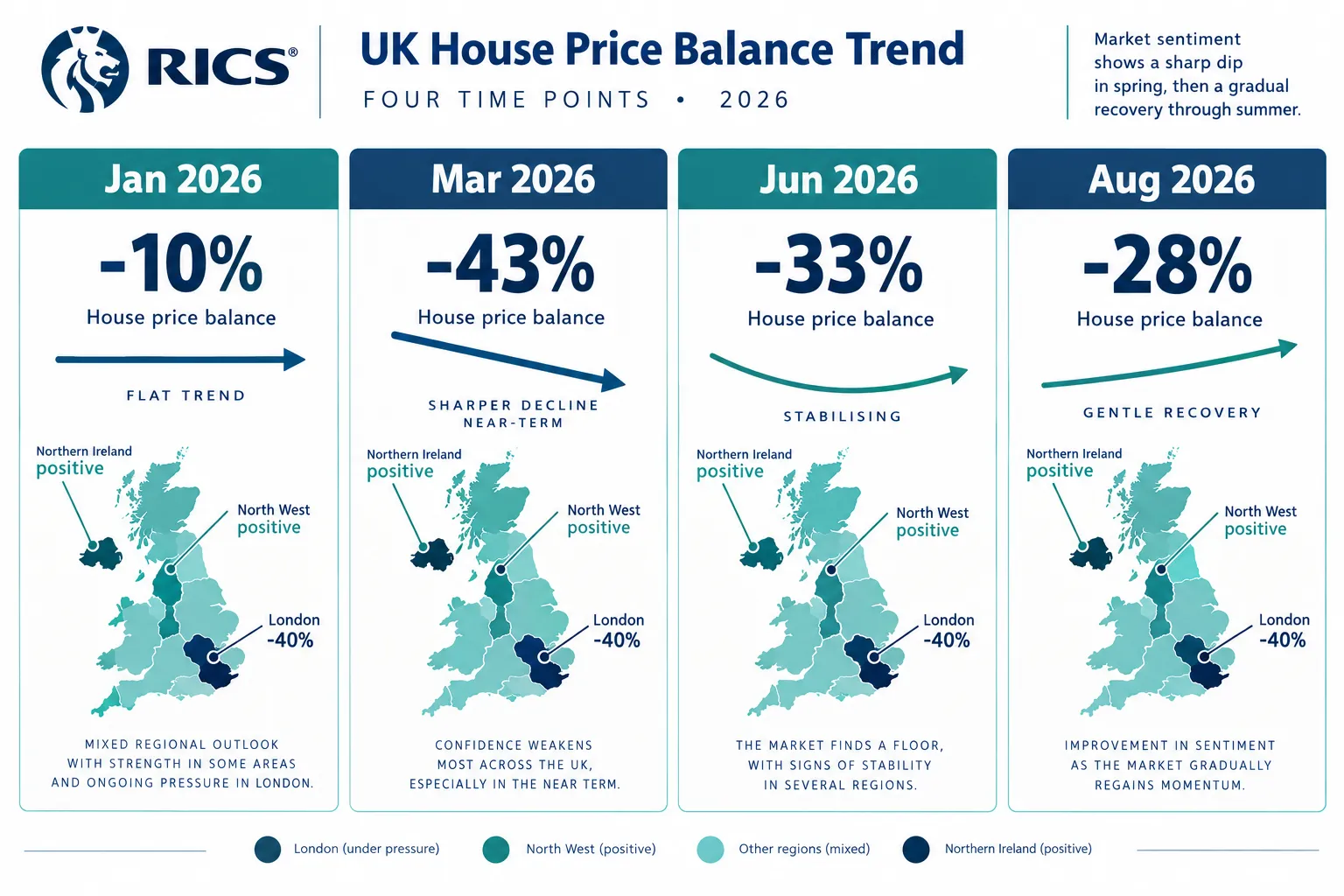
The most closely watched barometer of surveyor sentiment is the RICS UK Residential Market Survey, published monthly. Its headline "price balance" measures the percentage of surveyors reporting price rises minus those reporting falls. A negative reading does not mean prices are crashing, it means more professionals are seeing softness than strength in their local markets.
In January 2026, the national price balance stood at approximately -10%, a meaningful recovery from -19% in October 2025 [1]. February held broadly flat at -12% [1]. Then March brought a sharp deterioration in near-term expectations, with that series falling to -43%, even as the 12-month outlook remained barely positive at +2% [1]. By June 2026, the headline balance had settled at -33%, broadly unchanged from April and May, with near-term price expectations at -32% but the 12-month view edging into positive territory at +8% [2].
The August 2026 reading showed a modest improvement to -28%, the least negative reading since January and the fifth consecutive month of improvement in new buyer enquiries, which reached a net balance of -19% [4][6]. Surveyors contributing to that report expected prices to drift slightly lower over the following three months before steadying over a 12-month horizon, a picture of short-term softness rather than structural collapse [4][6].
What does this mean in practice? Surveyors setting formal valuations are not pricing in a deep downturn. They are applying modest downward adjustments that reflect current transaction evidence, not worst-case scenarios. For buyers, this means valuations are grounded and defensible, but there is still room for negotiation where genuine defects or market conditions support it.
"The market is subdued rather than in crisis, surveyors are seeing more agreed sale prices negotiated below asking levels, but the discounting is beginning to narrow as conditions stabilise." [3]
Regional Divergences That Surveyors Are Watching
The national average conceals sharp regional splits that directly affect how valuations are set and how negotiations play out.
| Region | Surveyor Price Expectation Balance (April 2026) | Direction |
|---|---|---|
| London | Approximately -40% | Falling |
| South East | Approximately -24% | Falling |
| East Anglia | Approximately -26% | Falling |
| Northern Ireland | Positive | Rising |
| Scotland | Positive | Rising |
| North West | Positive | Rising |
Source: RICS data cited in April 2026 market review [11]
Despite the negative near-term readings in the south, the same analysis found that the overall 12-month sentiment balance was +33%, meaning a net majority of surveyors expected prices to edge upward over the coming year [11]. This divergence between short-term caution and medium-term optimism is central to understanding how professional valuers are approaching their work in 2026.
For buyers in London and the South East, surveyors are more likely to produce valuations that sit below agreed purchase prices, a "down-valuation", because comparable evidence supports lower figures. In the North West or Northern Ireland, the same dynamic is less common because local price pressure is moving in the opposite direction. RICS property valuations are always grounded in local comparable evidence, which is why regional context matters so much.
What Surveyors Are Seeing in Valuations: Down-Valuations and Their Triggers
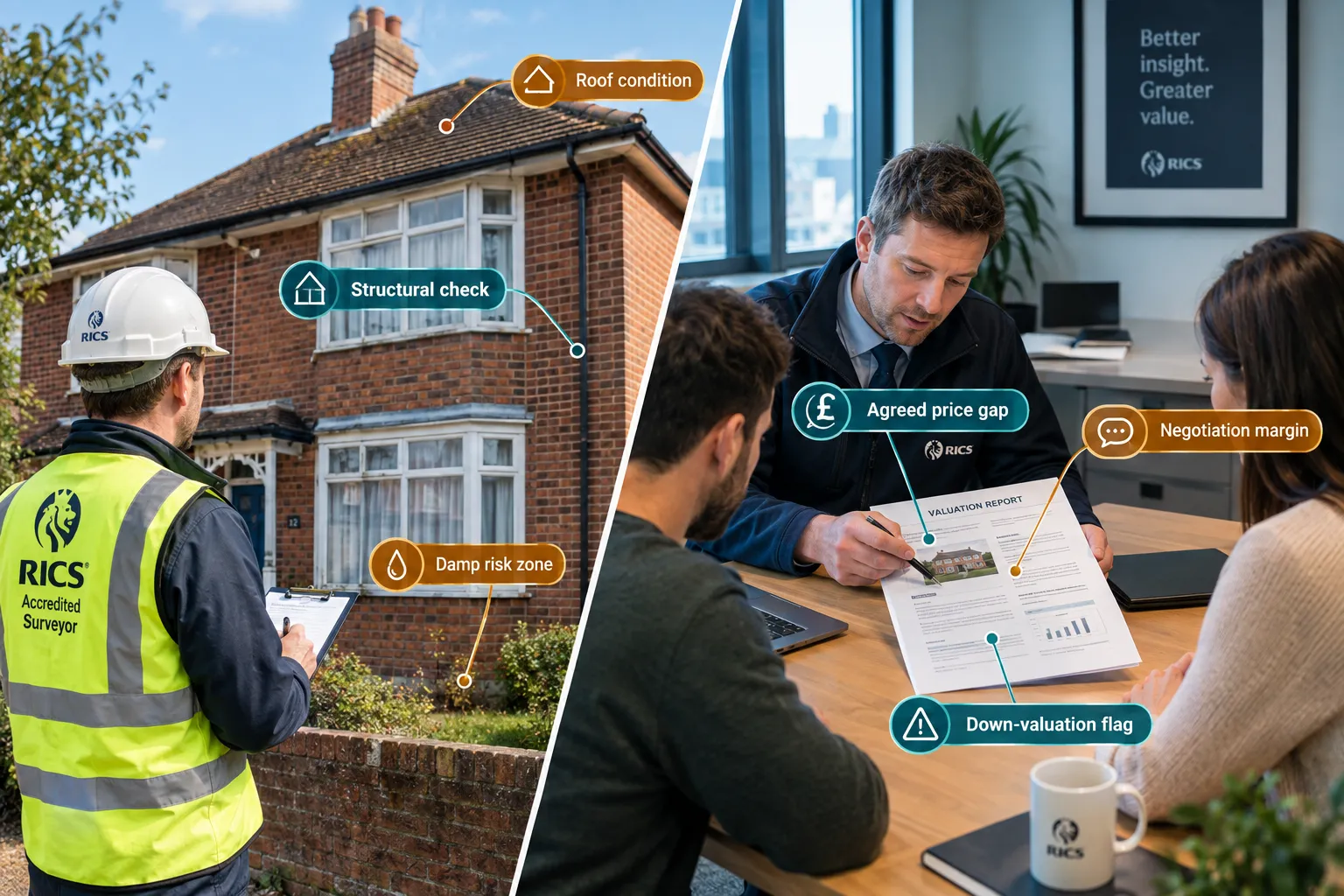
A formal valuation and a survey are distinct exercises, but they often intersect in ways that affect the final agreed price. When a surveyor identifies significant defects during a house inspection, those findings can, and should, feed directly into a buyer's negotiating position.
What Causes a Down-Valuation in 2026
Down-valuations occur when a lender's surveyor or an independent valuer concludes that a property is worth less than the price agreed between buyer and seller. In 2026, the most common triggers include:
- Comparable evidence gaps: In a market where transaction volumes remain subdued, there are fewer recent sales to support high asking prices, particularly for unusual or premium properties.
- Structural defects: Issues such as subsidence, damp penetration, or roof deterioration that reduce a property's market value relative to similar homes in better condition.
- Overstretched asking prices: Sellers who priced optimistically during the 2021-2022 boom and have not adjusted to current conditions.
- Regional softness: In markets where the RICS price balance is deeply negative, surveyors have stronger grounds to apply downward adjustments.
Properties built between the 1930s and 1970s carry particular risk. Hidden defects in 1930s-1970s UK houses, from original wiring to asbestos-containing materials and poorly maintained cavity walls, are frequently uncovered during building surveys and can materially affect both the formal valuation and the buyer's negotiating leverage.
The Difference Between a Level 2 and Level 3 Survey in This Market
The level of survey a buyer commissions determines how much information they have going into negotiations. A Level 2 vs Level 3 survey comparison is particularly relevant in 2026 because the market conditions reward buyers who have detailed, evidence-based grounds for renegotiation rather than vague requests for discounts.
- A Level 2 (Homebuyer Report) covers visible and accessible parts of the property, flags significant defects, and provides a market valuation. It suits standard properties in reasonable condition.
- A Level 3 (Building Survey) provides a full structural assessment, investigates concealed areas where possible, and is essential for older, larger, or non-standard properties.
In a market where sellers are already under pressure, a well-evidenced survey report carrying specific repair cost estimates gives buyers a credible basis for renegotiation. A vague request for a discount without supporting evidence is far easier for a seller to reject.
Buyer Negotiations in 2026: How the Market Is Playing Out
The 2026 UK House Price Outlook: What Surveyors Are Seeing in Valuations and Buyer Negotiations cannot be separated from the practical mechanics of how deals are being done. The data points to a market in which discounting is common but narrowing, and where the quality of a buyer's information determines the outcome.
The Forecaster Consensus and What It Means for Negotiations
Major forecasters entered 2026 broadly optimistic. Halifax projected 1-3% growth, Nationwide forecast 2-4%, and Zoopla estimated around 1.5% [14]. Those forecasts have since been revised. Savills' June 2026 update shifted from a +2% forecast to a -2% projection for mainstream UK house prices in 2026, citing higher mortgage costs and affordability pressures, while maintaining a longer-term view of 18.5% cumulative growth between 2026 and 2030 [15]. Pantheon Macroeconomics cut its 2026 forecast from +3% to +1%, and Knight Frank's latest projections point to approximately 1.5% growth in 2026, rising to 3% in 2027 and 4% in 2028 [5][7][15].
The practical implication for buyers is straightforward: surveyors and agents are not pricing in a recovery that has not yet arrived. Valuations reflect current transaction evidence, which in many parts of England means prices that are flat to slightly lower than 12 months ago. Buyers who understand this are negotiating from a position of knowledge rather than hope.
How Negotiations Are Unfolding
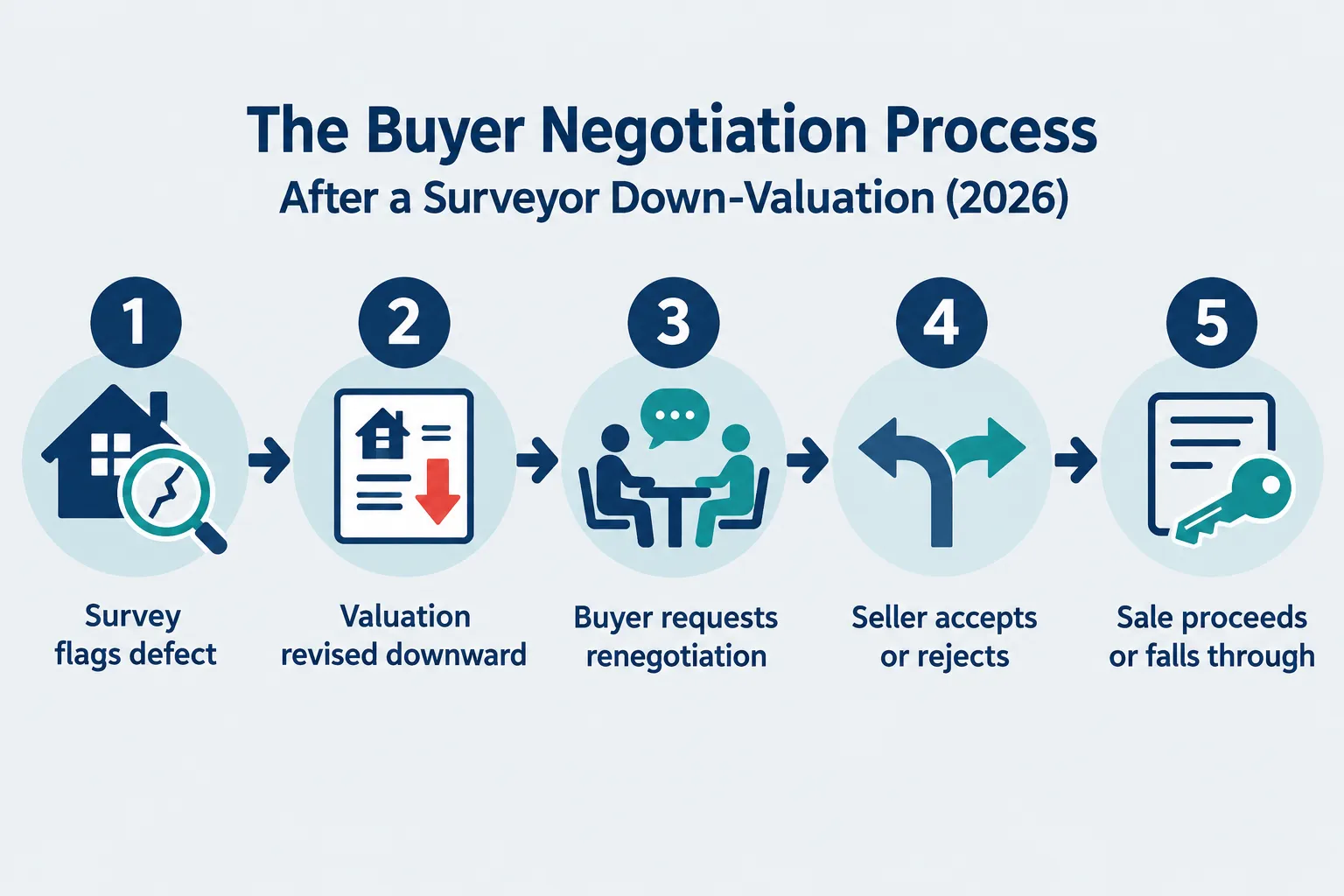
Based on the July and August 2026 RICS surveys, the pattern of negotiations in 2026 follows a recognisable structure [3][4][6]:
- Agreed price set above current market evidence, common where sellers priced during a stronger period and have not adjusted.
- Survey or valuation reveals a gap, either a formal down-valuation by a lender's surveyor or defects identified in a buyer-commissioned survey.
- Buyer requests a price reduction, supported by the survey report, repair cost estimates, or the lender's revised valuation figure.
- Seller accepts a partial reduction, rejects, or the sale falls through, outcomes vary by region, seller motivation, and the quality of evidence presented.
- Market stabilisation narrows the gap, as conditions improve, the difference between asking prices and agreed prices is beginning to reduce, meaning the window for large discounts may be closing.
Surveyors contributing to the September 2026 market overview described estate agents and surveyors as "more optimistic than earlier in the year," interpreting recent RICS surveys as evidence that expectations for price rises are improving from low levels [3][5]. This is consistent with a stabilising market in which valuations and negotiations are converging more predictably than during the sharper downturn of late 2025.
The Role of the Rental Market
One factor supporting underlying housing demand, and therefore limiting the depth of price falls, is the private rental sector. RICS data shows seven consecutive quarters of falling landlord instructions, with three-month rent expectations at a net balance of +28% in the latest 2026 reading [8]. Rising rents reduce the financial advantage of renting over buying, which sustains buyer demand even when mortgage costs are elevated. Surveyors and analysts see this as a floor under house prices, particularly in supply-constrained urban markets.
Practical Steps for Buyers Navigating the 2026 Market
Buyers who want to use the current market conditions to their advantage should take the following steps:
Before making an offer:
- Research recent comparable sales in the specific street and postcode, not just the broader area.
- Understand the regional RICS price balance for the area, a -40% balance in London carries different implications than a positive balance in Northern Ireland.
- Factor in the cost and type of survey needed before budgeting for the purchase.
After the survey:
- Read the homebuyers report example carefully and identify every item flagged as requiring urgent attention or further investigation.
- Obtain repair cost estimates from qualified contractors for any significant defects before approaching the seller.
- Use the surveyor's own negotiation strategies guidance, many survey reports include commentary on how identified issues affect market value.
If a down-valuation occurs:
- Do not panic. A down-valuation is a professional opinion based on available evidence, not a final verdict.
- Understand the difference between a lender's mortgage valuation and an independent RICS Red Book valuation, the latter carries more weight in formal disputes.
- If there is a genuine dispute about value, valuation disputes can be referred to an independent expert.
Conclusion
The 2026 UK House Price Outlook: What Surveyors Are Seeing in Valuations and Buyer Negotiations is a story of gradual stabilisation rather than dramatic movement in either direction. The RICS price balance has improved from its sharpest readings but remains negative nationally, with significant regional variation. Forecasters have moderated their expectations, with the consensus now pointing to flat-to-modest movement rather than the growth anticipated at the start of the year.
For buyers, the practical implications are clear. Surveyors are setting valuations that reflect short-term softness without pricing in a deep downturn. Negotiations are active, discounts are available where supported by evidence, but the window for the largest reductions may be narrowing as market conditions stabilise. The buyers who achieve the best outcomes in this environment are those who invest in a thorough survey, understand what the findings mean for value, and approach renegotiation with specific, documented evidence rather than general market sentiment.
Actionable next steps for buyers in 2026:
- Commission the right level of survey for the property type, a Level 3 building survey for older or non-standard homes, a Level 2 for standard modern properties.
- Work with a chartered surveyor who knows the local market and can provide comparable evidence to support any renegotiation.
- Do not rely solely on the lender's mortgage valuation, it is a risk assessment for the lender, not a comprehensive view of the property's condition or market value.
- Monitor the monthly RICS UK Residential Market Survey to track whether conditions in your target region are improving or deteriorating before committing to a purchase price.
References
[1] Uk Residential Survey February 2026 – rics.org
[2] Uk Residential Survey June 2026 – rics.org
[3] Uk House Prices Mortgage Rates September 2026 Surveyor Outlook – surveymerchant.com
[4] Rics House Price Balance – tradingeconomics.com
[5] House Prices – moneyweek.com
[6] Rics August 2026 Buyer Demand Up Appraisals Down – valuq.co.uk
[7] Uk Housing Market Forecast Q2 2026 – knightfrank.co.uk
[8] Rics August 2026 Seven Quarters Landlord Supply Fall Rents Btl – propertyinvestorsapp.co.uk