Radon gas kills approximately 1,100 non-smokers in the UK every single year — yet the majority of homebuyers have never asked their surveyor a single question about it [1]. As 2026 brings renewed regulatory focus and updated RICS guidance, building survey protocols for radon gas risks in UK properties are no longer a niche concern for rural Devon cottages. They are a mainstream professional obligation for chartered surveyors operating across high-risk regions.
This article sets out exactly what those protocols look like, which regions demand the closest scrutiny, and what buyers, sellers, landlords, and surveyors must understand about this invisible hazard in 2026.
Key Takeaways 📋
- Radon is the UK's leading cause of lung cancer in non-smokers, responsible for around 1,100 deaths annually [1]
- RICS surveyors do not test for radon directly but are obligated to flag risk, reference radon maps, and recommend specialist testing in affected areas [5]
- The UK action level is 200 Bq/m³ — properties exceeding this threshold must be remediated [2]
- High-risk areas include Cornwall, Devon, Somerset, the Peak District, and Northamptonshire, primarily due to granite and ironstone geology [2]
- Legal disclosure is mandatory under the TA6 property information form, and concealing radon results can result in legal action [4]
Why Radon Has Become a Priority in 2026 UK Property Surveys
For decades, radon sat at the margins of UK property due diligence. That position is rapidly changing. The World Health Organization estimates radon causes between 3% and 14% of all lung cancers across Europe [3]. In the UK context, this translates to a consistent annual death toll that dwarfs many better-publicised household hazards.
What has shifted in 2026 is the convergence of several pressures:
- Updated UKHSA radon potential mapping now offers finer geographic resolution, meaning more postcodes are being correctly identified as at-risk [10]
- Stricter landlord obligations under the Housing Act 2004 and Defective Premises Act 1972 require landlords to test properties where radon is suspected to exceed 200 Bq/m³ [3]
- The TA6 property information form explicitly asks sellers about radon testing history and results — concealment is illegal [4]
- Workplace action level reductions have brought the commercial threshold down to 300 Bq/m³, increasing scrutiny on mixed-use and commercial premises [1]
💬 "Radon is not a future risk. It is a present, measurable, and legally significant hazard that RICS professionals must address with the same rigour as damp, subsidence, or structural defects."
For anyone commissioning a building survey, understanding where radon sits within the surveyor's scope is now essential pre-purchase knowledge.
Understanding the RICS Surveyor's Role: Scope and Limitations
A critical point that many buyers misunderstand: RICS surveyors do not conduct radon testing themselves during a standard Level 2 or Level 3 inspection [5]. Radon measurement requires specialist detectors left in situ for approximately three months — a process incompatible with a single-day property inspection.
What RICS surveyors are responsible for includes:
| Surveyor Responsibility | Detail |
|---|---|
| Risk identification | Cross-referencing the property's location against UKHSA radon potential maps |
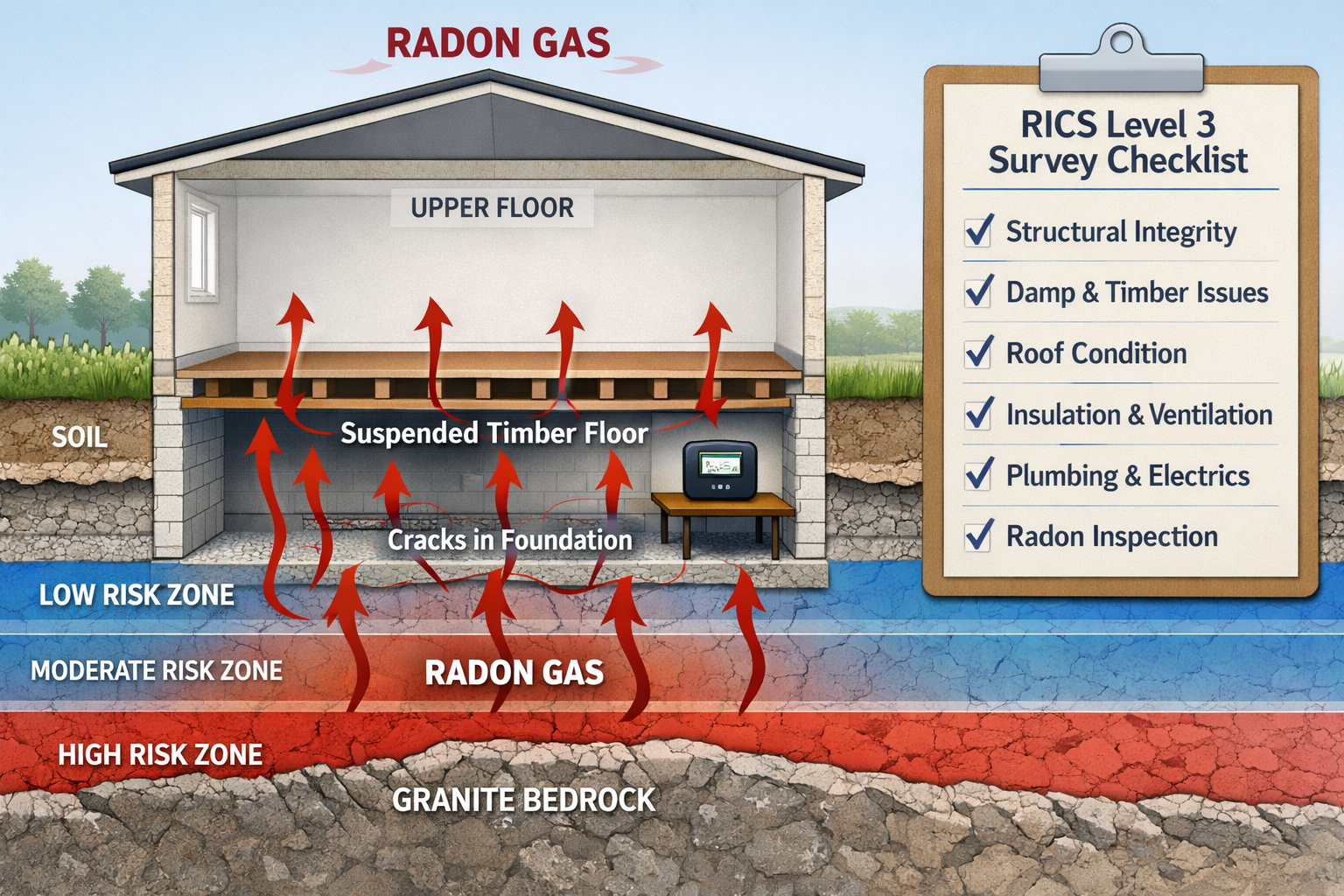
| Visual inspection | Identifying features that increase radon ingress risk (e.g., cracked floors, suspended timber floors, poor ventilation) |
| Flagging in report | Clearly noting radon risk in the survey report with appropriate urgency |
| Recommending specialist testing | Directing clients to accredited radon testing services where risk is elevated |
| Assessing existing mitigation | Noting the presence or absence of radon sumps, membranes, or ventilation systems |
This framework applies whether a surveyor is conducting a RICS HomeBuyer Survey or a full Level 3 building survey. However, the depth of investigation — and the radon-specific checklist — is considerably more detailed at Level 3.
Building Survey Protocols for Radon Gas Risks in UK Properties: The Level 3 Checklist
The Level 3 building survey (formerly the Full Structural Survey) is the most appropriate instrument for assessing radon risk in high-risk regions. Choosing the right survey type is itself a critical first step — and for properties in Cornwall, Devon, Somerset, Derbyshire, or Northamptonshire, a Level 3 is strongly advisable.
Pre-Inspection: Desk-Based Risk Assessment
Before visiting the property, a competent surveyor should:
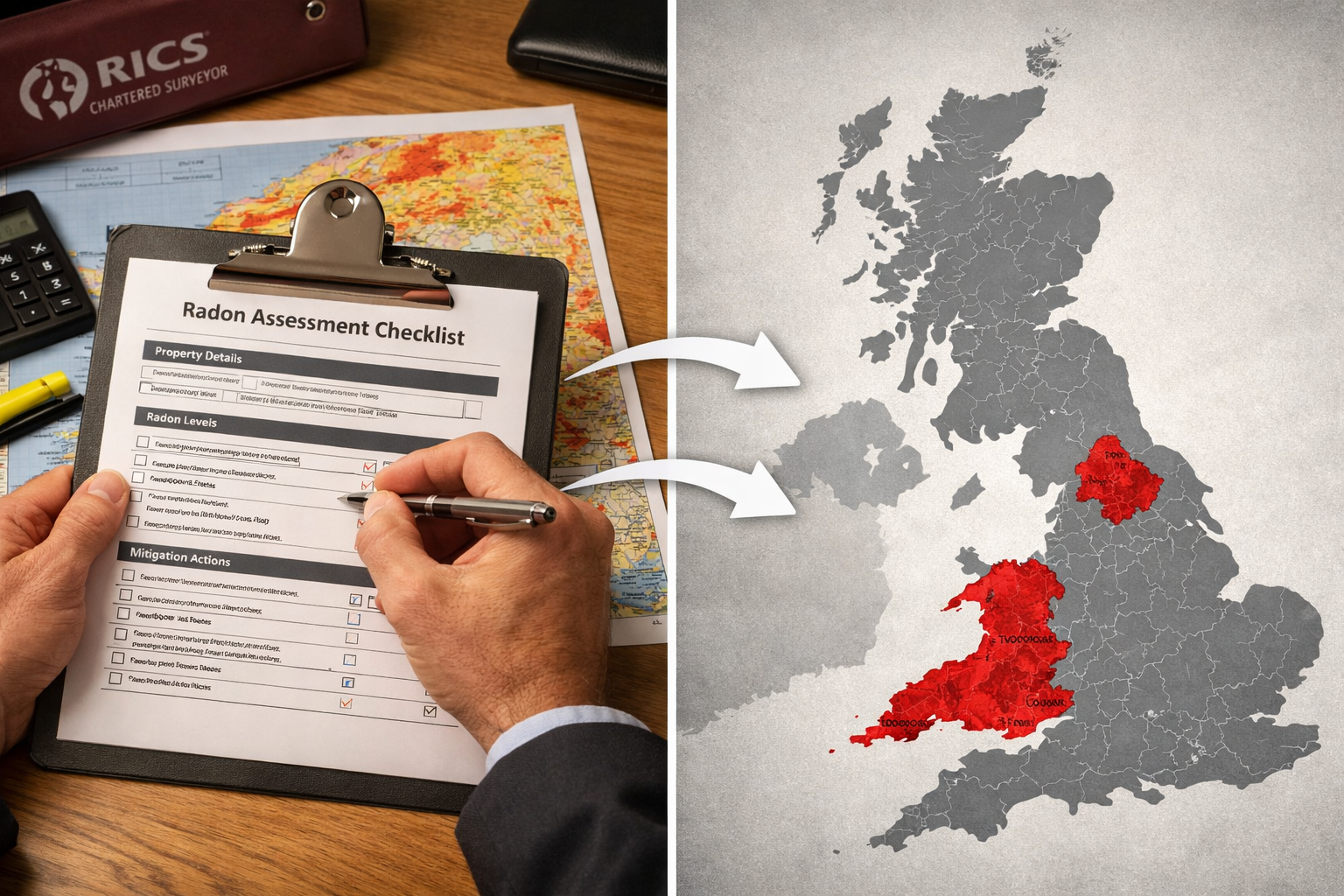
- ✅ Check UKHSA radon potential maps for the specific postcode [10]
- ✅ Review local geological data — granite, ironstone, and limestone substrates carry the highest risk [2]
- ✅ Examine planning history for evidence of previous radon remediation works
- ✅ Note property age — Victorian and Edwardian properties carry elevated risk due to suspended timber floors, cracked foundations, and cavity wall voids that facilitate gas entry [7]
- ✅ Check Building Regulations compliance — post-2000 new builds in affected areas should have radon-proof membranes and sump-ready construction under BR211 [2]
On-Site Inspection: What to Look For
During the physical inspection, the Level 3 protocol for radon risk assessment includes:
Foundation and Floor Level
- Inspect for cracks in solid concrete floors (primary entry point for radon)
- Identify suspended timber floor construction — the void beneath acts as a radon reservoir
- Check for the presence of a radon membrane (typically a heavy-duty polyethylene sheet)
- Look for evidence of a radon sump (a pipe penetrating the floor slab, often capped)
Ventilation Assessment
- Assess sub-floor ventilation bricks — blocked or insufficient airbricks significantly increase risk
- Check for mechanical underfloor ventilation systems
- Note the overall air exchange rate of the building
Wall and Structural Integrity
- Document cracks in walls at or below ground level
- Assess the condition of service entry points (pipes, cables) — unsealed penetrations are common radon pathways
- Check cavity wall construction for voids connecting to ground
Existing Mitigation Measures
- Confirm whether a positive pressure ventilation (PPV) system is installed
- Identify active sump systems with extraction fans
- Note the age and apparent condition of any radon barrier membranes
Post-Inspection: Reporting Standards
The 2026 RICS guidance for high-risk regions requires that radon risk be reported with clarity and proportionality. A robust Level 3 report should:
- Explicitly state whether the property falls within a UKHSA-designated radon Affected Area (where 1% or more of homes exceed the action level)
- Categorise the risk using a clear condition rating (typically Condition 2 or 3 depending on findings)
- Recommend professional radon testing where risk is identified, specifying the three-month testing period [4]
- Describe any existing mitigation and comment on its apparent adequacy
- Advise on Building Regulations compliance for new builds
High-Risk Regions: Where Building Survey Protocols for Radon Gas Risks in UK Properties Matter Most
The geographic distribution of radon risk in the UK is closely tied to underlying geology. Understanding this is fundamental to applying the right survey protocols.
🔴 Highest Risk Areas
| Region | Primary Geology | Risk Level |
|---|---|---|
| Cornwall | Granite batholith | Very High |
| Devon | Granite (Dartmoor/Exmoor) | Very High |
| Somerset | Limestone/granite margins | High |
| Peak District (Derbyshire) | Limestone | High |
| Northamptonshire | Ironstone | High |
| Parts of Lincolnshire | Limestone | Moderate-High |
| Scottish Highlands | Granite | Moderate-High |
🟡 Lower But Non-Negligible Risk Areas
The South East and Greater London generally present low radon risk. However, local geological anomalies can create elevated pockets even in predominantly low-risk areas [6]. Surveyors operating across London property surveys should not dismiss radon entirely — the UKHSA mapping should always be checked at postcode level.
💬 "Assuming London means no radon risk is a professional error. Postcode-level checking is non-negotiable under current RICS guidance."
Legal and Financial Implications for Property Transactions
Mandatory Disclosure Under the TA6 Form
Since updates to the TA6 property information form, sellers are legally required to disclose:
- Whether radon testing has been carried out
- The results of any such testing
- Whether remediation has been undertaken
Concealing elevated radon readings is illegal and has resulted in successful legal claims against sellers [4]. Buyers who discover undisclosed radon issues post-completion have grounds for misrepresentation claims.
Impact on Property Value
Properties with confirmed high radon levels — particularly those above the 200 Bq/m³ action level — typically experience a 5–10% reduction in market value [4]. This creates a direct negotiating opportunity for informed buyers. Understanding how a building survey can help negotiate property price is particularly relevant where radon findings emerge.
For buyers who receive a survey flagging radon risk, the recommended steps are:
- Commission a three-month specialist radon test before exchanging contracts
- Use results to negotiate either a price reduction or seller-funded remediation
- Obtain written confirmation of any remediation works and re-test results
- Ensure the TA6 form reflects accurate and current information
If a survey has already returned concerning findings, understanding what to do after a bad building survey report is an essential next step.
Landlord and Employer Obligations
Landlords operating in high-risk areas face specific legal duties. The Housing Act 2004 and Defective Premises Act 1972 require action where radon is suspected to exceed the domestic action level of 200 Bq/m³ [3].
For commercial and mixed-use properties, the workplace action level is 300 Bq/m³ — reduced from the previous 400 Bq/m³ threshold [1]. Employers must assess radon as a workplace hazard under UK health and safety legislation, and surveyors conducting building condition assessments of commercial premises must factor this into their reporting.
Remediation: What Happens When Radon Exceeds the Action Level
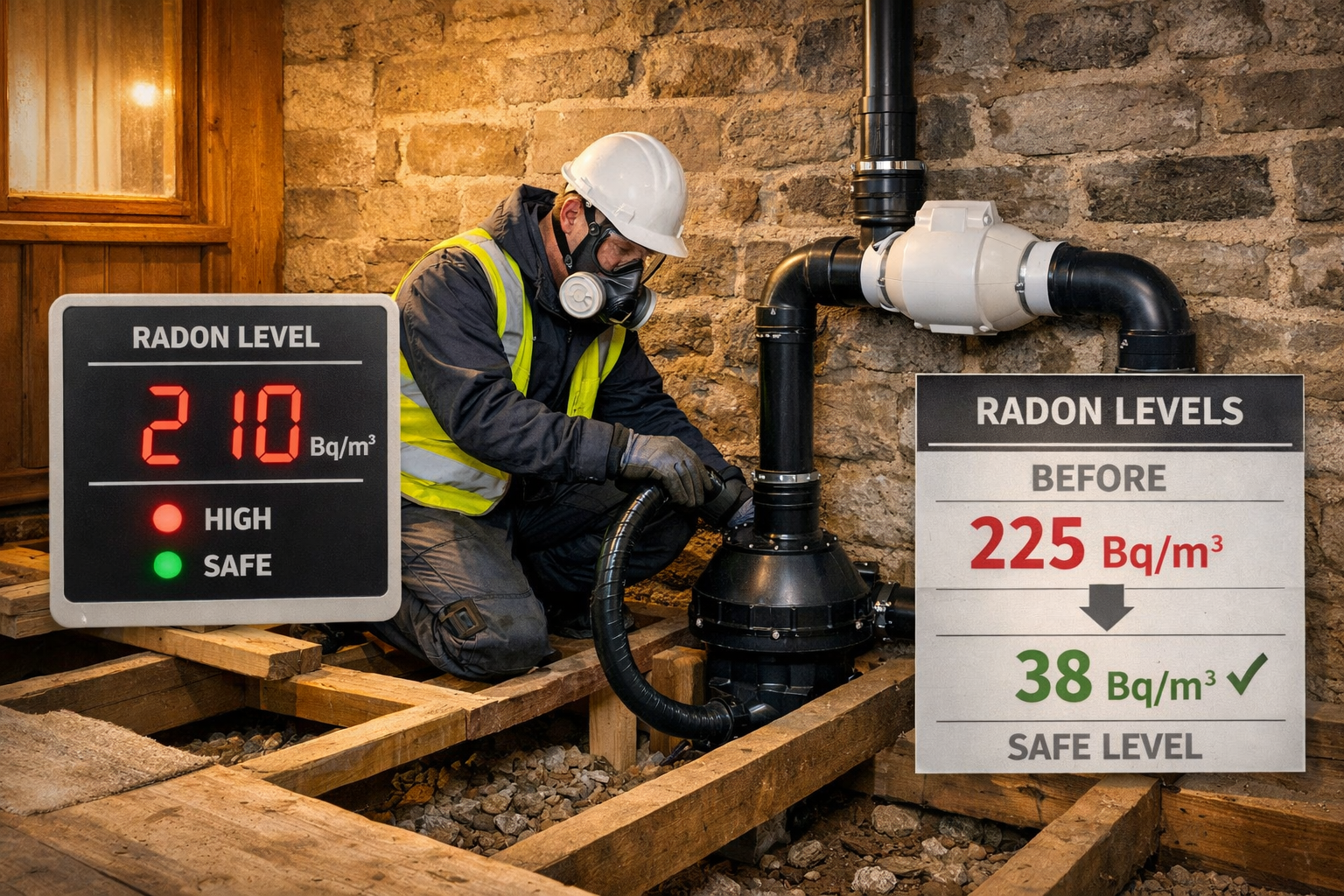
When testing confirms radon levels above 200 Bq/m³, remediation is not optional — it is a legal requirement for landlords and a strong practical imperative for owner-occupiers.
Common Remediation Methods
1. Radon Sump System (Most Effective)
A pipe is inserted beneath the floor slab and connected to an extraction fan. This creates negative pressure under the floor, drawing radon away before it can enter the building. Effectiveness: typically reduces levels by 50–99% [7].
2. Positive Pressure Ventilation (PPV)
A fan unit pushes fresh filtered air into the property, diluting radon concentrations. Less targeted than sump systems but useful in certain construction types.
3. Sub-Floor Ventilation Enhancement
Clearing blocked airbricks and installing additional ventilation to suspended timber floor voids. Effective for lower-level exceedances.
4. Sealing Entry Points
Applying radon-resistant sealants to floor cracks, service penetrations, and wall-floor junctions. Typically used as a supplementary measure rather than a standalone solution.
5. Radon-Proof Membranes (New Builds)
Under Building Regulations BR211, new builds in affected areas must include radon-proof membranes and sump-ready pipework. The UKHSA recommends a validation test in the first year of occupation regardless [2].
Post-Remediation Testing
Any remediation must be followed by a further three-month test to confirm effectiveness. This validation test should be documented and retained — it will be required for future property transactions and TA6 disclosure.
Applying 2026 RICS Guidance: Practical Steps for Surveyors and Buyers
The 2026 RICS guidance for high-risk regions consolidates best practice into a clear professional framework. For surveyors, the key obligations are:
- Always check radon potential maps at postcode level — not just regional level
- Treat radon as a material defect where risk indicators are present
- Document all relevant observations including floor construction type, ventilation, and existing mitigation
- Recommend specialist testing with clear timeframes and accredited providers
- Report with appropriate urgency — Condition 3 where action level exceedance is likely, Condition 2 where risk is present but unconfirmed
For buyers and property owners, the practical checklist is equally clear:
✅ Always commission a full RICS survey for properties in high-risk regions
✅ Request the surveyor's specific commentary on radon risk in the report
✅ Commission independent three-month radon testing before exchange in affected areas
✅ Check the TA6 form for seller disclosure of previous testing or remediation
✅ Factor remediation costs into purchase price negotiations
✅ For landlords: test all rental properties in affected areas and document results
Conclusion: Radon Risk Is a Surveying Standard, Not an Optional Extra
The building survey protocols for radon gas risks in UK properties have matured significantly by 2026. What was once treated as a specialist footnote is now a core component of competent RICS surveying practice — particularly in high-risk regions where granite and limestone geology create conditions for dangerous accumulation.
The professional and legal landscape is unambiguous: surveyors must identify and flag risk, sellers must disclose, landlords must test, and buyers must ask the right questions. The 1,100 annual deaths attributable to radon in the UK are not inevitable — they are largely preventable through awareness, testing, and remediation [1].
Actionable Next Steps
- Buyers in Devon, Cornwall, Somerset, Derbyshire, or Northamptonshire: Always request a Level 3 building survey and commission specialist radon testing before exchange
- Landlords in affected areas: Arrange professional radon testing for all tenancies — legal obligation, not best practice
- Surveyors: Integrate UKHSA postcode-level radon mapping into every pre-inspection desk study, regardless of region
- Sellers: Ensure TA6 forms accurately reflect all testing history — non-disclosure carries serious legal risk
- Anyone concerned about an existing property: Contact an accredited RICS surveyor to discuss radon risk assessment options
Radon cannot be seen, smelled, or tasted. But in 2026, there is no longer any excuse for it to go undetected in a properly conducted UK building survey.
References
[1] Radon In 2026 – https://properteco.co.uk/radon-in-2026/
[2] Radon Gas In Uk Homes Risks Testing And Property Safety Guide – https://www.blbsolicitors.co.uk/blog/radon-gas-in-uk-homes-risks-testing-and-property-safety-guide/
[3] Assessing Threats To Health From Radon – https://ww3.rics.org/uk/en/journals/property-journal/assessing-threats-to-health-from-radon-.html
[4] Selling House With Radon Gas – https://propertybuyerstoday.co.uk/selling-house-with-radon-gas/
[5] Do Surveyors Check For Radon – https://surveymatch.co.uk/do-surveyors-check-for-radon/
[6] Radon The Hidden Health Risk In Uk Homes – https://www.landmark.co.uk/news-insights/blog/radon-the-hidden-health-risk-in-uk-homes/
[7] Mitigating Radon Risk In Residential Properties – https://ww3.rics.org/uk/en/journals/property-journal/mitigating-radon-risk-in-residential-properties.html
[8] Radon Highlighting The Risk In Construction – https://www.ricsfirms.com/glossary/radon-highlighting-the-risk-in-construction/
[10] Radon Potential For Great Britain Version 34 – https://www.data.gov.uk/dataset/883fc284-637a-4e42-8556-80c4c0ef5a4f/radon-potential-for-great-britain-version-34