
New regulations under Awaab's Law now impose strict, legally enforceable timelines on social landlords to remedy serious damp and mould — and non-compliance is no longer a matter of administrative inconvenience but of real legal and financial consequence. Since the law came into force in October 2025, housing providers across England have faced a sharp rise in formal complaints, disrepair claims, and demands for independent expert evidence [1]. For building surveyors and expert witnesses, understanding Awaab's Law and the surge in damp & mould claims is no longer optional — it is a core professional competency for 2026 and beyond.
Key Takeaways
- Awaab's Law took effect in October 2025, requiring social landlords to investigate damp and mould within 10 working days and respond to emergency hazards within 24 hours.
- The law is expected to extend to private landlords during 2026 under the Renters Rights Bill, significantly widening its reach.
- Building surveyors are increasingly instructed as expert witnesses in disrepair claims, requiring court-ready, evidence-based reporting.
- Qualified surveyors must understand the Housing Health and Safety Rating System (HHSRS) and hold appropriate credentials to produce legally defensible assessments.
- Structured, audit-ready survey reports are now essential for housing associations, local authorities, and private landlords facing compliance scrutiny.
The Legislative Background: What Awaab's Law Actually Requires
Awaab's Law is named after Awaab Ishak, a two-year-old boy who died in 2020 from a respiratory condition caused by prolonged exposure to mould in a social housing flat in Rochdale. His death, and the subsequent inquest findings, prompted Parliament to act. The law was introduced as an amendment to the Social Housing (Regulation) Act 2023 and came into effect in October 2025 [1].
The core compliance obligations for social landlords are:
| Hazard Type | Required Action | Deadline |
|---|---|---|
| Emergency hazard | Attend and begin repair | Within 24 hours |
| Damp and mould (serious) | Investigate and produce written findings | Within 10 working days |
| Serious hazard (non-emergency) | Complete repair | Within 14 days of investigation |
| Other hazards (HHSRS) | Investigate and remediate | Timelines to be confirmed in 2026–27 rollout |
The law initially focuses on damp, mould, and emergency hazards in social housing. However, the scope is set to expand by 2026–2027 to cover a broader range of hazards under the Housing Health and Safety Rating System (HHSRS) [1][2]. Critically, plans are underway to extend these provisions to private landlords during 2026, aligned with the Renters Rights Bill [8]. That means the volume of claims and the demand for qualified survey evidence is set to grow substantially.
"Awaab's Law has fundamentally shifted the burden of proof. Landlords can no longer rely on informal inspections or delayed responses — they need documented, professional evidence from the moment a complaint is received."
Why Awaab's Law and the Surge in Damp & Mould Claims Matter to Surveyors
The practical effect of Awaab's Law has been immediate. Housing associations, local authorities, and arm's-length management organisations are now under significant pressure to demonstrate compliance. Many lack the in-house capacity to conduct structured, legally defensible inspections at the required pace. This has driven a surge in instructions to independent building surveyors and damp specialists [3].
The Health Dimension Cannot Be Ignored
Damp and mould are not cosmetic defects. Prolonged exposure to mould spores — particularly Aspergillus and Cladosporium species — is associated with respiratory illness, asthma exacerbation, and immune suppression, particularly in children and elderly residents [1]. When a surveyor produces a report under Awaab's Law, they are not simply cataloguing building defects. They are contributing to a health and safety determination that may directly affect a tenant's wellbeing and a landlord's legal exposure.
This health dimension elevates the standard of care expected from surveyors. A superficial visual inspection is unlikely to satisfy the evidential requirements of a disrepair claim or a regulatory investigation by the Regulator of Social Housing.
The Increase in Disrepair Claims
Since October 2025, legal firms specialising in housing disrepair have reported a marked increase in instructions from tenants citing non-compliance with Awaab's Law timelines [3]. Many of these claims require independent expert evidence to establish:
- The nature, extent, and cause of damp or mould
- Whether the condition constitutes a Category 1 or Category 2 hazard under the HHSRS
- Whether the landlord's response met the statutory timelines
- The likely health impact on occupants
Building surveyors who understand damp survey methodology and compliance reporting are increasingly central to these proceedings. A poorly constructed report — one that conflates condensation with penetrating damp, or fails to identify the root cause — can undermine an entire legal case.
The Role of the Expert Witness in Damp and Mould Disputes
Understanding Awaab's Law and the surge in damp & mould claims is only part of the challenge. Surveyors instructed as expert witnesses carry distinct duties that differ from those of an instructed surveyor acting for a client.
Duties to the Court vs. Duties to the Client
An expert witness's overriding duty is to the court, not to the party that instructed them. This is codified in Civil Procedure Rule 35 and the accompanying Practice Direction. A surveyor who shades their opinion to favour the instructing party risks serious professional and legal consequences, including costs sanctions and referral to the RICS.
Key obligations of an expert witness include:
- Providing an independent, objective opinion based on evidence
- Declaring any conflicts of interest
- Acknowledging where matters fall outside their expertise
- Complying with the court's procedural timetable
- Participating in without-prejudice expert discussions where directed
Qualifications and Credibility
Courts and tribunals scrutinise the qualifications of expert witnesses carefully. In damp and mould cases arising from Awaab's Law, surveyors are expected to demonstrate:
- RICS membership (MRICS or FRICS) as a baseline professional credential
- Specific competence in damp investigation, ideally supported by qualifications such as the ABBE Level 3 Award in Damp and Mould Surveying [6]
- Familiarity with the HHSRS scoring methodology
- Experience conducting condition surveys and building assessments in residential settings
Surveyors without the appropriate credentials risk having their evidence challenged or excluded. This is not a theoretical risk — it has occurred in housing disrepair cases where claimants or defendants have successfully argued that a surveyor lacked the specialist knowledge to opine on a particular defect type.
For those new to expert witness work, it is worth reviewing what a surveyor does across different roles and responsibilities to understand how the expert witness function fits within the broader professional landscape.
Conducting Compliant Damp and Mould Surveys: Technical Standards
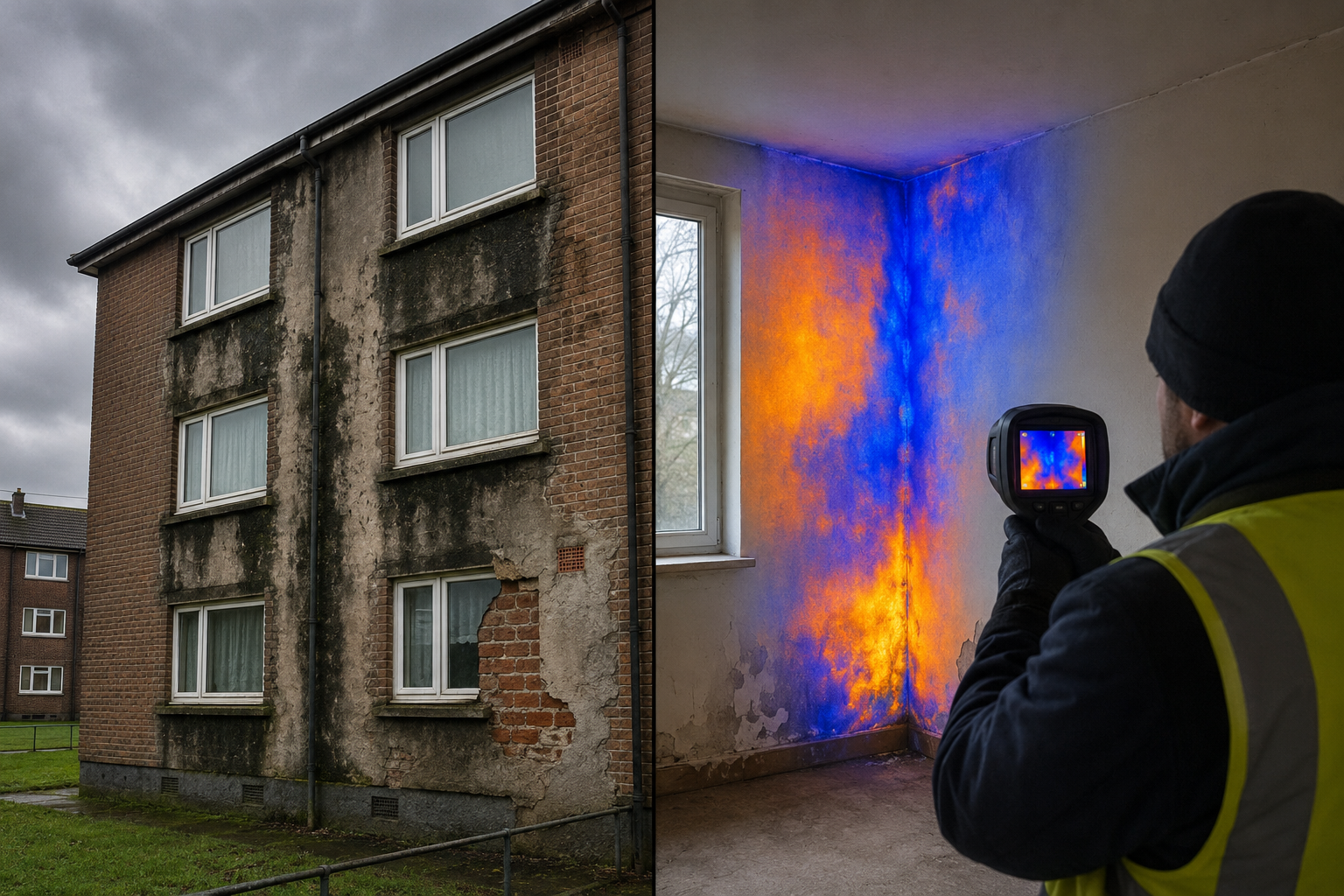
A survey conducted in response to an Awaab's Law complaint must go well beyond a visual walk-through. The following technical standards are now considered best practice in the industry.
Identifying the Type and Source of Damp
There are three primary categories of damp that surveyors must be able to distinguish:
- Condensation — caused by warm, moist air meeting cold surfaces; typically associated with inadequate heating, ventilation, or insulation
- Penetrating damp — caused by water ingress through walls, roofs, or around windows and doors
- Rising damp — caused by groundwater moving upward through masonry where the damp-proof course has failed
Each has a different cause, a different remediation pathway, and different implications for landlord liability. Misdiagnosis — particularly attributing penetrating damp to tenant behaviour — has been a recurring source of dispute in housing disrepair litigation.
Essential Survey Equipment
A compliant damp survey should employ:
- Calibrated moisture meters (both pin-type and capacitance) to measure moisture content in walls and floors
- Thermal imaging cameras to identify cold bridges, heat loss, and hidden moisture
- Hygrometers and data loggers to record temperature and relative humidity over time
- Borescopes where internal cavities need inspection without invasive opening up
Producing an Audit-Ready Report
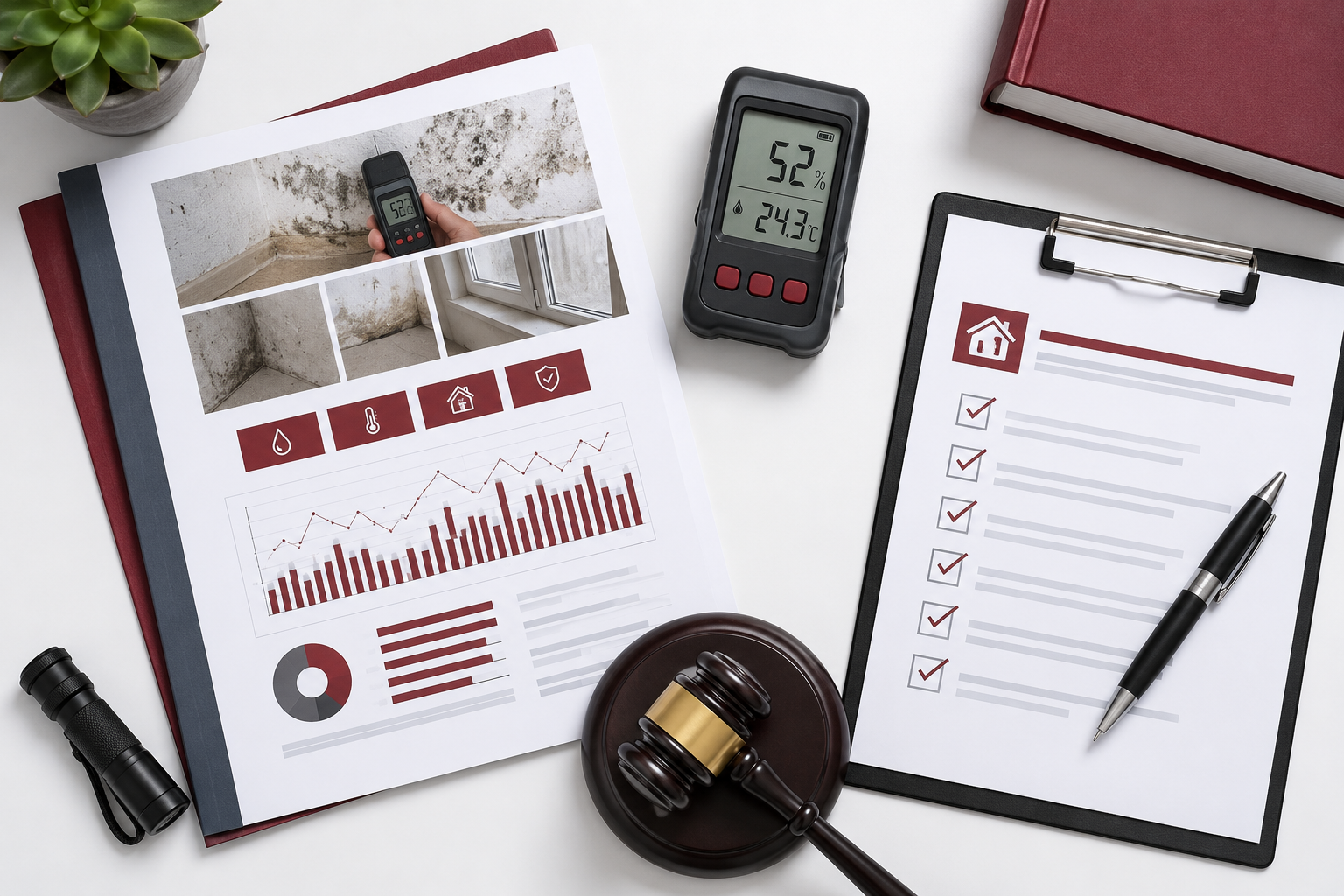
Under Awaab's Law, housing providers must be able to demonstrate that they investigated complaints within the statutory timeframe and that their findings were documented. This means survey reports must be:
- Dated and timestamped with the inspection date
- Supported by photographic evidence with location references
- Clear about methodology and equipment used
- Explicit about findings, their likely cause, and recommended remediation
- Structured to allow non-technical readers (including housing officers and tribunal members) to understand the conclusions
Some providers are now using compliance platforms such as Awaab Comply to structure inspections and generate standardised reports [5]. While these tools can assist housing officers, they do not replace the professional judgement of a qualified surveyor where the matter is complex or disputed.
Firms offering MRICS-led compliance surveys with rapid turnaround — some delivering reports within 72 hours — have seen significant growth in instructions from housing associations and local authorities seeking to meet statutory timescales [3]. For surveyors looking to understand the full scope of stock condition surveys and how they interact with compliance obligations, this is an area of growing professional relevance.
Practical Guidance for Surveyors and Expert Witnesses in 2026
The following practical steps are recommended for building surveyors who are active in, or considering entering, the Awaab's Law compliance and expert witness space.
Step 1: Verify and Strengthen Qualifications
- Ensure RICS membership is current and that CPD records reflect competence in damp investigation
- Consider obtaining the ABBE Level 3 Award in Damp and Mould Surveying if not already held [6]
- Review RICS guidance on acting as an expert witness, including the RICS Practice Statement on this topic
Step 2: Understand the HHSRS Framework
The Housing Health and Safety Rating System is the scoring mechanism used to classify hazards in residential properties. A Category 1 hazard (the higher risk band) triggers a landlord's legal duty to act. Surveyors must be able to:
- Apply the HHSRS likelihood and harm weightings correctly
- Distinguish between Category 1 and Category 2 hazards in their reports
- Explain HHSRS findings in plain language for non-specialist readers
Step 3: Develop Robust Report Templates
A well-structured report template that meets Awaab's Law evidential requirements will save time and reduce the risk of challenge. Key sections should include:
- Instruction and scope
- Inspection methodology and equipment
- Findings (with photographs and moisture readings)
- HHSRS assessment
- Causation analysis
- Recommended remediation and timescales
- Expert declaration (if acting as expert witness)
For surveyors who have received a negative or contested survey outcome, understanding what to do after a bad building survey report can also provide useful context for how reports are challenged and how to make findings more defensible.
Step 4: Stay Ahead of Legislative Expansion
The extension of Awaab's Law to private landlords during 2026 will significantly increase the volume of potential instructions [8]. Surveyors who establish expertise and a track record in social housing compliance now will be well-positioned to serve the private rental sector as the regulatory framework expands.
Monitoring updates from the Regulator of Social Housing, the Department for Levelling Up, Housing and Communities (now MHCLG), and RICS will be essential. The building regulations and compliance landscape is evolving rapidly, and surveyors who keep pace with it will have a clear competitive advantage.
Step 5: Consider the Medico-Legal Interface
In cases where tenants allege health harm caused by damp and mould, surveyors may be instructed alongside medical experts. Understanding how to present building pathology findings in a way that connects clearly to health outcomes — without straying into medical opinion — is a skill that distinguishes effective expert witnesses from merely competent ones.
Key Risks and Common Pitfalls
Surveyors entering this field should be aware of the following risks:
- Over-reliance on visual inspection: Moisture meters and thermal imaging are not optional extras — they are expected by courts and tribunals
- Conflating condensation with structural damp: This is the most common and most damaging error in housing disrepair reports
- Failing to declare limitations: If access was restricted or testing was not possible, this must be stated clearly
- Accepting instructions that create a conflict of interest: Surveyors who have previously acted for a landlord in an advisory capacity should be cautious about accepting expert witness instructions in a dispute involving the same landlord
- Missing statutory timelines: If a surveyor is instructed to assist a landlord in meeting the 10-working-day investigation requirement, delays in producing the report can expose the landlord to enforcement action
For those managing building condition assessments across a portfolio, building in systematic processes for Awaab's Law compliance — rather than responding reactively — is strongly advisable.
Conclusion
Awaab's Law has created a new professional imperative for building surveyors and expert witnesses. The combination of strict statutory timelines, rising disrepair litigation, and the imminent extension of the law to the private rental sector means that demand for qualified, credible survey evidence will only grow through 2026 and beyond.
Actionable next steps for surveyors:
- Audit current qualifications and CPD to ensure they cover damp investigation and HHSRS assessment
- Invest in appropriate survey equipment, including thermal imaging and data logging tools
- Develop audit-ready report templates that meet Awaab's Law evidential standards
- Review RICS guidance on expert witness obligations and ensure compliance with CPR 35
- Monitor legislative developments as the law expands to private landlords
- Build relationships with housing associations, local authorities, and legal firms who will need independent expert evidence
The surveyors who treat Awaab's Law not as a compliance burden but as a professional opportunity — one that rewards rigour, independence, and technical depth — will be best placed to serve clients and courts effectively in the years ahead.
References
[1] Awaabs Law – https://www.thedampologists.co.uk/awaabs-law?utm_source=openai
[2] Guides – https://awaabs-law.com/guides?utm_source=openai
[3] durndelldampsurveys.co.uk – https://www.durndelldampsurveys.co.uk/?utm_source=openai
[4] Awaabs Law Compliance In Rental Surveys Detecting And Reporting Damp Mould And Housing Hazards – https://wimbledonsurveyors.com/awaabs-law-compliance-in-rental-surveys-detecting-and-reporting-damp-mould-and-housing-hazards/?utm_source=openai
[5] redfearnexperts.co.uk – https://redfearnexperts.co.uk/?utm_source=openai
[6] Damp Mould Compliance Surveys – https://www.dampsafe.co.uk/damp-mould-compliance-surveys?utm_source=openai
[7] dampmouldsurveyor – https://www.dampmouldsurveyor.com/?utm_source=openai
[8] Mould Condensation – https://awaabslawltd.co.uk/mould-condensation/?utm_source=openai
[9] dampsafe.co.uk – https://www.dampsafe.co.uk/?utm_source=openai