


Nearly one in three party wall disputes escalates into a formal legal complaint — often because the homeowner chose the wrong surveyor at the outset. This guide to choosing the right party wall surveyor covers RICS credentials, fees and red flags so that both building owners and adjoining owners can make an informed appointment before a single brick is moved.
The Party Wall etc. Act 1996 gives surveyors significant quasi-judicial powers. Getting that appointment wrong is not just an inconvenience; it can add thousands of pounds in costs, delay your project by months, and damage a neighbourly relationship that may last decades. The checklist-driven approach below is designed to prevent exactly that.
Key Takeaways
- Only appoint a surveyor holding MRICS or FRICS designation — these credentials confirm professional training, insurance and ethical accountability.
- Party wall surveyor fees in 2026 range from £900 to over £15,000 depending on complexity; always request a written, itemised fee estimate before signing anything.
- A surveyor who cannot explain their fee structure, pressures you into an immediate appointment, or refuses to confirm professional indemnity insurance is a serious red flag.
- The building owner typically bears all reasonable party wall costs, but cost apportionment can shift in certain circumstances.
- A properly completed schedule of condition is a non-negotiable safeguard for both parties before any notifiable work begins.
Why the Party Wall Act Makes Surveyor Selection So Important
The Party Wall etc. Act 1996 is a piece of legislation that most homeowners encounter only once or twice in a lifetime, yet its procedural requirements are strict. Under the Act, a party wall surveyor does not simply advise — they make binding determinations called Party Wall Awards that govern how, when and under what conditions notifiable work can proceed. Understanding what a party wall surveyor does and the scope of their authority is the essential first step.
Because the surveyor's Award is legally enforceable, the professional you appoint must be genuinely impartial, technically competent and properly insured. An unqualified or conflicted surveyor can produce a flawed Award that is challenged in court — leaving both the building owner and the adjoining owner exposed to significant legal costs.
Understanding RICS Credentials: What to Look For
MRICS and FRICS — The Minimum Standard
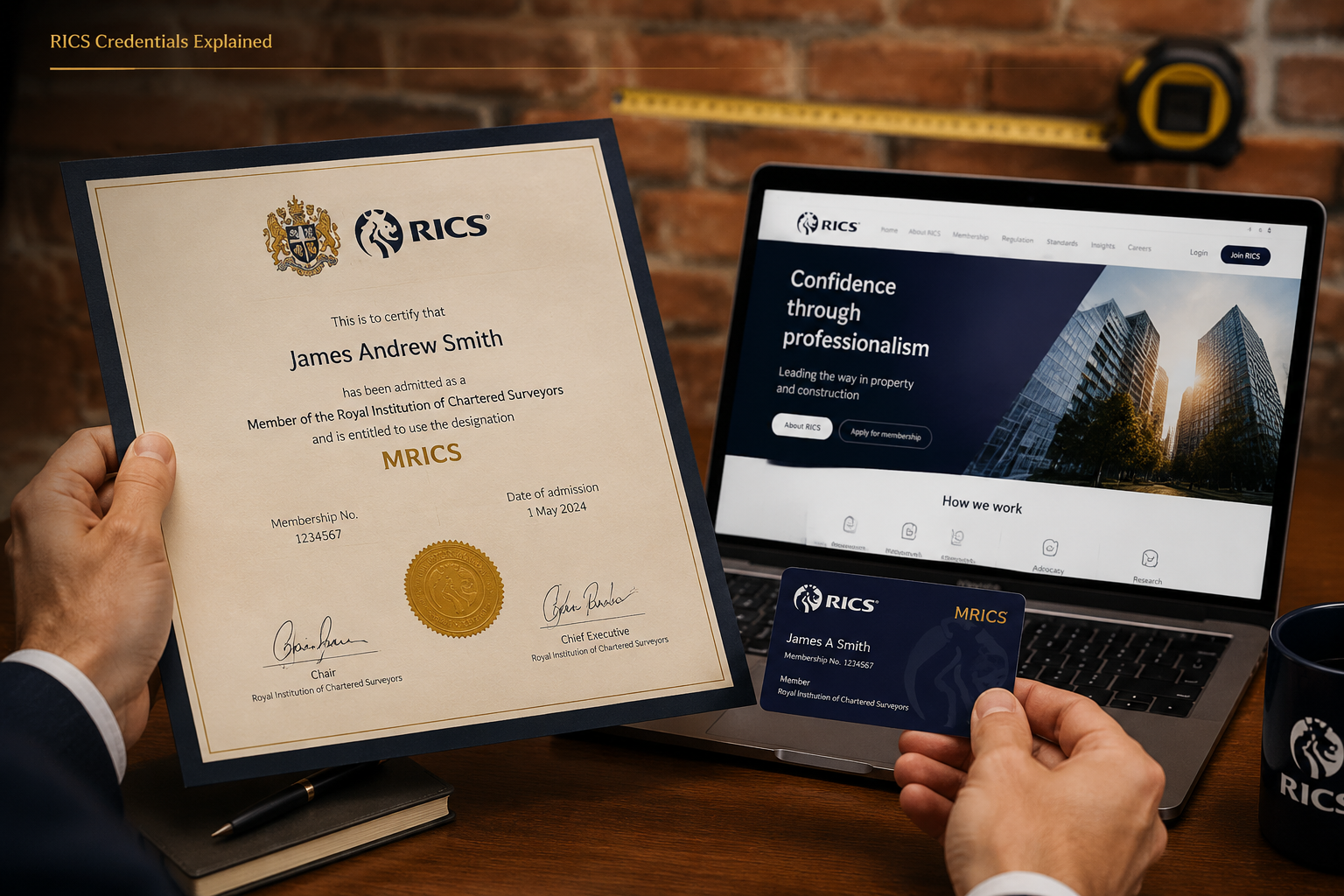
The Royal Institution of Chartered Surveyors (RICS) recommends that homeowners appoint only chartered surveyors holding the designations MRICS (Member of the Royal Institution of Chartered Surveyors) or FRICS (Fellow of the Royal Institution of Chartered Surveyors) [1]. These designations are not honorary titles — they confirm that the individual has:
- Passed rigorous academic and practical assessments
- Committed to ongoing Continuing Professional Development (CPD)
- Agreed to abide by the RICS Rules of Conduct
- Maintained adequate professional indemnity (PI) insurance
RICS-regulated firms are also required to operate formal complaints-handling procedures, which gives homeowners a clear route to redress if something goes wrong [1].
The RICS Professional Standard on Party Walls
In May 2023, RICS reissued its "Party Wall Legislation and Procedure" document as a formal professional standard [2]. This document sets out the responsibilities of surveyors under the Act, including requirements around professional conduct, impartiality and the preparation of Party Wall Awards. Any surveyor who is unaware of this standard — or who dismisses it — should be treated with caution.
How to Verify Credentials
Verification takes less than two minutes. Use the RICS "Find a Surveyor" tool at rics.org to confirm that the individual's membership is current. You can also ask the surveyor directly for:
- Their RICS membership number
- Evidence of current PI insurance (a certificate or schedule is acceptable)
- Confirmation of their CPD activity in party wall practice
"Appointing a surveyor without verifying their RICS membership is the single most avoidable mistake a homeowner can make in the party wall process."
A Practical Vetting Checklist for Homeowners
The following checklist applies whether you are the building owner (the person carrying out the works) or the adjoining owner (the neighbour affected by them). Work through every item before making a formal appointment.
Qualifications and Registration
- Holds current MRICS or FRICS designation (verified on rics.org)
- Registered with a recognised professional body (RICS, Pyramus & Thisbe Club, or Faculty of Party Wall Surveyors)
- Carries adequate professional indemnity insurance — ask for the policy limit and confirm it covers party wall work specifically
- Has no current disciplinary record with RICS
Relevant Experience
- Can demonstrate specific experience in party wall matters — not just general building surveying
- Familiar with the type of work proposed (basement excavation, loft conversion, rear extension, etc.)
- Knowledge of local authority requirements in your area — particularly relevant if you are in a densely built London borough where party wall matters are more frequent
For homeowners in specific London areas, local expertise matters. Surveyors covering areas such as Battersea, Hackney or Ealing will be familiar with the density of Victorian and Edwardian terraced housing that generates the majority of party wall notices in the capital.
Impartiality and Conflicts of Interest
Party wall surveyors perform a quasi-judicial function and must be free from bias [4]. Before appointing anyone, ask:
- Do you have any existing relationship with the other party, their contractor, or their solicitor?
- Have you previously acted for the other party in any capacity?
- Are you a family member, close friend or business associate of anyone involved?
The RICS Property Journal has explicitly noted that appointing family members or close friends as party wall surveyors compromises impartiality and should be avoided [4]. The 7th edition of the RICS guidance note, effective from December 2019, reinforces that ethical standards must sit alongside statutory duties [5].
Communication and Responsiveness
- Responds to initial enquiry within one to two business days
- Provides clear, jargon-free explanations of the process
- Willing to answer preliminary questions before a fee is agreed
- Offers a written engagement letter or terms of appointment
Party Wall Surveyor Fees in 2026: What to Expect

Fee transparency is one of the clearest indicators of a trustworthy surveyor. As of 2026, party wall surveyor fees range from £900 to over £15,000, depending on project complexity, the number of adjoining owners affected, and geographic location [3].
Typical Fee Ranges
| Service | Typical Cost (2026) |
|---|---|
| Serving a party wall notice | £75 – £200 |
| Simple Party Wall Award (single adjoining owner) | £700 – £2,000 |
| Complex Party Wall Award (multiple owners/deep excavation) | £3,000 – £15,000+ |
| London hourly rate | £200 – £400/hr |
| Regional hourly rate | £80 – £200/hr |
Source: [3][7]
Fixed Fee vs Hourly Billing
Fixed fees are appropriate for predictable, straightforward projects — a single-storey rear extension affecting one neighbour, for example. They give both parties cost certainty from the outset.
Hourly billing is more common for complex, multi-party projects such as basement excavations or large developments affecting several adjoining owners [3]. If a surveyor proposes hourly billing, always ask for a written estimate of the total hours anticipated, along with a cap or review mechanism.
Who Pays?
Under the Party Wall etc. Act 1996, the building owner is typically responsible for all reasonable party wall surveyor costs — including the fees of the adjoining owner's surveyor [6]. However, costs can be apportioned differently in specific circumstances. For instance, if a shared wall is already in disrepair and the adjoining owner has a legal obligation to contribute to its maintenance, the costs may be shared [6].
For party wall surveyor quotes and a better understanding of what drives fee variation, it helps to gather at least two to three written estimates before making a decision.
What a Fee Estimate Should Include
A properly presented fee estimate should itemise:
- Notice preparation and service costs
- Schedule of condition survey fee
- Party Wall Award drafting fee
- Any anticipated disbursements (travel, specialist reports)
- Hourly rate and estimated hours if not fixed-fee
- VAT treatment
Any surveyor who refuses to provide this level of detail in writing is displaying a significant warning sign.
Red Flags: When to Walk Away
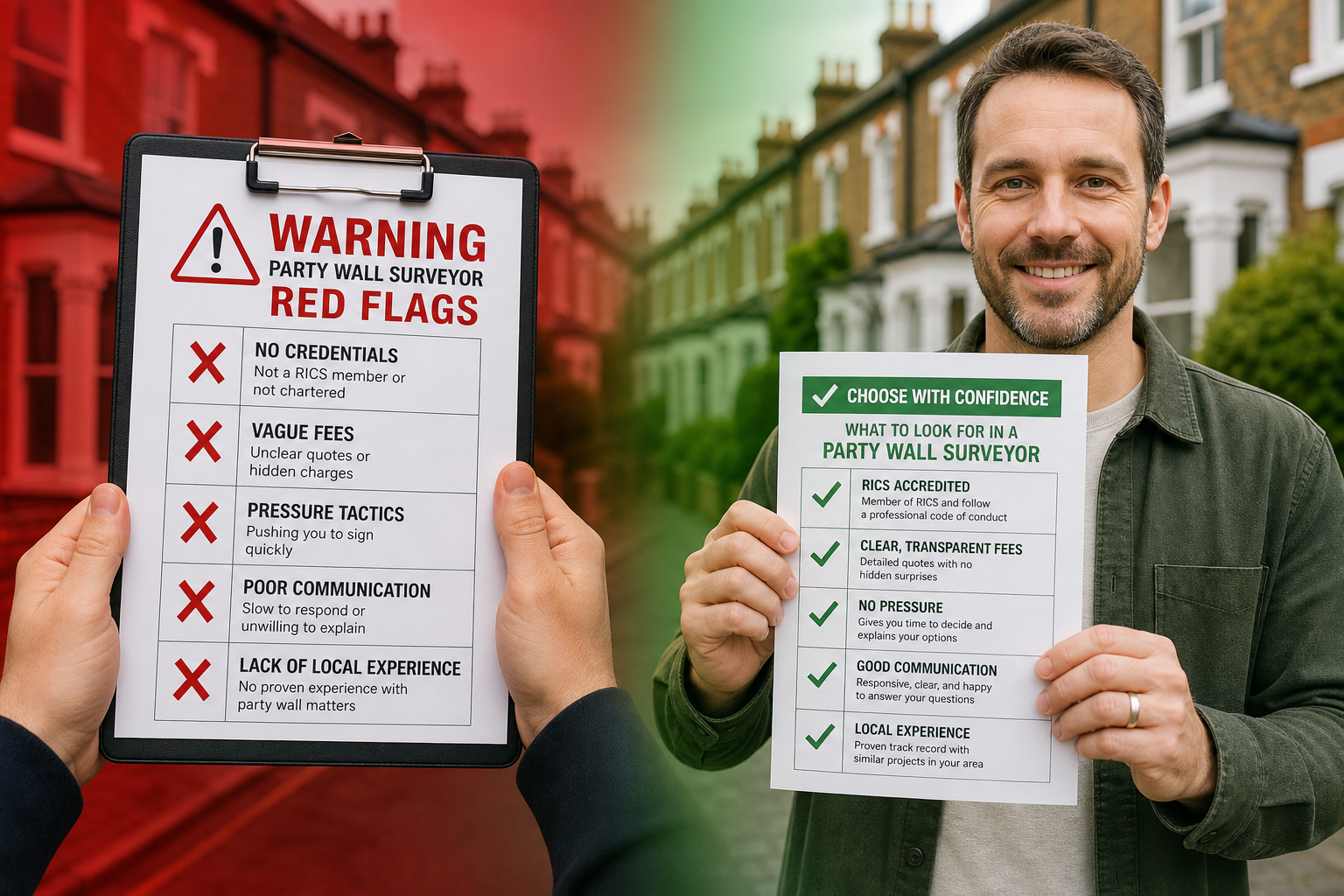
Choosing the right party wall surveyor means being just as clear about who to avoid as who to appoint. The following warning signs — drawn from industry experience and professional guidance [7] — should prompt homeowners to look elsewhere.
Credential Red Flags
- No verifiable RICS membership — always check rics.org directly, not just the surveyor's website
- Vague or evasive answers about professional indemnity insurance — a legitimate surveyor will provide insurance details without hesitation
- No formal complaints procedure — RICS-regulated firms are required to have one [1]
Fee and Commercial Red Flags
- Fees significantly below the market range — unusually low fees may indicate inexperience, underinsurance or a business model that relies on generating unnecessary disputes to inflate billable hours [7]
- No written fee estimate — verbal quotes are unenforceable and create disputes later
- Pressure to sign an engagement letter immediately — a reputable surveyor will give you time to consider
- Refusal to itemise costs — transparency is a professional obligation, not a courtesy
Conduct and Process Red Flags
- Failure to mention the schedule of condition — a schedule of condition documents the state of the adjoining property before work begins and is a fundamental safeguard in party wall practice [8]. Any surveyor who does not raise this proactively is either inexperienced or cutting corners.
- Conflicts of interest left undisclosed — the surveyor has a duty to declare any relationship with the other party
- Promises that the process will be "quick and painless" — party wall procedures have statutory timescales that cannot be compressed; a surveyor who implies otherwise is either uninformed or misleading you
- Acting for both parties without full, informed consent — while the Act permits an "agreed surveyor" arrangement, both parties must genuinely consent and the surveyor must be demonstrably impartial
A Note on the "Agreed Surveyor" Arrangement
The Act allows both the building owner and the adjoining owner to appoint a single "agreed surveyor" rather than each appointing their own. This can reduce costs, but it requires a high degree of trust in the surveyor's impartiality. If either party has any doubt, appointing separate surveyors is the safer course. For guidance on how the Party Wall Act 1996 applies to your specific situation, it is worth reviewing the procedural requirements before deciding on the appointment structure.
The Schedule of Condition: A Non-Negotiable Safeguard
A schedule of condition is a detailed photographic and written record of the state of the adjoining property — its walls, ceilings, floors, and any pre-existing cracks or defects — compiled before notifiable work begins [8]. It serves as the definitive reference point if the adjoining owner later claims that the building works caused damage.
Without a schedule of condition, any pre-existing crack becomes a potential dispute. With one, the burden of proof is clear and objective.
A competent party wall surveyor will raise the schedule of condition as a matter of course. If your surveyor does not mention it, raise it yourself — and if they dismiss its importance, treat that as a serious red flag.
Choosing the Right Party Wall Surveyor: A Homeowner's Guide to Finding Local Expertise
Geographic knowledge matters more than many homeowners realise. A surveyor who regularly works in your area will understand local construction methods, the typical condition of period housing stock, and the informal working relationships with local contractors and local authority building control officers that can smooth the process considerably.
When finding a surveyor near you, prioritise professionals who can demonstrate recent, relevant experience in your specific type of property and location. Ask for examples of Party Wall Awards they have produced for similar projects — a loft conversion in a Victorian terrace, for instance, or a basement excavation in a 1930s semi-detached house.
It is also worth noting that party wall surveyors are distinct from other property professionals. If you are simultaneously commissioning a RICS building survey on a property you are purchasing, the surveyor conducting that inspection may not have specialist party wall experience — these are different skill sets, and the appointment should be treated separately.
Dispute Resolution and Complaints: Knowing Your Rights
If a party wall dispute arises and cannot be resolved between the surveyors, the Act provides a mechanism for referral to a third surveyor — a neutral professional selected at the outset of the process. This three-surveyor framework is one of the Act's most important protections for both parties.
If you believe your surveyor has acted improperly, RICS-regulated firms must have a formal complaints-handling procedure [1]. If the firm's internal process does not resolve the matter, RICS provides an independent route to adjudication. Keep records of all correspondence, fee agreements and Awards from the outset — these will be essential if a complaint becomes necessary.
Conclusion
Choosing the right party wall surveyor is not a formality — it is a decision that shapes the entire trajectory of your building project and your relationship with your neighbour. The core principles are straightforward: verify RICS credentials before any other conversation, demand written and itemised fee estimates, insist on a schedule of condition, and walk away from any surveyor who cannot answer basic questions about their qualifications or insurance.
Actionable next steps for homeowners in 2026:
- Visit rics.org and use the "Find a Surveyor" tool to compile a shortlist of MRICS or FRICS-qualified party wall surveyors in your area.
- Contact at least three surveyors and request written fee estimates that itemise every cost element.
- Ask each surveyor directly about their PI insurance, complaints procedure and any potential conflicts of interest.
- Confirm that the surveyor will prepare a schedule of condition before works begin.
- Review the Party Wall etc. Act 1996 guidance so that you understand the process and can identify if a surveyor is cutting procedural corners.
Taking these steps before a notice is served will save time, money and stress — and significantly reduce the risk of a dispute that neither you nor your neighbour wants.
References
[1] Party Walls – https://www.rics.org/consumer-guides/party-walls?utm_source=openai
[2] Party Wall Legislation And Procedure – https://www.rics.org/profession-standards/rics-standards-and-guidance/sector-standards/building-surveying-standards/party-wall-legislation-and-procedure?utm_source=openai
[3] The Reality Of Party Wall Surveying In 2026 Fees Disputes And Daily Challenges From Industry Pros – https://www.canterburysurveyors.com/blog/the-reality-of-party-wall-surveying-in-2026-fees-disputes-and-daily-challenges-from-industry-pros/?utm_source=openai
[4] Fair Principles For Party Walls – https://ww3.rics.org/uk/en/journals/property-journal/fair-principles-for-party-walls.html?utm_source=openai
[5] Ethics And Party Wall Practice – https://ww3.rics.org/uk/en/journals/property-journal/ethics-and-party-wall-practice.html?utm_source=openai
[6] Party Wall Surveyor Cost – https://hoa.org.uk/advice/guides-for-homeowners/i-am-improving/party-wall-surveyor-cost/?utm_source=openai
[7] Cost Of A Party Wall Surveyor – https://www.canterburysurveyors.com/blog/cost-of-a-party-wall-surveyor/?utm_source=openai
[8] Party Wall Surveyor Impartiality In 2026 Balancing Client Duties With Adjoining Owner Protections – https://partywallsurveyorlondon.uk/blogs/party-wall-surveyor-impartiality-in-2026-balancing-client-duties-with-adjoining-owner-protections/?utm_source=openai