


Nearly one in three underpinning projects in the UK now triggers a formal dispute between neighbouring property owners — a statistic that reveals just how frequently the legal and procedural requirements around foundation work go unmet [1]. For homeowners planning basement conversions, subsidence repairs, or foundation strengthening in 2026, understanding the full scope of Party Wall Act obligations is not optional. It is the difference between a smooth project and a costly legal battle.
This guide covers everything involved in underpinning party walls in 2026: legal notices, structural assessments, and dispute avoidance — from the correct statutory notices to the role of surveyors in protecting both sides of a shared wall.
Key Takeaways
- Underpinning work affecting a party wall requires a Party Structure Notice served at least two months before work begins under the Party Wall etc. Act 1996.
- A Schedule of Condition report must be completed before any underpinning starts to protect both the building owner and the adjoining owner.
- Adjoining owners have 14 days to respond to a notice; silence is treated as dissent, which triggers the surveyor appointment process.
- Enhanced monitoring plans — including crack gauges and settlement plates — are now standard under 2026 surveyor protocols.
- Subsidence-related compensation awards can reach tens of thousands of pounds, making thorough documentation essential.
Understanding the Party Wall etc. Act 1996 and Its Relevance to Underpinning
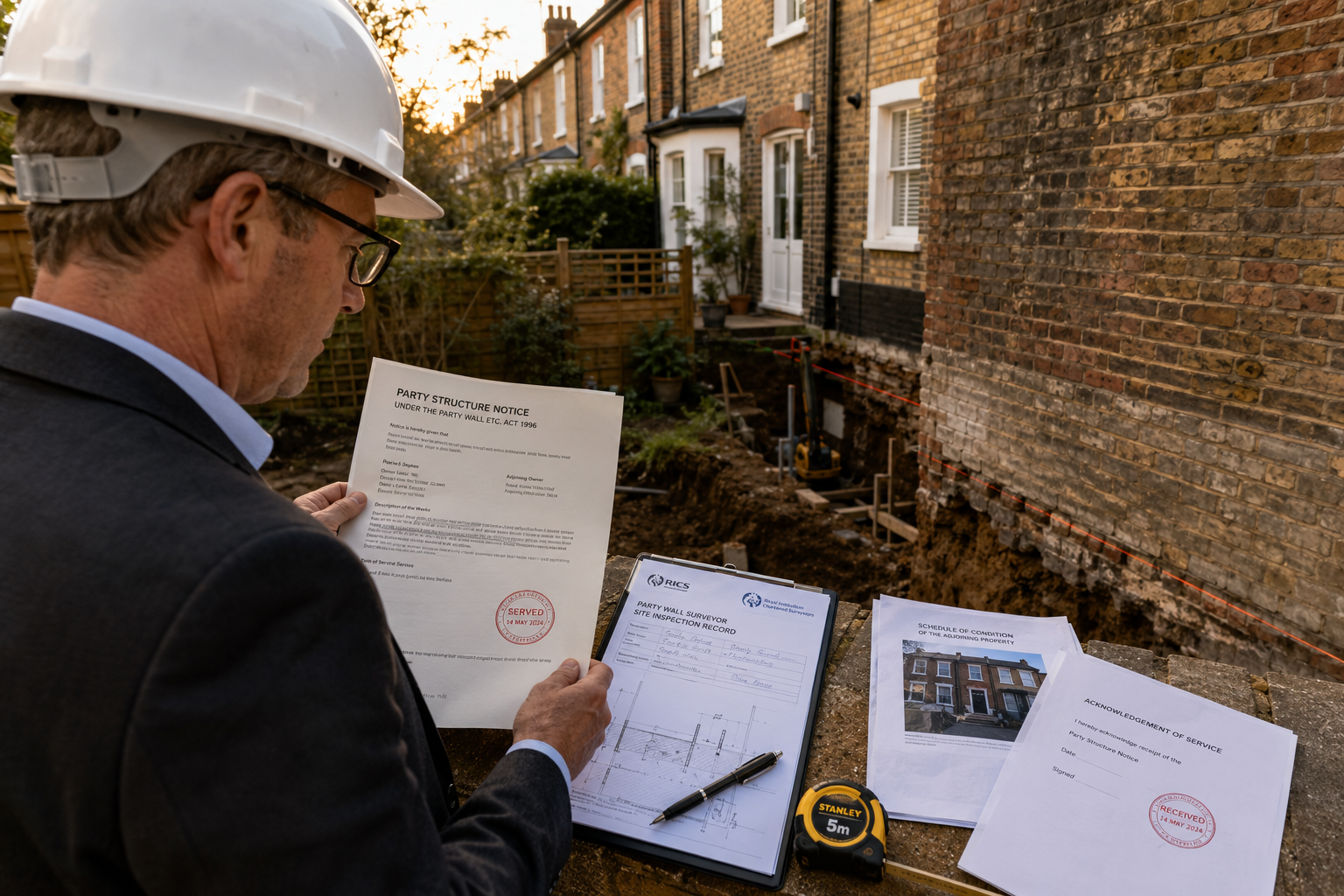
The Party Wall etc. Act 1996 governs all works that affect shared walls, boundary structures, and excavations near neighbouring buildings. Underpinning — the process of strengthening or deepening existing foundations — falls squarely within its scope whenever a party wall is involved.
The Act defines three categories of work, each requiring a different type of notice:
| Notice Type | Section | Trigger |
|---|---|---|
| Party Structure Notice | Section 2 | Works directly affecting a party wall, including underpinning |
| Line of Junction Notice | Section 1 | Building a new wall at or astride the boundary line |
| Adjacent Excavation Notice | Section 6 | Excavations within 3 or 6 metres of an adjoining structure |
For most underpinning projects, a Party Structure Notice under Section 2 is the primary requirement. If the underpinning involves excavation within 3 metres of the neighbouring structure at a depth greater than the neighbour's foundations, an Adjacent Excavation Notice under Section 6 is also required [4].
Understanding when you need a party wall agreement is the first step every building owner must take before commissioning any foundation work. Failing to serve the correct notice can result in injunctions, project delays, and significant legal costs.
What the Party Structure Notice Must Include
Under the Act, a valid Party Structure Notice must contain:
- The full name and address of the building owner
- A clear description of the proposed underpinning works
- The intended start date of the works
- Reference to the Party Wall etc. Act 1996
The notice must be served at least two months before the proposed start date [2]. This timeline is non-negotiable. Starting work without proper notice — or before the notice period expires — exposes the building owner to legal action from the adjoining owner.
The Adjoining Owner's Right to Respond
Once a Party Structure Notice is received, the adjoining owner has 14 days to respond in one of three ways:
- Consent in writing — work may proceed under agreed conditions
- Object to the works — triggering the appointment of surveyors
- Serve a counter-notice — requesting modifications or additional works
Critically, failure to respond within 14 days is treated as dissent under the Act [3]. This automatically triggers the dispute resolution process, requiring both parties to appoint surveyors. This is a common pitfall: adjoining owners who simply ignore a notice inadvertently escalate the situation rather than avoiding it.
For guidance on the broader legal requirements for boundary walls, including how notices interact with planning permissions, professional surveyor advice is strongly recommended.
Structural Assessments Before Underpinning Party Walls in 2026
A legal notice alone is not sufficient to protect either party. Before any underpinning begins, a comprehensive structural assessment must be carried out. In 2026, surveyor protocols have made this assessment more rigorous than ever, reflecting the increased complexity of urban foundation work and the rising cost of claims [1].
What a Pre-Underpinning Structural Assessment Covers
A thorough structural assessment for underpinning typically includes:
- Review of historic maps and drainage records to identify previous ground disturbances
- Subsidence data analysis to assess whether movement is ongoing or historic
- Geotechnical and soil investigation to determine load-bearing capacity and soil type
- Visual inspection of the party wall for existing cracks, movement, or deterioration
- Review of neighbouring property foundations where accessible
For properties in areas with clay-heavy soils — common across much of London — the risk of differential settlement during underpinning is particularly significant. Understanding subsidence and why it is a major problem is essential context for any structural engineer or surveyor preparing an underpinning assessment.
A structural survey carried out by a RICS-accredited surveyor provides the most reliable baseline for this assessment. The findings directly inform the Party Wall Award — the legal document that sets out how the works will be carried out.
The Mandatory Schedule of Condition
One of the most important requirements under 2026 surveyor protocols is the Schedule of Condition [1]. This is a detailed photographic and written record of the current state of both properties — including walls, floors, ceilings, and any existing defects — completed before underpinning work begins.
The Schedule of Condition serves two critical purposes:
- It establishes a baseline against which any new damage can be measured
- It provides documentary evidence if a compensation claim arises after the works
"A Schedule of Condition is not bureaucratic box-ticking. It is the single most effective tool for preventing neighbour disputes from escalating into costly legal proceedings."
Without a Schedule of Condition, it becomes extremely difficult to prove whether damage to the adjoining property was caused by the underpinning work or was pre-existing. Given that subsidence-related compensation awards can amount to tens of thousands of pounds [1], the cost of omitting this step is potentially enormous.
Enhanced Monitoring During Works
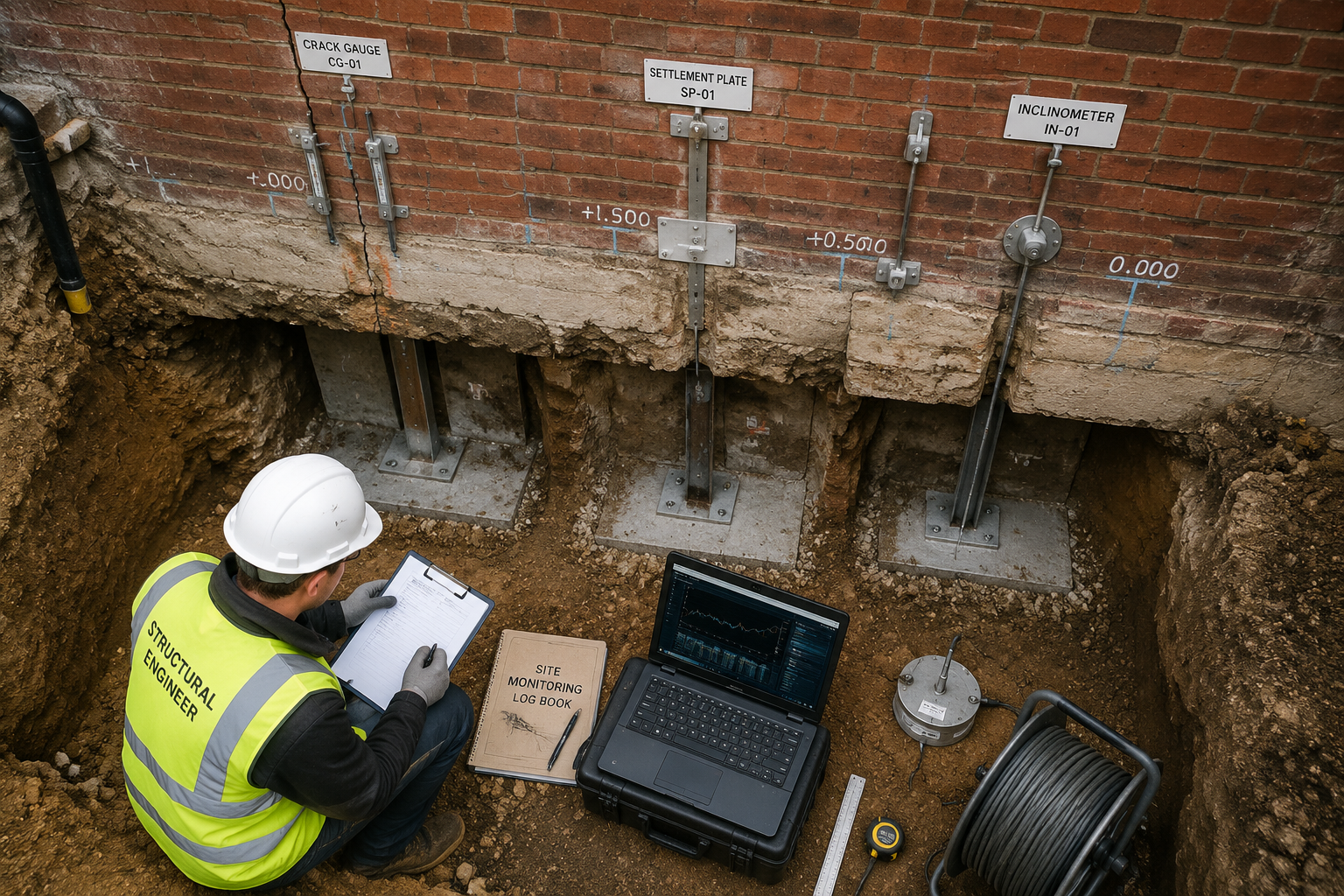
The 2026 surveyor protocols also mandate the use of structural monitoring plans throughout the underpinning process [1]. These plans typically include:
- Crack gauges — to measure any widening of existing cracks
- Inclinometers — to detect lateral movement in walls
- Settlement plates — to track vertical ground movement
- Regular inspection visits by the appointed surveyor
This monitoring data creates a continuous record of structural behaviour during the works. If movement exceeds agreed thresholds, work must pause and the cause investigated before proceeding. This proactive approach significantly reduces the likelihood of serious damage and the disputes that follow.
For a broader understanding of the importance of structural surveys in protecting property owners, reviewing current RICS guidance is advisable.
Dispute Avoidance: Legal Notices, Structural Assessments, and Surveyor Roles

The connection between underpinning party walls in 2026, legal notices, structural assessments, and dispute avoidance is direct: most disputes arise not from the underpinning work itself, but from failures in process. Inadequate notice, missing documentation, and poor communication between neighbours are the primary drivers of formal disputes [1].
How Surveyors Prevent and Resolve Disputes
When a dispute is triggered — either by the adjoining owner's dissent or by failure to agree on the Party Wall Award — both parties must appoint surveyors. There are two models:
- Two surveyors — one appointed by each party
- An agreed surveyor — a single surveyor appointed by both parties jointly
The appointed surveyors then draw up a Party Wall Award, which sets out:
- The nature and scope of the underpinning works
- The working hours and access arrangements
- The monitoring requirements during the works
- The rights and responsibilities of each party
- Compensation provisions if damage occurs
Surveyors play a central role in determining the time and manner in which underpinning works can be carried out, ensuring that the rights of both building and adjoining owners are protected under the Act [6]. Their independence is a legal requirement — a surveyor appointed under the Act owes a duty to the Act itself, not solely to the party who appointed them.
For complex projects, particularly those involving property boundary disputes or contested ownership of the party wall itself, the surveyor's role becomes even more critical.
The Real Cost of Getting It Wrong
The financial consequences of failing to comply with Party Wall Act requirements are significant. Consider the following scenarios:
| Failure | Potential Consequence | Estimated Cost |
|---|---|---|
| No notice served | Injunction to stop works | Legal fees + project delay costs |
| No Schedule of Condition | Unable to defend damage claim | Compensation award: potentially tens of thousands |
| Inadequate monitoring | Structural damage to adjoining property | Repair costs + compensation |
| Ignoring a counter-notice | Dispute escalation | Surveyor fees + legal costs |
The average cost of a boundary dispute gives a useful benchmark for understanding how quickly legal costs accumulate when party wall matters are handled incorrectly.
Practical Steps to Avoid Disputes in 2026
The following checklist summarises the key actions that building owners should take before, during, and after underpinning work:
Before work begins:
- Identify all adjoining owners and confirm their contact details
- Serve the correct notice(s) within the required timeframe
- Commission a full structural assessment and geotechnical report
- Complete a Schedule of Condition for both properties
- Appoint a RICS-accredited party wall surveyor
During works:
- Implement the agreed monitoring plan
- Maintain regular communication with the adjoining owner
- Ensure contractors comply with the Party Wall Award conditions
- Record any unexpected ground conditions or structural behaviour
After works:
- Carry out a post-completion inspection
- Compare post-work condition against the Schedule of Condition
- Retain all documentation for a minimum of six years
When Disputes Cannot Be Avoided
Even with full compliance, some disputes do proceed to formal resolution. In these cases, the quality of documentation becomes decisive. Surveyors who have maintained thorough records — including monitoring data, inspection reports, and photographic evidence — are in a far stronger position to defend their client's interests [1].
It is also worth noting that the Party Wall Act provides a third surveyor mechanism for situations where the two appointed surveyors cannot agree. Either surveyor can refer the matter to the third surveyor, whose decision is binding on both parties.
For homeowners in London seeking professional support, RICS-accredited surveyors offer the most reliable combination of technical expertise and legal knowledge for managing underpinning projects.
Conclusion
Underpinning party walls in 2026 demands a disciplined approach to legal notices, structural assessments, and dispute avoidance. The Party Wall etc. Act 1996 remains the governing framework, but the 2026 surveyor protocols have raised the bar for compliance — particularly around Schedules of Condition and structural monitoring.
Actionable next steps for building owners:
- Engage a RICS-accredited party wall surveyor at the earliest planning stage — before architects or contractors are appointed.
- Identify the correct notice type for your specific works (Party Structure Notice, Line of Junction Notice, or Adjacent Excavation Notice) and serve it within the statutory timeframe.
- Commission a structural assessment that includes geotechnical investigation and a review of historic drainage and subsidence records.
- Insist on a Schedule of Condition before any work begins — this document is your primary protection against unfounded claims.
- Implement a monitoring plan with crack gauges, inclinometers, and settlement plates as required by 2026 protocols.
- Maintain open communication with your adjoining owner throughout the project; many disputes are resolved informally when neighbours feel informed and respected.
The cost of getting these steps right is modest compared to the cost of getting them wrong. With subsidence-related awards running into tens of thousands of pounds and injunctions capable of halting projects entirely, professional guidance from the outset is the most cost-effective investment a building owner can make in 2026.
References
[1] Underpinning Works And Party Wall Agreements 2026 Surveyor Protocols For Foundation Stability Disputes – https://wimbledonsurveyors.com/underpinning-works-and-party-wall-agreements-2026-surveyor-protocols-for-foundation-stability-disputes/?utm_source=openai
[2] Party Wall Notice Requirements Service And Counter Notices – https://legalclarity.org/party-wall-notice-requirements-service-and-counter-notices/?utm_source=openai
[3] Guidance Note Party Wall Act 1996 – https://www.property-care.org/media/cc1gvsr4/guidance-note-party-wall-act-1996.pdf?utm_source=openai
[4] Party Walls – https://masefields.co.uk/surveying/party-walls/?utm_source=openai
[5] Underpinning Foundations And Party Wall Notices 2026 Surveyor Protocols For Structural Stability And Neighbor Protection – https://partywallsurveyorlondon.uk/blogs/underpinning-foundations-and-party-wall-notices-2026-surveyor-protocols-for-structural-stability-and-neighbor-protection/?utm_source=openai
[6] Party Walls – https://www.rics.org/consumer-guides/party-walls?utm_source=openai