

Fewer than six months after the Renters' Rights Act 2026 came fully into force, letting agents across England are already reporting a sharp rise in tenants filing First-tier Tribunal (FTT) applications to challenge proposed rent increases — a trend that signals a fundamental shift in how valuation surveyors must approach periodic tenancy work [1]. The old world of contractual rent review clauses, upward-only triggers, and infrequent step-changes is gone. In its place sits a recurring, evidence-driven cycle governed by Section 13 of the Housing Act 1988 as amended, where every annual review is a potential dispute and every surveyor instruction demands rigorous market analysis. Understanding rent review challenges in periodic tenancies and the valuation surveyor tactics required post-Renters' Rights Act 2026 is now essential for any practitioner advising landlords or tenants in the private rented sector.
Key Takeaways
- The Renters' Rights Act 2026 abolishes fixed-term assured shorthold tenancies, replacing them with periodic tenancies subject to annual Section 13 rent reviews.
- Contractual rent review clauses no longer apply; all increases must be evidenced against "open market rent" and challenged through the First-tier Tribunal.
- Landlord surveyors and tenant surveyors will employ divergent tactics — best comparables and upward adjustments versus condition penalties and downward concessions.
- The prohibition on rent bidding and significant advance payments strips "headline rents" of their evidential weight, requiring surveyors to look behind marketing data.
- RICS-standard comparable evidence, transparent adjustments, and awareness of "tenant walk-away risk" will define professional competence in this new environment.
How the Renters' Rights Act 2026 Reshaped Periodic Tenancy Rent Reviews
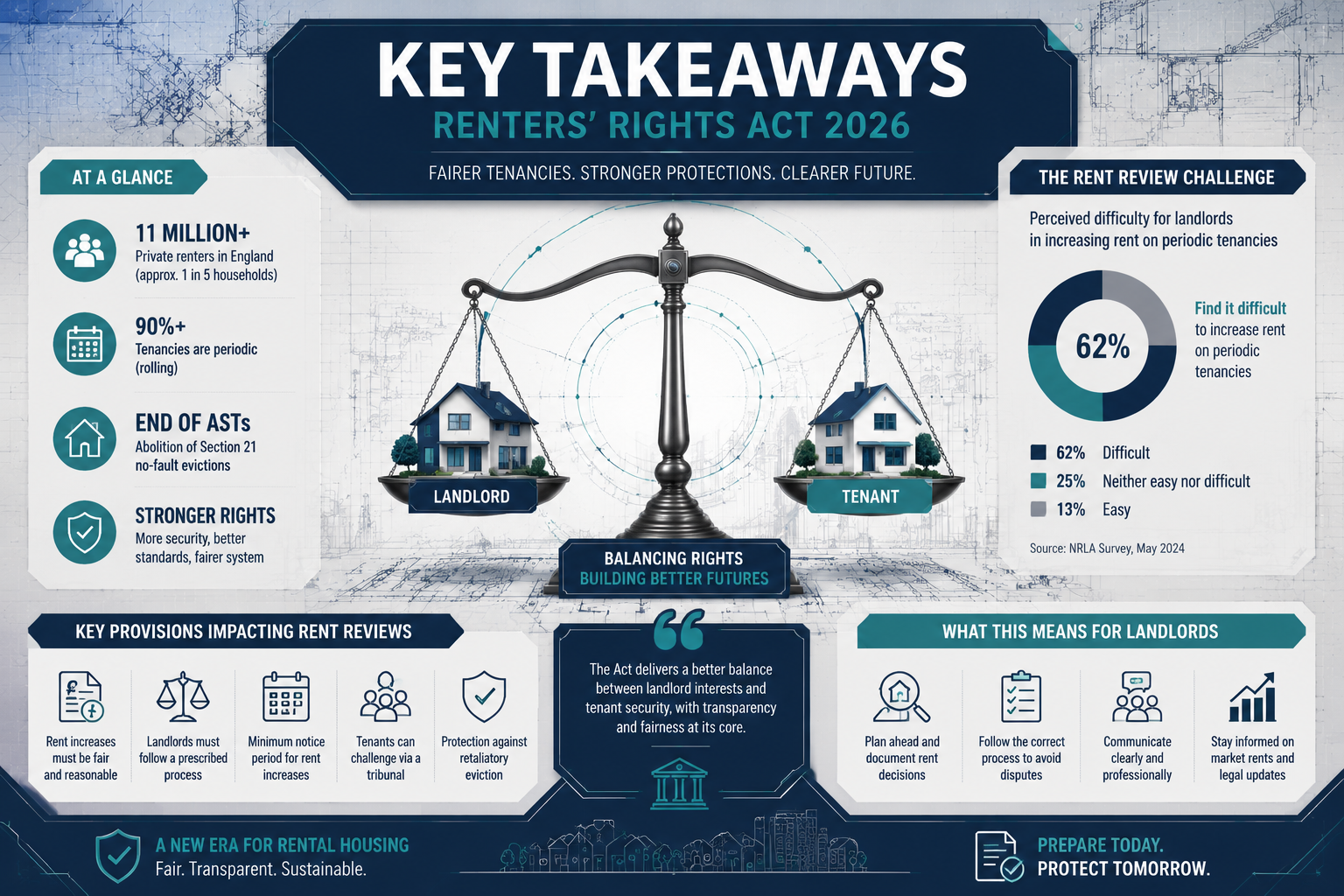
The Renters' Rights Act 2026 is the most significant reform to England's private rented sector in a generation [7]. Its core structural change — abolishing new fixed-term assured shorthold tenancies and converting all existing ones to periodic tenancies — has profound implications for rent review mechanics [1].
Under the previous regime, landlords could embed contractual rent review clauses into fixed-term agreements, setting the timing, frequency, and formula for increases. Those clauses are now effectively redundant for the residential private sector. Every periodic tenancy is subject to the statutory Section 13 process, which hard-codes three key constraints [10]:
| Constraint | Detail |
|---|---|
| Frequency | Maximum one rent increase per 12-month period |
| Notice | Minimum two months' written notice to the tenant |
| Cap | Increase cannot exceed "open market rent" |
This architecture creates a predictable but contestable annual cycle. A landlord who issues a Section 13 notice proposing a higher rent triggers a two-month window in which the tenant can accept, negotiate, or refer the matter to the FTT [4]. If referred, the tribunal determines the open market rent — and that determination becomes the new contractual rent, regardless of what either party proposed [10].
The practical consequence: valuation surveyors are no longer occasional advisers called in for a major lease event. They are now recurring participants in an annual process where the standard of evidence presented to the FTT will directly determine outcomes for both landlords seeking sustainable income and tenants resisting unaffordable increases [3].
What "Open Market Rent" Means in the New Context
The statutory cap at "open market rent" sounds straightforward. In practice, it is anything but. The FTT is required to determine the rent at which the property would be let in the open market by a willing landlord to a willing tenant, on the same terms as the existing tenancy. That definition excludes scarcity value, bidding war premiums, and — critically — any rent paid in advance beyond what the Act permits [8].
The Act's prohibition on requiring significant rent in advance and its ban on rent bidding processes are not merely consumer protections. They are evidential rules that reshape the comparables market itself [9]. Surveyors can no longer rely on "headline rents" achieved through competitive letting processes as straightforward evidence of market level. They must look behind the marketing practice to identify what a property would have let for in a transparent, non-competitive process — a more demanding analytical task that rewards surveyors with deep local knowledge.
For those working across London's diverse rental submarkets, understanding micro-location dynamics is essential. The property surveyors covering Knightsbridge and Westminster will face very different comparables pools than those operating in Croydon or Battersea, and the adjustment methodology must reflect those differences transparently.
Rent Review Challenges in Periodic Tenancies: Valuation Surveyor Tactics Post-Renters' Rights Act 2026 — The Landlord Perspective

When instructed by a landlord, a valuation surveyor's primary objective is to build the strongest credible case that the proposed rent does not exceed — and ideally closely tracks — the open market level. The word "credible" is important. FTT panels have demonstrated a willingness to discount evidence that appears cherry-picked or methodologically opaque [10]. The following tactical framework reflects current best practice for landlord instructions.
Selecting and Presenting Comparable Evidence
The foundation of any Section 13 case is comparable rental evidence. For landlord surveyors, the tactical priorities are:
- Prioritise recent, higher-rent comparables from the same micro-location — ideally within 0.25 miles and let within the preceding six months.
- Evidence improvements and amenities that justify uplift: recent kitchen or bathroom refurbishment, EPC rating upgrades, new appliances, or access to communal facilities.
- Apply upward time adjustments where market rents have risen since the comparable letting date, supported by published rental indices (ONS, Zoopla, or Rightmove rental trackers).
- Disclose concessions carefully — if a comparable was let with a rent-free period or a landlord contribution to moving costs, adjust the effective rent accordingly before presenting it as evidence.
"Tribunals will expect RICS-style comparables and transparent adjustments rather than crude averages. A schedule of comparables without adjustment reasoning is likely to carry little weight."
This transparency requirement is not merely good practice — it reflects the FTT's evolving expectations. Early practitioner commentary following the Act's implementation suggests that panels are treating unexplained comparable schedules with scepticism, particularly where the selected properties are materially superior to the subject [3].
Addressing the Prohibition on Bidding Evidence
Because the Act prohibits landlords from inviting or accepting bids above the asking rent, any comparable that was let through a competitive process before the Act's commencement date requires careful treatment. Surveyors should:
- Identify whether the comparable rent was influenced by a bidding process.
- If so, apply a downward adjustment to strip out the bidding premium — estimated by reference to the gap between initial asking rent and achieved rent in that letting.
- Document the adjustment methodology clearly in the report.
Failure to address this issue leaves the landlord's evidence vulnerable to a tenant surveyor's attack on the comparables' reliability.
Factoring in Tenant Walk-Away Risk
One of the more subtle tactical shifts required under the new regime relates to demand elasticity. Because tenants in periodic tenancies can now exit with relatively short notice and without the financial penalty of breaking a fixed term, the demand curve for any given property is more elastic than it was under the old regime [8]. A proposed rent that is technically at market level but sits at the very top of the range may deter renewal and trigger a void period.
Landlord surveyors should therefore frame their valuation not merely as a point estimate but as a range, with commentary on where within that range the proposed rent sits. Positioning at the lower end of the market range, supported by evidence, can be a stronger tactical position than an aggressive top-of-market claim that the FTT reduces — leaving the landlord with a lower rent than they would have achieved through a more measured approach.
Rent Review Challenges in Periodic Tenancies: Valuation Surveyor Tactics Post-Renters' Rights Act 2026 — The Tenant Perspective
For tenant-instructed surveyors, the tactical toolkit is a mirror image of the landlord approach — but the analytical demands are equally rigorous. The goal is not to argue that the property has no rental value, but to demonstrate that the landlord's proposed rent exceeds the genuine open market level when the property's specific characteristics are properly accounted for.
Building the Downward Adjustment Case
Tenant surveyors should systematically examine the following factors, each of which can support a downward adjustment from the landlord's comparables:
- Condition and disrepair: Any outstanding landlord repair obligations, evidence of damp, structural issues, or poor maintenance reduces the property's market appeal. A damp survey or building condition assessment can provide objective evidence of condition deficiencies that justify a lower rent.
- EPC rating: Properties with poor energy performance ratings (E, F, or G) face increasing tenant resistance as energy costs remain elevated. A below-average EPC rating relative to the landlord's comparables is a legitimate basis for downward adjustment.
- Location penalties: Proximity to noise sources, poor transport links, or neighbourhood amenity deficits that are not reflected in the landlord's selected comparables should be explicitly addressed.
- Lack of upgrades: Where the landlord's comparables feature recently refurbished kitchens, bathrooms, or appliances and the subject property does not, a condition adjustment is appropriate.
Selecting Counter-Comparables
Tenant surveyors should seek comparables from:
- Less prominent listings — properties let without premium marketing, through smaller agents, or with longer void periods before letting, which tend to reflect a more realistic market level.
- Similar stock in the same street or estate — direct comparables that the landlord's surveyor may have omitted because they achieved lower rents.
- Properties with comparable EPC ratings — ensuring like-for-like comparison on energy efficiency.
The prohibition on bidding also works in the tenant's favour here. Any comparable that the landlord presents which was let pre-Act through a competitive process is vulnerable to challenge on the grounds that the achieved rent was inflated by bidding dynamics that no longer exist in the market [9].
Procedural Tactics: Timing and Documentation
Tenants have two months from receipt of a Section 13 notice to refer the matter to the FTT. Tenant surveyors should advise clients to:
- Acknowledge receipt of the notice promptly and in writing.
- Commission a comparable rental analysis immediately — the two-month window is short.
- Attempt negotiation with the landlord before filing, using the surveyor's analysis as leverage. Many cases settle before tribunal, saving both parties cost and time [4].
- If filing, ensure the FTT application is accompanied by a full comparables schedule with adjustment notes, not merely a bare assertion that the rent is too high.
For those unfamiliar with the broader valuation landscape, understanding how an RICS survey can support property price negotiations provides useful context for the evidential standards that professional bodies expect in contested valuations.
Evidence Standards, RICS Compliance, and FTT Expectations
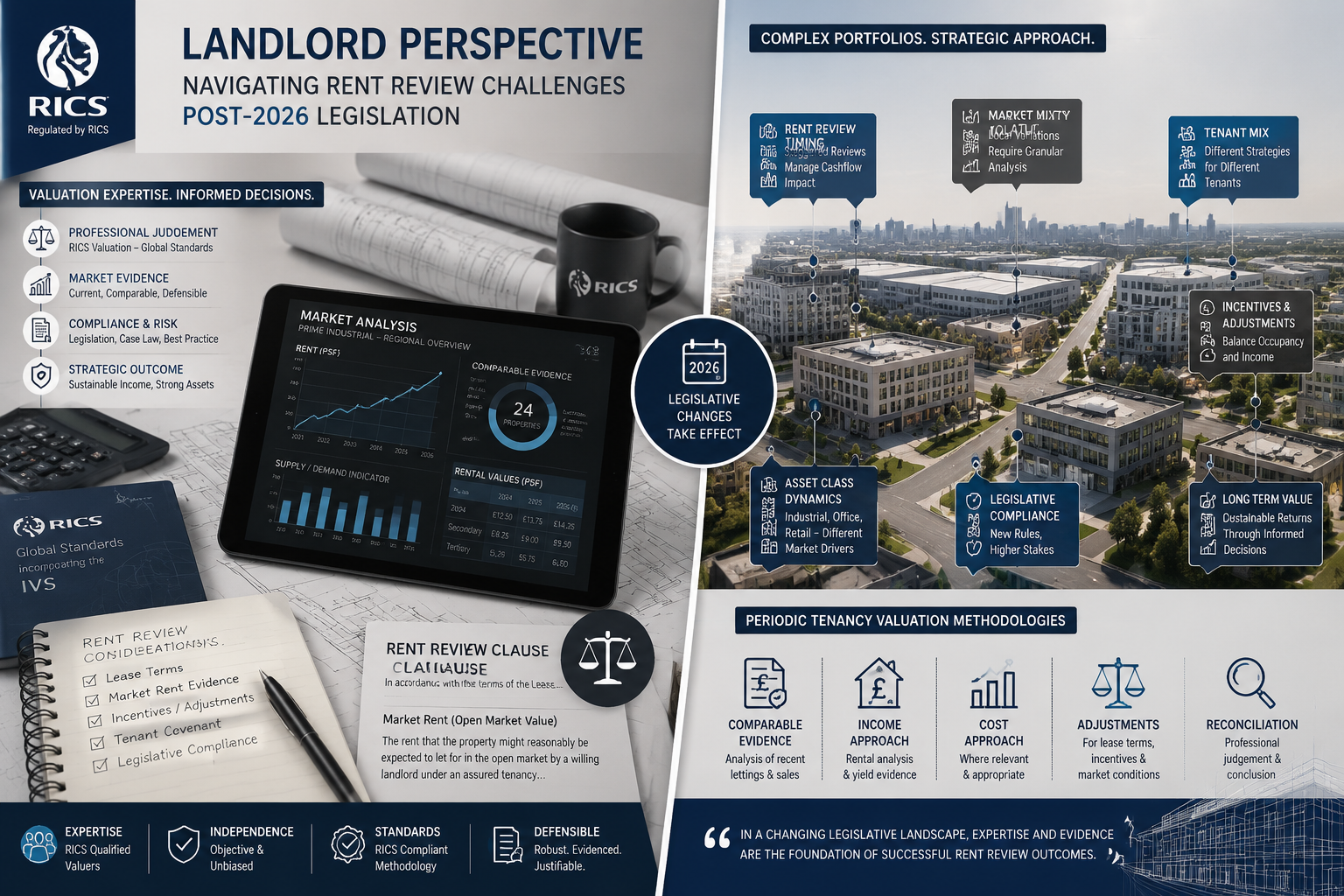
The FTT is not a court of law, but it operates with increasing procedural rigour in rent review cases. Surveyors presenting evidence — whether as expert witnesses or as advocates for a party — should be aware of the following standards.
RICS Professional Standards
RICS members instructed on Section 13 matters are bound by the Red Book (RICS Valuation — Global Standards) where a formal valuation is being produced, and by the Rules of Conduct in all cases. Key obligations include:
- Independence and objectivity: A surveyor instructed by one party must still present evidence honestly and not suppress unfavourable comparables.
- Transparency of methodology: All adjustments to comparables must be explained and quantified.
- Competence: Surveyors should only accept instructions in markets where they have genuine local knowledge and access to reliable comparable data.
Working with RICS-accredited surveyors ensures that the evidence presented meets the professional standards that FTT panels increasingly expect. Panels have shown a preference for structured comparable schedules over narrative-only submissions, and surveyors who present evidence in a format consistent with RICS guidance are likely to be treated as more credible witnesses [3].
The Role of Condition Surveys in Rent Review Disputes
One underused tool in rent review disputes is the formal condition survey. Where a tenant argues that the property's condition justifies a lower rent, a building survey or structural survey can provide objective, professionally produced evidence of defects that supports the downward adjustment argument. Similarly, a landlord who has recently invested in improvements may commission a condition report to demonstrate the property's superior state relative to comparables.
The condition survey is particularly valuable where:
- The parties disagree about the extent of disrepair.
- The landlord's comparables are materially superior in condition to the subject property.
- There are outstanding Section 11 repair obligations that the landlord has not fulfilled.
Avoiding Common Evidential Pitfalls
Both landlord and tenant surveyors should be alert to the following errors that can undermine FTT submissions:
| Common Pitfall | Why It Matters |
|---|---|
| Using comparables more than 12 months old without time adjustment | Markets move; stale evidence is discounted |
| Failing to disclose incentives in comparable lettings | Inflates apparent market rent; undermines credibility |
| Selecting comparables outside the micro-location without justification | FTT panels are locally aware and will question outliers |
| Presenting a single comparable | Insufficient evidential base; panels expect a range |
| Ignoring EPC differences | Increasingly material to tenant demand and market rent |
Practical Workflow for Surveyors in 2026
Given the annual cycle created by the Act, surveyors advising landlords with multiple properties should consider establishing a systematic workflow:
- Pre-notice research: Three to four weeks before issuing a Section 13 notice, conduct a comparables sweep of the micro-location using portal data, direct agent enquiries, and any available Land Registry or VOA rental data.
- Comparable selection and adjustment: Select a minimum of three to five comparables, apply documented adjustments for condition, size, location, and time, and produce a defensible market rent range.
- Notice calibration: Position the proposed rent within the market range — not necessarily at the ceiling — to reduce the risk of FTT challenge and tenant exit.
- Negotiation phase: If the tenant challenges, use the surveyor's analysis as the basis for without-prejudice negotiation before the FTT hearing date.
- FTT preparation: If the matter proceeds to tribunal, prepare a formal comparables schedule in RICS-compliant format, with a covering expert report that explains the methodology and conclusions.
For tenant surveyors, the same workflow applies in reverse, with the addition of a condition assessment at step one where the property's physical state is likely to be material to the outcome.
Those seeking expert building evaluation support or residential property advice in connection with rent review disputes can benefit from engaging a local surveyor with direct knowledge of the relevant rental submarket.
Conclusion
The Renters' Rights Act 2026 has not merely reformed tenancy law — it has created a new professional discipline within residential valuation. Rent review challenges in periodic tenancies, and the valuation surveyor tactics required post-Renters' Rights Act 2026, demand a higher standard of market analysis, evidential transparency, and procedural awareness than most practitioners have previously applied to residential rental work [1][3].
Actionable next steps for surveyors and their clients:
- Landlords should commission a market rent analysis before issuing every Section 13 notice, not merely when a challenge is anticipated. A well-evidenced notice reduces the risk of tribunal and positions the landlord as a credible participant if a challenge does arise.
- Tenants who receive a Section 13 notice should seek surveyor advice within the first two weeks of the two-month window — not at the last moment. Early analysis enables negotiation, which is faster and cheaper than tribunal.
- Surveyors should invest in building micro-location comparable databases, establish relationships with local letting agents who can provide pre-marketing rental data, and familiarise themselves with FTT procedural requirements before their first instruction.
- Both parties should treat condition evidence — including formal building surveys and EPC certificates — as a standard component of the rent review file, not an optional extra.
The annual rhythm of Section 13 reviews will generate a steady stream of instructions for surveyors who position themselves as specialists in this area. Those who invest in the right methodology now will be well placed to serve both landlords and tenants in what is becoming one of the most active areas of residential property practice in England.
References
[1] The Renters Rights Act Information Sheet 2026 – https://assets.publishing.service.gov.uk/media/69bc04b8f7b1c24d8e23ce60/The_Renters__Rights_Act_Information_Sheet_2026.pdf
[3] Renters Rights Act Lenders Landlords – https://ww3.rics.org/uk/en/journals/property-journal/renters-rights-act-lenders-landlords.html
[4] Periodic Tenancies Explained What May 1st Changes Mean For Your Rental Income – https://www.elliotleigh.com/post/periodic-tenancies-explained-what-may-1st-changes-mean-for-your-rental-income/
[7] Understanding The Renters Rights Act What The 2026 Changes Mean For Landlords And Tenants In England – https://www.bannerjones.co.uk/resources/understanding-the-renters-rights-act-what-the-2026-changes-mean-for-landlords-and-tenants-in-england
[8] Renters Rights Act In 2026 A Tenant S Guide To Your New Protections – https://www.augustapp.com/blog/renters-rights-act-in-2026-a-tenant-s-guide-to-your-new-protections
[9] Renters Rights Act Implementation 6365569 – https://www.jdsupra.com/legalnews/renters-rights-act-implementation-6365569/
[10] Section 13 Rent Tribunal Challenge 2026 Landlord Guide – https://letcompliance.com/blog/section-13-rent-tribunal-challenge-2026-landlord-guide/