
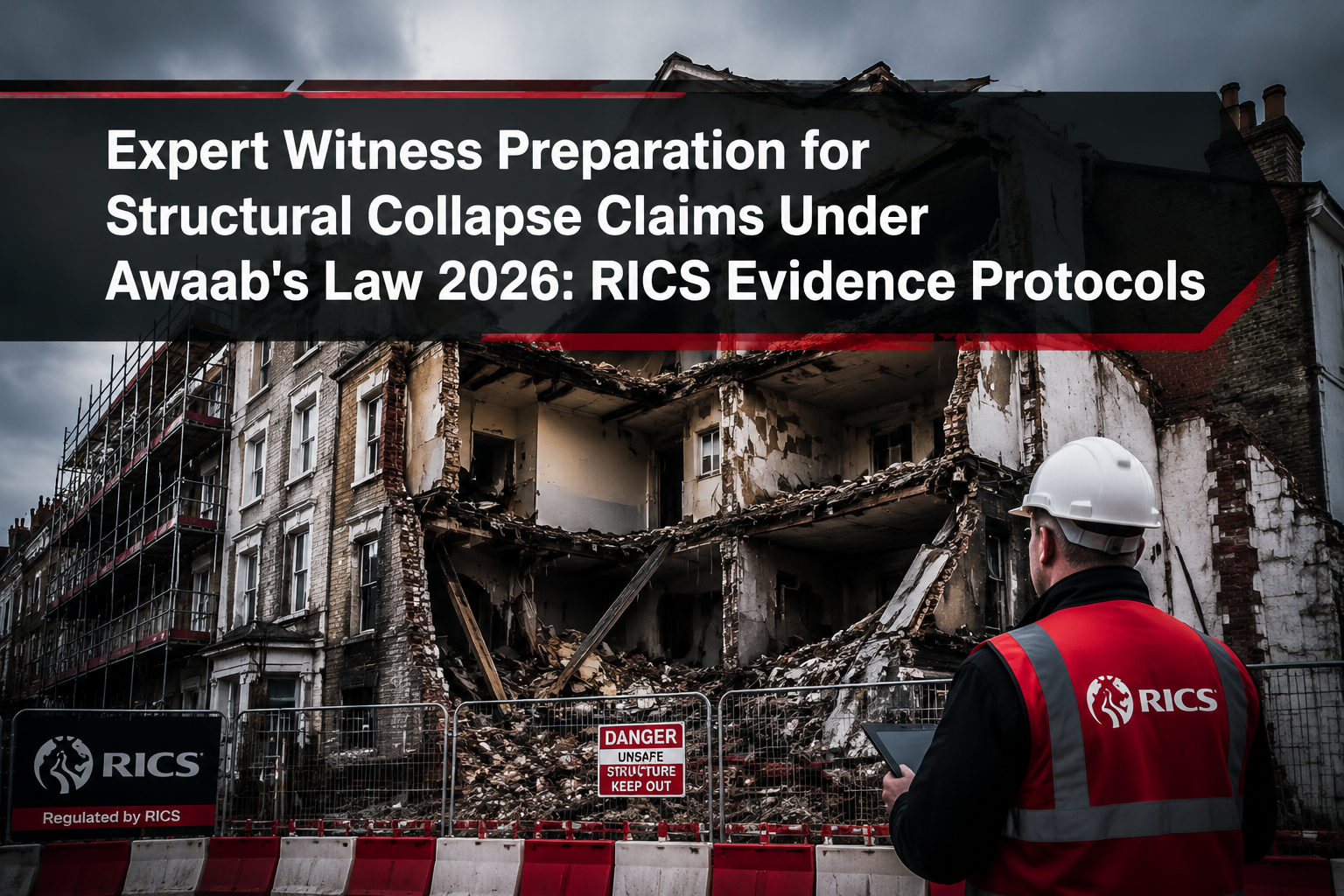
Fewer than 30% of expert witness reports submitted in housing disrepair cases meet full Civil Procedure Rules Part 35 compliance on first submission — a statistic that carries serious consequences now that Awaab's Law 2026 has dramatically expanded the scope of hazards landlords must address and the speed at which they must act. For structural surveyors stepping into the expert witness role, the stakes have never been higher. Expert Witness Preparation for Structural Collapse Claims Under Awaab's Law 2026: RICS Evidence Protocols is no longer a niche specialism; it is a core professional competency that every RICS-registered surveyor handling rental property disputes must master.
This guide provides step-by-step guidance on structuring court-ready reports, meeting new structural and explosion hazard standards, and applying current photography and modeling protocols that satisfy both RICS professional standards and tribunal expectations. [1]
Key Takeaways
- Awaab's Law 2026 extends mandatory hazard categories to include structural collapse, explosion risk, excess cold, falls, and fire — all of which require specialist expert evidence.
- RICS-compliant expert witness reports must include a formal declaration of independence, detailed inspection methodology, and a comprehensive hazard assessment aligned with the Housing Health and Safety Rating System (HHSRS).
- Expert witnesses owe their primary duty to the court, not the instructing party — fee arrangements contingent on case outcomes are strictly prohibited.
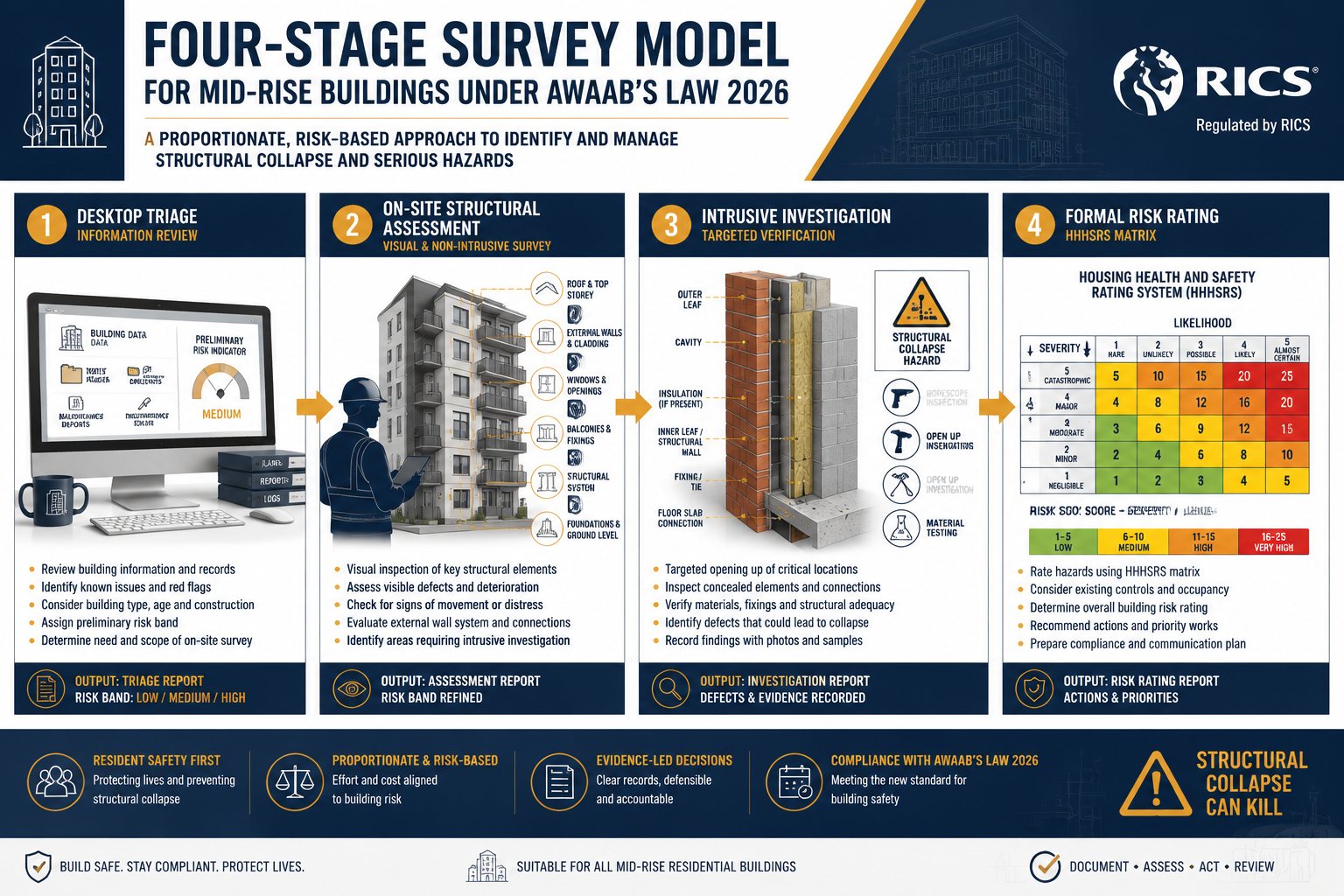
- A four-stage survey model (desktop triage, on-site assessment, intrusive investigation, formal risk rating) is now the accepted standard for mid-rise private rental sector buildings.
- RICS accreditation and structured training, including the Expert Witness Certificate, significantly reduce the risk of report rejection and professional sanction.
What Awaab's Law 2026 Means for Structural Collapse Claims
Awaab's Law, named after two-year-old Awaab Ishak who died in 2020 as a result of prolonged mould exposure in social housing, was initially enacted through the Social Housing (Regulation) Act 2023. The 2026 extension broadened its reach significantly. It now applies to a wider range of private rental sector properties and introduces mandatory investigation and remediation timelines for an expanded list of hazards — including structural collapse, explosion risk, excess cold, falls from height, and fire. [3]
For expert witnesses, this expansion is consequential. Where previously a structural surveyor might have been instructed to comment narrowly on damp or mould, they must now assess whether a property presents a Category 1 or Category 2 hazard under the HHSRS across multiple risk domains simultaneously. A cracked load-bearing wall may trigger both a structural collapse risk assessment and a falls hazard evaluation. A gas installation defect may require both explosion risk analysis and fire risk commentary.
The practical result: expert reports in 2026 are longer, more technically complex, and subject to greater judicial scrutiny than at any previous point in UK housing law.
The Expanded Hazard Categories Requiring Expert Evidence
| Hazard Category | Awaab's Law 2026 Trigger | HHSRS Classification |
|---|---|---|
| Structural collapse | Visible cracking, subsidence, failed supports | Category 1 if imminent risk |
| Explosion risk | Gas installation defects, pressure vessel failures | Category 1 |
| Excess cold | Inadequate heating, thermal bridging | Category 1 or 2 |
| Falls from height | Defective staircases, balconies, roof access | Category 1 or 2 |
| Fire | Faulty electrics, blocked escape routes | Category 1 |
Surveyors working in areas with older housing stock — such as those covered by Wandsworth property surveyors or Southwark property surveyors — will encounter these multi-hazard scenarios with increasing frequency given the age and condition of the local rental stock.
The Four-Stage Survey Model: A Structured Approach to Evidence Gathering
Building surveys for structural collapse risk now follow a structured four-stage model that has become the accepted professional standard for mid-rise private rental sector buildings under Awaab's Law 2026. [6] Each stage generates specific evidence that feeds directly into the expert witness report.
Stage 1: Rapid Desktop Triage
Before visiting the property, the expert witness must conduct a thorough desktop review. This includes:
- Title register and planning history — identifying any unauthorized structural alterations
- Previous survey reports — establishing a documented condition timeline
- Building Regulations completion certificates — confirming compliance at the time of construction
- Maintenance records and landlord correspondence — identifying known defects and response times
- Aerial and satellite imagery — detecting external changes not visible at ground level
Desktop triage allows the surveyor to form preliminary hypotheses about structural risk before setting foot on site. It also ensures the on-site inspection is targeted and efficient, reducing the risk of missing critical evidence. [6]
Stage 2: On-Site Structural Assessment
The on-site inspection for a structural collapse claim under Awaab's Law 2026 must go well beyond a standard Level 2 HomeBuyer Report. A Level 3 Building Survey is the minimum acceptable standard, and in many cases, a specialist structural engineer must be co-instructed. [6]
Key on-site activities include:
- External inspection of all elevations, including roof structure, chimney stacks, and retaining walls
- Internal inspection of load-bearing walls, floor structures, and ceiling voids
- Crack mapping using photogrammetry or manual measurement and categorization (BRE Digest 251 crack classification)
- Assessment of lateral restraint, lintel condition, and foundation movement indicators
- Documentation of any explosion risk indicators — gas meter condition, pipework integrity, ventilation adequacy
Photography standards at this stage are critical. Every defect must be photographed with:
- A wide-angle establishing shot showing the defect in context
- A mid-range shot identifying the specific location
- A close-up shot with a scale rule or reference object
- Metadata showing date, time, and GPS coordinates where possible
Courts have rejected expert evidence where photographs lacked scale references or could not be independently verified. [1]
Stage 3: Intrusive Investigation
Where desktop triage and on-site assessment identify suspected concealed defects, intrusive investigation is required. This may involve:
- Opening up wall cavities to inspect ties and insulation condition
- Lifting floor coverings to inspect joists and subfloor structure
- Borescope inspection of voids and ducts
- Mortar sampling for carbonation and sulfate testing
- Ground investigation where subsidence is suspected
Intrusive investigations must be carried out with the property owner's or landlord's consent, or by order of the tribunal. The expert witness must document the scope, methodology, and findings of any intrusive work in a separate appendix to the main report.
Stage 4: Formal Risk Rating
The final stage involves translating physical findings into a formal HHSRS risk rating. This requires calculating the likelihood of a harmful occurrence and the probable spread of harms, producing a numerical Hazard Score that determines whether the hazard is Category 1 (requiring mandatory action) or Category 2. [6]
For structural collapse specifically, the expert must also consider:
- Likelihood of partial versus full collapse
- Number of occupants at risk
- Vulnerability of occupants (children, elderly, disabled)
- Proximity to neighboring properties
This risk rating forms the numerical backbone of the expert witness report and is the figure most likely to be challenged by opposing counsel.
Structuring the Expert Witness Report for Court: Step-by-Step RICS Evidence Protocols
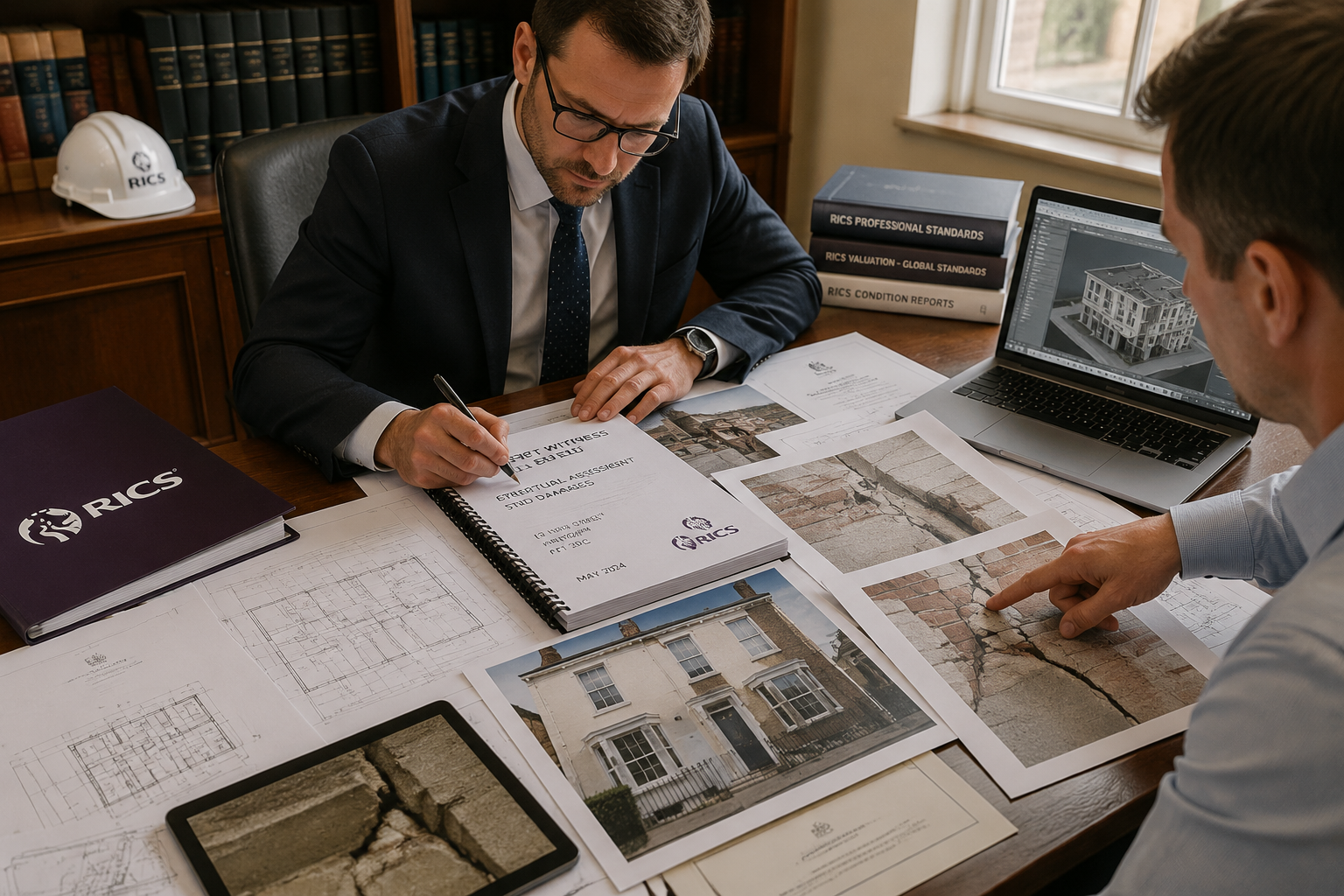
Expert Witness Preparation for Structural Collapse Claims Under Awaab's Law 2026: RICS Evidence Protocols requires a report structure that satisfies three simultaneous audiences: the instructing solicitor, the opposing party's expert, and the tribunal or court. RICS professional standards set out the mandatory components, and non-compliance risks both report rejection and professional sanction. [2] [4]
Mandatory Report Components
A fully compliant expert witness report for a structural collapse claim must contain the following sections in order:
1. Cover Page and Instructions Received
State the expert's full name, qualifications, RICS membership number, and accreditation status. Reproduce the letter of instruction in full or as an appendix. Confirm the questions the expert has been asked to address.
2. Expert's Declaration of Independence
This is non-negotiable. The declaration must confirm that:
- The expert understands their overriding duty is to the court, not the instructing party [4]
- The evidence given is independent and impartial
- The expert has not entered into any contingent fee arrangement [10]
- The expert will notify the court if their opinion changes
"The expert's duty to the court overrides any obligation to the person from whom the expert has received instructions or by whom the expert is paid." — CPR Part 35.3 [9]
3. Summary of Qualifications and Relevant Experience
List only qualifications and experience directly relevant to structural collapse assessment. Overstating expertise is a common ground for cross-examination attack.
4. Documents Reviewed
Provide a complete, dated list of every document reviewed, including those that did not support the expert's conclusions. Omitting unfavorable documents is a serious breach of the duty of candor. [2]
5. Inspection Methodology
Describe the four-stage survey process in detail. State which stages were completed, which were not (and why), and what limitations this places on the evidence. Identify any areas that could not be inspected and the reason.
6. Factual Findings
Present findings objectively, organized by hazard category. Use the crack classification system, HHSRS scoring, and any relevant British Standards or Eurocodes as reference frameworks. Attach all photographs as numbered exhibits with captions.
7. Expert Opinion and Hazard Assessment
Distinguish clearly between factual findings and professional opinion. State the basis for each opinion, including any assumptions made. Where two reasonable expert views exist, acknowledge both and explain why one is preferred. [4]
8. Conclusions and Recommendations
Provide a clear, numbered list of conclusions that directly answer the questions posed in the letter of instruction. Recommendations for remediation should be costed where possible, referencing current market rates.
9. Statement of Truth
Sign and date the statement of truth as required by CPR Part 35.
Photography and 3D Modeling Standards
In 2026, courts increasingly expect expert witnesses in structural collapse cases to supplement photographic evidence with digital modeling. Accepted tools include:
- Photogrammetry software (e.g., Agisoft Metashape, RealityCapture) to produce 3D point clouds of crack patterns and structural deformation
- Drone survey footage for external elevations above safe manual inspection height
- Thermal imaging to identify moisture ingress, thermal bridging, and concealed voids
- Structural BIM models where original design drawings are available
All digital evidence must be submitted in a format accessible to the court, with metadata intact. Raw files must be retained and disclosed on request. [1]
For surveyors unfamiliar with these tools, co-instructing a specialist is preferable to submitting inadequate evidence. RICS-accredited experts operating across Battersea property surveys and Croydon property surveys increasingly work in multidisciplinary teams precisely for this reason.
RICS Accreditation, Training, and the Independence Imperative
Expert Witness Preparation for Structural Collapse Claims Under Awaab's Law 2026: RICS Evidence Protocols is not a role that any RICS member can step into without specific preparation. The professional and legal risks are substantial. [5]
RICS Expert Witness Accreditation
RICS operates a formal Expert Witness Accreditation Service that assesses candidates against defined standards of experience, training, and quality assurance. [7] Accreditation signals to instructing solicitors and tribunals that the expert:
- Has completed structured training in legal duties and report preparation
- Maintains a continuing professional development record in expert witness work
- Has been assessed by RICS as meeting the required competency threshold
Accreditation is not mandatory, but unaccredited experts face greater scrutiny in cross-examination and are less likely to be instructed by experienced housing law solicitors.
The Expert Witness Certificate and Training Pathway
RICS offers the Expert Witness Certificate, a structured training program covering: [8]
- Legal duties under CPR Part 35 and Practice Direction 35
- Managing appointments and conflicts of interest
- Preparing compliant reports and schedules of condition
- Giving oral evidence and handling cross-examination
- Understanding joint expert statements and single joint expert appointments
Surveyors handling dilapidations claims who are expanding into Awaab's Law structural collapse work should complete this training before accepting their first expert witness instruction.
A RICS webinar scheduled for July 8, 2026, focuses specifically on housing disrepair claims, covering process, evidence standards, and professionalism — a timely resource for surveyors building this competency.
Prohibited Fee Arrangements
One of the most frequently overlooked compliance requirements is the prohibition on contingent fee arrangements. Expert fees must not be linked to the outcome of the case in any way. [10] This means:
- No success fees or bonuses tied to a favorable judgment
- No fee reductions if the case is lost
- No arrangements where payment depends on the case proceeding to hearing
Any such arrangement creates an actual or perceived conflict of interest that will undermine the expert's credibility and may result in the report being excluded from evidence.
Managing Conflicts of Interest
Before accepting an instruction, the expert must conduct a conflicts check covering:
- Previous instructions from the same landlord or tenant
- Any financial interest in the property or related parties
- Prior opinions expressed publicly on the specific issues in dispute
Where a potential conflict exists, it must be disclosed to the instructing solicitor immediately. Failure to disclose is a disciplinary matter under RICS Rules of Conduct. [5]
Surveyors who regularly work as RICS-qualified surveyors will be familiar with the general principles of professional independence, but the expert witness context applies these principles with additional legal force.
Common Pitfalls and How to Avoid Them
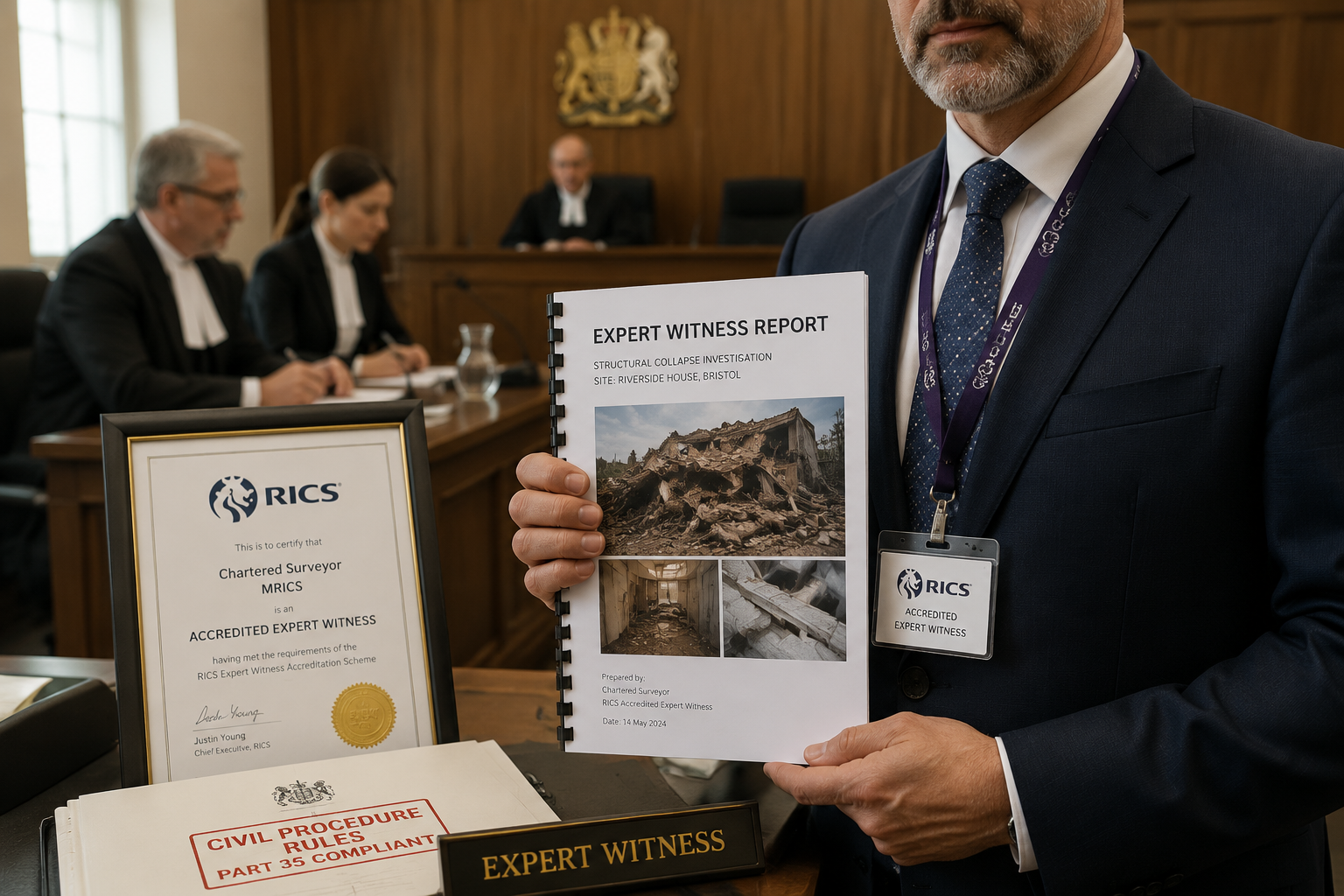
Even experienced surveyors make avoidable errors when transitioning into the expert witness role. The most common failures in structural collapse claims under Awaab's Law 2026 include:
| Common Pitfall | Consequence | Prevention |
|---|---|---|
| Photographs without scale references | Evidence challenged or excluded | Always use scale rules; record metadata |
| Opinions beyond area of expertise | Cross-examination attack; credibility loss | Co-instruct specialists; limit scope |
| Failure to disclose contrary evidence | Breach of duty of candor; professional sanction | List all documents reviewed, including adverse ones |
| Contingent fee arrangements | Report excluded; disciplinary action | Confirm fixed-fee basis in writing before starting |
| Inadequate crack classification | HHSRS score disputed | Use BRE Digest 251; photograph and measure all cracks |
| Missing declaration of independence | Report non-compliant with CPR Part 35 | Use a standard template declaration on every report |
Surveyors operating in areas with high concentrations of older rental stock — including those providing condition surveys in London — should build these checks into a pre-report compliance checklist.
Conclusion
The intersection of Awaab's Law 2026 and RICS evidence protocols has created a demanding but clearly defined framework for expert witnesses in structural collapse claims. The key to compliance is methodical preparation: following the four-stage survey model, structuring reports to meet every CPR Part 35 requirement, applying current photography and 3D modeling standards, and maintaining absolute independence throughout the process.
Actionable next steps for surveyors preparing to take on expert witness work in 2026:
- Enroll in the RICS Expert Witness Certificate if not already completed — this is the single most effective step toward compliance and credibility. [8]
- Apply for RICS Expert Witness Accreditation to signal professional standing to instructing solicitors. [7]
- Develop a standard report template that includes all mandatory CPR Part 35 components, with a pre-populated declaration of independence.
- Invest in photogrammetry and thermal imaging capability or establish relationships with specialist subcontractors who can provide these services.
- Review every letter of instruction against your competence — decline or co-instruct where the hazard category falls outside your direct expertise.
- Attend the RICS housing disrepair webinar on July 8, 2026 to stay current with evolving evidence standards.
- Conduct a conflicts check before every instruction and document the outcome in writing.
The courts are applying greater scrutiny to expert evidence in housing disrepair cases than ever before. Surveyors who invest in preparation, training, and rigorous report structuring will not only serve their clients well — they will protect their own professional standing in an increasingly demanding regulatory environment.
References
[1] Expert Witness Roles In Structural Collapse Disputes Under Awaabs Law 2026 Evidence Standards For Party Wall Awards – https://wimbledonsurveyors.com/expert-witness-roles-in-structural-collapse-disputes-under-awaabs-law-2026-evidence-standards-for-party-wall-awards/?utm_source=openai
[2] Viewcompounddoc – https://consultations.rics.org/surveyorsasexpertwitness/viewCompoundDoc?docid=16248980&partid=16250356&pfv=y&utm_source=openai
[3] Expert Witness Challenges In Awaabs Law 2026 Hazard Extensions Evidence Standards For Excess Cold Falls And Fire Risks – https://wimbledonsurveyors.com/expert-witness-challenges-in-awaabs-law-2026-hazard-extensions-evidence-standards-for-excess-cold-falls-and-fire-risks/?utm_source=openai
[4] Role Responsibilities Expert Witnesses Built Environment – https://www.rics.org/news-insights/role-responsibilities-expert-witnesses-built-environment?utm_source=openai
[5] Expert Witness Duties Responsibilities – https://ww3.rics.org/uk/en/journals/built-environment-journal/expert-witness-duties-responsibilities.html?utm_source=openai
[6] Building Survey Protocols For Structural Collapse Risks Awaabs Law 2026 Extensions And High Risk Property Assessments – https://nottinghillsurveyors.com/blog/building-survey-protocols-for-structural-collapse-risks-awaabs-law-2026-extensions-and-high-risk-property-assessments?utm_source=openai
[7] Expert Witness Accreditation Service – https://www.rics.org/dispute-resolution-service/panel-of-experts/expert-witness-accreditation-service?utm_source=openai
[8] Expert Witness Training Courses – https://www.rics.org/dispute-resolution-service/training-qualification-accreditations/expert-witness-training-courses?utm_source=openai
[9] Expert Witness Roles In Awaabs Law 2026 Disputes Testifying On Expanded Hazards In Private Rental Properties – https://kingstonsurveyors.com/expert-witness-roles-in-awaabs-law-2026-disputes-testifying-on-expanded-hazards-in-private-rental-properties/?utm_source=openai
[10] Expert Witness Challenges In Awaabs Law 2026 Disputes Testifying On Expanded Hazards In Rental Valuations – https://manchestersurveyors.com/expert-witness-challenges-in-awaabs-law-2026-disputes-testifying-on-expanded-hazards-in-rental-valuations/?utm_source=openai