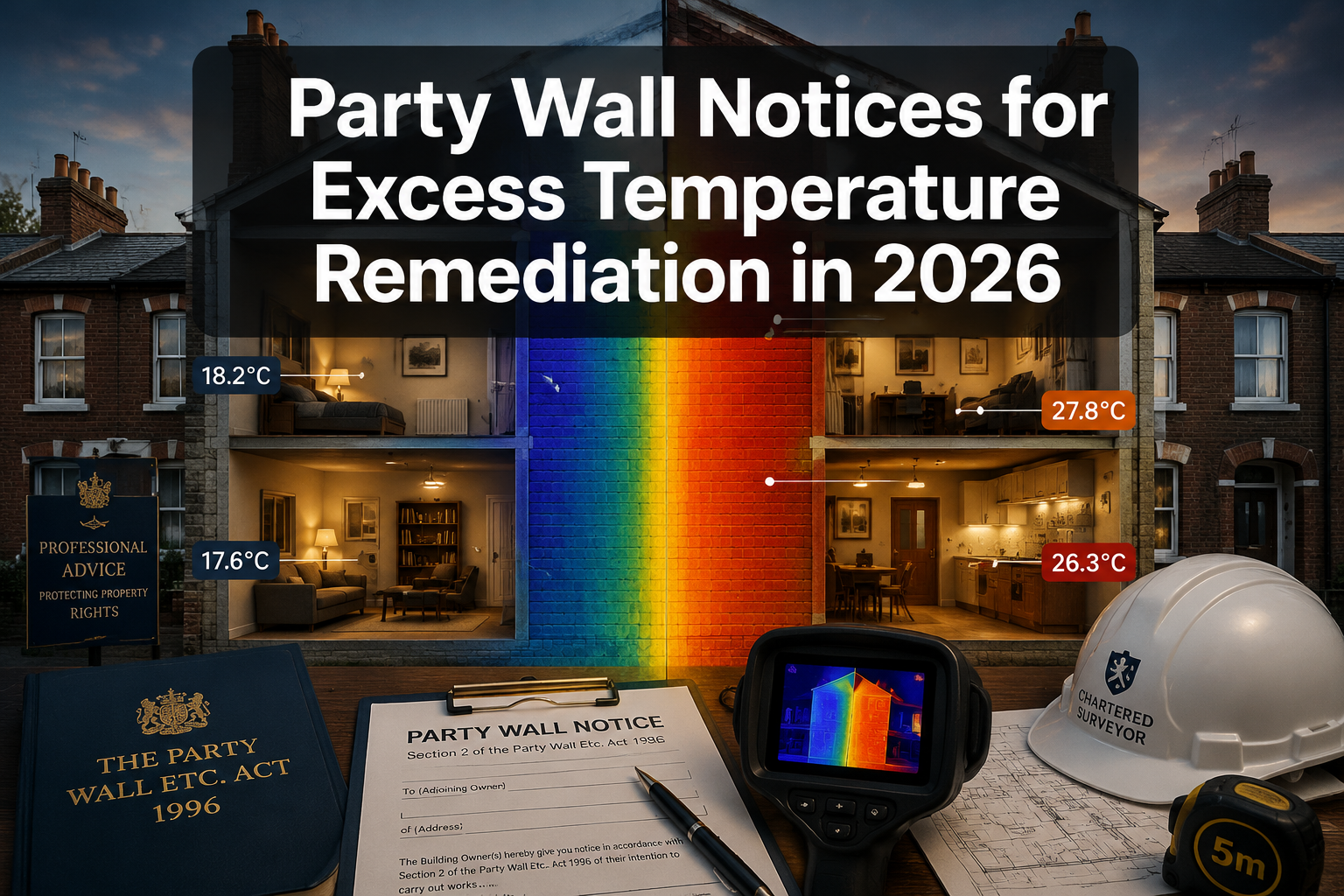
Excess heat and cold in rental homes now carry legal deadlines — and when the fix involves a shared wall, a second regulatory framework immediately comes into play. From May 2026, Awaab's Law applies to private landlords across England, mandating prompt action on housing hazards including excess temperature. When that remediation requires insulation retrofits, ventilation upgrades, or structural interventions near a shared boundary, the Party Wall etc. Act 1996 is triggered simultaneously. Understanding how Party Wall Notices for Excess Temperature Remediation in 2026: Awaab's Law Compliance Near Shared Boundaries work together is no longer optional — it is a legal necessity for landlords, building owners, and their surveyors.

Key Takeaways
- Awaab's Law now covers excess heat and cold in private rented homes, with Phase 2 expanding hazard categories from October 2026.
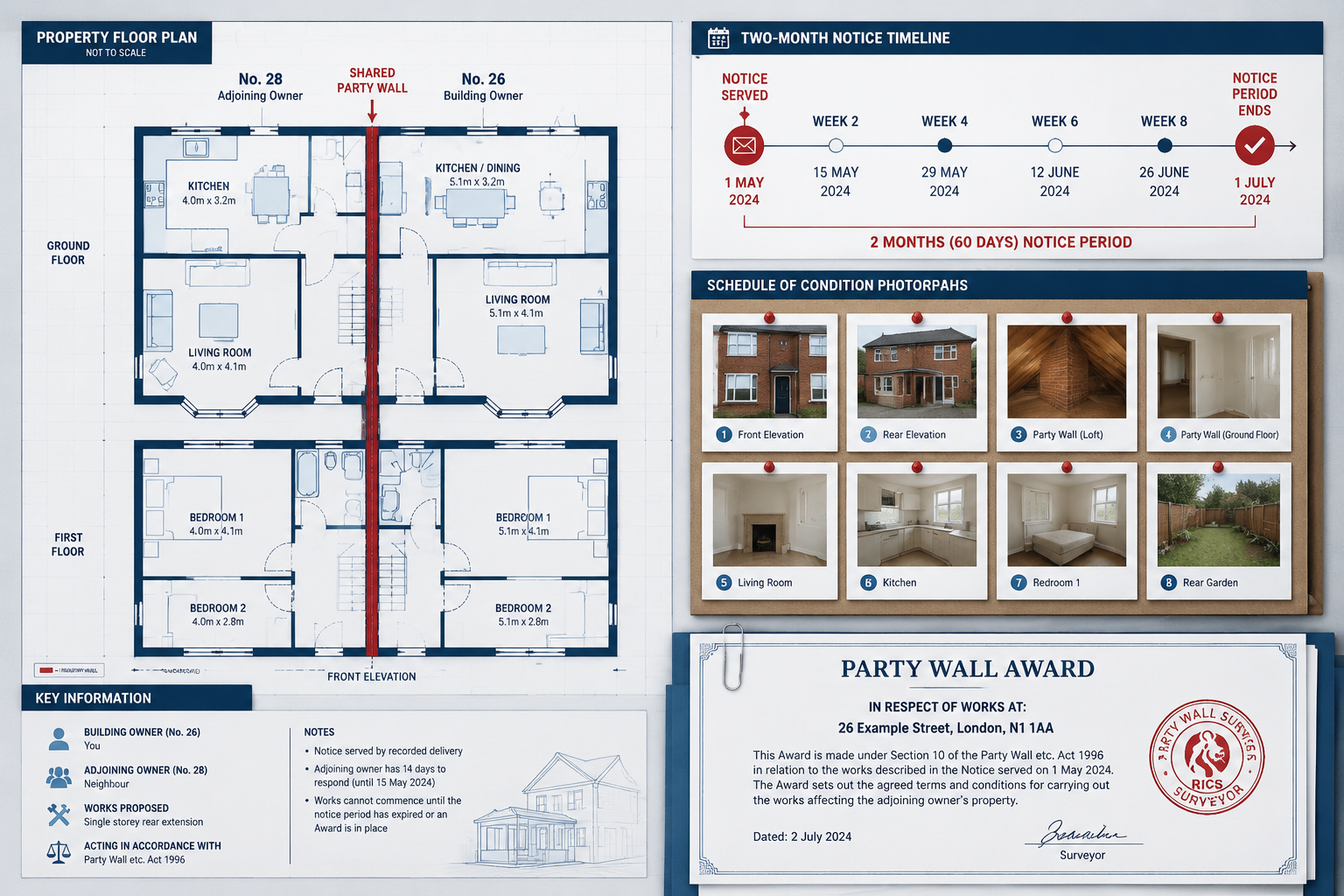
- Any remediation work affecting a party wall requires a valid Party Structure Notice served at least two months before works begin.
- Schedules of condition must be completed before works start to protect both parties from future liability.
- Damp, ventilation, and thermal provisions should be explicitly written into party wall awards to prevent disputes under both regulatory frameworks.
- Local authorities have enhanced enforcement powers under Awaab's Law, making timely, compliant action essential.
What Awaab's Law Now Requires in 2026
Awaab's Law originated from the tragic death of two-year-old Awaab Ishak, who died in 2020 as a direct result of prolonged exposure to mould in a social housing property. The legislation that followed initially applied to social landlords. However, as of May 2026, private landlords in England are now bound by the same obligations, making the regulatory landscape significantly broader. [1]
The Two-Phase Rollout
The expansion follows a structured two-phase approach:
| Phase | Effective Date | Hazards Covered |
|---|---|---|
| Phase 1 | May 2026 | Damp and mould |
| Phase 2 | October 2026 | Excess cold, excess heat, fire risks, and additional HHSRS hazards |
Phase 2 is particularly significant for temperature remediation. From October 2026, landlords face mandatory investigation timelines and remediation deadlines for properties where excess heat or cold constitutes a Category 1 hazard under the Housing Health and Safety Rating System (HHSRS). [1]
Remediation Timelines Under Awaab's Law
The law imposes strict deadlines that leave little room for procedural delays:
- Emergency hazards: Remediation must begin within 24 hours of identification.
- Urgent hazards: Works must commence within 7 days.
- Non-urgent hazards: Investigation must be completed within 14 days, with a written remediation plan issued promptly thereafter.
These timelines create an immediate tension with the Party Wall etc. Act 1996, which requires a minimum two-month notice period before most structural works can begin. Navigating this tension is the central challenge for landlords whose properties share boundaries with neighbouring owners.
When Temperature Remediation Triggers Party Wall Obligations
Not every insulation upgrade or ventilation fix will touch a party wall. However, a significant proportion of excess temperature remediation in terraced and semi-detached housing — which makes up the majority of the private rented sector in cities like London — will involve shared structures. [1]
Works That Commonly Trigger the Party Wall Act
The following remediation activities are likely to engage the Party Wall etc. Act 1996:
- External wall insulation (EWI) applied to or near a party wall line
- Internal wall insulation (IWI) installed on the party wall face
- Roof insulation where the party wall extends into the roof void
- Ventilation duct installation passing through or adjacent to a party wall
- Mechanical heat recovery ventilation (MHRV) systems requiring structural penetrations
- Cavity wall insulation in walls shared with or abutting a neighbouring property
Under the Party Wall Act 1996, a landlord proposing any of these works must serve the correct notice on the adjoining owner before proceeding. Failure to do so does not make the works illegal after the fact, but it does expose the building owner to injunctions, mandatory removal of works, and significant legal costs.
Understanding the Correct Notice Type
There are three types of notice under the Act, and selecting the right one matters:
- Party Structure Notice — for works directly to the party wall itself (cutting in, raising, thickening, or inserting insulation into the shared structure). Must be served at least two months before works begin.
- Line of Junction Notice — for building a new wall at or astride the boundary. Required at least one month before works begin.
- Three-Metre or Six-Metre Notice — for excavations near a neighbouring building's foundations. Required at least one month before works begin.
For most excess temperature remediation scenarios, the Party Structure Notice will be the relevant instrument. The notice must clearly describe the proposed work, the intended start date, and the name and address of the building owner. [2]
For a detailed breakdown of what to do once a notice has been received, the guide on what to do when you receive a party wall notice provides practical step-by-step guidance.
The Two-Month Notice Problem: Resolving the Timeline Conflict
The most pressing practical difficulty in Party Wall Notices for Excess Temperature Remediation in 2026: Awaab's Law Compliance Near Shared Boundaries is the clash between Awaab's Law's tight remediation deadlines and the Party Wall Act's mandatory two-month notice period.
"Proactive drafting of party wall notices and agreements is the single most effective tool for landlords facing overlapping compliance deadlines under Awaab's Law and the Party Wall Act." [1]
Proactive Identification as the Solution
The only reliable way to resolve this tension is to identify potential temperature hazards before they become formal complaints or enforcement notices. Landlords and their surveyors should:
- Conduct annual thermal assessments of properties sharing boundaries, particularly those built before 1980 with limited insulation.
- Identify party wall implications early during any planned remediation scoping exercise.
- Serve Party Structure Notices immediately upon identifying a likely need for works, even before a formal HHSRS assessment has concluded.
- Engage the adjoining owner proactively to agree on works without the need for a formal dispute process, which adds further delay.
Where a landlord can demonstrate that they served notice promptly upon identifying the hazard, enforcement authorities are likely to view the two-month notice period as a reasonable procedural requirement rather than evidence of non-compliance. Documentation of every step is critical. [3]
Agreed Surveyor vs. Two Surveyors
When an adjoining owner dissents from a party wall notice, both parties must appoint surveyors. They can agree on a single Agreed Surveyor, or each appoint their own, with a Third Surveyor nominated in case of disagreement. For temperature remediation works that need to proceed quickly, an Agreed Surveyor arrangement is generally faster and more cost-effective. Understanding the cost of a party wall surveyor is an important early step in budgeting for compliance.
Schedules of Condition: The Essential Pre-Works Document
Before any party wall works begin, a Schedule of Condition must be prepared. This is a detailed photographic and written record of the adjoining owner's property — particularly the party wall and any rooms adjacent to it — documenting its state before remediation works commence. [1]
Why Schedules of Condition Matter More Under Awaab's Law
In the context of excess temperature remediation, schedules of condition serve a dual purpose:
- They protect the building owner from claims that remediation works caused new damage to the neighbouring property.
- They establish a baseline against which post-works conditions can be assessed, which is directly relevant to Awaab's Law compliance monitoring.
A thorough schedule should include:
- Photographic evidence of all wall surfaces, ceilings, and floors adjacent to the party wall
- Moisture readings taken at regular intervals across the shared structure
- Thermal imaging data where available, documenting existing heat loss patterns
- Notes on any pre-existing cracks, damp patches, or ventilation deficiencies
For properties where diagnosis of damp and timber issues is already a concern, the schedule provides an invaluable record that separates pre-existing conditions from any caused by remediation works.
Drafting the Party Wall Award: Including Thermal and Ventilation Provisions
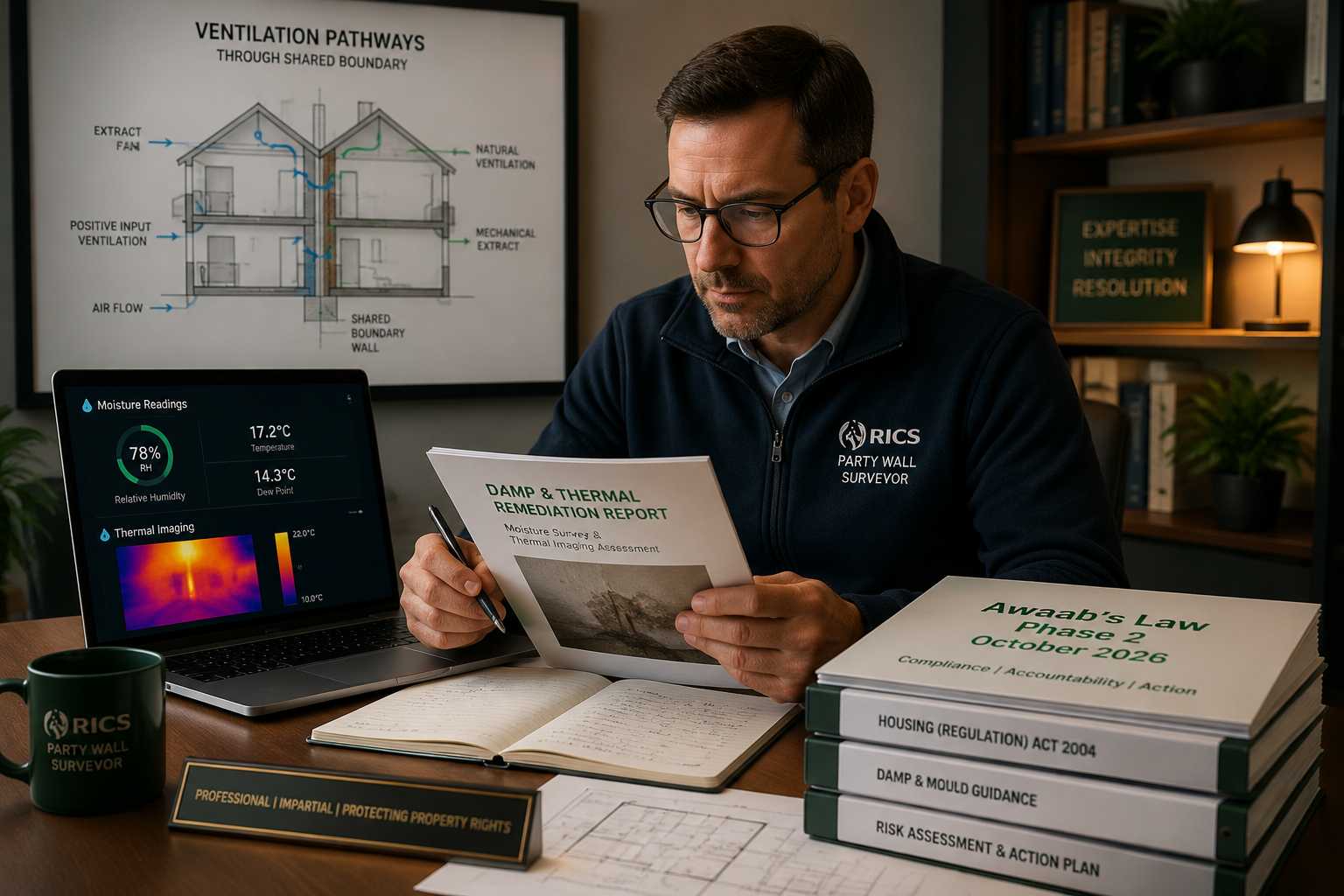
A party wall award is the formal document that governs how works are carried out. In the context of Awaab's Law compliance, surveyors are strongly advised to go beyond standard boilerplate and include specific provisions addressing temperature and ventilation. [1]
What to Include in an Award for Temperature Remediation
Thermal performance clauses should specify:
- The insulation materials to be used and their minimum U-values
- How thermal bridging at the party wall junction will be managed
- Requirements for post-installation thermal imaging to verify performance
Ventilation provisions should address:
- How existing ventilation pathways through or adjacent to the party wall will be maintained or replaced
- Requirements for trickle ventilators or mechanical ventilation where airtightness is increased
- Obligations to monitor humidity levels in the adjoining property for a defined period post-works
Moisture management clauses should cover:
- Vapour control layer installation and detailing at party wall junctions
- Obligations to address any moisture ingress identified during works
- Timescales for remediation if post-works monitoring reveals elevated moisture levels
Including these provisions is not merely best practice — it is a form of risk management. Failure to address moisture pathways and ventilation in a party wall award can create overlapping liabilities under both the Party Wall Act and Awaab's Law. [1]
For guidance on how the Party Wall Act applies more broadly, the comprehensive overview of how the Party Wall Act 1996 applies to you is a valuable starting point.
Enforcement, Liability, and the Role of Local Authorities
Under the extended provisions of Awaab's Law, local authorities in England now hold significantly enhanced enforcement powers. Environmental Health Officers can issue improvement notices, hazard awareness notices, and in serious cases, emergency remediation orders. [3]
What Non-Compliance Looks Like in Practice
A landlord who fails to remediate excess heat or cold within the statutory timelines faces:
- Improvement notices requiring works within a specified period
- Civil penalties of up to £30,000 for the most serious breaches
- Rent repayment orders allowing tenants to reclaim up to 12 months' rent
- Prohibition orders preventing the property from being let until hazards are resolved
Where those remediation works also involved a party wall and the landlord failed to serve the correct notice, a second layer of liability arises. The adjoining owner can apply to the courts for an injunction, and in some cases, for the removal of works already completed. The financial implications of dual non-compliance are therefore substantial.
The Surveyor's Central Role
Qualified surveyors — particularly those with experience in both building pathology and party wall procedure — are the most effective resource for landlords navigating this regulatory overlap. An expert party wall surveyor in London will be able to:
- Identify which works require formal notice
- Draft notices and awards that address both the Party Wall Act and Awaab's Law requirements
- Conduct pre-award condition surveys that stand up to scrutiny
- Advise on the fastest compliant route to remediation
The responsibilities of a party wall surveyor extend well beyond paperwork — in the context of Awaab's Law compliance, they include active risk assessment and proactive dispute prevention.
Practical Compliance Checklist for Landlords in 2026
The following checklist summarises the key steps for landlords facing excess temperature remediation near shared boundaries:
Before Works Begin
- Identify whether proposed works affect a party wall, boundary, or adjacent structure
- Determine the correct notice type (Party Structure Notice for most temperature remediation works)
- Serve notice on all adjoining owners at least two months before the intended start date
- Appoint a surveyor if the adjoining owner dissents or fails to respond within 14 days
- Commission a Schedule of Condition covering all areas adjacent to the party wall
During Award Drafting
- Include specific thermal performance requirements in the award
- Address ventilation continuity and moisture management explicitly
- Set post-works monitoring obligations and timescales
- Agree on a method for resolving any disputes arising from post-works conditions
After Works Are Completed
- Conduct post-works thermal imaging and moisture assessment
- Provide the adjoining owner with a copy of all post-works reports
- Retain all documentation for a minimum of six years
- Notify the local authority Environmental Health team if required under Awaab's Law
Conclusion
Party Wall Notices for Excess Temperature Remediation in 2026: Awaab's Law Compliance Near Shared Boundaries represents one of the most complex regulatory intersections in the current private rented sector landscape. The combination of Awaab's Law's urgent remediation timelines and the Party Wall Act's mandatory notice periods demands a proactive, well-documented approach from the outset.
The landlords and building owners who will navigate this successfully are those who act before hazards become enforcement matters — commissioning thermal assessments, serving party wall notices early, and working with qualified surveyors to draft awards that address both regulatory frameworks comprehensively.
Actionable next steps:
- Audit all rental properties sharing boundaries for potential excess temperature hazards before October 2026's Phase 2 expansion.
- Engage a qualified party wall surveyor to assess whether planned remediation works trigger notice obligations under the Party Wall Act.
- Serve Party Structure Notices as early as possible to build in the two-month statutory period before works must begin.
- Ensure all party wall awards include explicit thermal, ventilation, and moisture management clauses.
- Document every step of the process — from hazard identification through to post-works verification — to demonstrate compliance to local authority enforcement officers.
The regulatory landscape in 2026 is demanding, but it is navigable with the right professional support and a clear understanding of how these two frameworks interact.
References
[1] Party Wall Awards Under Awaabs Law Extensions 2026 Checklists For Damp And Ventilation Disputes – https://wimbledonsurveyors.com/party-wall-awards-under-awaabs-law-extensions-2026-checklists-for-damp-and-ventilation-disputes/?utm_source=openai
[2] Party Wall Notice – https://ourpartywall.co.uk/guides/party-wall-notice?utm_source=openai
[3] Party Wall Agreements For Electrical Hazard Remediation In Shared Prs Walls Awaabs Law 2026 Compliance Essentials – https://wimbledonsurveyors.com/party-wall-agreements-for-electrical-hazard-remediation-in-shared-prs-walls-awaabs-law-2026-compliance-essentials/?utm_source=openai