Fewer than one in three UK homebuyers commission an independent building survey before exchanging contracts — yet structural defects discovered after completion cost the average buyer thousands of pounds in unplanned repairs. That statistic sits at the heart of a sweeping wave of homebuying reform that is reshaping property transactions in 2026. As governments on both sides of the Atlantic move toward mandatory upfront condition disclosures, building surveyors are racing to develop robust building survey checklists for homebuying reform preparations: adapting to upfront condition assessments in 2026 has become one of the profession's most urgent practical challenges.
This article explains what the reforms require, how a well-structured survey checklist should be built, and what buyers, sellers, and surveyors need to do right now.
Key Takeaways
- Legislative reforms in 2026 are pushing toward mandatory upfront property condition assessments before a home is listed for sale.
- Building surveyors must expand and standardise their checklists to handle higher inspection volumes and new procedural requirements.
- A thorough checklist covers structure, fabric, services, damp, drainage, and legal compliance — not just visible defects.
- Buyers who understand what an upfront survey must cover are better placed to negotiate, budget, and avoid post-completion surprises.
- Choosing the correct survey level — and a qualified RICS surveyor — remains the single most important decision in the process.
The Reform Landscape Driving Demand for Upfront Surveys
The pressure for upfront condition transparency has been building for years, but 2026 has brought it to a head. In the United States, the Housing for the 21st Century Act — passed by the House of Representatives in February 2026 — includes provisions to streamline federal reviews and modernise housing transaction processes, with greater emphasis on pre-listing disclosure [5]. The Rural Housing Service Reform Act, passed as part of the same landmark package, targets accountability gaps that have long delayed rural buyers from accessing reliable property information [6].
Meanwhile, a Congressional hearing titled "Housing Affordability: Saving the American Dream," convened on 15 January 2026, placed property condition transparency squarely in the debate about what makes homeownership genuinely accessible rather than merely nominally available [7].
In the mortgage space, the Federal Housing Administration, Fannie Mae, and Freddie Mac announced on 22 April 2026 the adoption of VantageScore 4.0 and FICO 10T credit scoring models, designed to expand access to homeownership and sharpen the accuracy of risk assessments [1]. Separately, effective 1 January 2026, the threshold for higher-priced mortgage loans exempt from special appraisal requirements rose from $33,500 to $34,200, reflecting a 2.1% increase in the Consumer Price Index for Urban Wage Earners and Clerical Workers [3]. These mortgage-level changes signal a broader regulatory direction: greater scrutiny of property condition at the point of transaction.
HUD also announced updated loan limits for 2026 covering Single Family Title II forward and Home Equity Conversion Mortgage programmes, reflecting continued home price appreciation [2]. Higher loan values make pre-purchase condition certainty even more critical — a buyer taking on a larger mortgage cannot afford to discover a failing roof or compromised foundations after completion.
What this means for the UK market: While the legislative specifics differ, the direction of travel is identical. UK reform proposals centred on upfront property information — including condition assessments — are gaining traction, and surveyors must be ready for the procedural and volume demands that mandatory upfront surveys will create.
"The shift toward upfront condition disclosure is not a bureaucratic inconvenience — it is the single most effective way to reduce transaction fall-through rates and give buyers genuine informed consent."
What a Reform-Ready Building Survey Checklist Must Cover
Building survey checklists for homebuying reform preparations: adapting to upfront condition assessments in 2026 requires surveyors to move beyond a reactive, buyer-commissioned model toward a standardised, pre-listing framework. The checklist must be comprehensive enough to satisfy regulatory scrutiny, yet structured enough to be completed consistently across high inspection volumes.
Understanding which home survey is right for you is the starting point. A Level 2 Homebuyer Report suits most standard properties in reasonable condition; a Level 3 Building Survey is essential for older, larger, or significantly altered properties. The checklist structure differs accordingly, but both must address the following core categories.
Structural Integrity
- Foundations: Evidence of subsidence, heave, or differential settlement; crack patterns in walls (width, direction, taper)
- Roof structure: Condition of rafters, purlins, ridge board, and any signs of spread or deflection
- Floors: Bounce or deflection in timber floors; cracking or heave in solid floors
- Walls: Plumb and alignment of external and internal load-bearing walls; lintel condition above openings
- Chimney stacks: Pointing, flashing, pot condition, and structural stability
Building Fabric and Envelope
- Roof covering: Tile or slate condition, missing or slipped units, felt and batten condition
- Gutters and rainwater goods: Blockages, leaks, and fixings
- External walls: Pointing, render, cladding, and any evidence of penetrating damp
- Windows and doors: Frame condition, glazing integrity, draught sealing, and security hardware
- External joinery: Fascias, soffits, bargeboards — rot, paint failure, and fixing condition
Services and Installations
- Electrical installation: Age of consumer unit, evidence of rewiring, visible wiring condition — note that a full Electrical Installation Condition Report (EICR) is a separate specialist instruction
- Heating system: Boiler age and service history, radiator condition, visible pipework
- Plumbing: Stop valve location and operation, visible pipework condition, water pressure
- Drainage: Inspection chamber condition, signs of blocked or collapsed drains — a CCTV drain survey is recommended as a separate instruction for older properties
Damp and Timber
Damp is one of the most frequently misdiagnosed defects in UK property surveys. A reform-ready checklist must distinguish between rising damp, penetrating damp, and condensation — each with different remediation costs and urgency. For detailed cost benchmarks, the damp survey cost guide provides a useful reference. Timber assessment should include checks for woodworm, wet rot, and dry rot, particularly in roof voids and sub-floor spaces.
Legal and Compliance Items
- Planning and building regulations: Evidence of consented works; any apparent unauthorised extensions or conversions
- Party wall matters: Signs of shared wall issues or past disputes — the Party Wall Act 1996 guide explains the legal framework surveyors must reference
- Energy performance: EPC rating and any recommendations that affect insurability or mortgage eligibility
- Asbestos: Properties built before 2000 require a note on the likelihood of asbestos-containing materials
Adapting Checklist Workflows for High-Volume Upfront Assessments
If upfront surveys become mandatory, the profession faces a volume challenge it has not previously encountered at scale. A property listed for sale would require a condition assessment before marketing begins — rather than after an offer is accepted. This compresses timelines and demands that surveyors operate with greater efficiency without sacrificing accuracy.
For a deeper comparison of survey types and their appropriate use cases, the Level 2 vs Level 3 survey guide is essential reading for both surveyors and buyers navigating the new landscape.
Standardising the Checklist Format
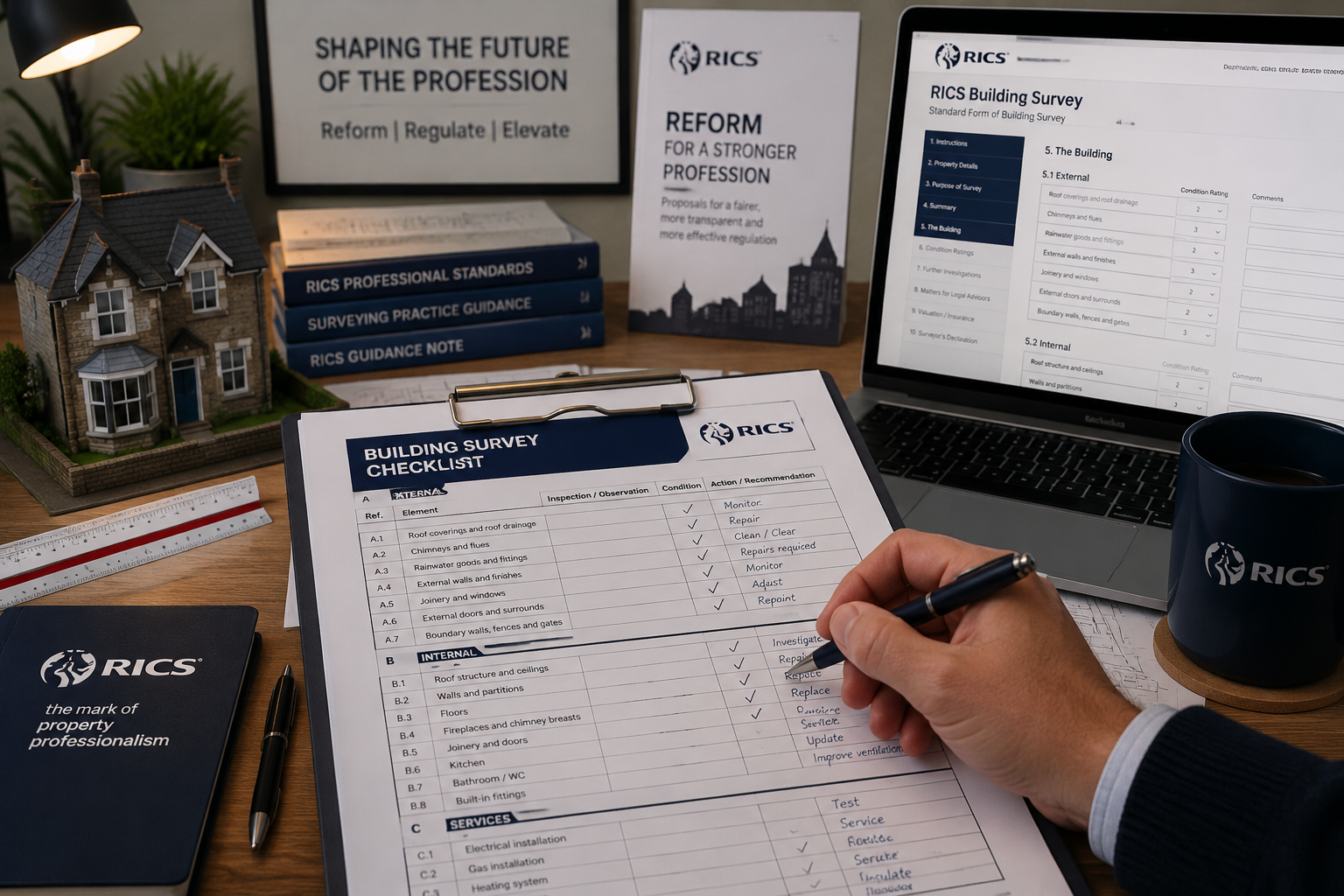
Reform-ready checklists should use a consistent condition rating system — ideally aligned with the RICS three-condition rating scale (Condition Rating 1, 2, and 3) already embedded in Level 2 and Level 3 survey formats. Standardisation enables:
| Benefit | Practical Impact |
|---|---|
| Faster report production | Surveyors spend less time on formatting, more on inspection |
| Easier buyer comparison | Buyers can compare condition ratings across multiple properties |
| Regulatory compliance | Reports meet any mandated disclosure format from day one |
| Reduced dispute risk | Consistent language reduces ambiguity in defect descriptions |
Digital Checklist Tools
Paper-based checklists are no longer adequate for high-volume upfront assessment programmes. Surveyors should adopt mobile inspection platforms that allow:
- Real-time photo annotation linked to checklist items
- Automatic condition rating prompts based on element type
- Cloud-based report generation with version control
- Integration with Land Registry and EPC data for pre-inspection research
Triage and Prioritisation
Not every defect carries equal weight. A reform-ready checklist must include a clear triage protocol that separates:
- Urgent safety issues (Category 1 hazards under the Housing Health and Safety Rating System)
- Significant defects requiring specialist investigation before exchange
- Maintenance items that are the buyer's ongoing responsibility
- Cosmetic issues with no structural or legal consequence
This triage approach mirrors best practice already embedded in RICS Homebuyer Survey methodology and should be extended to any new upfront assessment format.
How Buyers Should Use Upfront Survey Checklists
Understanding what an upfront survey checklist covers transforms a buyer from a passive recipient of information into an active participant in the transaction. Once an offer has been accepted, the survey report becomes a negotiation tool, a budgeting document, and a legal protection — all at once. The guide on what to do when your property offer has been accepted walks through this process in detail.
Key actions for buyers reviewing an upfront survey report:
- Read the condition ratings first. Any Condition Rating 3 item requires immediate specialist investigation — do not proceed to exchange without a specialist report and cost estimate.
- Cross-reference with the EPC. Poor energy performance ratings combined with fabric defects (e.g., failed cavity wall insulation, single glazing) indicate significant upgrade costs.
- Request the surveyor's notes. The formal report is a summary; the surveyor's inspection notes often contain additional context that informs negotiation.
- Commission specialist reports where flagged. A building survey checklist identifies the need for further investigation — it does not replace a structural engineer's report, a CCTV drain survey, or an EICR.
- Use the report to renegotiate price. Significant defects identified upfront give buyers legitimate grounds to renegotiate before exchange, not after.
There are also persistent misconceptions about what surveys do and do not cover. The common myths about property surveys resource addresses these directly and is worth reviewing before commissioning any assessment.

Building Survey Checklists for Homebuying Reform Preparations: Regional Considerations
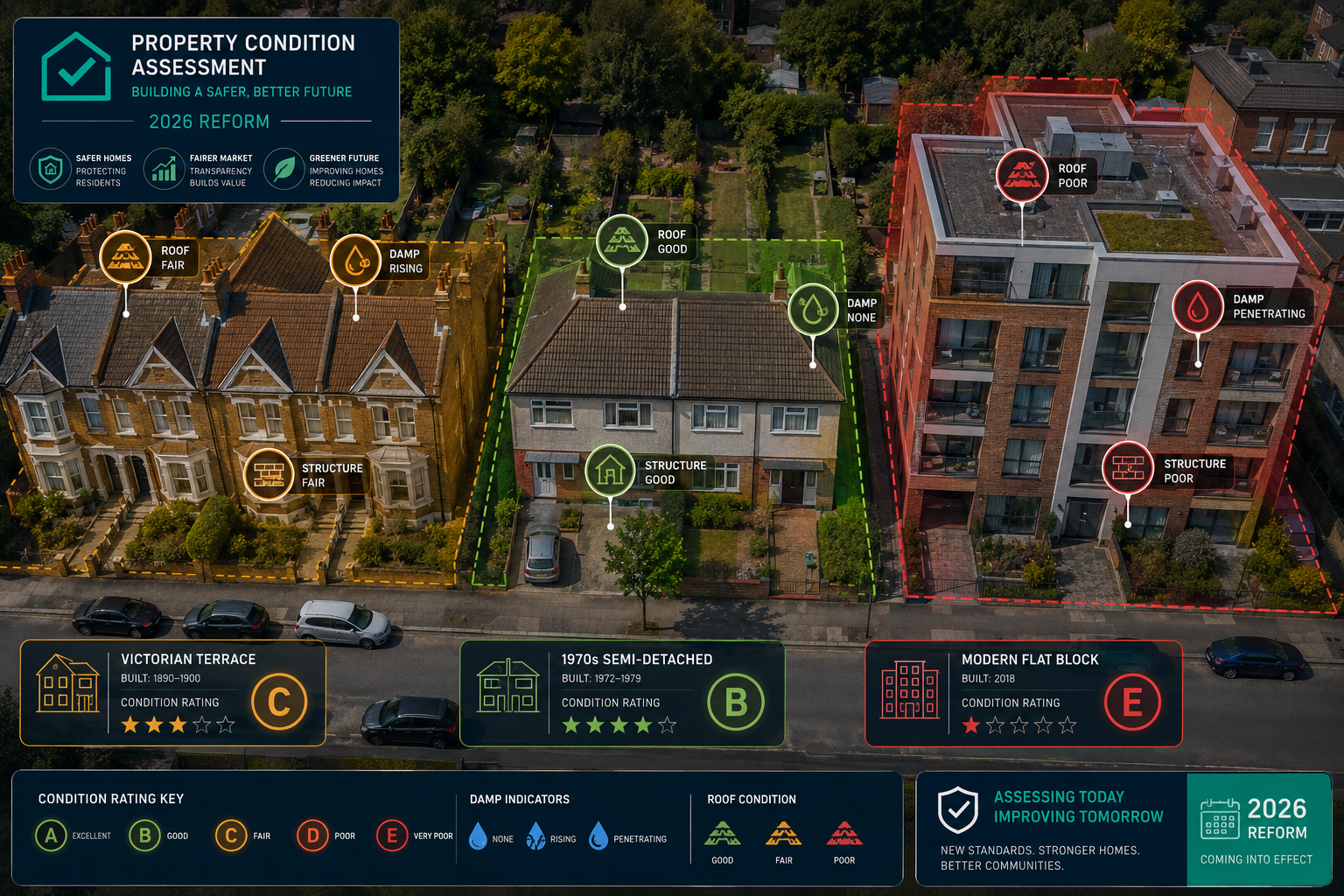
Property condition varies significantly by region, age of housing stock, and construction type. A checklist designed for a Victorian terrace in South London will have different emphasis areas than one designed for a 1970s semi-detached in the East Midlands. Reform-ready surveyors must build regional knowledge into their checklist frameworks.
In London, for example, properties in areas such as Barnet, Bromley, and Wandsworth present a mix of Victorian, Edwardian, and post-war housing, each with characteristic defect profiles:
- Victorian and Edwardian stock: Solid wall construction (no cavity), original timber floors, slate roofs, lead pipework, and lime mortar pointing — all requiring specialist knowledge to assess accurately
- 1930s to 1960s stock: Early cavity wall construction (often unfilled), asbestos-containing materials in artex, floor tiles, and roof panels, and original single-glazed steel-framed windows
- Post-1980s stock: Cavity wall insulation that may have failed or been incorrectly installed, UPVC windows approaching end of life, and flat roof extensions requiring careful condition assessment
A stock condition survey approach — used extensively in the social housing sector — offers a useful model for upfront assessment programmes. The stock condition survey methodology provides a systematic element-by-element framework that translates well into the reform context.
Institutional Investor Activity and Market Distortion
One dimension of the 2026 reform debate that directly affects survey demand is the growing scrutiny of institutional investors in the residential market. A White House report published in April 2026 found that every 1% of housing stock purchased by institutional investors causes house prices to rise by 1.7%, with some markets such as Atlanta experiencing a total price impact of approximately 6% [9]. Legislative proposals introduced in February 2026 include bills to eliminate tax advantages for large real estate investors and, in some proposals, to ban institutional firms from purchasing single-family properties altogether [8].
If these measures succeed in redirecting supply toward individual buyers, transaction volumes will increase — and with them, demand for upfront condition assessments. Surveyors who have already built scalable, reform-ready checklist systems will be best positioned to meet that demand.
Conclusion
The convergence of legislative reform, mortgage market modernisation, and growing buyer demand for transparency has made building survey checklists for homebuying reform preparations: adapting to upfront condition assessments in 2026 a professional priority that can no longer be deferred. The direction of policy — from the Housing for the 21st Century Act in the US to upfront information proposals in the UK — is unambiguous: property condition must be disclosed earlier, more consistently, and in a format that buyers can actually use.
Actionable next steps for surveyors:
- Audit existing checklist templates against the RICS condition rating framework and identify gaps
- Invest in mobile inspection technology that supports high-volume, standardised reporting
- Develop regional checklist variants that reflect local housing stock characteristics
- Build referral networks with structural engineers, damp specialists, and drainage contractors to support the specialist investigation phase
Actionable next steps for buyers:
- Do not rely solely on a mortgage valuation — commission an independent Level 2 or Level 3 survey
- Read the condition ratings in any upfront survey report before making or confirming an offer
- Budget for specialist follow-up investigations on any Condition Rating 3 items
- Choose a RICS-qualified surveyor with demonstrable local knowledge of the property type
The reforms coming into force in 2026 represent an opportunity, not a burden. Buyers gain genuine informed consent. Sellers gain faster, more certain transactions. Surveyors gain a central, mandated role in the homebuying process. The checklist is the foundation on which all of that rests.
References
[1] Homebuying Advances Into New Era Of Credit Score Competition – https://www.fhfa.gov/news/news-release/homebuying-advances-into-new-era-of-credit-score-competition?utm_source=openai
[2] Hud No 25 145 – https://www.hud.gov/news/hud-no-25-145?utm_source=openai
[3] Agencies Announce Dollar Thresholds For Smaller Loan Exemption From Appraisal Requirements For Higher Priced Mortgage Loans 2025 – https://www.consumerfinance.gov/about-us/newsroom/agencies-announce-dollar-thresholds-for-smaller-loan-exemption-from-appraisal-requirements-for-higher-priced-mortgage-loans-2025/?utm_source=openai
[4] Governor Healey Announces 25000 In Interest Free Downpayment Assistance Now Available For More First Time Homebuyers – https://www.mass.gov/news/governor-healey-announces-25000-in-interest-free-downpayment-assistance-now-available-for-more-first-time-homebuyers?utm_source=openai
[5] Fitzpatrick Helps Advance Major Bipartisan Victory To Expand Housing Supply And Lower Costs For Pa 1 Families – https://fitzpatrick.house.gov/2026/2/fitzpatrick-helps-advance-major-bipartisan-victory-to-expand-housing-supply-and-lower-costs-for-pa-1-families?utm_source=openai
[6] Nunn Rural Housing Reform Bill Passes House As Part Of Landmark Housing Package – https://nunn.house.gov/2026/02/10/nunn-rural-housing-reform-bill-passes-house-as-part-of-landmark-housing-package/?utm_source=openai
[7] Burlison Announces Hearing On Making Housing More Affordable – https://oversight.house.gov/release/burlison-announces-hearing-on-making-housing-more-affordable/?utm_source=openai
[8] Housing Affordability Institutional Home Buying Ban Bills – https://www.cbsnews.com/news/housing-affordability-institutional-home-buying-ban-bills/?utm_source=openai
[9] Erp 2026 6. Protecting And Rebuilding The American Dream Of Homeownership – https://www.whitehouse.gov/wp-content/uploads/2026/04/ERP-2026-6.-Protecting-and-Rebuilding-the-American-Dream-of-Homeownership.pdf?utm_source=openai