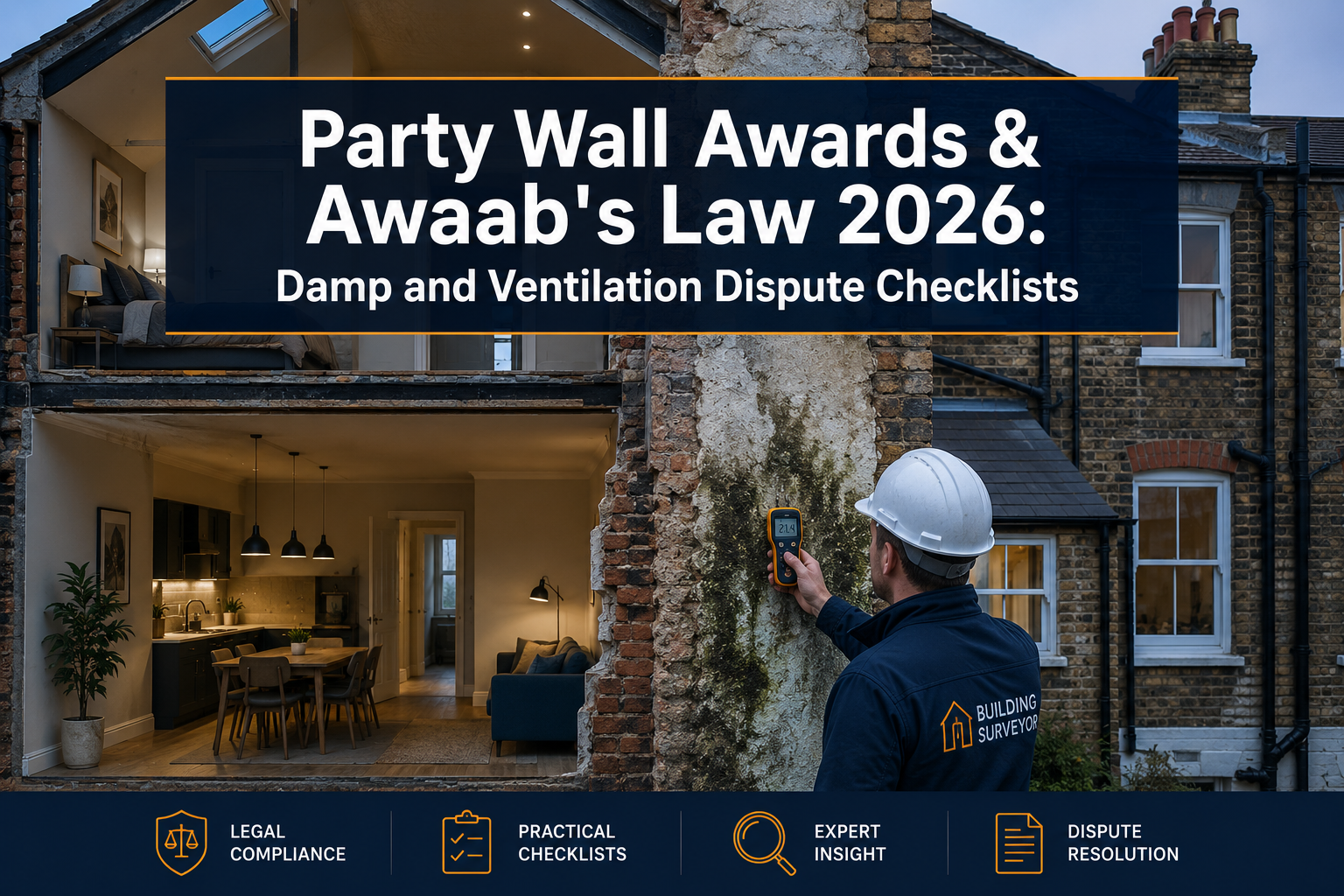
Stricter rental regulations are now crossing the boundary between landlord-tenant law and neighbour-to-neighbour building disputes — and surveyors who fail to account for this shift are leaving their clients exposed. As of May 2026, Awaab's Law applies to private landlords in England, and a second phase scheduled for October 2026 extends statutory hazard categories well beyond damp and mould [1][4]. For properties sharing a party wall — particularly converted terraces and Victorian subdivisions — this creates a direct collision between the Party Wall etc. Act 1996 and the new health-and-safety obligations under Awaab's Law. Understanding how Party Wall Awards Under Awaab's Law Extensions: 2026 Checklists for Damp and Ventilation Disputes intersect is no longer optional for surveyors, landlords, or adjoining owners.
Key Takeaways
- Awaab's Law now applies to private landlords in England from May 2026, with Phase 2 extending to additional hazards including excess cold, heat, and fire risks from October 2026.
- Party wall awards in shared-wall conversions must now anticipate moisture risk and ventilation disruption caused by notifiable building works.
- Surveyors should embed specific damp and ventilation clauses into awards to preempt neighbour claims under Awaab's Law.
- A structured pre-award checklist helps both building owners and adjoining owners document baseline conditions before work begins.
- Failure to address moisture pathways in a party wall award can result in overlapping liability under both the Party Wall Act and Awaab's Law enforcement timelines.
Why Awaab's Law and Party Wall Awards Now Overlap
The Party Wall etc. Act 1996 governs notifiable building work — excavations, new walls on boundaries, and alterations to shared structures. A party wall award is the legally binding document that sets out how that work must proceed, protecting both the building owner and the adjoining owner [2][3]. Historically, these awards focused on structural protection: preventing cracks, subsidence, and load-bearing damage.
Awaab's Law changes the risk landscape. Named after two-year-old Awaab Ishak, who died in 2020 from prolonged exposure to mould in a social housing property, the legislation originally applied to social landlords under the Social Housing (Regulation) Act 2023. Its extension to private landlords from May 2026 means that any hazardous condition — including damp caused by building work — can now trigger mandatory investigation and repair timescales [4].
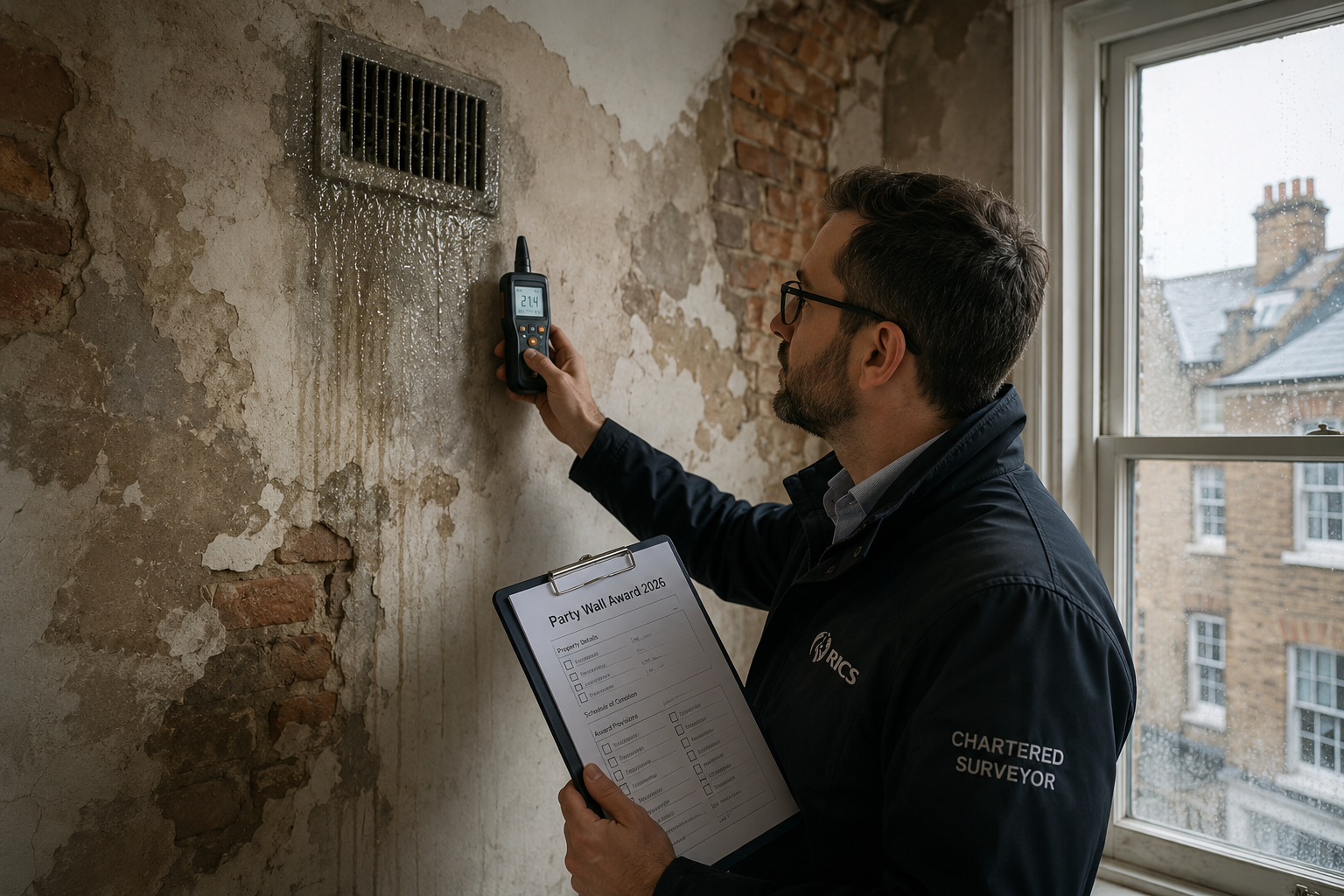
The critical intersection: When a building owner undertakes notifiable work on a party wall in a converted terrace, that work can disrupt moisture barriers, block ventilation pathways, or introduce cold bridges into an adjoining tenant's home. If the adjoining property is a rented flat, the landlord of that flat now has statutory obligations under Awaab's Law. If the party wall award failed to protect against those moisture risks, the landlord faces enforcement action — and may have grounds to claim against the building owner.
The Conversion Problem
Victorian and Edwardian terraces converted into flats present the highest risk. These buildings were designed as single dwellings. Their party walls were never built to separate independently heated, independently ventilated units. When loft conversions, rear extensions, or basement works are carried out on one half of a converted terrace, the thermal and moisture dynamics of the shared wall change significantly.
"The party wall is not just a structural boundary — in a conversion, it is also a moisture management boundary. Disturbing it without addressing ventilation and damp risk is no longer just poor practice; it can now trigger statutory obligations under Awaab's Law."
Surveyors acting under the Party Wall etc. Act 1996 must now think beyond structural integrity. A schedule of condition documenting pre-existing damp or ventilation defects is more important than ever — not just to protect the building owner from spurious claims, but to establish a baseline against which Awaab's Law hazard assessments can be measured.
The 2026 Legal Framework: What Has Changed
Awaab's Law Phase 1 and Phase 2
Phase 1 of Awaab's Law for private landlords (effective May 2026) requires landlords to:
- Acknowledge a complaint about damp or mould within a prescribed period
- Investigate the hazard within a set timeframe
- Begin repairs within a further statutory window
Phase 2, scheduled for October 2026, expands the hazard categories to include excess cold, excess heat, fire risks, electrical hazards, and explosion risks [1]. This is significant for party wall disputes because:
- Notifiable building works can introduce excess cold through disrupted insulation
- Structural alterations can block or remove ventilation routes
- Electrical work near party walls can create fire risk pathways
The Housing Health and Safety Rating System (HHSRS) methodology underpins enforcement under both phases. Surveyors preparing party wall awards should be familiar with HHSRS hazard scoring, particularly for Category 1 hazards that trigger mandatory local authority action [1][5].
RICS Guidance in 2026
The Royal Institution of Chartered Surveyors is consulting on the 8th edition of Party Wall Legislation and Procedure in 2026. This edition is expected to address the interaction between party wall awards and wider health and safety obligations, including the expanded scope of Awaab's Law [3]. Surveyors should monitor RICS updates and ensure their award templates reflect current best practice.
For a detailed breakdown of surveyor roles and notice periods under current guidance, see the party wall awards explained guide covering 2026 RICS developments.
Scottish Regulations
Scotland has implemented its own version of Awaab's Law through the Investigation and Commencement of Repair (Scotland) Regulations 2026, which impose duties on both social and private landlords to investigate damp and mould reports within defined timescales [6]. While Scottish party wall legislation differs from the English framework, the principle of embedding moisture risk clauses in building agreements is equally relevant north of the border.
Party Wall Awards Under Awaab's Law Extensions: 2026 Checklists for Damp and Ventilation Disputes
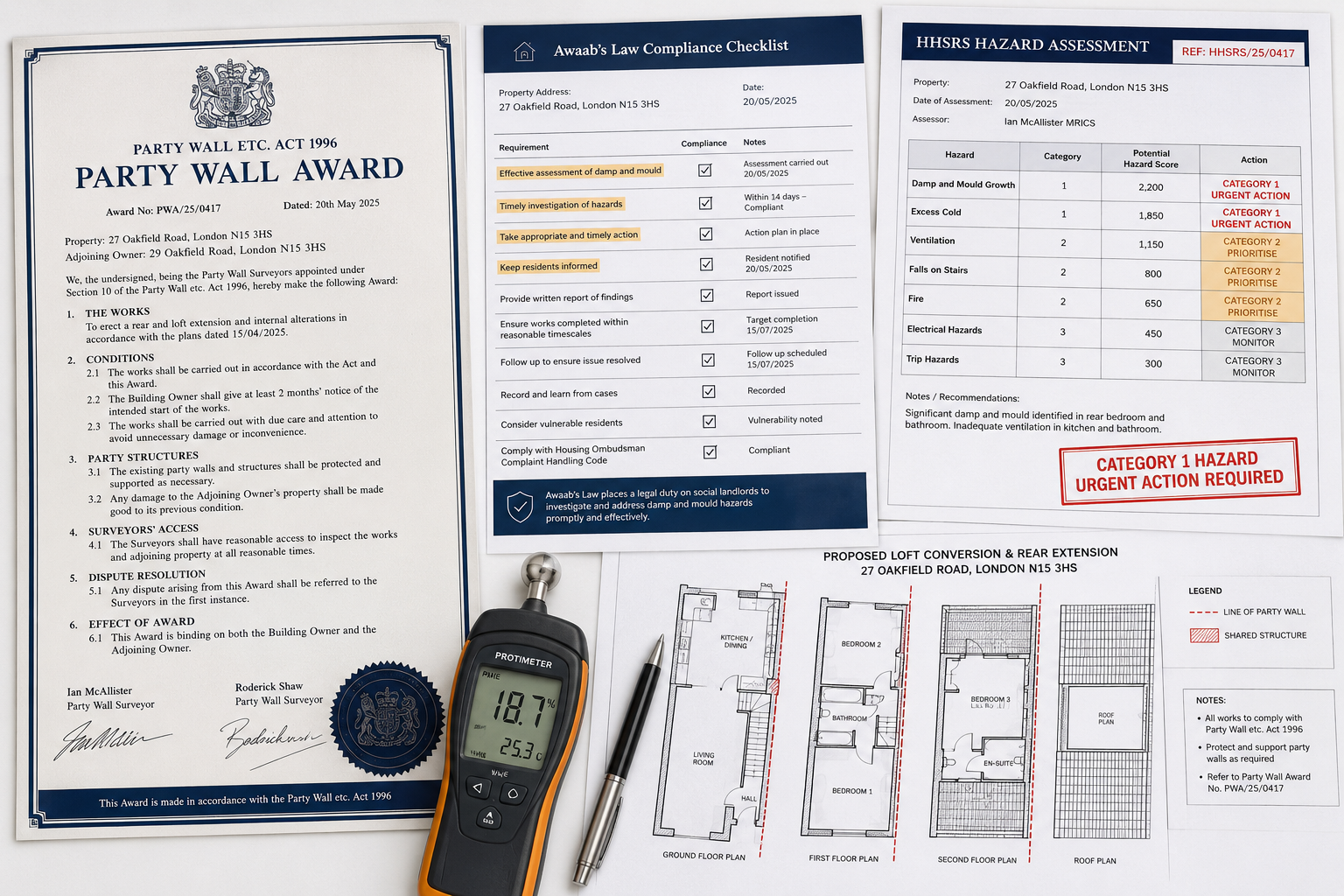
The following checklists are designed for use by surveyors, building owners, and adjoining owners in 2026. They address the specific risks created by the overlap between party wall proceedings and Awaab's Law obligations.
Pre-Award Checklist: Baseline Documentation
Before a party wall award is issued, surveyors should ensure the following are recorded:
| Item | Action Required | Notes |
|---|---|---|
| Moisture readings at party wall | Measure and record | Use calibrated damp meter; log date and conditions |
| Ventilation routes serving adjoining property | Identify and photograph | Note any that pass through or near the party wall |
| Existing damp or mould in adjoining property | Document with photos | Establish pre-existing conditions clearly |
| Thermal imaging of party wall | Recommended for conversions | Identifies cold bridges before work begins |
| HHSRS hazard assessment | Commission if tenant occupies adjoining property | Establishes baseline hazard score |
| Schedule of condition | Mandatory | See RICS guidance on scope and format |
A thorough damp survey of the adjoining property before work begins is strongly recommended. This protects the building owner from post-work claims and gives the adjoining owner's landlord a defensible baseline for Awaab's Law purposes.
Award Drafting Checklist: Moisture and Ventilation Clauses
The award itself should include the following provisions where party wall works could affect damp or ventilation:
Structural and moisture protections:
- Specification of damp-proof course continuity requirements at the party wall
- Prohibition on blocking or reducing existing ventilation openings without providing equivalent replacement ventilation
- Requirement to maintain or restore cavity wall insulation continuity
- Specification of breathable membranes where applicable
Ventilation-specific clauses:
- Identification of all mechanical and passive ventilation routes serving the adjoining property that pass through or adjacent to the party wall
- Prohibition on works that reduce air flow to habitable rooms in the adjoining property below Building Regulations Part F standards
- Requirement for post-work ventilation testing if works are within 1 metre of identified ventilation routes
Damp monitoring provisions:
- Requirement for post-work moisture readings at agreed intervals (typically 3 months and 6 months after completion)
- Named surveyor responsible for post-work monitoring
- Agreed threshold moisture readings that trigger remedial action
- Clear liability clause: if post-work readings exceed pre-work baseline, the building owner bears remediation costs
Awaab's Law interaction clause (recommended for 2026 awards):
"Where the adjoining property is subject to a tenancy, the building owner acknowledges that works carried out under this award must not create or materially worsen any hazard as defined under the Housing Health and Safety Rating System. Should any damp, mould, or ventilation deficiency attributable to works under this award be identified by a local authority enforcement officer under Awaab's Law, the building owner shall be responsible for remediation costs and any associated landlord penalties."
Post-Work Checklist: Compliance Verification
After notifiable works are complete, the following steps should be taken before the award is formally closed:
- Commission independent moisture readings at all previously recorded points
- Compare readings against pre-work baseline documented in the schedule of condition
- Inspect all ventilation routes identified in the award for blockage or damage
- Obtain written confirmation from the adjoining owner or their surveyor that no new damp or mould has appeared
- If the adjoining property is tenanted, confirm with the landlord that no Awaab's Law complaints have been received relating to the works
- Retain all post-work documentation for a minimum of six years
Practical Guidance for Landlords and Adjoining Owners
What Landlords Must Do When Party Wall Works Affect Their Property
If a tenant's rented flat adjoins a property undergoing notifiable building works, the landlord faces dual obligations. Under Awaab's Law, any complaint about damp or mould triggers mandatory investigation timescales regardless of the cause [4][5]. The landlord cannot defer action simply because the damp may have been caused by a neighbour's building work.
Landlords should:
- Serve a formal party wall notice response (dissent) to ensure a surveyor is appointed and an award is issued
- Request that the award include specific moisture and ventilation protection clauses
- Commission a damp survey report before works begin to establish baseline conditions
- Monitor the property during and after works for signs of new damp or mould
- If damp appears during or after works, notify the building owner in writing immediately and document the timeline carefully
Understanding when a party wall agreement is needed is the first step for any adjoining owner — including landlords whose tenants occupy the affected property.
What Building Owners Must Do to Reduce Awaab's Law Exposure
Building owners undertaking notifiable works in converted terraces or other shared-wall properties should take proactive steps to limit their liability:
- Serve party wall notices promptly and in the correct form [7]
- Appoint a qualified party wall surveyor with experience in moisture risk assessment
- Agree to include damp and ventilation clauses in the award before works begin
- Ensure contractors understand the ventilation protection requirements in the award
- Retain all post-work monitoring records
For guidance on what a party wall surveyor does and how they protect both parties, the party wall surveyor duties guide provides a clear overview.
The Role of Expert Witnesses in 2026 Disputes
As Awaab's Law enforcement increases, disputes about whether building works caused damp or ventilation deficiencies will increasingly reach tribunal. Expert witnesses in these cases must be able to:
- Demonstrate familiarity with HHSRS hazard methodology
- Produce defensible reports that meet RICS expert witness standards
- Distinguish between pre-existing conditions and works-related damage using baseline documentation [1][8]
The expansion of Awaab's Law hazard categories in October 2026 means expert witnesses will need to address not just damp and mould, but also excess cold and ventilation failure as distinct hazard categories [1]. A party wall award that includes a robust pre-work schedule of condition and post-work monitoring requirements will significantly strengthen the building owner's position in any subsequent tribunal proceedings.

Common Mistakes to Avoid in 2026
Relying on a standard award template without moisture clauses. Generic party wall award templates do not include Awaab's Law interaction clauses or post-work moisture monitoring requirements. In 2026, this is no longer adequate for shared-wall conversions.
Failing to commission a pre-work damp survey. Without a documented baseline, it is impossible to prove that post-work damp was pre-existing. This leaves building owners exposed to claims they cannot defend.
Ignoring ventilation routes. Many surveyors focus on structural elements and overlook passive ventilation routes — air bricks, underfloor vents, and cavity ventilation — that run through or near party walls. Blocking these during works can create Awaab's Law hazards in the adjoining property.
Not notifying the adjoining owner promptly. Delays in serving party wall notices reduce the time available to negotiate award terms. If the adjoining owner is a landlord with tenanted flats, they need adequate time to commission their own damp survey and request appropriate award clauses [7].
Underestimating Phase 2 hazard categories. From October 2026, excess cold becomes a statutory hazard under Awaab's Law. Insulation disruption caused by party wall works can introduce cold bridges that meet the HHSRS threshold for a Category 1 hazard. Surveyors must account for thermal performance, not just moisture [1].
Conclusion
The convergence of party wall law and Awaab's Law in 2026 creates a new standard of care for surveyors, landlords, and building owners alike. Party Wall Awards Under Awaab's Law Extensions: 2026 Checklists for Damp and Ventilation Disputes represent a practical response to a genuine legal gap — one that leaves landlords exposed to enforcement action for hazards caused by their neighbours' building works.
Actionable next steps for 2026:
- Review all current party wall award templates and add moisture risk and ventilation protection clauses before issuing new awards in shared-wall conversions.
- Commission a professional damp survey of the adjoining property before notifiable works begin — whether you are the building owner or the adjoining owner.
- If you are a landlord with a tenanted flat adjoining a building site, dissent to the party wall notice and appoint your own surveyor to negotiate award terms.
- Ensure post-work moisture monitoring is written into the award with clear timescales, named surveyors, and agreed remediation triggers.
- Monitor RICS guidance updates for the 8th edition of Party Wall Legislation and Procedure, expected to address Awaab's Law interaction directly.
- For Phase 2 compliance from October 2026, extend pre-work assessments to include thermal imaging and cold bridge risk assessment alongside standard damp surveys.
Surveyors who embed these protections into their awards now will be better positioned to defend their clients — and their own professional standing — as Awaab's Law enforcement scales up across England and Scotland.
References
[1] Expert Witness Challenges In Awaabs Law 2026 Hazard Extensions Evidence Standards For Excess Cold Falls And Fire Risks – https://wimbledonsurveyors.com/expert-witness-challenges-in-awaabs-law-2026-hazard-extensions-evidence-standards-for-excess-cold-falls-and-fire-risks/?utm_source=openai
[2] Party Wall Award – https://www.aylingassociates.com/knowledge/party-wall-award?utm_source=openai
[3] Party Wall Awards Explained Surveyor Roles Notice Periods And Dispute Resolution Under 2026 Rics Guidance – https://wimbledonsurveyors.com/party-wall-awards-explained-surveyor-roles-notice-periods-and-dispute-resolution-under-2026-rics-guidance/?utm_source=openai
[4] Awaabs Law Landlord Guide 2026 – https://letsafeuk.co.uk/guides/awaabs-law-landlord-guide-2026?utm_source=openai
[5] Damp Mould Enforcement Timeline – https://prscheck.co.uk/resources/damp-mould-enforcement-timeline?utm_source=openai
[6] Lghps062026r07 – https://www.parliament.scot/chamber-and-committees/committees/committee-reports/lghp/2026/3/25/lghps062026r07?utm_source=openai
[7] Party Wall Agreement – https://hoa.org.uk/advice/guides-for-homeowners/i-am-improving/party-wall-agreement/?utm_source=openai
[8] Expert Witness Roles In Awaabs Law 2026 Disputes Testifying On Expanded Hazards In Private Rental Properties – https://kingstonsurveyors.com/expert-witness-roles-in-awaabs-law-2026-disputes-testifying-on-expanded-hazards-in-private-rental-properties/?utm_source=openai