
Rental yields in England and Wales hit an average of 8.1% in Q1 2026 — a 0.7 percentage point rise year-on-year — yet the structural condition of many properties attracting those yields remains a serious blind spot for investors [2]. The convergence of constrained housing supply, shifting landlord geography, and tightening regulation has made Building Surveys for Buy-to-Let in High-Demand Regions: Assessing Risks in Tenant-Driven Markets 2026 one of the most consequential due-diligence steps any landlord can take. Skipping this step in a fast-moving lettings market is not boldness — it is exposure.
Key Takeaways
- Average rental yields in England and Wales reached 8.1% in Q1 2026, with the North East leading at 9.8%, drawing significant investor attention northward.
- The Midlands and North now account for over 50% of mortgaged buy-to-let purchases, up from 35% in 2015, making regional structural risk assessment essential.
- A full Level 3 building survey is the most appropriate tool for older or converted stock common in high-yield northern markets.
- The Renters Rights Act (effective May 2026) increases the regulatory cost of undetected defects, particularly around energy performance and habitability.
- Structural remediation costs for severe issues can exceed £60,000, making pre-purchase surveys a financially rational investment, not an optional extra.

Why High-Demand Regions Are Reshaping Buy-to-Let Risk Profiles
The geography of buy-to-let investment has undergone a fundamental shift. The Midlands and North now account for over 50% of mortgaged BTL purchases, compared with just 35% in 2015. Over the same period, the South's share has fallen from nearly 56% to 38% [1]. By early 2025, 40% of all BTL purchases were concentrated in the Midlands and North, driven by lower acquisition costs and the kind of rental yields that London stopped offering years ago [3].
This migration of capital northward is not without consequence for surveyors and investors alike. The housing stock in cities such as Manchester, Leeds, Sheffield, and Liverpool is predominantly Victorian and Edwardian terraced or semi-detached property. These buildings carry a very different risk profile from the newer stock that dominated southern BTL portfolios.
Key characteristics of northern high-yield stock:
| Property Type | Common Defects | Remediation Risk |
|---|---|---|
| Victorian terrace | Damp, subsidence, aging roofs | High |
| Edwardian semi-detached | Timber decay, chimney issues | Medium-High |
| Converted flats | Fire safety, shared services | High |
| 1960s–80s blocks | Cladding, flat roof failures | Variable |
Meanwhile, multifamily housing starts dropped by over 40% between 2023 and 2025, and supply constraints are expected to persist due to high material costs and elevated interest rates [5]. In undersupplied rental markets, landlords face pressure to acquire quickly. That urgency is precisely when structural due diligence gets skipped — and when it matters most.
The Renters Rights Act, effective May 2026, has added a further layer of complexity. It introduces significant reforms to tenancy structures and possession processes, meaning landlords who inherit properties with habitability defects face not only remediation costs but also legal exposure if tenants cannot be moved on through traditional routes [6]. In this environment, understanding what a building survey actually reveals — before exchange — is a commercial necessity.
Understanding Building Surveys for Buy-to-Let in High-Demand Regions: Assessing Risks in Tenant-Driven Markets 2026
Not all surveys are equal, and the type chosen should match the property and the investor's purpose. For buy-to-let acquisitions in high-demand regions, the choice typically falls between a Level 2 (Homebuyer Report) and a Level 3 (Full Building Survey). Understanding the key difference between Level 2 and Level 3 surveys is the starting point for any informed landlord.
Level 2 vs Level 3: What BTL Investors Actually Need
A Level 2 survey provides a condition rating for each element of the property, flags urgent defects, and gives a market valuation. It suits properties built after 1900 in reasonable condition. A Level 3 survey goes further: it describes the construction, explains how defects occurred, estimates repair costs, and assesses future maintenance liability. For older stock common in high-yield northern markets, the Level 3 is almost always the appropriate choice.
Professional landlords focus specifically on defects that affect yield and regulatory compliance: structural instability, electrical safety failures, and energy performance shortfalls [4]. These are not minor cosmetic concerns. Severe structural instability alone can cost between £30,000 and £60,000 or more to remediate, with knock-on effects for insurance premiums and resale value [10].
The Five Structural Checks That Determine Rental Viability
For a buy-to-let property in a tenant-driven market, a building survey should prioritise the following:
- Foundation and subsidence assessment — particularly critical in clay-heavy soils common across the Midlands and parts of Yorkshire.
- Roof structure and covering — aging slate or clay tile roofs on Victorian stock are a frequent source of water ingress and timber decay.
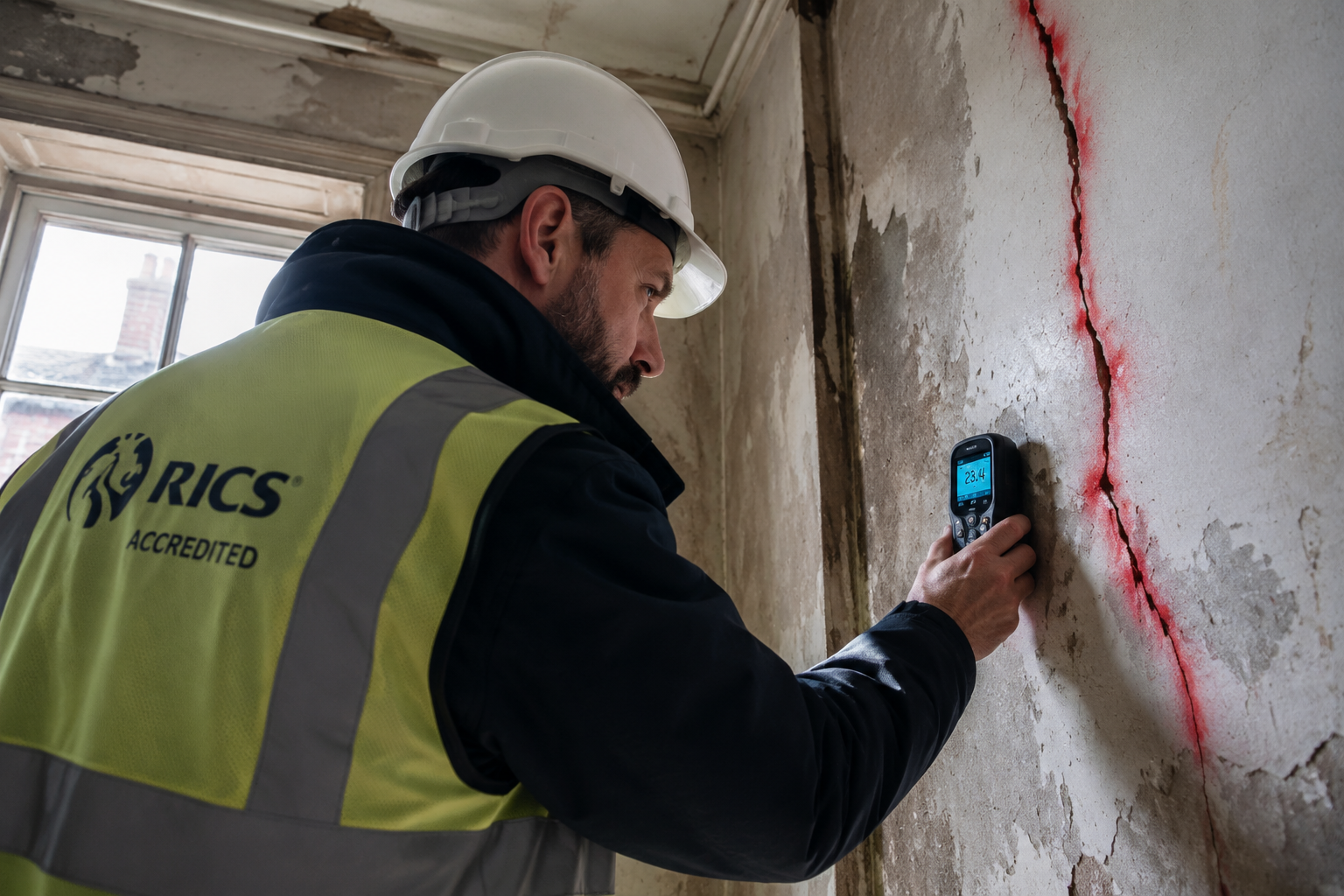
- Damp and timber condition — rising damp, penetrating damp, and wet rot in floor joists are common in properties that have had intermittent occupation.
- Electrical and gas installation condition — older wiring (rubber-insulated or aluminium) and non-compliant consumer units represent both safety and legal risks.
- Energy Performance Certificate (EPC) rating — under current and forthcoming regulations, properties below EPC band C face lettings restrictions that directly affect yield.
For investors operating across multiple locations, specialist building surveyor services that understand local construction typologies are invaluable. A surveyor familiar with the specific clay geology of the East Midlands, for example, will interpret foundation movement very differently from one whose practice is concentrated in London.
Regional Case Studies: Where Structural Risk Meets Lettings Demand
Manchester and Salford
Manchester's rental market remains one of the tightest in the UK. Vacancy rates in inner-city postcodes consistently run below 2%, and average rents rose by over 9% in 2025. The dominant stock for BTL acquisition is the two-up two-down terrace, many built between 1880 and 1910.
Common survey findings in this stock:
- Lateral spread in external gable walls due to the absence of adequate wall ties
- Chimney stack deterioration leading to water penetration at roof junctions
- Cellar dampness affecting ground-floor timber floors
- Inadequate ventilation in converted basement flats
A surveyor working in this market needs to assess not just the condition of the property being purchased, but also the condition of adjoining properties. In terraced rows, structural movement in one unit frequently affects neighbours. Understanding party wall obligations before committing to a purchase can prevent costly disputes post-completion.
Leeds and Bradford
The Leeds-Bradford corridor has seen some of the strongest BTL yield growth in the country. The North East region broadly recorded yields of 9.8% in Q1 2026 [2], and Yorkshire cities are performing comparably. New investors are increasingly targeting this corridor precisely because acquisition prices remain accessible [7].
The challenge is that much of the available stock in Bradford in particular consists of pre-1919 back-to-back or through-terrace housing with limited structural modification since construction. Survey findings in this area frequently include:
- Inadequate damp-proof courses (or none at all)
- Flat-roof extensions added without planning permission
- Outdated single-skin rear extensions with no cavity insulation
- Shared drainage systems with unclear responsibility
These defects are not necessarily deal-breakers, but they must be priced accurately. A detailed building survey with remediation cost estimates allows investors to negotiate the purchase price based on objective evidence. This process — using survey findings to reduce acquisition cost — is a well-established strategy that can substantially improve net yield. Understanding how a survey can help negotiate a property's price is as relevant in Leeds as it is in London.
Liverpool and Merseyside
Liverpool's rental market benefits from strong student and young professional demand. The city has a high proportion of converted Victorian townhouses split into flats — a property type that carries specific survey risks.
Converted properties require particular attention to:
- Fire compartmentation — inadequate separation between flats is a regulatory and safety issue
- Shared services — who owns and maintains the roof, drains, and external walls?
- Lease structure — short leases or poorly drafted leases can affect mortgage availability and resale
For leasehold acquisitions in this category, understanding what to check before buying a leasehold property is as important as the physical survey itself.
How Institutional Investors Approach Building Surveys for Buy-to-Let in High-Demand Regions: Assessing Risks in Tenant-Driven Markets 2026
The professionalisation of the landlord sector has accelerated since 2016, when tax and regulatory changes began squeezing smaller operators. By the first half of 2024, landlords purchased only 10% of homes sold across Great Britain — the lowest share since 2010 [8]. Those who remain active are increasingly sophisticated, and their approach to surveys reflects that.
Institutional and professional landlords typically employ a tiered assessment framework [9]:
Tier 1 — Portfolio Screening: A desktop review of planning history, flood risk, EPC data, and comparable sales before commissioning any physical inspection.
Tier 2 — Condition Survey: A Level 2 or Level 3 building survey, depending on property age and type, to establish a baseline condition rating.
Tier 3 — Specialist Reports: Where the Level 3 survey flags concerns, specialist reports are commissioned — structural engineer assessments, damp and timber surveys, or electrical installation condition reports (EICRs).
Tier 4 — Ongoing Monitoring: For portfolios of converted or mixed-use properties, monitoring surveys track structural movement or defect progression over time.
This layered approach is not exclusive to large operators. Any landlord acquiring in a high-demand region can adopt the same logic, scaling it to the size of their portfolio. The key discipline is not to compress the process under market pressure.
"The cost of a comprehensive building survey is typically 0.1% to 0.3% of the purchase price. The cost of an undetected structural defect can be 10 to 20 times that figure."
EPC Compliance as a Survey Priority in 2026
Energy performance has moved from a background consideration to a front-line investment risk. Under current government direction, rental properties will need to meet minimum EPC standards to be legally let. Properties rated E, F, or G are already subject to restrictions, and the trajectory toward a minimum Band C requirement for new tenancies is well established.
A building survey that does not address the current EPC rating and the cost of improvement to reach Band C is incomplete for BTL purposes. Surveyors should be explicitly briefed to comment on:
- Current insulation levels (loft, cavity, solid wall)
- Heating system age and efficiency
- Window glazing specification
- Potential for renewable energy installations
This is particularly relevant in the older northern stock described above, where solid-wall construction makes retrofitting expensive. An investor who discovers post-purchase that achieving Band C requires £15,000 of solid wall insulation has effectively reduced their net yield without realising it at the time of acquisition.

Practical Steps for Commissioning the Right Survey
Commissioning a building survey for a BTL acquisition in a high-demand region requires more than simply booking the cheapest RICS surveyor available. The following checklist reflects best practice for 2026:
- Specify the purpose: Tell the surveyor explicitly that the property is intended for letting. This changes the focus toward habitability, regulatory compliance, and tenant safety, not just resale value.
- Request cost estimates: Ask for indicative remediation costs for any Category 3 (urgent) defects identified. This is essential for price negotiation and financial modelling.
- Confirm local knowledge: A surveyor with experience in the specific area and building type will identify region-specific risks that a generalist might miss.
- Ask about EPC uplift costs: Explicitly request commentary on the cost of improving the EPC rating to Band C.
- Consider a specialist damp report: In pre-1919 stock, a standalone damp and timber survey alongside the Level 3 building survey provides additional granularity.
- Review the survey before exchange: Ensure there is time between survey receipt and exchange of contracts to obtain specialist quotes for any flagged defects.
For investors active across London and the South East as well as northern markets, working with building surveyors who cover multiple regions ensures consistent reporting standards and comparable risk assessments across a portfolio.
Conclusion
The case for rigorous building surveys in buy-to-let acquisitions has never been stronger. Constrained housing supply is sustaining lettings demand across high-yield northern and Midlands markets, but the older stock that delivers those yields carries structural, regulatory, and energy performance risks that are not visible at a viewing. The Renters Rights Act 2026 has raised the stakes further, making pre-existing defects a potential legal liability rather than simply a maintenance inconvenience.
Actionable next steps for BTL investors in 2026:
- Commission a Level 3 building survey for any pre-1919 property, regardless of the asking price.
- Brief the surveyor on the intended use as a rental property and request EPC uplift cost commentary.
- Use survey findings to negotiate the purchase price or request remediation before completion — this is standard practice, not confrontation.
- For converted or leasehold properties, obtain a specialist fire compartmentation and leasehold review alongside the physical survey.
- Build a relationship with a RICS-accredited surveyor who has demonstrable experience in the target region.
- Factor all identified defect remediation costs into the yield calculation before committing to purchase.
The investors who will build durable, compliant, and profitable BTL portfolios in 2026 are those who treat the building survey not as a box-ticking exercise but as the foundation of every acquisition decision. To explore survey options relevant to your target region or to discuss a specific property, contact a qualified surveyor with regional expertise before committing to any purchase.
References
[1] Buy To Let Investment Shifts From South To North – https://www.propertywire.com/news/uk/buy-to-let-investment-shifts-from-south-to-north/?utm_source=openai
[2] Rental Yields Rise Across All Regions As Buytolet Fundamentals Hold Firm – https://www.christophernevill.co.uk/news/rental-yields-rise-across-all-regions-as-buytolet-fundamentals-hold-firm.html?utm_source=openai
[3] Northern Cities Overtake London In Buy To Let Demand – https://www.propertyreporter.co.uk/northern-cities-overtake-london-in-buy-to-let-demand.html?utm_source=openai
[4] Building Surveys For Buy To Let Properties Spotting Risks In 2026s Professional Landlord Wave – https://wimbledonsurveyors.com/building-surveys-for-buy-to-let-properties-spotting-risks-in-2026s-professional-landlord-wave/?utm_source=openai
[5] Multifamily Housing – https://www.pwc.com/us/en/industries/financial-services/asset-wealth-management/real-estate/emerging-trends-in-real-estate-pwc-uli/property-type-outlook/multifamily-housing.html?utm_source=openai
[6] Uk Buy To Let Lending Outlook 2026 And 2027 Recovery Gathers Pace Amid Shifting Mortgage Conditions – https://www.propertywire.com/buy-to-let/uk-buy-to-let-lending-outlook-2026-and-2027-recovery-gathers-pace-amid-shifting-mortgage-conditions/?utm_source=openai
[7] Why Buy To Let Landlords Are Moving North 2025 – https://www.pauzible.com/knowledge-hub/why-buy-to-let-landlords-are-moving-north-2025?utm_source=openai
[8] Buy To Let Purchases Fall To Record Low – https://www.hamptons.co.uk/articles/buy-to-let-purchases-fall-to-record-low?utm_source=openai
[9] Building Surveys For Institutional Buy To Let Portfolios Assessing Quality Standards When Professional Landlords Dominate 2026 Market – https://www.canterburysurveyors.com/blog/building-surveys-for-institutional-buy-to-let-portfolios-assessing-quality-standards-when-professional-landlords-dominate-2026-market/?utm_source=openai
[10] Building Surveys For 2026 Buy To Let Investment Surge Spotting High Yield Opportunities And Risks – https://wimbledonsurveyors.com/building-surveys-for-2026-buy-to-let-investment-surge-spotting-high-yield-opportunities-and-risks/?utm_source=openai