
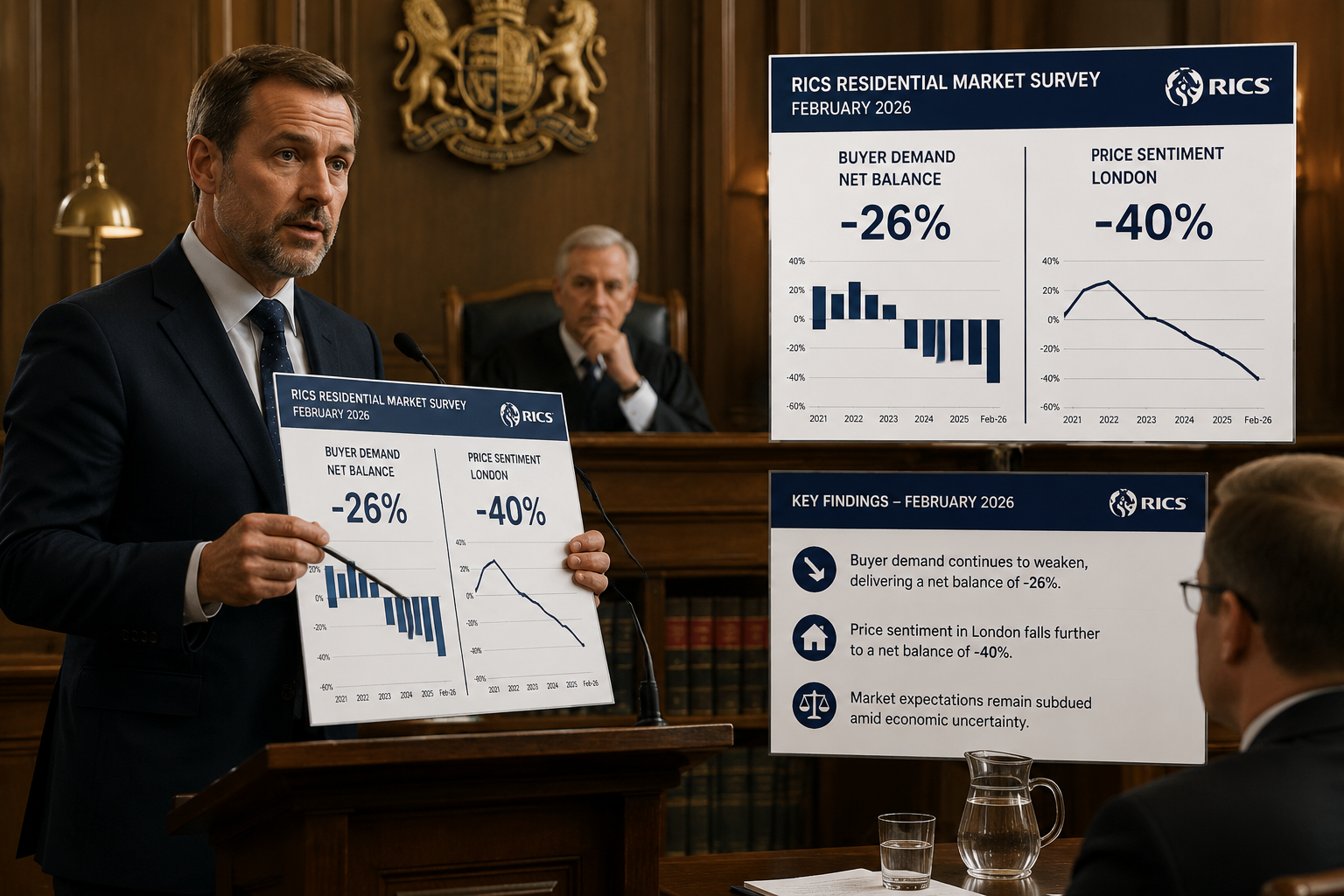
A net balance of -26% in new buyer enquiries recorded by RICS in February 2026 is not simply a market statistic — in a courtroom or tribunal setting, it is a piece of evidence [1]. For surveyors called upon as expert witnesses, defending cautious Q2 2026 valuations as expert witness by leveraging RICS February data against AVM challenges has become one of the most pressing professional tasks of the year. Automated Valuation Models (AVMs) frequently produce figures that appear precise, yet they struggle to account for the kind of demand collapse and regional divergence that the RICS February 2026 survey so clearly documents. This article sets out the strategic, methodological, and evidential framework that expert witnesses need to counter AVM-based challenges with authority and credibility.
Key Takeaways
- The RICS February 2026 survey recorded a -26% net balance in buyer enquiries and a -18% net balance in short-term price expectations, providing powerful empirical grounding for cautious valuations.
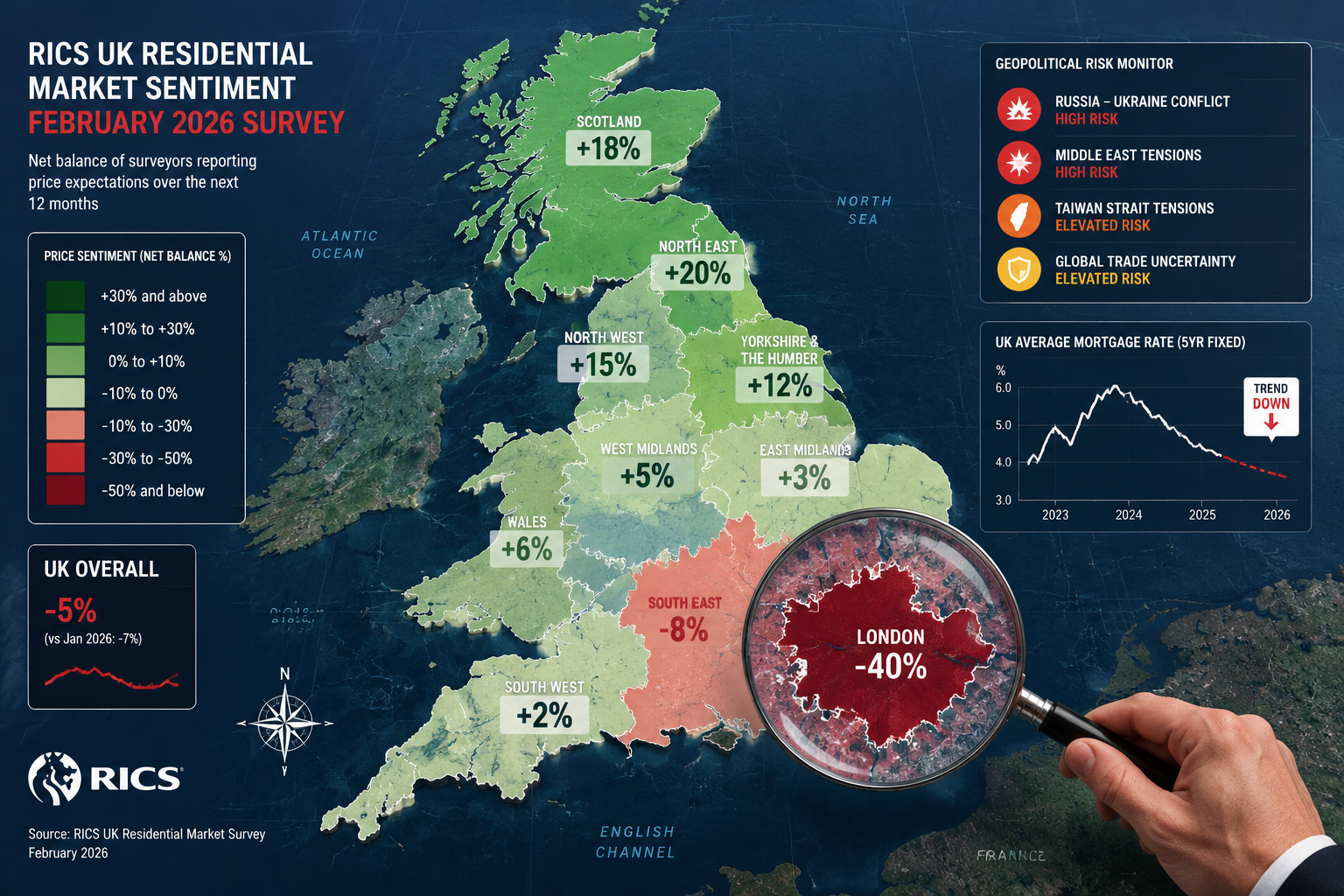
- London's price sentiment net balance fell to -40%, demonstrating that national AVM averages mask severe regional disparities.
- Traditional AVMs lose accuracy in low-transaction markets, making professional judgment essential in Q2 2026 conditions.
- Geopolitical factors, including the ongoing Middle East conflict, have raised borrowing costs and suppressed buyer confidence in ways that algorithmic models cannot adequately capture.
- Expert witnesses who anchor their testimony to published RICS data, regional evidence, and documented market conditions are better positioned to withstand AVM-based challenges in disputes.
Why Q2 2026 Market Conditions Demand Cautious Valuations
The UK housing market entered the second quarter of 2026 under significant pressure. The RICS UK Residential Market Survey for February 2026 painted a clear picture: buyer demand was falling sharply, price expectations had turned negative, and regional markets were diverging in ways that aggregate data could not capture [1].
Key RICS February 2026 data points:
| Indicator | Net Balance | Direction |
|---|---|---|
| New Buyer Enquiries | -26% | Falling |
| Short-Term Price Expectations | -18% | Negative |
| London Price Sentiment | -40% | Sharply Negative |
| Northern Ireland / North West | Positive | Firmer |
These figures did not exist in isolation. By March 2026, the net balance for new buyer enquiries had worsened further to -39%, marking the weakest reading since August 2023 [1]. For an expert witness, this trajectory is critical: it demonstrates that February's cautious readings were not an anomaly but the beginning of a sustained deterioration.
Why does this matter for valuations? A valuation conducted in Q1 or Q2 2026 that reflected a discounted or conservative market value was not a professional error. It was a professionally appropriate response to documented market conditions. The RICS data provides the empirical backbone to defend that position.
The Role of Geopolitical Uncertainty
Market softness in 2026 has not been driven by domestic factors alone. The ongoing Middle East conflict has contributed to rising borrowing costs across global markets, with direct knock-on effects for UK mortgage availability and buyer confidence [3]. When borrowing costs rise unexpectedly, the pool of qualifying buyers shrinks, sales volumes fall, and the price discovery mechanism that AVMs depend upon becomes unreliable.
An expert witness who can connect macro-level geopolitical risk to specific local market outcomes — supported by RICS survey data — builds a narrative that is both factually grounded and accessible to a judge or arbitrator. For those involved in legal disputes relating to property valuations, this kind of contextual framing can be decisive.
Understanding AVM Limitations in a Low-Transaction Market
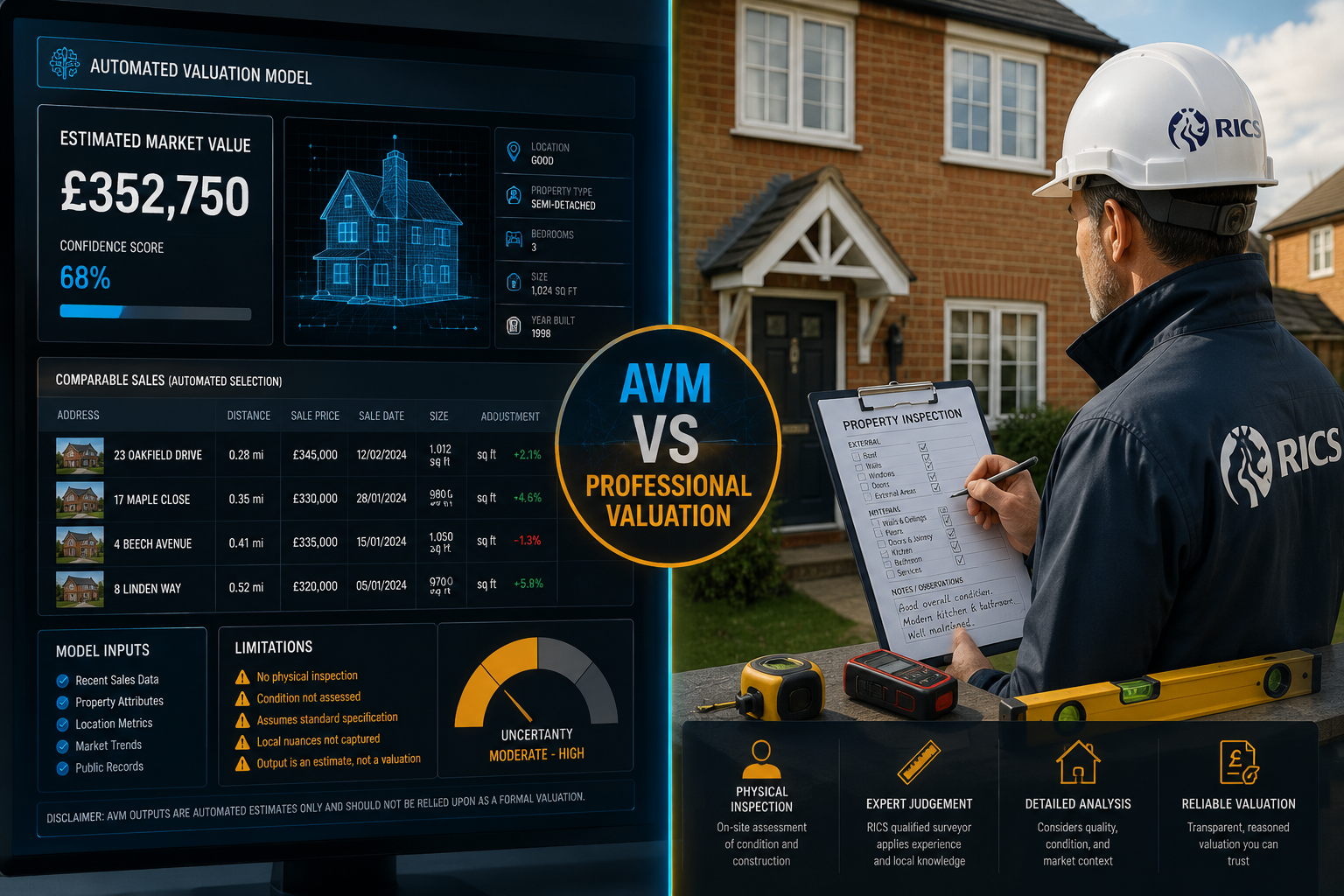
Automated Valuation Models are built on one fundamental assumption: that there are sufficient recent comparable transactions to generate a reliable estimate. In a market where buyer enquiries have fallen by 26% and then 39% in consecutive months, that assumption collapses [1].
How Traditional AVMs Fail in Volatile Conditions
Traditional AVMs rely heavily on recent comparable sales data. When transaction volumes fall sharply, the pool of comparables shrinks, and the model is forced to reach back further in time or draw on geographically distant sales. Both approaches introduce error [2].
Common AVM failure modes in Q2 2026 conditions:
- Stale comparables: Using transactions from Q3 or Q4 2025 when market sentiment has shifted materially
- Geographic averaging: Applying national or regional averages that mask the -40% London price sentiment divergence [1]
- Condition blindness: Inability to account for property-specific factors such as structural defects, tenure complications, or access issues
- Sentiment lag: AVMs cannot incorporate forward-looking indicators such as negative short-term price expectations until those expectations manifest in completed sales
Research into retrieval-enhanced real estate appraisal methods has highlighted that the selection of comparable properties is one of the most significant drivers of appraisal accuracy, and that improving this selection process is an active area of development [7]. This concedes the very point that expert witnesses need to make: comparable selection requires professional judgment, not algorithmic automation.
"AVMs should not be solely relied upon, especially in complex or volatile markets." — RICS guidance on responsible AI use in valuations [5]
The Appraisal Gap Problem
The appraisal gap — the difference between what an AVM suggests a property is worth and what a qualified surveyor concludes after inspection — has widened in 2026. Factors including climate risk, limited comparable data, and the structural limitations of algorithmic models are making valuation accuracy more challenging across the sector [6]. When an AVM produces a figure that is materially higher than a professionally reasoned valuation, the instinct may be to assume the surveyor is wrong. In Q2 2026, the opposite is more likely to be true.
For those seeking to understand the professional standards that govern surveyor conduct, the RICS surveyor responsibilities framework provides important context on the obligations that qualified valuers must meet.
Defending Cautious Q2 2026 Valuations as Expert Witness: Leveraging RICS February Data Against AVM Challenges in Practice
The practical challenge for an expert witness is translating market data into courtroom-ready evidence. Defending cautious Q2 2026 valuations as expert witness by leveraging RICS February data against AVM challenges requires a structured approach that combines quantitative evidence, qualitative context, and professional credibility.
Building the Evidential Framework
Step 1: Anchor to Published Data
The RICS UK Residential Market Survey is a peer-reviewed, professionally published dataset with a long track record of market reliability. Citing a -26% net balance in buyer enquiries and a -18% net balance in short-term price expectations gives the expert witness a foundation that opposing counsel cannot easily dismiss [1]. These are not the surveyor's opinions — they are the aggregated findings of hundreds of qualified professionals across the country.
Step 2: Demonstrate Regional Specificity
A common AVM defence is that the national picture does not match the local data. The expert witness should pre-empt this by demonstrating that the RICS data itself shows regional divergence. London's -40% price sentiment net balance is not a national figure — it is a London-specific finding [1]. If the disputed property is in London or another underperforming region, this specificity strengthens the cautious valuation considerably.
For properties in specific London locations, local market knowledge supported by RICS data is particularly powerful. Surveyors covering areas such as Chelsea, Battersea, and Bromley will be well-placed to connect regional RICS sentiment data to hyperlocal transaction evidence.
Step 3: Address AVM Methodology Directly
Rather than simply asserting that the AVM is wrong, the expert witness should explain why it is structurally likely to be wrong in these conditions. The argument runs as follows:
- AVMs depend on comparable transaction data
- Transaction volumes have fallen sharply in Q2 2026
- The comparables available to the AVM are therefore either stale, geographically distant, or both
- The AVM's output is therefore unreliable as a measure of current market value
This is not speculation — it is a methodological critique grounded in how AVMs are built and how they fail [2].
Step 4: Document the Valuation Process
The expert witness must be able to demonstrate that the original valuation followed a rigorous, documented process. This includes the selection and weighting of comparables, the application of adjustments for condition and location, and the consideration of market sentiment indicators. A RICS building survey or specific defect survey conducted at the time of valuation can provide contemporaneous evidence of property condition that an AVM would never capture.
Case Study: Geopolitical Volatility as a Valuation Defence
Consider a scenario where a lender challenges a Q1 2026 valuation on the grounds that an AVM conducted in Q2 2026 produces a figure 8% higher. The expert witness's defence would proceed as follows:
-
Establish the market timeline: The RICS February 2026 survey showed buyer enquiries at -26%, with the trend worsening to -39% by March [1]. The AVM's Q2 comparables may post-date a brief stabilisation that does not reflect conditions at the date of the original valuation.
-
Introduce geopolitical context: Rising borrowing costs linked to the Middle East conflict suppressed buyer confidence during the valuation period [3]. This is a documented, external factor that the AVM cannot model retrospectively.
-
Challenge the AVM's comparable pool: In a low-transaction market, the AVM may have drawn on a small number of transactions that do not represent the broader market. The expert witness can request disclosure of the AVM's comparable dataset and challenge its representativeness.
-
Affirm professional judgment: The original surveyor applied professional judgment informed by real-time market intelligence. That judgment, exercised by a qualified RICS professional, carries evidential weight that an algorithm cannot replicate [4].
The Importance of RICS Credentials in Expert Witness Testimony
Courts and tribunals place significant weight on the professional standing of expert witnesses. A surveyor who is a member of RICS and who can demonstrate adherence to RICS valuation standards carries inherent credibility. The reasons to choose RICS surveyors include not only technical competence but also the ethical framework and professional accountability that underpin their findings.
Expert witnesses should also be prepared to explain how their valuation methodology aligns with RICS guidance on responsible AI use, which explicitly cautions against sole reliance on AVMs in complex or volatile markets [5]. This positions the professional valuation as the methodologically superior approach, not simply an alternative opinion.
Strengthening Expert Witness Credibility: Practical Recommendations
The following recommendations are addressed to surveyors who may be called upon to defend cautious Q2 2026 valuations in dispute proceedings.
Before the hearing:
- Obtain and review the full RICS February 2026 UK Residential Market Survey and any subsequent monthly updates
- Document the comparable transactions available at the date of valuation, noting any gaps or limitations in the dataset
- Prepare a written critique of the AVM methodology, addressing the specific conditions under which it was run
- Gather any contemporaneous market commentary, lender guidance, or estate agent data that corroborates the cautious valuation
During testimony:
- Present RICS data as independent, published evidence rather than as support for a personal opinion
- Explain AVM limitations in plain language accessible to a non-specialist tribunal
- Acknowledge areas of uncertainty while demonstrating that the valuation approach was proportionate and reasoned
- Resist the temptation to overstate certainty — a well-reasoned range is more credible than a single precise figure
On cross-examination:
- Be prepared to explain why the RICS February 2026 data is relevant to the specific property and location
- Challenge the opposing party to disclose the AVM's comparable dataset and confidence interval
- Point to the trajectory of market deterioration from February to March 2026 as evidence that caution was warranted
For expert witnesses involved in lease-related disputes, the lease extension valuation context adds another layer of complexity, as declining market sentiment directly affects the relativity calculations that underpin tribunal awards.
The Evolving AVM Landscape and What It Means for Expert Witnesses
It would be misleading to suggest that AVMs are uniformly unreliable. In May 2026, ATTOM launched an AI-powered AVM drawing on over 30 years of property data and achieving a median error of 2.9% across 98 million US properties [2]. This represents a genuine advance in algorithmic valuation capability.
However, two important caveats apply. First, a 2.9% median error means that a significant proportion of valuations carry errors well above that figure — and in a disputed case, the property in question is rarely the median case. Second, this model was developed for the US market, where transaction volumes and data availability differ materially from the UK. The conditions that make AVMs more reliable — high transaction volumes, standardised property types, stable market sentiment — are precisely the conditions that do not characterise the UK market in Q2 2026.
The expert witness who acknowledges AVM advances while demonstrating why those advances do not resolve the specific methodological problems present in the disputed valuation is more credible than one who dismisses AVMs entirely. Intellectual honesty strengthens expert witness testimony.
Conclusion
Defending cautious Q2 2026 valuations as expert witness by leveraging RICS February data against AVM challenges is a task that demands both technical rigour and strategic clarity. The RICS February 2026 survey provides an exceptionally strong evidential foundation: a -26% net balance in buyer enquiries, a -18% net balance in short-term price expectations, and a -40% London price sentiment reading that exposes the inadequacy of national AVM averages [1]. Geopolitical pressures have compounded domestic demand weakness in ways that algorithmic models are structurally unable to capture [3].
Actionable next steps for expert witnesses and instructing solicitors:
- Obtain the RICS February 2026 UK Residential Market Survey and incorporate its specific data points into expert reports as primary evidence.
- Commission a formal methodological critique of any AVM relied upon by the opposing party, focusing on comparable pool size, data vintage, and confidence intervals.
- Ensure that the original valuation file documents the market conditions, comparable selection rationale, and sentiment indicators considered at the date of valuation.
- Engage a RICS-qualified surveyor with direct experience of the relevant local market to provide testimony grounded in both professional standards and hyperlocal knowledge.
- Frame the defence not as "the AVM is wrong" but as "the AVM is structurally unsuited to these specific market conditions" — a position supported by published research and RICS guidance.
The market conditions of Q2 2026 are unusual, but they are documented. That documentation is the expert witness's most powerful tool.
References
[1] UK Residential Survey February 2026 – https://www.rics.org/news-insights/uk-residential-survey-february-2026?utm_source=openai
[2] ATTOM Launches AI-Powered AVM Built on 30 Years of Property Intelligence – https://www.attomdata.com/news/most-recent/attom-launches-ai-powered-avm-built-on-30-years-of-property-intelligence/?utm_source=openai
[3] UK Housing Market Slows as Ongoing Middle East Conflict Raises Borrowing Costs – https://www.rics.org/news-insights/uk-housing-market-slows-as-ongoing-middle-east-conflict-raises-borrowing-costs?utm_source=openai
[4] Valuation Challenges From RICS February 2026 Survey: Expert Witness Strategies for -26% Buyer Enquiry Dip Disputes – https://wimbledonsurveyors.com/valuation-challenges-from-rics-february-2026-survey-expert-witness-strategies-for-26-buyer-enquiry-dip-disputes/?utm_source=openai
[5] Defending Surveyor Valuations Against AVMs in Cautious Q2 2026 Markets: RICS Insights from February Residential Survey – https://wimbledonsurveyors.com/defending-surveyor-valuations-against-avms-in-cautious-q2-2026-markets-rics-insights-from-february-residential-survey/?utm_source=openai
[6] The Appraisal Gap in 2026 – https://www.housingwire.com/articles/the-appraisal-gap-in-2026/?utm_source=openai
[7] Retrieval-Enhanced Real Estate Appraisal Research – https://arxiv.org/abs/2603.12986?utm_source=openai