


As of early 2026, approximately 68,700 build-to-rent units are under construction across the United States, with nearly 42,000 of those located in the Southern states alone [10]. That figure represents not just a housing trend but a structural shift in how residential land is planned, surveyed, and delivered at scale. For surveyors, engineers, and property professionals, Surveying for Build-to-Rent Communities: Navigating the 2026 Boom in Rental Developments has become one of the most pressing practice areas of the decade. The sheer volume of new master-planned rental neighborhoods entering the pipeline demands a rigorous, technically precise approach to topographic assessment, boundary definition, and sustainability compliance that goes well beyond a standard residential survey.
Key Takeaways
- The BTR sector is expanding rapidly in 2026, with tens of thousands of units under construction nationwide, creating significant demand for specialist surveying services.
- Topographic and boundary surveys are foundational to master-planned BTR developments, where site-wide infrastructure must be coordinated across large, complex parcels.
- Sustainability surveys, including drainage assessments and green infrastructure planning, are now a standard expectation from both planners and institutional investors.
- Technology integration — including drone LiDAR, GIS platforms, and AI-assisted site screening — is reshaping how surveyors deliver data on BTR projects.
- Understanding the full pipeline of BTR development activity helps surveyors position their services strategically and align with developer timelines.
The Scale of the 2026 BTR Pipeline and What It Means for Surveyors
The build-to-rent market did not arrive quietly. After a period of investor hesitation driven by elevated interest rates, Northmarq's 2026 BTR report confirmed that investors re-entered the sector in the second half of 2025 as rates stabilised and economic momentum returned [9]. The Southeast led all regions in transaction volume, recording approximately $1.1 billion in BTR property transactions [9]. That capital re-entry has triggered a wave of new ground-breakings and land acquisitions that surveyors are now being asked to support.
The projects making headlines in 2026 illustrate the diversity and geographic spread of this boom:
- Legacy MCS completed two BTR communities in Hutto, Texas — Yardhomes Cottonwood Creek and Village at Hutto Station — adding 570 rental homes to a fast-growing Central Texas market [1].
- Bridge Tower acquired 14 acres in Fate, Texas for The Enclave at Fate Village, a 179-home luxury BTR townhome community with construction imminent [2].
- Crescent Communities closed on land for HARMON Clemmons, a 154-unit BTR development in Clemmons, North Carolina, their second BTR project in the Triad region [3].
- Cavan Companies announced The Bungalows at Maple Woods, a 153-unit single-story BTR community in Kansas City's Northland corridor, with horizontal construction projected for June 2026 [7].
- Tricon, part of Blackstone's real estate portfolio, opened a 307-unit BTR community in Southern California's Inland Empire, targeting renters priced out of homeownership [8].
Each of these projects required — or will require — a comprehensive surveying programme before a single foundation is poured. The scale of BTR development, where a single site may encompass hundreds of individual units across dozens of acres, makes the surveying brief fundamentally different from a standard residential or commercial instruction.
For surveyors working in this space, understanding the construction surveying requirements specific to master-planned rental communities is essential. These are not one-off dwellings; they are coordinated infrastructure projects that demand site-wide data consistency from the very first survey.
Topographic Surveying Needs for Master-Planned Rental Neighbourhoods
Why Topographic Accuracy Is Non-Negotiable
In a BTR community of 150 to 600 units, every drainage decision, road gradient, utility corridor, and building pad elevation is interdependent. An error in the topographic baseline does not affect one home — it cascades across the entire development. This is why topographic surveys on BTR sites must be conducted to a higher standard of precision and detail than those on smaller residential parcels.
A well-executed topographic survey for a BTR development will typically include:
| Survey Element | Purpose |
|---|---|
| Contour mapping at 0.25–0.5m intervals | Drainage design and earthworks planning |
| Existing utility identification | Conflict avoidance during infrastructure installation |
| Tree and vegetation survey | Planning compliance and ecology assessment |
| Boundary and title verification | Preventing legal disputes across large parcels |
| Spot heights at proposed building pads | Foundation design and flood risk assessment |
| Access and road gradient profiling | Transport planning and emergency vehicle access |
The land surveying process on a BTR site often begins months before planning permission is granted. Developers need accurate data to test the financial viability of a scheme, model drainage outcomes, and satisfy planning authority requirements. Surveyors who can deliver this data quickly and accurately are in high demand.
Boundary Surveys and Title Complexity
Large BTR parcels frequently involve the assembly of multiple land titles, agricultural lots, or former commercial sites. This creates boundary survey complexity that can delay a project if not addressed early. Disputed boundaries, historical easements, and ransom strips are all common issues on greenfield and brownfield BTR sites.
Surveyors should conduct a thorough title examination alongside the physical boundary survey, cross-referencing OS mapping, Land Registry data, and any historical deeds. Where ambiguities exist, early resolution avoids costly disputes later. The average cost of a boundary dispute can run into tens of thousands of pounds once legal fees are factored in — a figure that developers are highly motivated to avoid.
Technology Driving Efficiency on Large Sites
The integration of drone-mounted LiDAR, total stations, and GIS platforms has significantly reduced the time required to survey large BTR parcels. AI-assisted site screening tools are now being used by developers to pre-assess land viability before commissioning a full topographic survey, allowing surveyors to focus their effort on the most technically demanding aspects of a site [build.inc, 2026].
Geographic Information Systems (GIS) are particularly valuable on BTR projects because they allow survey data to be layered with planning constraints, flood risk zones, ecological designations, and infrastructure capacity maps. This multi-layered analysis supports faster decision-making and more robust planning submissions.
Sustainability Surveys and Building Regulations in the BTR Context
The Green Infrastructure Imperative
Institutional investors backing BTR communities in 2026 are applying Environmental, Social, and Governance (ESG) criteria to their development decisions. This means sustainability is no longer a planning requirement to be managed — it is a core investment metric. Surveyors who can deliver sustainability-focused assessments alongside their technical surveys are adding measurable value to the development process.
Key sustainability survey elements now expected on BTR sites include:
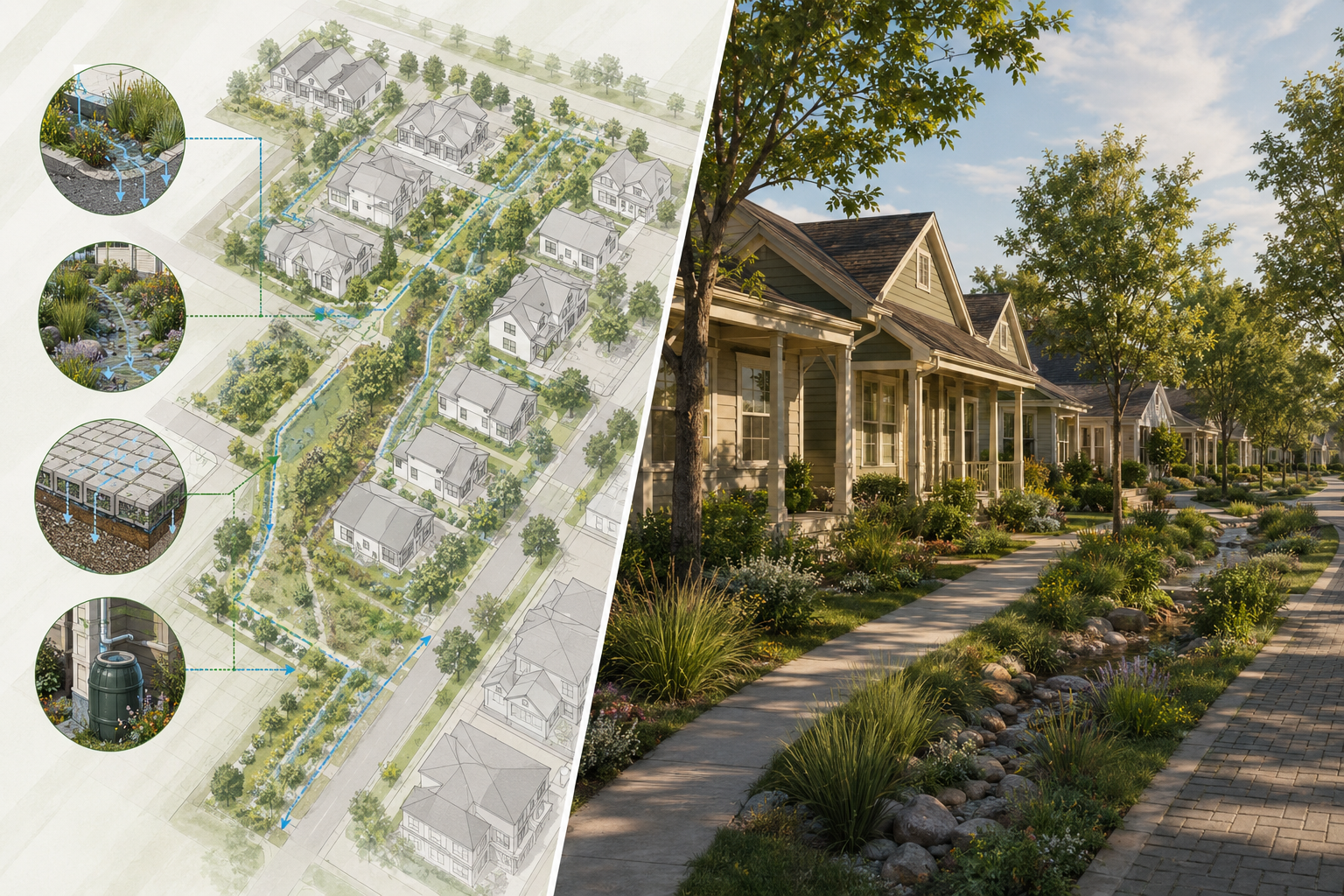
- Drainage and SuDS assessment: Sustainable Drainage Systems are a planning requirement on most new developments. Surveyors must map existing watercourses, assess infiltration rates, and identify opportunities for permeable paving, bioswales, and attenuation ponds.
- Flood risk topographic modelling: BTR sites in growth corridors often sit adjacent to flood-prone areas. Accurate topographic data is the foundation of any credible flood risk assessment.
- Ecology and habitat surveys: Large greenfield BTR parcels may contain protected habitats or species. Early identification prevents costly planning delays.
- Ground condition and contamination screening: Former agricultural or industrial land requires Phase 1 and potentially Phase 2 environmental surveys before development can proceed.
Compliance with building regulations is another area where surveyors play a critical role. On BTR sites, where hundreds of units must meet the same regulatory standards, a systematic approach to compliance checking is far more efficient than unit-by-unit assessment. Chartered surveyors with BTR experience can develop site-wide compliance frameworks that streamline the inspection process.
Stock Condition Surveys for Completed BTR Assets
Once a BTR community is built and occupied, the asset management phase begins. Institutional landlords managing hundreds of rental homes need a clear, ongoing picture of the physical condition of their portfolio. A stock condition survey provides exactly this — a systematic assessment of the condition of every unit and shared space, identifying maintenance liabilities and capital expenditure requirements.
For BTR operators, stock condition surveys serve multiple functions:
- Asset management planning: Identifying which components — roofs, cladding, mechanical systems — will require replacement within a defined investment horizon.
- Investor reporting: Demonstrating to institutional backers that the physical asset is being maintained to the required standard.
- Dilapidations management: Establishing a baseline condition record that supports dilapidations assessments when tenancies end.
- Regulatory compliance: Meeting landlord obligations under housing and health and safety legislation.
"A stock condition survey on a BTR community is not a one-time exercise — it is the foundation of a long-term asset management strategy that protects both the physical investment and the rental income stream."
Damp and Structural Monitoring in Rental Communities
High-density rental communities present specific challenges around damp, condensation, and structural performance. With many units sharing party walls and roof structures, a damp problem in one unit can indicate a systemic issue affecting multiple properties. Surveyors conducting damp surveys on BTR assets must approach the assessment with this systemic perspective in mind.
Early identification of damp and moisture ingress is particularly important in BTR communities because:
- Tenant turnover creates windows of inspection opportunity that owner-occupied properties do not have.
- Institutional landlords face reputational and regulatory risk if damp issues are not addressed promptly.
- The cost of remediation scales significantly if a systemic defect — such as a failed cavity tray or inadequate ventilation design — is not identified early.
Navigating the 2026 BTR Boom: Strategic Positioning for Surveyors
Understanding Developer Timelines and Entry Points
Surveying for Build-to-Rent Communities: Navigating the 2026 Boom in Rental Developments requires more than technical competence — it requires an understanding of how BTR development programmes are structured and where surveying services are most needed.
The typical BTR development timeline creates multiple surveying entry points:
Pre-acquisition phase: Feasibility topographic surveys, boundary reviews, and desktop environmental assessments. Developers need rapid turnaround at this stage to support land bids.
Planning phase: Full topographic surveys, drainage modelling, ecology assessments, and planning support surveys. This is the most technically intensive phase for surveyors.
Construction phase: Setting-out surveys, infrastructure monitoring, and building regulations compliance inspections. Construction surveying expertise is critical here.
Operational phase: Stock condition surveys, condition monitoring, and dilapidations assessments as the asset matures.
Surveyors who position themselves as long-term partners across all four phases — rather than one-off service providers — are best placed to build sustainable relationships with BTR developers and operators.
Regional Hotspots and Market Intelligence
The geographic concentration of BTR activity in 2026 gives surveyors clear signals about where demand is strongest. In the US, the Southern states dominate the pipeline [10], with Texas, North Carolina, Arizona, and South Carolina all seeing significant new BTR ground-breakings in the first half of 2026 [1][2][3][4][8]. In the UK, BTR activity is concentrated in major urban centres and their commuter belts, where affordability pressures are most acute.
NexMetro Communities began pre-leasing Avilla Bella Camino, a 229-unit BTR community in San Tan Valley, Arizona, in May 2026, with rents starting in the high $1,700s for a one-bedroom unit [6]. This pricing reflects the affordability gap that is driving BTR demand — households who cannot afford to purchase are seeking high-quality rental alternatives, and developers are responding at scale.
Avanta Residential's $7 million preferred equity investment in the Amare Rio Rancho BTR community in New Mexico — a 128-unit development offering a mix of townhomes and detached patio homes — illustrates how smaller markets are also attracting institutional capital [5].
For surveyors, monitoring BTR pipeline data from sources such as RealPage, CoStar, and local planning portals provides advance notice of where surveying demand will emerge. Building relationships with BTR developers before they break ground — rather than responding to tenders after the fact — is the most effective business development strategy in this sector.
The Role of Chartered Surveyors in BTR Quality Assurance
The scale and institutional nature of BTR investment means that developers and their backers demand rigorous quality assurance. Chartered surveyors with RICS accreditation are well positioned to provide the independent technical oversight that institutional investors require.
This includes:
- Independent monitoring surveyor roles during construction
- Pre-completion inspections of individual units against specification
- Defect liability period inspections
- Expert witness services in the event of construction disputes
The condition survey report is a particularly valuable tool in the BTR context, providing a documented record of property condition at key stages of the development and operational lifecycle.
Conclusion
The build-to-rent sector's 2026 expansion is creating a sustained and growing demand for specialist surveying expertise across the entire development lifecycle. From the first topographic assessment of a raw land parcel to the ongoing stock condition monitoring of a mature rental community, surveyors are embedded in every stage of the BTR process.
Actionable next steps for surveyors looking to capitalise on the 2026 BTR boom:
- Develop BTR-specific service packages that address the full development lifecycle — from pre-acquisition feasibility surveys through to operational stock condition assessments.
- Invest in technology — drone LiDAR, GIS capability, and AI-assisted data analysis are no longer optional on large BTR sites. Surveyors who cannot offer these tools will lose instructions to those who can.
- Build sustainability competence — ESG requirements from institutional investors mean that drainage, ecology, and environmental surveys are now core BTR deliverables, not optional extras.
- Monitor the pipeline actively — use RealPage, local planning portals, and developer press releases to identify BTR projects in your geographic market before they go to tender.
- Position as a long-term partner — BTR operators manage assets for decades. Surveyors who build relationships across the full asset lifecycle generate far more value — and revenue — than those who engage only at the construction phase.
The affordability crisis driving BTR demand is not a short-term phenomenon. The structural shift toward institutional rental housing is reshaping residential development, and surveyors who align their skills and services with this shift will find themselves at the centre of one of the most active sectors in property for years to come.
References
[1] Legacy Mcs Completes Two Build To Rent Communities In Hutto As Growth Accelerates Across Central Texas – https://www.globenewswire.com/news-release/2026/05/20/3298892/0/en/Legacy-MCS-Completes-Two-Build-to-Rent-Communities-in-Hutto-as-Growth-Accelerates-Across-Central-Texas.html?utm_source=openai
[2] Bridge Tower Expands Into Fate With 179 Home Luxury Build To Rent Community – https://www.mannpublications.com/mannreport/2026/03/17/bridge-tower-expands-into-fate-with-179-home-luxury-build-to-rent-community/?utm_source=openai
[3] Crescent Communities Closes On Land For Harmon Clemmons Its Second Build To Rent Community In North Carolina S Triad Region – https://www.crescentcommunities.com/media/press/crescent-communities-closes-on-land-for-harmon-clemmons-its-second-build-to-rent-community-in-north-carolina-s-triad-region/?utm_source=openai
[4] Trilogy Investment Company Breaks Ground On 73 Unit Build To Rent Community – https://www.wncbusiness.com/2026/01/21/560992/trilogy-investment-company-breaks-ground-on-73-unit-build-to-rent-community?utm_source=openai
[5] Avanta Residential Announces 70 Million Preferred Equity Investment In Amare Rio Rancho Build To Rent Community – https://www.avantaresidential.com/press/avanta-residential-announces-70-million-preferred-equity-investment-in-amare-rio-rancho-build-to-rent-community?utm_source=openai
[7] Cavan Companies Expands Midwest Platform With 153 Unit Build To Rent Community In Kansas City 302695305 – https://www.prnewswire.com/news-releases/cavan-companies-expands-midwest-platform-with-153-unit-build-to-rent-community-in-kansas-city-302695305.html?utm_source=openai
[9] Investors Return To Build To Rent As Rates Stabilize – https://www.globest.com/2026/03/27/investors-return-to-build-to-rent-as-rates-stabilize/?utm_source=openai
[10] Btr Under Construction 2026 – https://www.realpage.com/analytics/btr-under-construction-2026/?utm_source=openai