


By 2026, the UK has more than 1.2 million home battery storage systems installed — and that number is climbing fast alongside a surge in electric vehicle (EV) charging points fitted to terraced and semi-detached properties across London and beyond. For millions of homeowners sharing walls with neighbours, this energy revolution is quietly creating a legal minefield. Party Wall Awards for Battery Storage and EV Infrastructure: Surveyor Strategies in 2026 Energy Boom has become one of the most pressing topics in property law, as surveyors navigate new technical risks, updated RICS guidance, and complex cost-sharing disputes that the Party Wall Act 1996 was never originally designed to handle.
This article breaks down exactly what building owners, adjoining owners, and party wall surveyors need to know — from notice requirements and schedules of condition to excavation risks and the landmark RICS 8th Edition consultation that is reshaping professional practice in 2026.
Key Takeaways
- ⚡ Home battery storage and EV charging installations near shared walls can trigger the Party Wall Act 1996, requiring formal notices and potentially a Party Wall Award.
- 📋 The RICS draft 8th Edition guidance (April 2026) introduces updated award templates and specifically addresses shared EV charging infrastructure in terraced developments.
- 🏗️ Excavation and vibration risks from battery installation groundworks near party walls demand thorough schedules of condition before work begins.
- 💷 The building owner pays all reasonable party wall costs, including the adjoining owner's surveyor fees — a rule that applies equally to energy infrastructure projects.
- 🔍 Surveyor independence is now more strictly enforced, with the new guidance cracking down on "notice-chasing" and ensuring awards cannot be challenged as ultra vires.
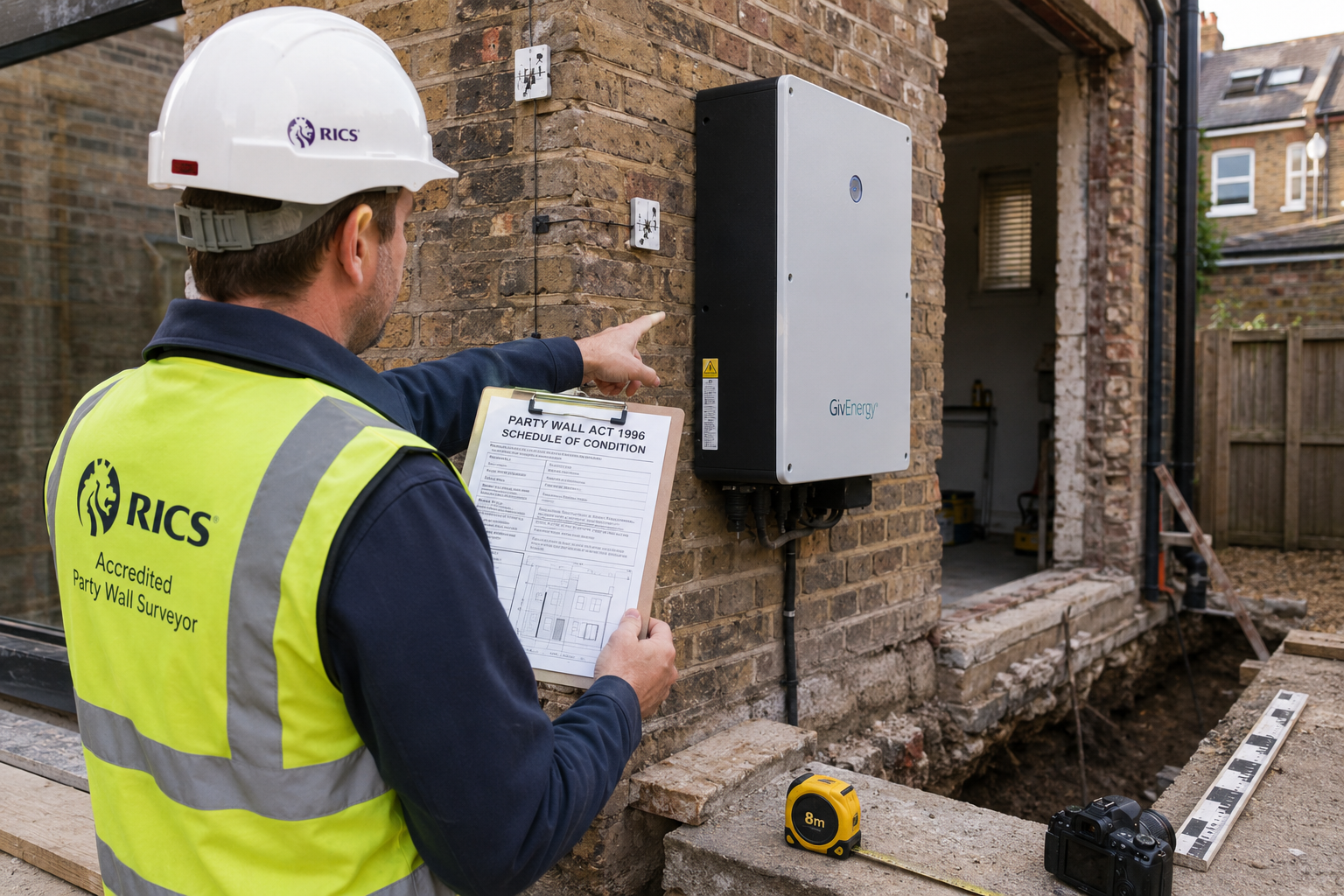
Why Battery Storage and EV Chargers Are Triggering the Party Wall Act in 2026
Most homeowners assume the Party Wall Act 1996 only applies to major building works — loft conversions, rear extensions, or basement excavations. In 2026, that assumption is increasingly wrong.
Installing a home battery storage unit (such as a Tesla Powerwall or similar system) often involves:
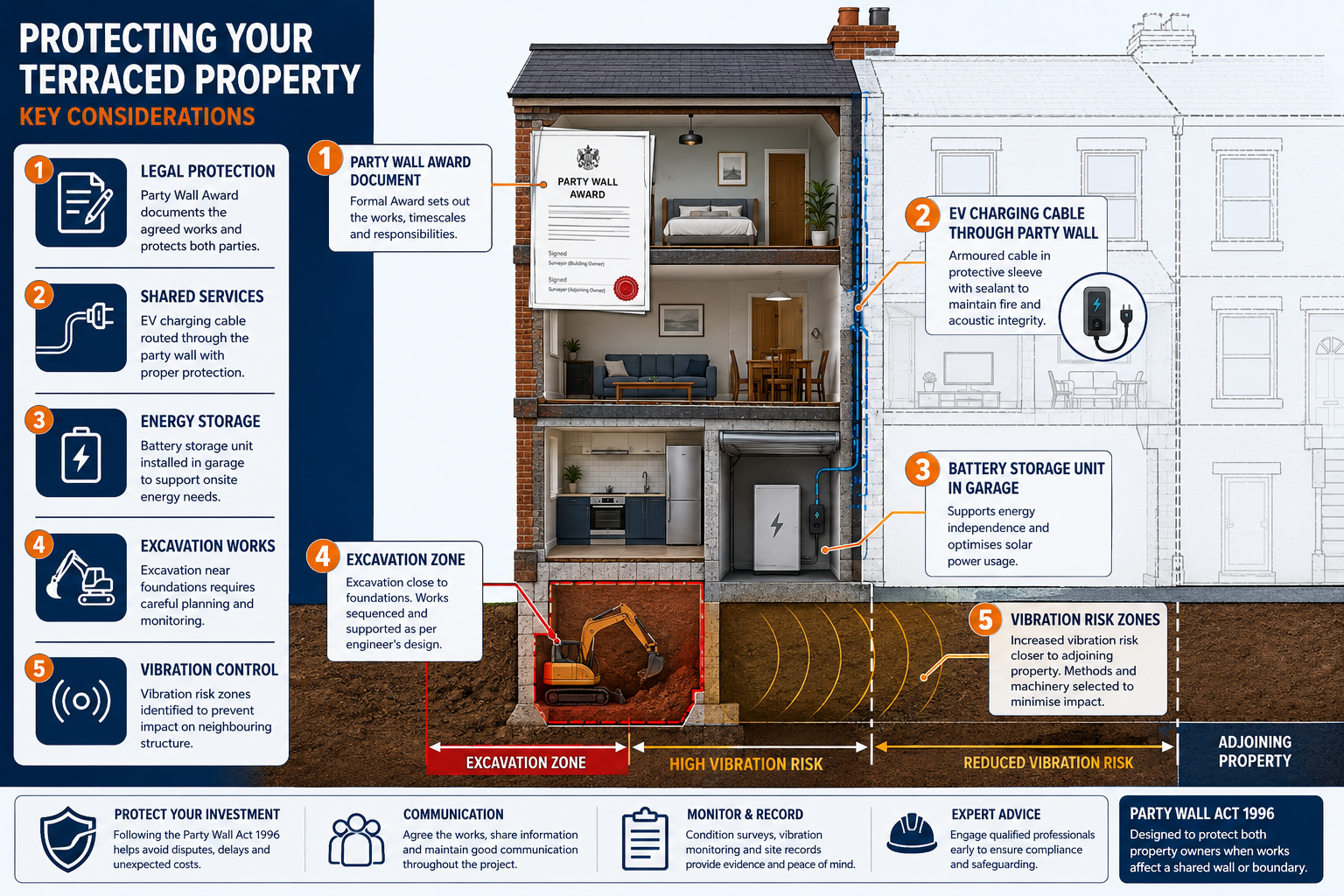
- Fixing heavy brackets or anchors into or near a party wall or party fence wall
- Running conduit or cabling through shared structures
- Groundworks or trenching for underground cabling within 3–6 metres of a neighbour's foundations
Similarly, shared EV charging infrastructure in terraced developments frequently requires:
- Drilling through party walls to route cables
- Installing shared ducting along boundary structures
- Excavating shared forecourts or driveways
Under the Party Wall Act 1996, any of these activities can trigger a legal obligation to serve a Party Wall Notice on adjoining owners before work begins. Failure to do so can result in injunctions, costly delays, and even legal action.
💬 "The energy transition is creating party wall disputes that didn't exist five years ago. Surveyors need to understand both the law and the technology." — Industry observation, 2026
When Does a Notice Become Mandatory?
The Act creates obligations under three main scenarios:
| Trigger | Relevant Section | Typical Energy Infrastructure Example |
|---|---|---|
| Works on or to a party wall | Section 2 | Fixing battery brackets into shared wall |
| New wall at boundary line | Section 1 | Installing shared EV charging pillar on boundary |
| Excavation near foundations | Section 6 | Trenching for underground EV cable ducts |
For a full breakdown of when formal notices are required, see when you need a Party Wall Agreement.
Schedules of Condition: The Critical First Step for Energy Infrastructure Projects
Before any battery storage groundworks or EV charging installation begins near a party wall, a Schedule of Condition is the most important protective document a surveyor can prepare. [1]
A schedule of condition records the exact pre-works state of the adjoining property, including:
- ✅ Existing cracks in walls, ceilings, and floors
- ✅ Settlement patterns and structural movement
- ✅ Condition of external surfaces and boundary structures
- ✅ Underground services (drainage, gas, electricity)
- ✅ Photographic evidence with date stamps
This document protects both parties. If vibration from battery installation groundworks causes a crack to appear in a neighbour's kitchen wall, the schedule of condition determines whether that crack was pre-existing or caused by the works. Without it, disputes become expensive and difficult to resolve. [4]
For energy infrastructure projects affecting multiple properties — such as a shared EV charging network across a terraced row — surveyors are now conducting comprehensive multi-property schedules, documenting mechanical systems and underground services in detail. [3]
Learn more about what a thorough schedule of condition covers and why it matters before any works begin.
Vibration and Excavation Risks Specific to Energy Projects
Battery storage systems and EV infrastructure present unique vibration and excavation risks that standard residential party wall work does not always involve:
Vibration risks:
- Drilling into masonry for heavy battery wall mounts
- Using percussive tools near shared brick or stone walls
- Installing ground anchors or footings for EV charging pedestals
Excavation risks:
- Trenching for underground cabling within the 3-metre and 6-metre zones defined by Section 6 of the Act
- Disturbing existing drainage or utility runs near shared foundations
- Weakening load-bearing soil in older terraced properties
In terraced London properties — particularly Victorian and Edwardian stock — shared walls are often in a more fragile condition than they appear. A building survey carried out before works can identify hidden vulnerabilities that a schedule of condition alone may not capture.
Party Wall Awards for Battery Storage and EV Infrastructure: Surveyor Strategies in 2026 Energy Boom — The RICS 8th Edition Update
In April 2026, the Royal Institution of Chartered Surveyors (RICS) launched a formal consultation on the draft 8th Edition of "Party Wall Legislation & Procedure." This is the most significant update to professional guidance in years, and it directly addresses the challenges created by the 2026 energy boom. [1]
Key Changes in the Draft 8th Edition
1. EV Charging Infrastructure Addressed Directly
For the first time, the RICS guidance specifically covers shared EV charging infrastructure in terraced developments, focusing on fair cost allocation among adjoining owners. Where a shared charging system benefits multiple properties, the guidance provides a framework for apportioning costs equitably rather than placing the entire burden on a single building owner. [2]
2. Stronger Surveyor Independence Rules
The draft 8th Edition reinforces that a party wall surveyor's appointment is personal and statutory. This means surveyors must act independently — they cannot simply follow client instructions. This is particularly important in energy infrastructure projects, where developers or energy companies may attempt to pressure appointed surveyors toward expedient outcomes. [1]
3. Updated Award Templates
The new edition includes:
- Revised letters of appointment
- Updated terms of engagement
- A new draft Award document template designed to improve consistency across the profession [1]
These templates are especially useful for battery storage and EV infrastructure awards, which involve technical specifications (load ratings, cable specifications, vibration limits) that older award templates were not designed to accommodate.
4. Jurisdiction Clarifications to Prevent Ultra Vires Awards
Recent legal cases have seen Party Wall Awards challenged because surveyors acted outside their jurisdiction. The 8th Edition addresses this directly, providing clearer boundaries to prevent awards being overturned in court — a risk that is amplified when surveyors deal with novel energy infrastructure scenarios they may not have encountered before. [1]
5. Cracking Down on "Notice-Chasing"
The guidance strengthens requirements around transparent fee practices and proper notice service, targeting the practice of surveyors proactively soliciting party wall work by approaching adjoining owners uninvited. [1]
Surveyor Appointment Models for Energy Projects
The Party Wall Act offers three appointment models. For complex energy infrastructure projects, the choice matters: [3]
| Model | How It Works | Best For |
|---|---|---|
| Agreed Surveyor | Single surveyor acts for both parties | Simple, low-risk battery installations |
| Two Surveyors | Each party appoints their own | Shared EV infrastructure, higher-risk excavations |
| Third Surveyor | Appointed in case of dispute | Escalated disagreements on cost or method |
For most shared EV charging schemes across terraced rows, the two-surveyor model tends to produce the most balanced outcomes, as each party has independent professional representation. [3]
💬 "The two-surveyor approach isn't adversarial — it's a structured way to ensure both building and adjoining owners get fair, independent advice on complex energy works."
Working Hours and Practical Award Conditions
Party Wall Awards for energy infrastructure projects typically include strict working hours restrictions to protect adjoining owners from unreasonable disruption: [4]
- 🕗 Monday to Friday: 8:00 am – 6:00 pm (noisy works)
- 🕗 Saturday: 8:00 am – 1:00 pm (noisy works)
- 🚫 Sunday and Bank Holidays: No noisy works permitted
Awards also commonly specify:
- Maximum vibration levels during drilling or groundworks
- Dust and debris management protocols
- Notification requirements before each phase of work begins
- Access rights for post-works inspection
Cost Allocation and Fee Transparency in 2026 Energy Projects
One of the most common sources of confusion — and dispute — in party wall matters is who pays for what. The rule under the Party Wall Act is clear: the building owner bears all reasonable costs, including: [4]
- Their own surveyor's fees
- The adjoining owner's surveyor's fees
- Award preparation costs
- Third surveyor fees (if required)
- Land Registry search fees
For energy infrastructure projects, this cost structure can become complex. A developer installing a shared EV charging network across ten terraced properties may face ten separate sets of adjoining owner surveyor fees. Understanding this exposure upfront is essential for project budgeting.
For guidance on party wall costs and what to expect from the process, consulting a qualified surveyor early can prevent expensive surprises later.
Choosing the Right Surveyor for Energy Infrastructure Work
Not every party wall surveyor has the technical background to handle battery storage or EV infrastructure projects competently. In 2026, the most effective surveyors in this space combine: [3]
- RICS membership and up-to-date CPD on the 8th Edition guidance
- Experience with utilities and energy infrastructure projects
- Knowledge of relevant health and safety regulations (including electrical safety standards)
- Familiarity with vibration monitoring and structural risk assessment
For those seeking party wall surveyors in London with the right credentials, verifying RICS membership and relevant project experience is the essential first step.
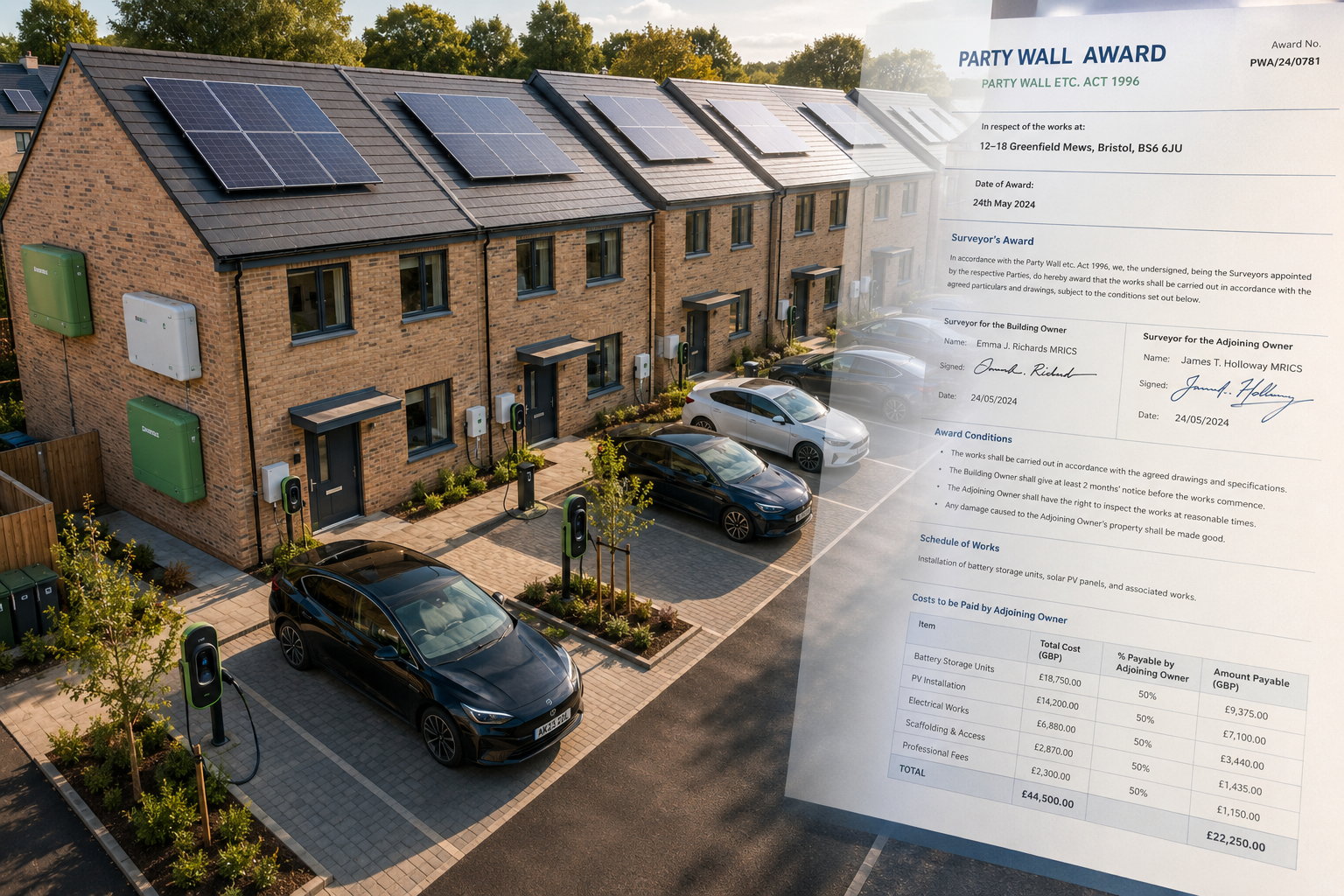
Practical Strategies: Applying Party Wall Awards for Battery Storage and EV Infrastructure in the 2026 Energy Boom
Here is a step-by-step strategic framework for building owners, developers, and surveyors navigating energy infrastructure party wall matters in 2026:
Step 1: Early Legal Assessment 🔍
Before any design work is finalised, assess whether the proposed battery storage or EV charging installation will:
- Affect a party wall or party fence wall
- Involve excavation within 3–6 metres of an adjoining foundation
- Require penetrating or fixing into any shared structure
Use the Party Wall Act guide to map the legal triggers against the specific installation design.
Step 2: Serve Correct Notices on Time ⏰
- Section 1 Notice: At least one month before works begin (new boundary wall)
- Section 2 Notice: At least two months before works begin (works to existing party wall)
- Section 6 Notice: At least one month before excavation begins
Notices must be served correctly — errors in form or timing can invalidate the process and expose the building owner to legal risk. For guidance on what to do when you receive a Party Wall Notice, both parties should understand their rights from the outset.
Step 3: Commission a Thorough Schedule of Condition 📸
Before any groundworks, drilling, or vibration-generating activity begins, a detailed schedule of condition must be completed and agreed. For shared EV infrastructure projects, this should cover every adjoining property in the affected row.
Step 4: Draft a Technically Specific Award 📄
The Party Wall Award for energy infrastructure should go beyond standard residential award language to include:
- Technical specifications for the battery or EV system
- Vibration and noise limits during installation
- Cable routing and penetration details
- Post-works reinstatement obligations
- Access rights for inspection and maintenance
Step 5: Monitor and Document Throughout Works 📊
Appoint a surveyor to conduct periodic monitoring visits during the works, particularly during any excavation or heavy drilling phases. This provides an ongoing record that protects both parties if damage claims arise later.
Conclusion: Actionable Next Steps for 2026
The intersection of the UK's energy transition and the Party Wall Act 1996 is creating new challenges — and new opportunities — for property owners and surveyors alike. Party Wall Awards for Battery Storage and EV Infrastructure: Surveyor Strategies in 2026 Energy Boom is not a niche concern: it affects every terraced homeowner considering a battery system or EV charger, and every developer planning shared energy infrastructure in residential settings.
Here is what to do right now:
- ✅ Assess your project early — determine whether the Party Wall Act applies before committing to an installation design.
- ✅ Engage a qualified RICS surveyor with specific experience in energy infrastructure and the updated 8th Edition guidance.
- ✅ Serve notices correctly and on time — errors here are costly and avoidable.
- ✅ Commission a schedule of condition before any works begin, covering all adjoining properties.
- ✅ Budget for all party wall costs upfront, including adjoining owner surveyor fees.
- ✅ Ensure your Party Wall Award is technically specific to the energy installation, not just a generic residential template.
The 2026 energy boom is not slowing down. Getting the party wall process right from the start protects your investment, your neighbours' properties, and your legal position throughout.
References
[1] Viewcompounddoc – https://consultations.rics.org/party_walls_8th_edition_guidance/viewCompoundDoc?clientUID=&docid=16799988&partid=16802804&sessionid=&voteid=&utm_source=openai
[2] Party Wall Awards Explained Surveyor Roles Notice Periods And Dispute Resolution Under 2026 RICS Guidance – https://wimbledonsurveyors.com/party-wall-awards-explained-surveyor-roles-notice-periods-and-dispute-resolution-under-2026-rics-guidance/?utm_source=openai
[3] Party Wall Surveys For 2026 Infrastructure Expansions Navigating Utilities And Energy Projects – https://www.canterburysurveyors.com/blog/party-wall-surveys-for-2026-infrastructure-expansions-navigating-utilities-and-energy-projects/?utm_source=openai
[4] Party Wall Act 1996 Step By Step Guide To Notices Awards And Surveyor Models For 2026 Projects – https://wimbledonsurveyors.com/party-wall-act-1996-step-by-step-guide-to-notices-awards-and-surveyor-models-for-2026-projects/?utm_source=openai
[5] How To Choose The Right Party Wall Surveyor Simple Surveys Advice Guide – https://www.simplesurvey.co.uk/uncategorised/how-to-choose-the-right-party-wall-surveyor-simple-surveys-advice-guide/?utm_source=openai
[6] Party Wall Awards Explained – https://www.partywallagreementlondon.co.uk/blog/party-wall-awards-explained.html?utm_source=openai
[7] How Much Does Party Wall Surveyor Cost – https://www.metsurveyors.co.uk/post/how-much-does-party-wall-surveyor-cost?utm_source=openai