
Over 4.6 million households in England rent privately — and as of 2026, every single landlord managing those properties must now navigate a new national registration system that directly intersects with one of the most procedurally rigid areas of property law: the Party Wall etc. Act 1996. The collision between Party Wall Surveyor Duties Under Private Rented Sector Database: Registration Impacts from Renters' Rights Act 2026 is not theoretical. It is already reshaping how surveyors verify ownership, how awards are served, and how dispute timelines are managed across the country.
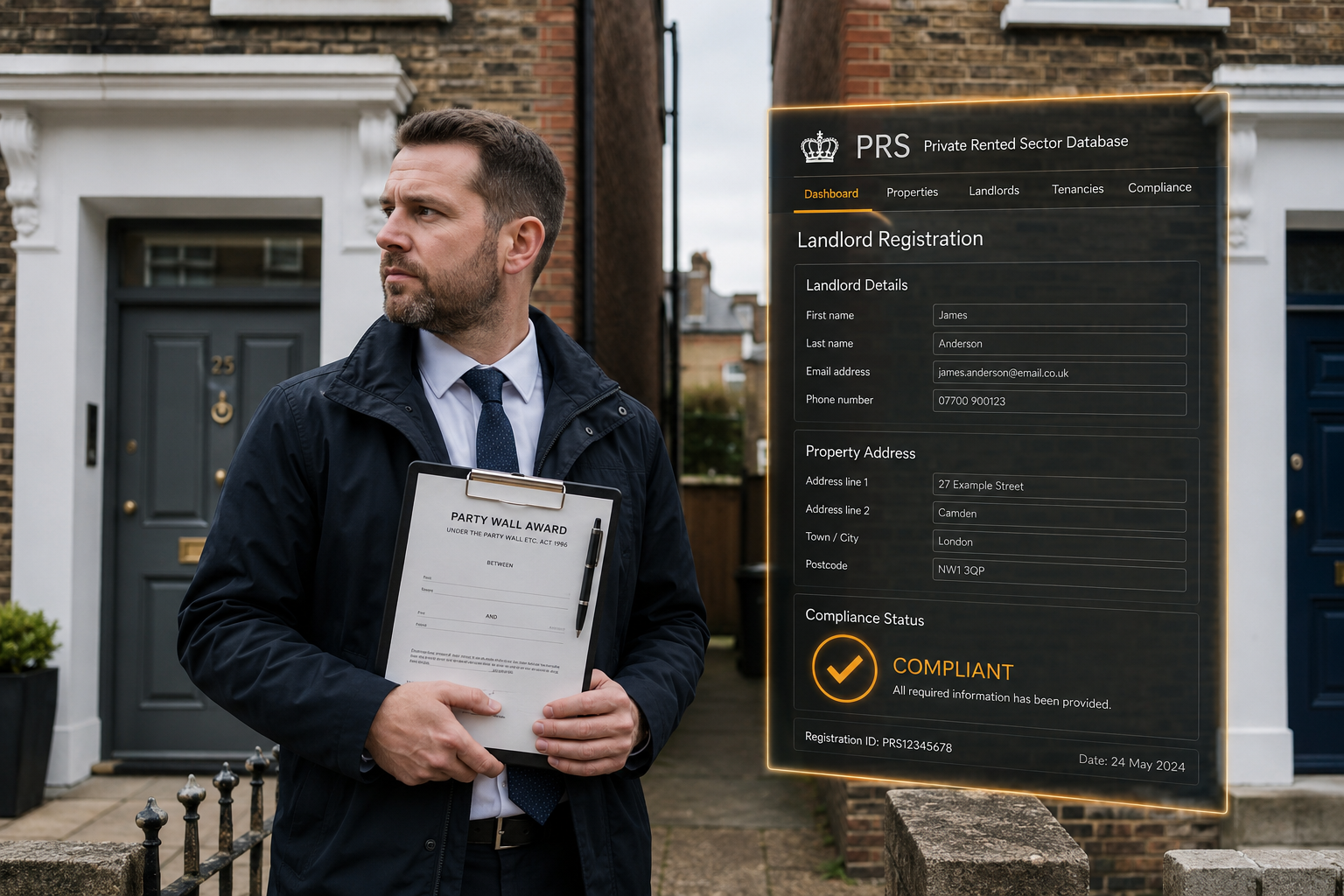
Key Takeaways 📋
- The Private Rented Sector (PRS) Database, launching late 2026, requires all landlords to register themselves and their rental properties on a national system [2].
- Party wall surveyors must now verify landlord registration status before serving notices and awards to ensure correct legal identity and address.
- The abolition of Section 21 'no fault' evictions from May 1, 2026 changes the legal landscape for landlords involved in party wall disputes [1].
- Award timelines may be affected where landlord registration is incomplete, creating procedural risks for building owners and adjoining owners alike.
- Surveyors operating across London and beyond need updated compliance workflows to align party wall procedures with the new rental sector framework.
Understanding the Renters' Rights Act 2026 and the PRS Database
The Renters' Rights Act 2026 represents the most significant overhaul of the private rental sector in a generation. Its provisions are wide-ranging, but for party wall professionals, two elements stand out above all others.
The Private Rented Sector Database: What It Is
Scheduled for rollout in late 2026, the PRS Database is a mandatory national register requiring all landlords to register both themselves and their rental properties [2]. The database is designed to improve transparency, accountability, and enforcement across the sector. Local authorities gain enhanced powers to investigate non-compliant landlords, with higher fines available for breaches [1].
For party wall surveyors, this database becomes a critical verification tool. When a building owner undertakes notifiable works — such as excavations near a boundary, loft conversions, or structural alterations to a shared wall — the adjoining owner's legal identity must be correctly established. If that adjoining owner is a landlord, their registered details on the PRS Database become the authoritative source for:
- Confirming the correct legal name for party wall notices
- Establishing a verified correspondence address for award service
- Identifying whether a property is tenanted, which affects access arrangements
Key Provisions Affecting Landlord Identity and Property Status
| Renters' Rights Act 2026 Provision | Relevance to Party Wall Process |
|---|---|
| Mandatory PRS Database registration [2] | Confirms landlord identity for notice service |
| Written tenancy information requirement [3] | Establishes tenant occupancy status |
| Assured periodic tenancies (rolling agreements) [1] | Affects access negotiation timelines |
| Strengthened local authority enforcement [1] | Creates compliance pressure on unregistered landlords |
| Landlord Ombudsman Scheme [2] | Alternative dispute pathway for tenant-related access disputes |
💡 Pull Quote: "A party wall award served to the wrong legal entity — or to an unregistered landlord's outdated address — risks being legally defective. The PRS Database removes that uncertainty."
How Party Wall Surveyor Duties Under Private Rented Sector Database Registration Impacts from Renters' Rights Act 2026 Change Verification Workflows
The practical effect of the Renters' Rights Act 2026 on party wall surveyor duties is most visible in the pre-notice verification stage. Before the Act, surveyors relied on Land Registry records, electoral roll data, and correspondence history to identify adjoining owners. These remain valid tools, but the PRS Database adds a new mandatory layer.
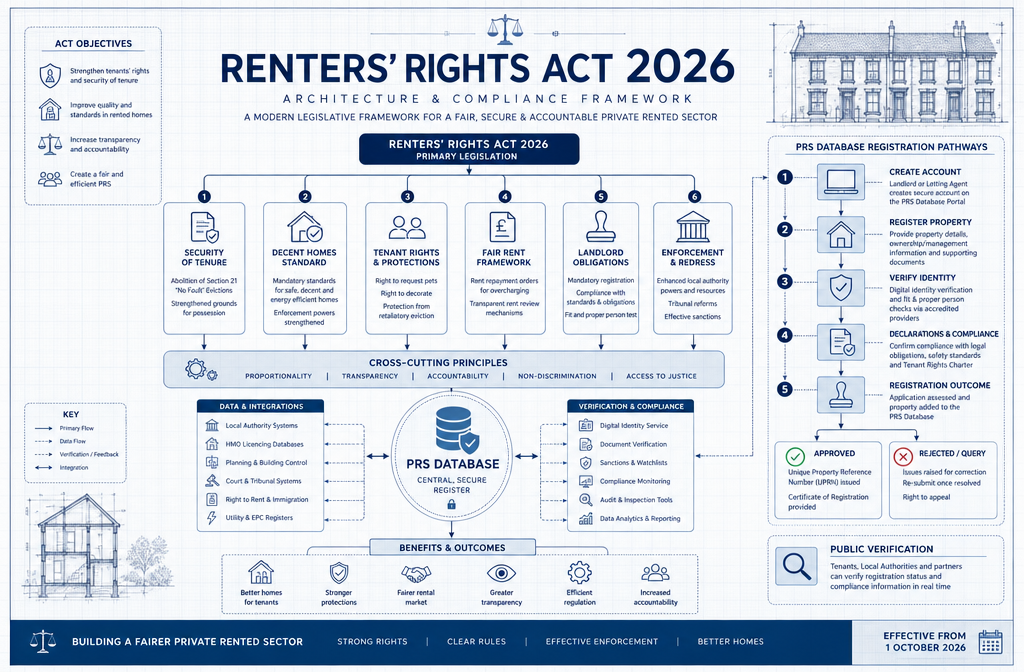
Step-by-Step: Updated Verification Protocol
Step 1 — Land Registry Search
Confirm the registered proprietor of the adjoining property. This remains the foundational step.
Step 2 — PRS Database Cross-Reference (New for 2026)
Check whether the registered proprietor appears on the PRS Database as a landlord. If the property is tenanted, the database will confirm the landlord's registered name and contact address.
Step 3 — Tenancy Status Confirmation
Under the Act, landlords must provide tenants with written tenancy information including the landlord's name and address [3]. Surveyors can request this documentation from tenants where access or occupancy status is in dispute.
Step 4 — Notice Service
Party wall notices must be served on the owner of the adjoining property, not the tenant. Where a landlord is registered on the PRS Database, that registered address becomes the correct service address.
Step 5 — Award Execution
The party wall award must name the correct legal parties. An award naming an unregistered or incorrectly identified landlord may be challenged.
What Happens When a Landlord Is Not Yet Registered?
The PRS Database launches late 2026, meaning a transitional period exists. During this window, some landlords may not yet be registered. In these cases, surveyors should:
- ✅ Rely on Land Registry data as the primary source
- ✅ Document all verification steps taken
- ✅ Serve notice by recorded delivery to the registered address and the property itself
- ✅ Note in the award that PRS registration was checked and the outcome
Unregistered landlords face enforcement action from local authorities [1], but this does not invalidate a party wall notice served in good faith to their last known address. Understanding party wall surveyor responsibilities in this context is essential for risk management.
Section 8 Notices, Eviction Grounds, and Party Wall Dispute Timelines
One of the most significant indirect impacts of the Renters' Rights Act 2026 on party wall practice relates to the abolition of Section 21 'no fault' evictions, which took effect on May 1, 2026 [1]. Landlords can now only recover possession through Section 8 notices, citing specific legal grounds such as rent arrears or anti-social behaviour.
Why This Matters for Party Wall Surveyors
Consider this scenario: a landlord-owned adjoining property is tenanted. The building owner serves a party wall notice. The landlord, simultaneously pursuing a Section 8 eviction of their tenant, is focused on possession proceedings. This creates several complications:
- Access for surveys: Under the Party Wall etc. Act 1996, surveyors may need access to the adjoining property to prepare a schedule of condition. Where possession proceedings are active, tenant cooperation may be limited.
- Award service timing: If a tenant vacates mid-dispute, the landlord's registered PRS Database address becomes even more critical for ongoing correspondence.
- Dispute escalation risk: A landlord distracted by Section 8 proceedings may fail to respond to party wall notices within the statutory 14-day period, triggering a deemed dispute and the appointment of surveyors.
⚠️ Important: The transition to assured periodic tenancies (rolling agreements with no fixed end date) [1] means tenants can end their tenancy with two months' notice at any time. This increases the likelihood of mid-dispute occupancy changes at adjoining properties.
Rent Increases and Their Indirect Effect
Landlords are now limited to one rent increase per year with two months' notice [1]. While this has no direct bearing on party wall law, it does affect landlord-tenant relationships. A landlord who has recently issued a rent increase notice may face a less cooperative tenant when access for party wall surveys is required. Experienced party wall surveyors in London are already factoring this into their access negotiation strategies.
Practical Guidance for Surveyors: Navigating the New Compliance Landscape

The intersection of party wall law and the Renters' Rights Act 2026 demands updated practice protocols. Below is practical guidance for surveyors working in this environment.
Updating Appointment and Award Templates
All standard party wall award templates should be reviewed to include:
- A field for the adjoining owner's PRS Database registration number (where applicable)
- A declaration confirming the verification steps taken to establish the owner's identity
- Provisions for mid-dispute occupancy changes
Communicating with Tenants vs. Landlords
The Party Wall etc. Act 1996 is clear: the owner is the relevant party, not the tenant. However, the Renters' Rights Act 2026 strengthens tenant rights in ways that affect practical access:
- Tenants now have greater security of tenure under assured periodic tenancies [1]
- Landlords cannot discriminate against tenants with children or those on benefits [1] — surveyors should be sensitive to household circumstances when arranging access
- The Landlord Ombudsman Scheme [2] provides tenants with a formal complaints route; surveyors should ensure their conduct does not inadvertently create grounds for a complaint
Working with the Landlord Ombudsman Scheme
The Landlord Ombudsman Scheme, also launching in late 2026 [2], provides a non-court dispute resolution pathway. While primarily designed for landlord-tenant disputes, it may become relevant where:
- A tenant alleges that party wall works have made a property uninhabitable
- A landlord uses the scheme to resolve a dispute with a building owner that overlaps with their tenancy obligations
Surveyors should be aware of this pathway and understand that their awards may be referenced in ombudsman proceedings. For guidance on legal requirements for boundary walls and related compliance, staying current with RICS guidance is essential.
Geographic Considerations: London Focus
The density of tenanted properties in London makes the PRS Database particularly significant for party wall practice in the capital. Areas with high concentrations of private rentals — including Hackney, Southwark, Newham, and Brent — will see the highest volume of cases where PRS Database verification is required.
Surveyors operating across these boroughs should establish direct relationships with local authority enforcement teams, who now have enhanced powers to confirm landlord registration status [1].
Key Risks and How to Mitigate Them
Understanding construction project legal requirements in the context of the new rental sector framework helps surveyors anticipate and manage the following risks:
Risk Table: Party Wall Process Under PRS Database Framework
| Risk | Likelihood | Impact | Mitigation |
|---|---|---|---|
| Notice served to wrong landlord address | Medium | High — award may be defective | Cross-reference Land Registry with PRS Database |
| Mid-dispute tenant vacates | High in 2026 | Medium — access disruption | Build access provisions into award |
| Landlord fails to respond (distracted by Section 8) | Medium | Medium — deemed dispute triggered | Document all service attempts |
| PRS Database not yet live for all landlords | High in transition period | Low if documented | Rely on Land Registry; document verification |
| Award naming incorrect legal entity | Low | High — legal challenge risk | Verify registration before finalising award |
The Broader Regulatory Picture: What Surveyors Must Track in 2026
Beyond the PRS Database, the Renters' Rights Act 2026 introduces several provisions that create an evolving compliance environment:
- Ban on rental bidding [4]: Landlords must publish an asking rent and cannot accept above-asking bids. This affects property values and, indirectly, the cost-benefit analysis of party wall works.
- Limits on rent in advance [4]: Capped at one month's rent, payable only after a tenancy agreement is signed. This affects landlord cash flow and their capacity to fund works.
- Pet ownership rights [1]: Tenants can request pets; landlords cannot unreasonably refuse. Surveyors arranging property access should be aware of potential animal-related complications.
- Prohibition on discrimination [1]: Landlords cannot refuse tenants based on benefits receipt or having children. This shapes the demographic profile of tenanted adjoining properties.
For surveyors seeking to stay ahead of these changes, resources from expert party wall advisors and RICS-accredited professionals provide the most reliable guidance.
Conclusion: Actionable Next Steps for Party Wall Surveyors in 2026
The Party Wall Surveyor Duties Under Private Rented Sector Database: Registration Impacts from Renters' Rights Act 2026 represent a genuine and immediate shift in professional practice. The days of relying solely on Land Registry data to identify adjoining owners are giving way to a multi-source verification model anchored by the new PRS Database.
Immediate Actions for Surveyors ✅
- Update verification checklists to include PRS Database cross-referencing as a standard pre-notice step.
- Revise award templates to record landlord registration status and verification methodology.
- Brief clients — particularly building owners — on how the new rental sector framework may affect notice timelines and access arrangements.
- Monitor the PRS Database rollout closely; RICS guidance [2] will be updated as the system goes live.
- Engage with local authority enforcement teams in high-rental boroughs to establish information-sharing protocols.
- Review access provisions in all active awards where the adjoining property is tenanted, given the increased likelihood of mid-dispute occupancy changes under assured periodic tenancies.
The Renters' Rights Act 2026 is not a party wall statute — but its reach into landlord identity, property registration, and tenant rights creates a compliance environment that every party wall surveyor must understand. Those who adapt their workflows now will be better positioned to deliver legally robust awards and protect their clients from procedural challenge.
References
[1] Renters Rights Act Overview For Tenants – https://www.gov.uk/guidance/renters-rights-act-overview-for-tenants?utm_source=openai
[2] Renters Rights Act Implementation Roadmap – https://ww3.rics.org/uk/en/journals/property-journal/renters-rights-act-implementation-roadmap.html?utm_source=openai
[3] The Renters Rights Act Information Sheet 2026 – https://www.gov.uk/government/publications/the-renters-rights-act-information-sheet-2026?utm_source=openai
[4] Renters Rights Act – https://www.wigan.gov.uk/Resident/Housing/Private-Sector-Housing/Tenants/Renters-Rights-Act.aspx?utm_source=openai