

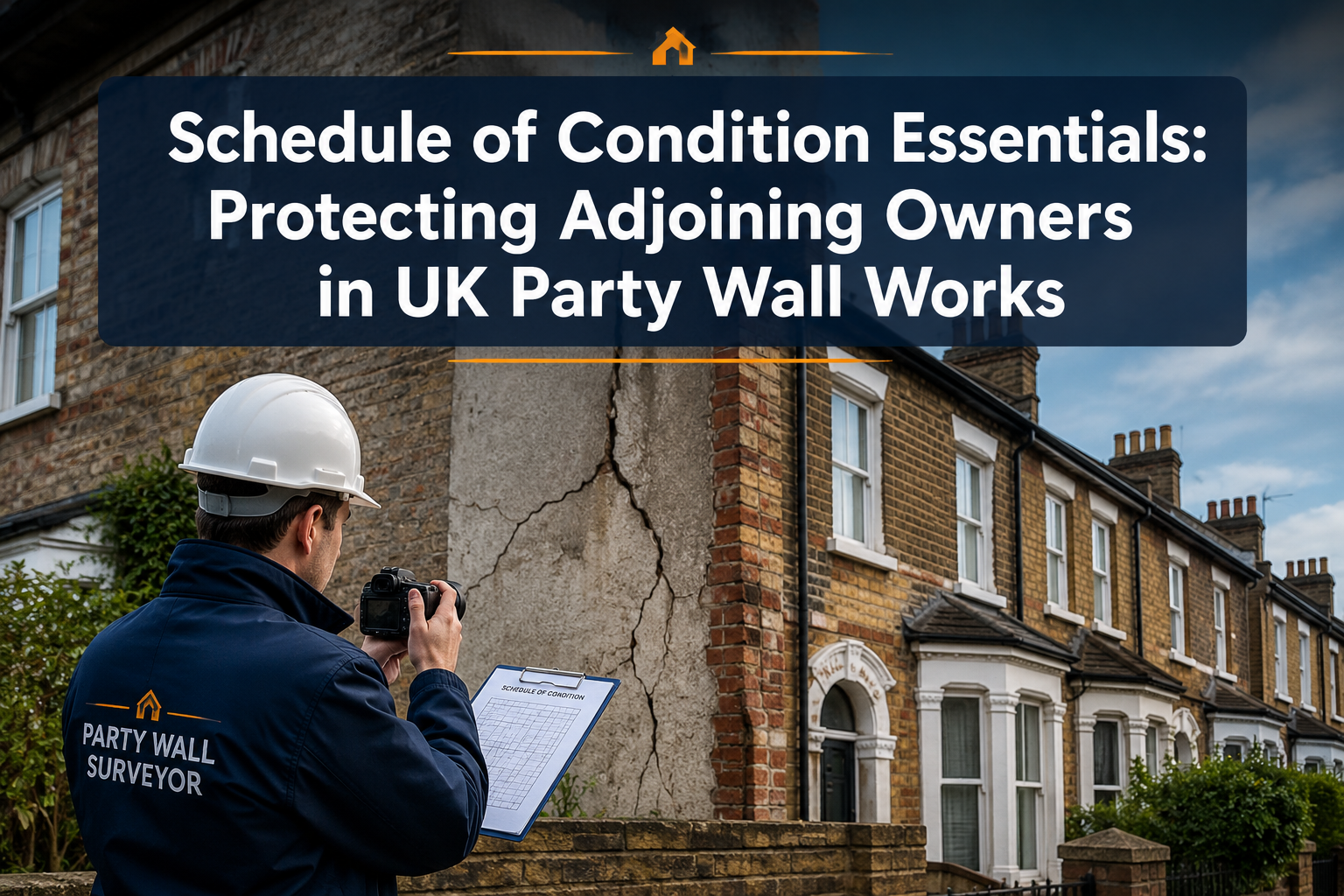
Nearly 40% of party wall disputes that escalate to formal resolution involve disagreements about whether construction work caused damage to a neighbouring property — disputes that a properly prepared Schedule of Condition could have resolved in minutes. [7] Understanding the Schedule of Condition essentials: protecting adjoining owners in UK party wall works is no longer optional for anyone living next to a building project. It is the single most powerful piece of evidence available to an adjoining owner, and in 2026, industry best practice treats it as a non-negotiable step in any party wall process.
This guide breaks down exactly what a Schedule of Condition must contain, how to use it to defend against false damage claims, and the common pitfalls that render even well-intentioned surveys useless in a dispute.
Key Takeaways 📋
- A Schedule of Condition (SoC) is a detailed pre-construction record of an adjoining owner's property, used to prove whether damage occurred as a result of building works.
- While not legally compulsory under the Party Wall etc. Act 1996, SoCs are now treated as standard — and essential — professional practice. [3]
- An effective SoC must include dated photographs, written descriptions, floor plans, and a surveyor's signature to carry evidential weight.
- SoCs are routinely incorporated into Party Wall Awards, making them legally binding reference documents. [9]
- Adjoining owners who skip an SoC risk being unable to prove pre-existing conditions versus new damage — leaving them exposed to costly disputes with no evidence.
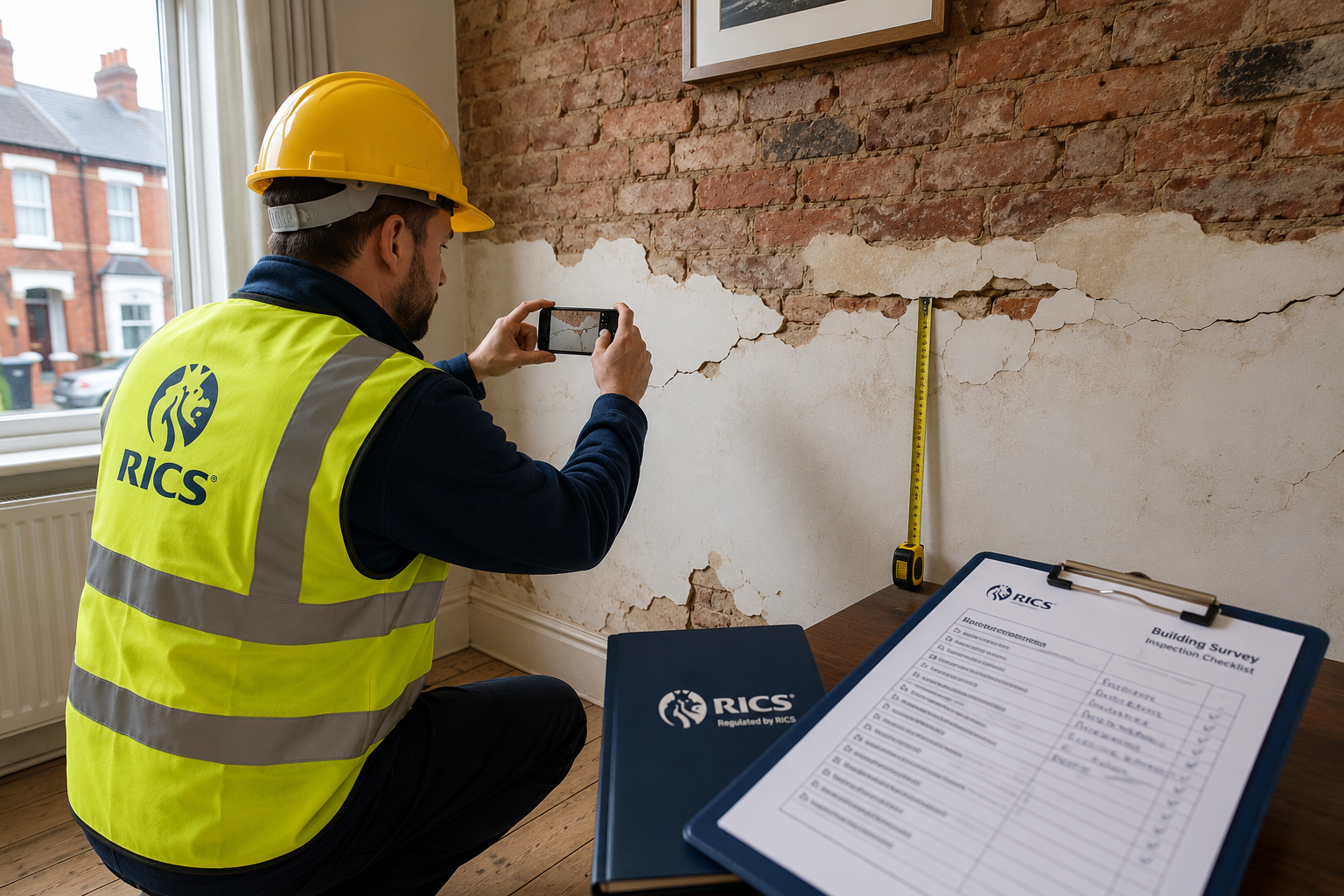
What Is a Schedule of Condition and Why Does It Matter?
A Schedule of Condition is a formal, documented record of the existing state of a property — typically an adjoining owner's home — prepared before any notifiable building works begin under the Party Wall etc. Act 1996. [1]
Its purpose is straightforward: it creates an evidential baseline. If a neighbour's loft conversion, basement dig, or rear extension causes cracking, settlement, or structural damage, the SoC is the document that proves what was already there before the drill ever touched the wall.
💬 "A Schedule of Condition is the adjoining owner's insurance policy — not against damage happening, but against being unable to prove it." [4]
The Legal Framework: Not Compulsory, But Treated as Essential
The Party Wall etc. Act 1996 does not explicitly require a Schedule of Condition to be prepared. [5] However, in 2026, no experienced party wall surveyor would proceed with a Party Wall Award without one. The reason is practical: without a pre-construction record, it becomes almost impossible to distinguish between:
- Damage that existed before works began
- Damage caused by the notifiable works
- Damage caused by unrelated factors (weather, settlement, age)
Courts and dispute resolution panels consistently favour parties who can produce photographic and written evidence. [8] An SoC is that evidence.
Who Commissions and Pays for the SoC?
In almost all cases, the building owner (the person carrying out the works) bears the cost of preparing the Schedule of Condition for the adjoining owner's property. [6] This is because the building owner is the party creating the risk. The SoC is typically prepared by:
- The adjoining owner's appointed party wall surveyor
- An agreed surveyor acting for both parties
- Occasionally, the building owner's surveyor — though this is less common for evidential independence
Schedule of Condition Essentials: Protecting Adjoining Owners in UK Party Wall Works — What Must Be Included
A Schedule of Condition that fails to capture the right information is worse than useless — it creates a false sense of security. Here is what a robust, dispute-proof SoC must contain in 2026. [7]
1. Property Identification and Context
Every SoC must open with clear identification:
| Element | Detail Required |
|---|---|
| Property address | Full postal address of the adjoining property |
| Date of inspection | Exact date (critical for legal validity) |
| Surveyor details | Name, qualifications, firm, contact |
| Scope statement | Areas inspected and areas excluded |
| Works description | Brief summary of the notifiable works proposed |
2. Room-by-Room Written Descriptions
Each room or area must be described in writing, noting:
- Wall finishes (plaster, paint, tiles — and their condition)
- Ceilings (any existing cracks, staining, or sagging)
- Floors (type, any existing movement or gaps)
- Windows and doors (whether they open/close freely, any gaps in frames)
- External areas (boundary walls, garden surfaces, outbuildings)
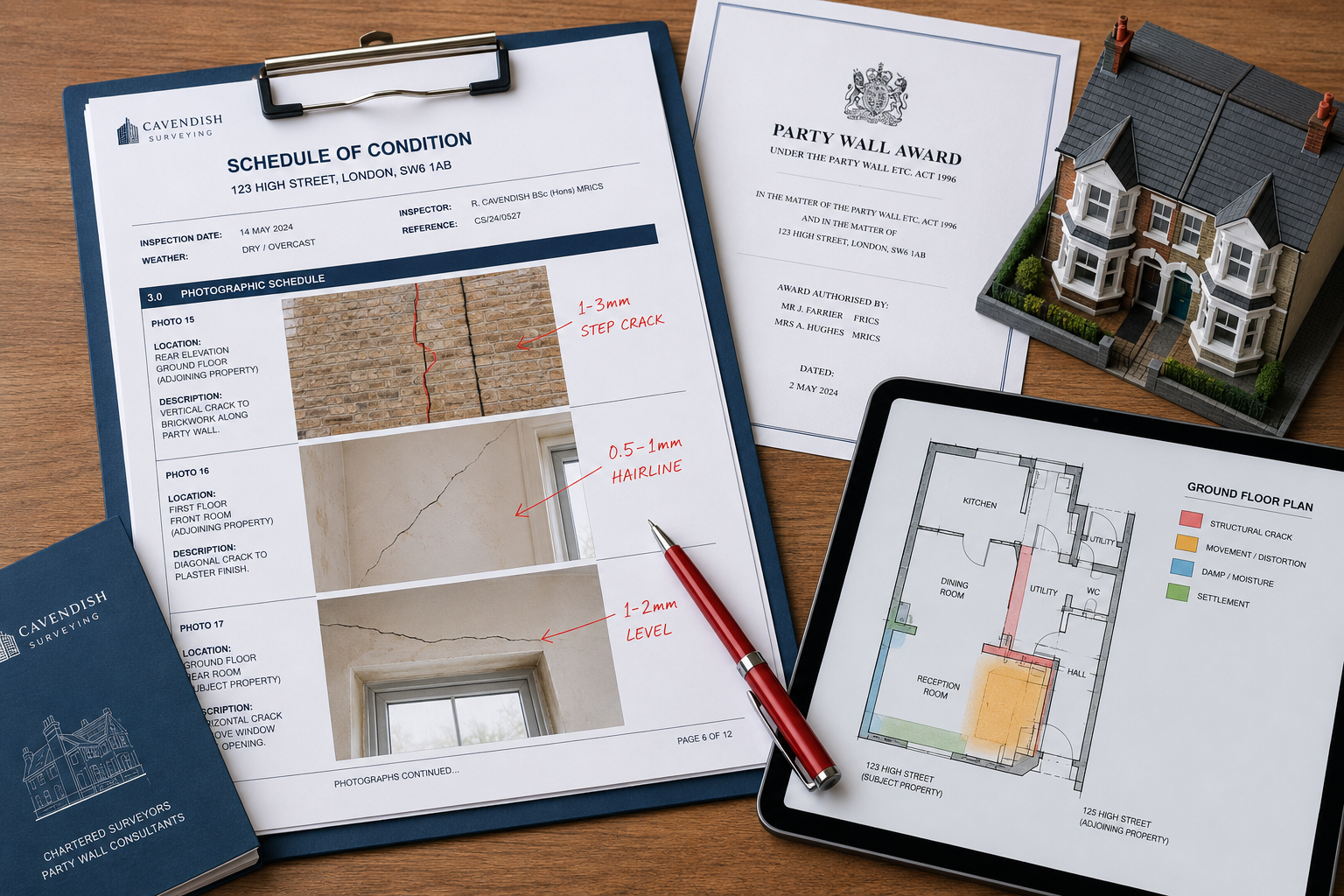
Descriptions should be specific and measurable. "Hairline crack to plaster, approximately 150mm long, running diagonally from upper-right corner of window reveal, Room 1 (front bedroom)" is useful. "Some cracking noted" is not. [2]
3. Photographic Evidence — The Heart of the SoC
Photography is the most important element of any modern Schedule of Condition. Best practice in 2026 requires: [7]
✅ Dated and geotagged photographs (metadata embedded in digital files)
✅ Scale reference in photos of cracks (a coin, ruler, or crack gauge)
✅ Wide-angle shots establishing room context, followed by close-up detail shots
✅ Consistent lighting — flash or supplementary lighting for dark corners
✅ Sequential numbering cross-referenced to written descriptions
✅ External elevations of all walls adjacent to the proposed works
⚠️ Common Pitfall: Low-resolution smartphone photos taken without scale references are routinely challenged in disputes. Use a dedicated camera or a high-quality device with metadata enabled.
4. Crack Monitoring Markers
Where existing cracks are present, surveyors should install tell-tale crack monitors (also called crack gauges) before works begin. These inexpensive devices measure whether a crack widens, narrows, or remains stable during construction. [4]
Including a record of installed monitors in the SoC — with baseline readings — transforms a static document into a dynamic monitoring system.
5. Structural Elements and Party Wall Itself
The SoC must specifically document the condition of:
- The party wall or party fence wall itself (both faces where accessible)
- Any chimney breasts shared between properties
- Foundations visible at ground level or in cellars
- Drainage — inspection covers, gullies, and any signs of existing movement
This is especially important for building condition assessments near basement excavations, where ground movement risk is highest.
Integrating the SoC into the Party Wall Award
One of the most significant developments in party wall practice is the routine incorporation of Schedules of Condition directly into Party Wall Awards. [9] This elevates the SoC from a helpful document to a legally binding reference point.
How Integration Works
When a party wall surveyor prepares the Party Wall Award, the SoC is typically:
- Attached as a schedule to the Award document
- Referenced by clause — the Award will state that the building owner must make good any damage not recorded in the SoC
- Used to define the reinstatement obligation — the standard of repair required if damage occurs
This means that if a crack appears post-construction that is not in the SoC, the building owner is presumed responsible and obligated to repair it. [9] The burden of proof effectively shifts.
What Happens Without an SoC in the Award?
Without an SoC incorporated into the Award, an adjoining owner who discovers damage faces an uphill battle:
- They must prove the damage is new (difficult without a baseline)
- The building owner can claim damage was pre-existing
- Disputes may require independent expert evidence at significant cost
- Resolution can take months or years
Understanding what to do when you receive a party wall notice — including requesting an SoC — is the first step in protecting your position.
Common Pitfalls That Undermine a Schedule of Condition
Even well-intentioned SoCs can fail in disputes. These are the most frequent errors identified in 2026 practice: [7][8]
❌ Pitfall 1: Incomplete Coverage
Surveyors who only inspect rooms immediately adjacent to the works miss the fact that vibration and ground movement can affect rooms several metres away. A comprehensive SoC covers the entire property, not just the shared wall side.
❌ Pitfall 2: Vague Language
Phrases like "generally satisfactory condition" or "minor defects noted" provide no evidential value. Every defect must be described with location, dimensions, direction, and severity.
❌ Pitfall 3: No Surveyor Signature or Credentials
An unsigned SoC, or one prepared by an unqualified person, carries little weight in a formal dispute. Always ensure the document is prepared and signed by a qualified surveyor — ideally a RICS-accredited professional. [2]
❌ Pitfall 4: Prepared Too Late
An SoC prepared after works have started is almost worthless. The inspection must be completed, agreed, and ideally incorporated into the Party Wall Award before the first day of notifiable works. [3]
❌ Pitfall 5: No Agreement on the Document
Where possible, both parties (or their surveyors) should sign off on the SoC as an accurate record. A disputed SoC — where one party later claims it was incomplete — weakens its evidential value significantly. [10]
❌ Pitfall 6: Digital Files Not Preserved Properly
Photographs stored only on a phone that is later lost, or in a format that strips metadata, lose their evidential value. SoC files should be:
- Backed up to cloud storage with timestamps
- Stored in PDF/A format for long-term preservation
- Copies held by both surveyors and ideally the adjoining owner
A Practical SoC Template: Room-by-Room Inspection Checklist
Use this template as a starting framework. A qualified surveyor will expand each section with property-specific detail.
SCHEDULE OF CONDITION — INSPECTION CHECKLIST

Property: _____________________ Date: _____________
Surveyor: _____________________ RICS No: __________

EXTERNAL
[ ] Front elevation — photograph + written description
[ ] Rear elevation — photograph + written description
[ ] Party/boundary walls — photograph + written description
[ ] Garden surfaces, paths, outbuildings
[ ] Drainage gullies and inspection chambers

INTERNAL — EACH ROOM
[ ] Ceiling: cracks, staining, sagging (describe + photo)
[ ] Walls: cracks, bulges, damp patches (describe + photo)
[ ] Floor: movement, gaps, squeaks (describe + photo)
[ ] Windows/doors: operation, gaps in frames (describe + photo)
[ ] Crack monitors installed? Location: _____________

BASEMENT/CELLAR (if applicable)
[ ] Foundation walls — condition
[ ] Any signs of water ingress or movement

SURVEYOR SIGN-OFF
Signature: _________________ Date: _____________
Agreed by adjoining owner: _________________ Date: _____________
Schedule of Condition Essentials: Protecting Adjoining Owners in UK Party Wall Works — Digitalisation and Future Practice
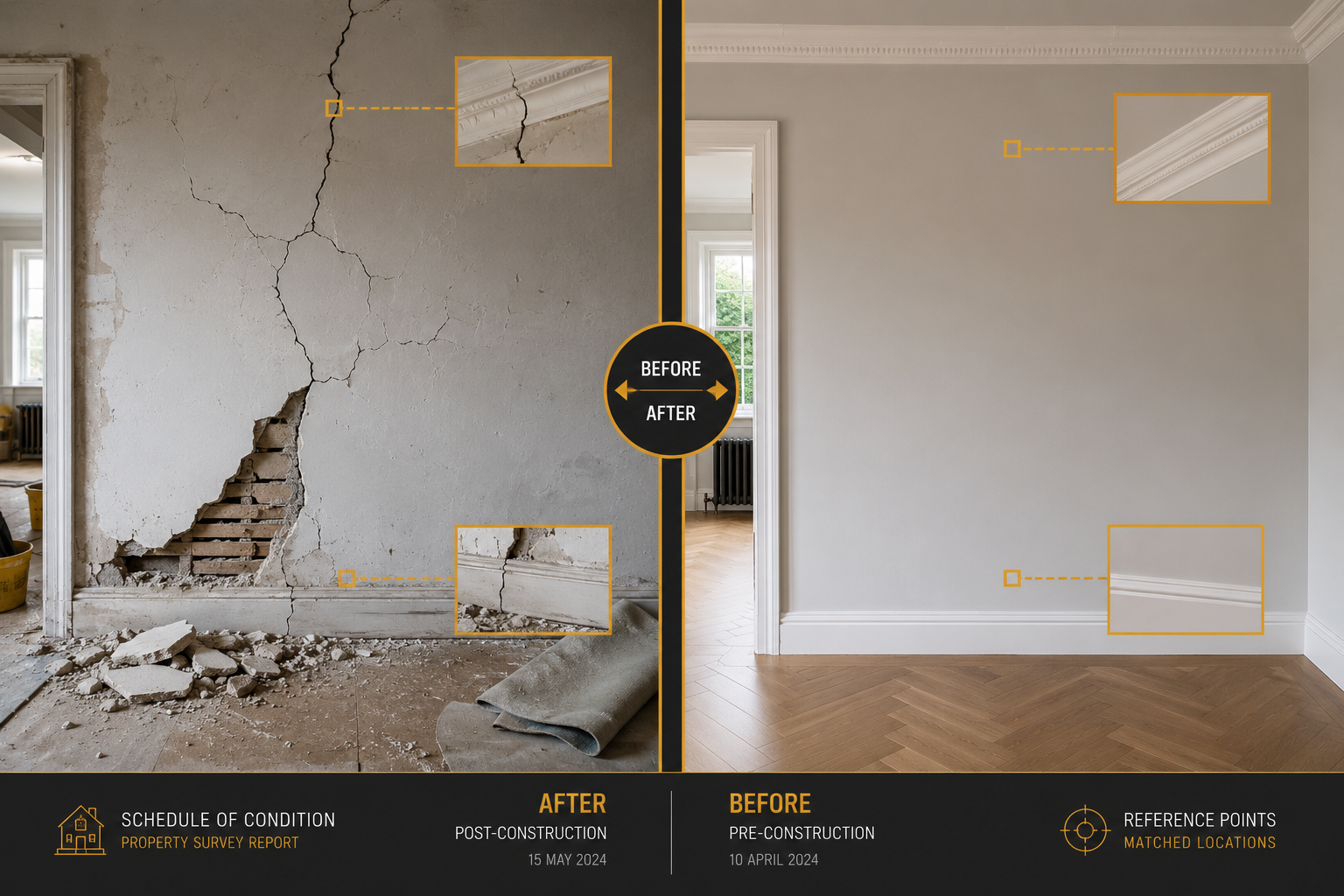
The professionalisation of SoCs has accelerated significantly. In 2026, leading surveyors are moving beyond paper-based documents toward fully digital SoC platforms that offer: [7]
- Automated metadata embedding in photographs
- Interactive floor plans with clickable defect markers
- Time-stamped cloud storage with audit trails
- QR-coded crack monitors linked to digital baseline records
This digitalisation makes SoCs more defensible in disputes and easier to share between surveyors, solicitors, and insurers. For adjoining owners in complex urban environments — particularly in areas like London where party wall surveyor services handle high volumes of terraced and semi-detached properties — digital SoCs are rapidly becoming the standard.
The Link Between SoCs and Reduced Post-Construction Claims
Industry analysis from 2026 confirms a direct correlation: properties where a comprehensive SoC was prepared and incorporated into the Party Wall Award see significantly fewer disputed damage claims post-construction. [7] When both parties know that a detailed baseline exists, building owners take greater care during works, and false or exaggerated claims by adjoining owners are also deterred.
This mutual protection is the true value of the Schedule of Condition — it is not a weapon for one side, but a neutral factual record that protects everyone. [8]
Conclusion: Your Action Plan as an Adjoining Owner
A Schedule of Condition is the most practical, cost-effective protection available to any adjoining owner facing nearby building works. The essentials are clear:
✅ Act immediately upon receiving a party wall notice — do not wait until works begin.
✅ Appoint a qualified party wall surveyor to prepare and sign the SoC before works start.
✅ Ensure the SoC is incorporated into the Party Wall Award as a legally binding schedule.
✅ Insist on comprehensive coverage — every room, every elevation, with dated photographs and scale references.
✅ Preserve digital copies with metadata intact, held by both parties.
✅ Install crack monitors on any existing defects adjacent to the works.
The cost of a properly prepared SoC is a fraction of the cost of a single disputed repair claim — or the legal fees involved in proving one. In 2026, no adjoining owner should accept a Party Wall Award that does not include one.
For a building condition assessment or to speak with an experienced party wall surveyor about protecting your property before works begin, take action as soon as the party wall notice arrives. The clock starts the moment that notice lands on your doormat.
References
[1] Schedule Of Condition – https://www.ansteyhorne.co.uk/news/schedule-of-condition
[2] Schedule Of Condition Survey – https://christopheranthony.org.uk/schedule-of-condition-survey/
[3] Understanding The Significance Of A Schedule Of Condition In Party Wall Work – https://www.surveyingservices.uk/post/understanding-the-significance-of-a-schedule-of-condition-in-party-wall-work
[4] Schedule Of Condition – https://echelonpartywall.co.uk/resources/guides/schedule-of-condition/
[5] Party Wall Agreement – https://hoa.org.uk/advice/guides-for-homeowners/i-am-improving/party-wall-agreement/
[6] Party Wall Agreements What You Need To Know – https://www.fmb.org.uk/find-a-builder/ultimate-guides-to-home-renovation/party-wall-agreements-what-you-need-to-know.html
[7] Schedules Of Condition In Party Wall Works Best Practices To Prevent Post Construction Claims In 2026 – https://nottinghillsurveyors.com/blog/schedules-of-condition-in-party-wall-works-best-practices-to-prevent-post-construction-claims-in-2026
[8] Schedules Of Condition – https://www.peterbarry.co.uk/blog/schedules-of-condition/
[9] Schedules Of Condition In Party Wall Awards Protecting All Parties In 2026 Disputes – https://partywallsurveyorlondon.uk/blogs/schedules-of-condition-in-party-wall-awards-protecting-all-parties-in-2026-disputes/
[10] Party Wall Schedule Of Condition – https://www.aldsurveying.co.uk/party-wall-schedule-of-condition/