


Between January and April 2026, landlords accounted for 13.3% of all home purchases in Great Britain — matching levels not seen since early 2016 [2]. That headline figure alone signals a profound structural shift in the buy-to-let market. Surveying buy-to-let kerb appeal priorities: institutional landlord investments in 2026 market uplift has become a central discipline for property professionals, as larger portfolio operators replace exiting small landlords and raise the bar on presentation standards. With rental supply still running 23% below pre-pandemic levels [4], the competition for quality tenants at premium rents has never been more intense — and the exterior condition of a property is increasingly the first battleground.
Key Takeaways 📋
- Institutional landlords are consolidating the buy-to-let market, acquiring stock from smaller operators and demanding higher physical standards.
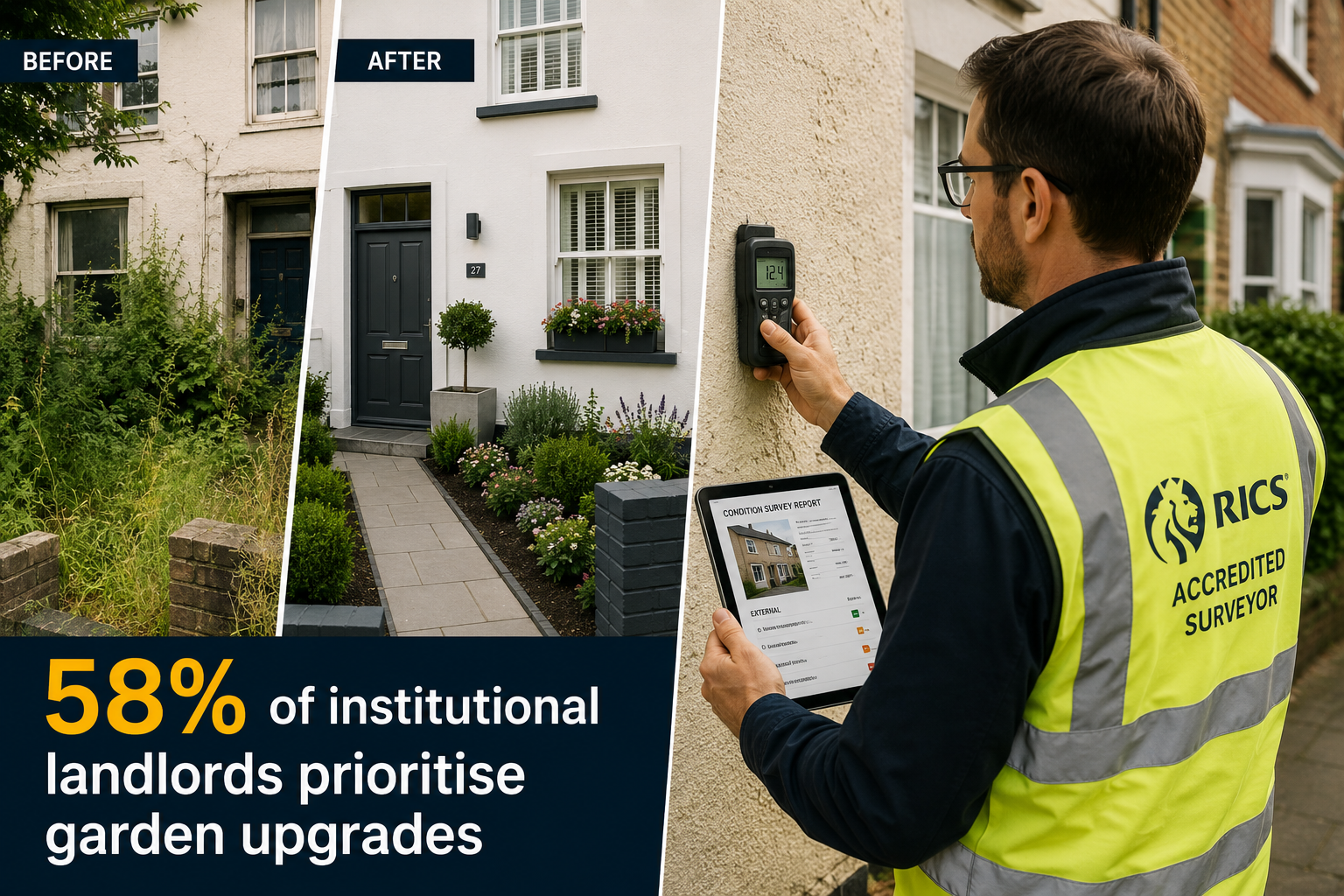
- Kerb appeal — particularly gardens and exterior finishes — ranks among the top upgrade priorities, with 58% of professional landlords investing in garden improvements.
- Professional condition surveys are now a due diligence standard, not an optional extra, for institutional buyers seeking to justify premium rents.
- Regional markets in Northern England and the North West are seeing the sharpest surge in landlord activity, creating localised demand for surveying services.
- Conservative underwriting and cash-flow discipline are shaping investment decisions, making pre-purchase survey data more financially critical than ever.
The 2026 Buy-to-Let Landscape: Why Institutions Are Driving the Market
The buy-to-let sector in 2026 is undergoing a generational handover. The Renters' Rights Act eliminated no-fault evictions and strengthened tenant protections, prompting many smaller, accidental landlords to sell up [1]. Larger institutional operators — build-to-rent funds, family offices, and professional portfolio companies — have stepped in to absorb that stock.
💬 "The market is not shrinking — it is professionalising. Institutional capital is replacing amateur capital, and the standards expected of rental properties are rising accordingly."
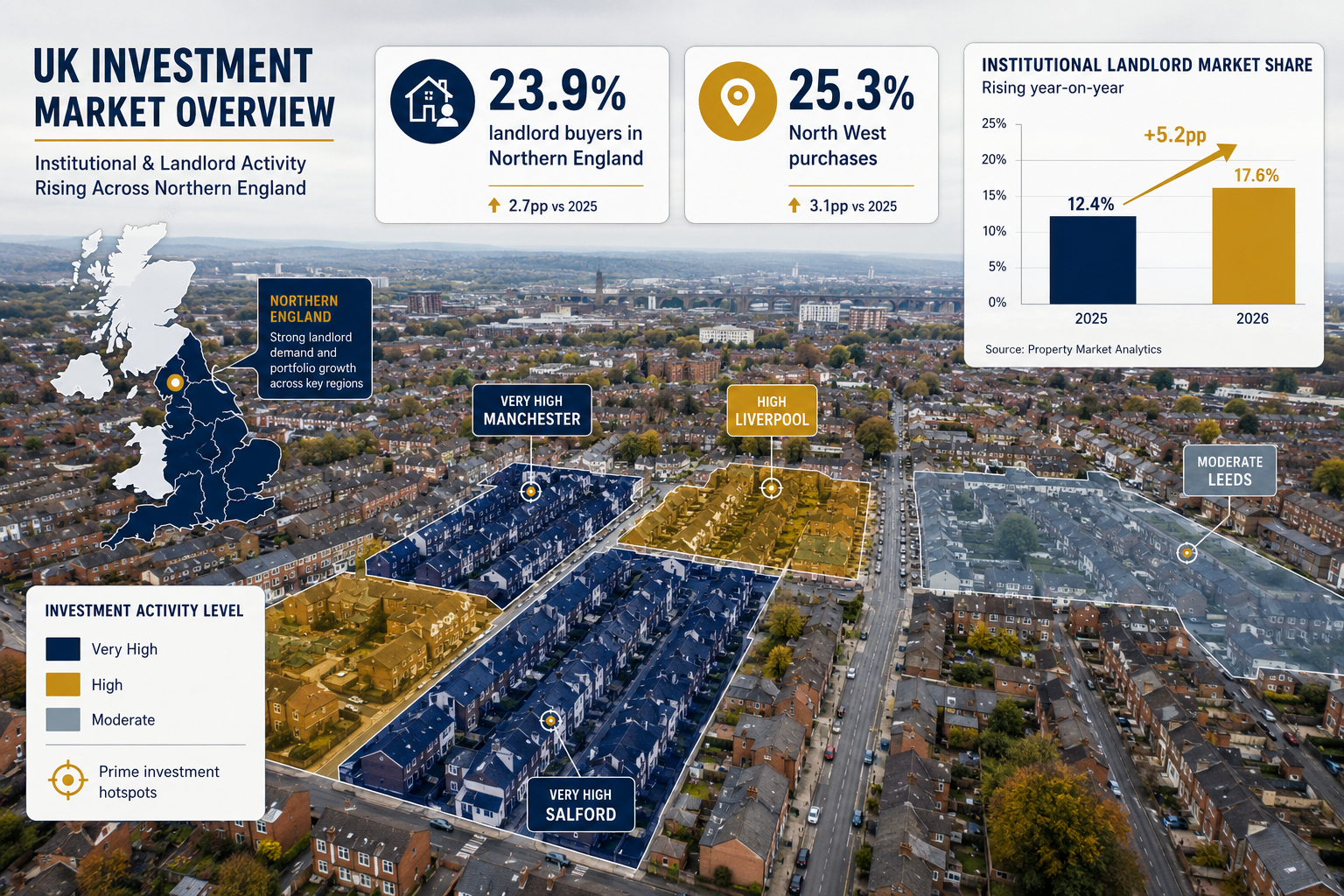
This consolidation is most visible in regional data. In Northern England, landlords represented 23.9% of buyers in the first four months of 2026, up sharply from 14.5% in the same period of 2025. The North West saw even more dramatic growth, with landlords accounting for 25.3% of purchases — more than double the 2025 figure [2]. These are not opportunistic individuals; these are disciplined operators deploying capital with specific return targets.
Mortgage Conditions Are Improving 📉
Financing conditions have also improved meaningfully. The average two-year fixed buy-to-let mortgage rate fell from approximately 4.96% in early 2025 to 4.28% by February 2026, easing the affordability pressure that had suppressed activity [3]. Combined with motivated sellers and greater debt availability, this is creating favourable conditions for a rebound in transaction activity and asset values [8].
For surveyors, this translates directly into increased demand for professional assessments. Institutional buyers do not complete acquisitions without thorough due diligence. Understanding what a surveyor does and their professional responsibilities has become essential knowledge for landlords navigating this more complex market.
Kerb Appeal as a Financial Instrument: The 58% Garden Upgrade Priority
Kerb appeal is no longer a cosmetic afterthought. For institutional landlords, it is a measurable financial lever — one that directly influences achievable rent, void periods, and tenant quality. Surveying buy-to-let kerb appeal priorities: institutional landlord investments in 2026 market uplift requires understanding precisely which exterior improvements deliver the strongest return on investment.
The Garden Premium 🌿
Research consistently shows that 58% of professional landlords are investing in garden improvements as part of their acquisition and refurbishment strategy. The rationale is straightforward: a well-maintained front garden signals property quality before a prospective tenant even steps inside. It reduces void periods, attracts longer-term tenants, and supports higher asking rents.
Key garden upgrades institutional landlords are prioritising in 2026 include:
| Upgrade Type | Estimated Cost Range | Rental Premium Potential |
|---|---|---|
| Lawn turfing and edging | £500 – £1,500 | 3–5% rent uplift |
| Low-maintenance planting | £800 – £2,000 | Reduced void risk |
| New front path or paving | £1,000 – £3,500 | Improved first impression |
| Boundary wall/fence repair | £600 – £2,500 | Tenant security perception |
| External lighting | £300 – £900 | Safety and aesthetic value |
Understanding UK boundary wall rules is critical before undertaking any boundary improvements, as legal responsibilities can affect both cost and timeline.
Exterior Finishes: Paint, Render, and Windows 🏠
Beyond gardens, institutional landlords are focusing heavily on:
- Rendered and painted facades — fresh render or masonry paint can transform a tired mid-century terrace into a premium rental asset
- uPVC or composite front doors — high-impact, low-maintenance upgrades that signal quality
- Window condition — clean, well-maintained windows with no failed double-glazing units are a baseline expectation for quality tenants
- Guttering and drainage — often overlooked, but a visible broken gutter signals neglect and raises damp concerns
This last point is particularly important. Visible damp evidence on exterior walls is a significant deterrent to quality tenants and a red flag in any professional assessment. A damp survey in London can identify hidden moisture issues before they become visible problems — and before they undermine rental valuations.
Why Kerb Appeal Directly Affects Survey Outcomes
A property's exterior condition is not merely aesthetic — it is structurally diagnostic. Surveyors examining a buy-to-let acquisition will assess:
- Roof condition and flashings visible from the street
- Chimney stack integrity
- External wall condition, including cracks, spalling, or staining
- Driveway and path drainage
- Boundary structures and their condition
Each of these elements feeds directly into a condition survey report, which institutional landlords are increasingly commissioning before exchange. A poor exterior assessment can trigger price renegotiation — and understanding how to renegotiate after a poor building survey result is a skill that professional landlords are actively developing.
How Professional Surveys Justify Premium Pricing in the 2026 Market

Surveying buy-to-let kerb appeal priorities: institutional landlord investments in 2026 market uplift is not just about identifying problems — it is about building the evidential case for premium rent positioning. This is where the discipline of professional surveying intersects directly with institutional investment strategy.
The Due Diligence Imperative
Institutional landlords are increasingly relying on professional property surveys to ensure properties meet high standards and can command premium rents [5]. This shift is driven by several converging factors:
- Regulatory compliance — The Renters' Rights Act and evolving EPC requirements mean that structural and condition defects carry greater legal and financial risk than in previous cycles [1].
- Conservative underwriting — In 2026, disciplined investors are focusing on in-place performance and durable cash flow, with conservative income assumptions [6]. A survey provides the factual baseline for those assumptions.
- Lender requirements — As buy-to-let mortgage lending recovers through 2026 and 2027 [3], lenders are applying more rigorous valuation and condition standards, making independent surveys a practical necessity.
Choosing the Right Survey Level for Buy-to-Let Acquisitions
Not all surveys are equal, and institutional landlords need to match survey type to acquisition risk profile. The key options are:
RICS Home Survey Level 2 (Homebuyer Report)
- Suitable for modern, well-maintained properties in good condition
- Covers visible defects and condition ratings
- Cost-effective for lower-risk acquisitions
RICS Home Survey Level 3 (Building Survey)
- Recommended for older properties, those with visible defects, or unusual construction
- Provides detailed structural analysis and maintenance recommendations
- Essential for period terraces and Victorian stock common in Northern England portfolios
For a detailed comparison, the guide on Home Survey Level 2 vs Level 3 provides clear criteria for making the right choice. Understanding the key differences between Level 2 and Level 3 surveys helps landlords avoid under-surveying high-risk stock.
How Survey Data Supports Rent Justification
A well-executed survey does more than flag problems — it creates a documented condition baseline that supports premium rent positioning in several ways:
- Confirms absence of structural defects, removing tenant objections
- Validates recent improvement works, providing evidence of investment
- Identifies EPC-relevant issues (insulation, glazing, heating systems) that can be addressed pre-let to achieve higher energy ratings
- Supports insurance applications with accurate condition data
- Provides negotiation leverage when acquiring from smaller landlords exiting the market
💬 "A clean survey is not just risk mitigation — it is a marketing document. It tells the tenant: this property has been professionally assessed and meets a high standard."
Cash-Flow Discipline and Survey ROI
Morgan Stanley's 2026 real estate outlook highlights that institutional investors are prioritising cash-flow growth over cap rate compression, focusing on locations with clear demand-supply imbalances [8]. With national rent growth projected at a modest 1–3% annually through late 2026 [7], the margin for error on property condition is narrow.
The financial logic is compelling:
- A Level 3 building survey typically costs £600–£1,200 for a standard residential property
- Identifying a £15,000 structural defect before purchase enables price renegotiation — see average price reductions after a survey
- A property achieving £150/month higher rent due to certified condition recovers survey costs within weeks
- Avoiding a single void period caused by undisclosed condition issues saves more than the survey cost
For institutional operators managing portfolios of 20, 50, or 200 properties, these marginal gains compound significantly.
Regional Hotspots and Surveying Demand in 2026
The geographic concentration of institutional landlord activity in 2026 has created specific regional demand for surveying services. The North West and Northern England are the most active markets [2], but London and the South East remain significant for higher-value acquisitions.
Key Regional Considerations 🗺️
Northern England & North West
- High volume of Victorian and Edwardian terraced stock requiring Level 3 surveys
- Greater prevalence of damp and timber issues in older housing stock
- Strong rental demand from young professionals and key workers
London
- Higher acquisition costs make survey ROI even more compelling
- Leasehold complexities require additional due diligence — see what to check before buying a leasehold property
- Party wall considerations are common in terraced and semi-detached stock
Midlands and South East
- Growing institutional interest as Northern yields compress
- Mixed-age housing stock requiring careful survey level selection
Actionable Framework: Surveying Kerb Appeal for Maximum Rent Uplift
Professional landlords and their advisors can use the following framework when assessing buy-to-let kerb appeal priorities for 2026 acquisitions:
Pre-Purchase Checklist ✅
Exterior Assessment (Visual)
- Roof covering condition (slates, tiles, flat roof membranes)
- Chimney stacks and flashings
- External wall finish (render, brick, cladding)
- Window and door condition
- Guttering and downpipes
- Driveway, paths, and drainage
Garden and Boundary
- Front garden condition and maintenance requirements
- Boundary wall and fence condition
- Rear garden accessibility and usability
- External lighting provision
Survey Commissioning
- Select appropriate RICS survey level based on property age and condition
- Commission damp and timber inspection for pre-1970s stock
- Review survey findings against acquisition price
- Use survey data to build post-acquisition improvement schedule
Conclusion: Surveying as a Competitive Advantage in 2026
The professionalisation of the buy-to-let market in 2026 has elevated surveying from a transactional necessity to a strategic competitive tool. Institutional landlords who invest in thorough condition assessments — and who prioritise kerb appeal improvements informed by survey findings — are systematically outperforming those who rely on visual inspections alone.
The data is clear: landlord market share is rising, regional activity is accelerating, and rental supply remains constrained [2][4]. In this environment, the properties that command premium rents and minimal voids are those that have been professionally assessed, strategically improved, and presented to the highest standard.
Actionable Next Steps for Professional Landlords and Surveyors:
- Commission a Level 2 or Level 3 RICS survey on every acquisition — match the level to the property's age and risk profile
- Prioritise garden and exterior improvements in refurbishment budgets — the 58% of landlords already doing this are capturing measurable rent uplifts
- Use survey findings as a negotiation tool — condition data supports price reductions and post-purchase improvement planning
- Build a regional surveying network in active markets (North West, Northern England) to support rapid acquisition due diligence
- Align survey data with EPC improvement plans to meet regulatory requirements and maximise energy efficiency ratings
- Review RICS-accredited surveying services to ensure assessments meet lender and regulatory standards
The landlords winning in 2026 are not simply buying more properties — they are buying better properties, assessed more thoroughly, and presented more professionally. Kerb appeal is where that competitive advantage begins, and professional surveying is how it is measured.
References
[1] Buy To Lets In 2026 A Market In Transition – https://www.legalandgeneral.com/adviser/mortgage-club/news-and-insights/digest/articles/buy-to-lets-in-2026-a-market-in-transition/
[2] Landlord To Landlord Sales Hit Record Share Of Buy To Let Transactions – https://www.mpamag.com/uk/mortgage-types/buy-to-let/landlord-to-landlord-sales-hit-record-share-of-buy-to-let-transactions/575617
[3] UK Buy To Let Lending Outlook 2026 And 2027 Recovery Gathers Pace Amid Shifting Mortgage Conditions – https://www.propertywire.com/buy-to-let/uk-buy-to-let-lending-outlook-2026-and-2027-recovery-gathers-pace-amid-shifting-mortgage-conditions/
[4] A Changing Buy To Let Landscape – https://www.legalandgeneral.com/adviser/mortgage-club/news-and-insights/digest/articles/a-changing-buy-to-let-landscape/
[5] Buy To Let Property Surveys Why Institutional Landlords Are Driving Demand For Professional Assessments In 2026 – https://wimbledonsurveyors.com/buy-to-let-property-surveys-why-institutional-landlords-are-driving-demand-for-professional-assessments-in-2026/
[6] Multifamily Underwriting Trends – https://www.walkerdunlop.com/insights/multifamily-underwriting-trends
[7] 2026 Predictions For Apartment Investors – https://steadfast-direct.com/market-insights/2026-predictions-for-apartment-investors
[8] Real Estate 2026 Outlook – https://www.morganstanley.com/im/en-sg/institutional-investor/insights/articles/real-estate-2026-outlook.html