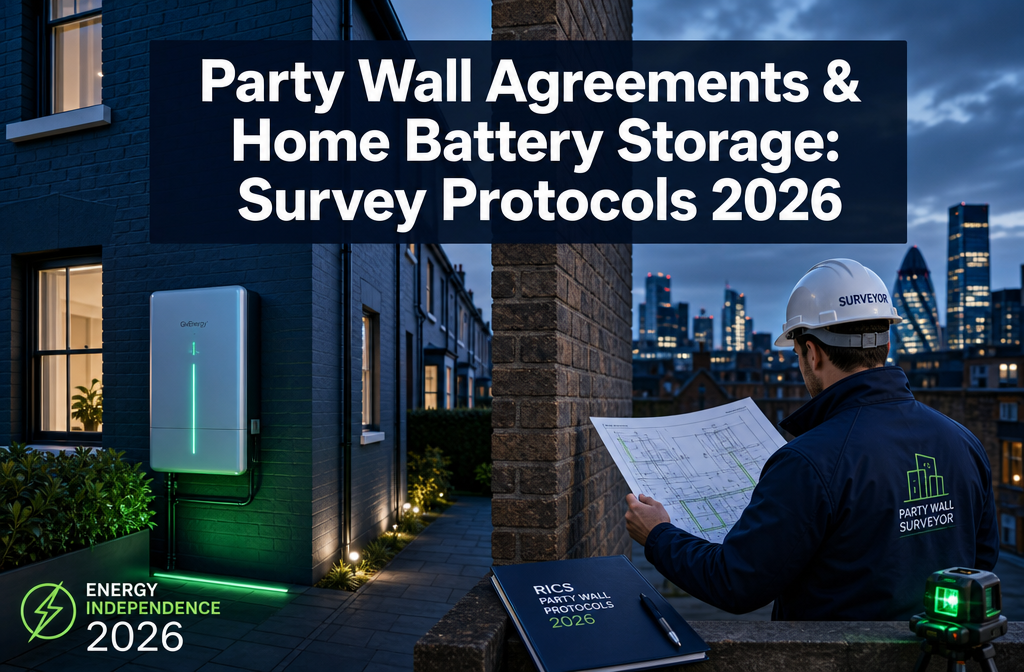
Home battery storage installations in UK terraced and semi-detached properties have surged by an estimated 40% year-on-year as the 2026 energy independence push accelerates demand for domestic solar-plus-storage systems [3]. Yet thousands of homeowners are drilling, chasing, and bracket-mounting heavy lithium battery cabinets onto shared walls without ever serving a Party Wall Notice — a legal oversight that can trigger disputes, invalidate insurance, and even require costly remediation work.
Party Wall Agreements for Home Battery Storage Systems: Survey Protocols Amid 2026 Energy Independence Push sits at the intersection of two fast-moving worlds: the UK's established (and often misunderstood) Party Wall etc. Act 1996 framework, and the rapid growth of domestic energy storage technology. This article provides a practical, step-by-step guide for homeowners, installers, and chartered surveyors navigating this emerging compliance challenge.
Key Takeaways 📋
- Mounting a home battery system on a party wall can trigger the Party Wall etc. Act 1996, requiring formal notice to adjoining owners before work begins.
- No dedicated UK regulation exists specifically for battery-party wall scenarios — surveyors apply existing Act principles to assess structural load, fire separation, and drilling works.
- A Schedule of Condition must be prepared before installation to protect both parties from future damage claims.
- A Party Wall Award (agreement) formalises the terms under which battery installation work may proceed on or near a shared wall.
- Chartered surveyors in 2026 are increasingly treating large wall-hung battery cabinets the same way they treat steel beam fixings and service penetrations under the Act.
Why Home Battery Installs Are Triggering Party Wall Questions in 2026
The UK government's net-zero trajectory and rising energy costs have made home battery storage systems one of the fastest-growing retrofit technologies of 2026 [3]. Products like lithium iron phosphate (LFP) wall-mounted units — some weighing between 60 kg and 120 kg — are now routinely installed in garages, utility rooms, and hallways of terraced houses. In many of these properties, the most practical mounting surface is the party wall itself.
💡 Pull Quote: "A 100 kg battery cabinet fixed to a shared wall is no different in legal terms from fixing a steel beam — the Party Wall etc. Act 1996 does not care what the load is made of, only what it does to the wall."
This is where the legal complexity begins. The Party Wall etc. Act 1996 was not written with battery storage in mind. However, its core principles — protecting adjoining owners from structural interference, fire risk, and unnotified works — apply directly to many battery installation scenarios.
What Makes a Battery Installation "Notifiable"?
Not every battery installation triggers the Act. The key question is whether the work materially affects the party wall. The following scenarios are most likely to be notifiable:
| Scenario | Likely Notifiable? | Reason |
|---|---|---|
| Heavy battery (>50 kg) wall-mounted on party wall | ✅ Yes | Structural loading on shared structure |
| Drilling through party wall for cable runs | ✅ Yes | Cutting into party wall |
| Surface-fixed lightweight unit on internal leaf only | ⚠️ Possibly | Depends on fixing depth and wall type |
| Battery installed on non-party (external) wall | ❌ Unlikely | Does not affect shared structure |
| Chasing cables into party wall plaster | ⚠️ Possibly | Depends on depth and fire separation impact |
Chartered surveyors in 2026 are increasingly applying the same analytical framework used for air-source heat pump brackets and MVHR duct penetrations — if the work cuts into, adds load to, or compromises the fire separation of a party wall, it is notifiable under Section 2 of the Act.
Step-by-Step Survey Protocols for Party Wall Agreements for Home Battery Storage Systems: Survey Protocols Amid 2026 Energy Independence Push
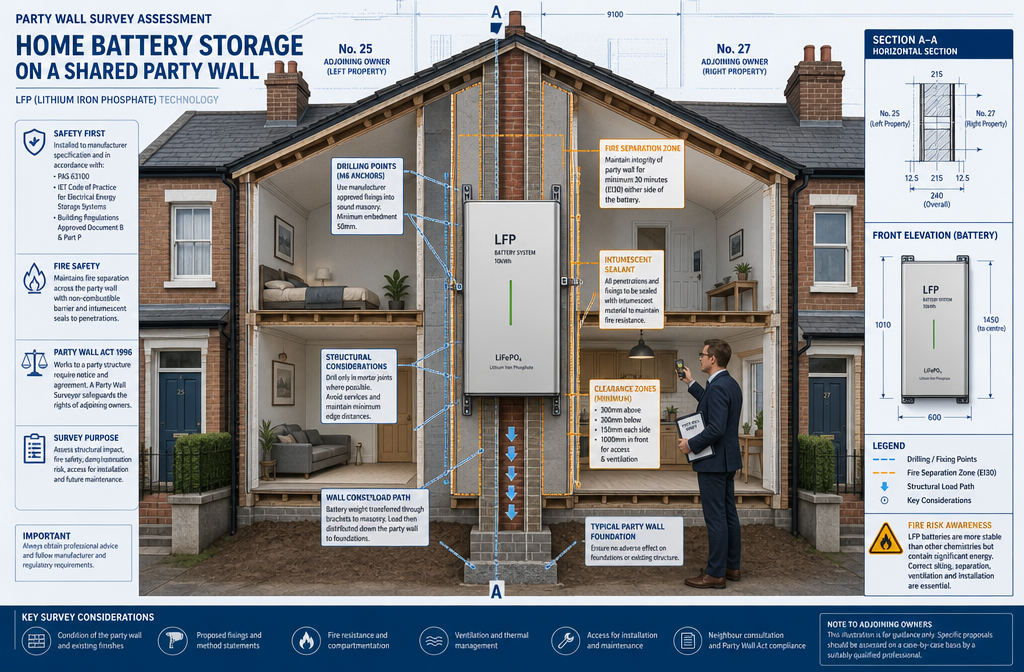
Understanding the procedural steps is essential for both homeowners planning an installation and surveyors advising clients. The following protocol reflects current best practice as applied by RICS-accredited party wall surveyors in 2026.
Step 1: Pre-Installation Assessment 🔍
Before any notice is served, a competent person — ideally a party wall surveyor — should assess:
- Wall type: Is it a true party wall (shared ownership), a party fence wall, or a party structure?
- Battery weight and fixing method: Bracket-mounted systems with deep anchor bolts into masonry are more likely to be notifiable than surface-fixed lightweight units.
- Cable routing: Does the installation require drilling through the wall or chasing into it?
- Fire separation: Does the installation affect the fire-rated performance of the wall? LFP batteries carry lower thermal runaway risk than older lithium-ion chemistries, but fire safety remains a material consideration.
- Proximity to boundary: Works within 3 metres of an adjoining structure and below the lowest floor level may also trigger Section 6 of the Act (excavation provisions), though this is rarely relevant for battery installs.
Step 2: Serving the Party Wall Notice
If the assessment confirms the work is notifiable, the building owner (the person carrying out the work) must serve a Party Wall Notice on all adjoining owners. Key requirements:
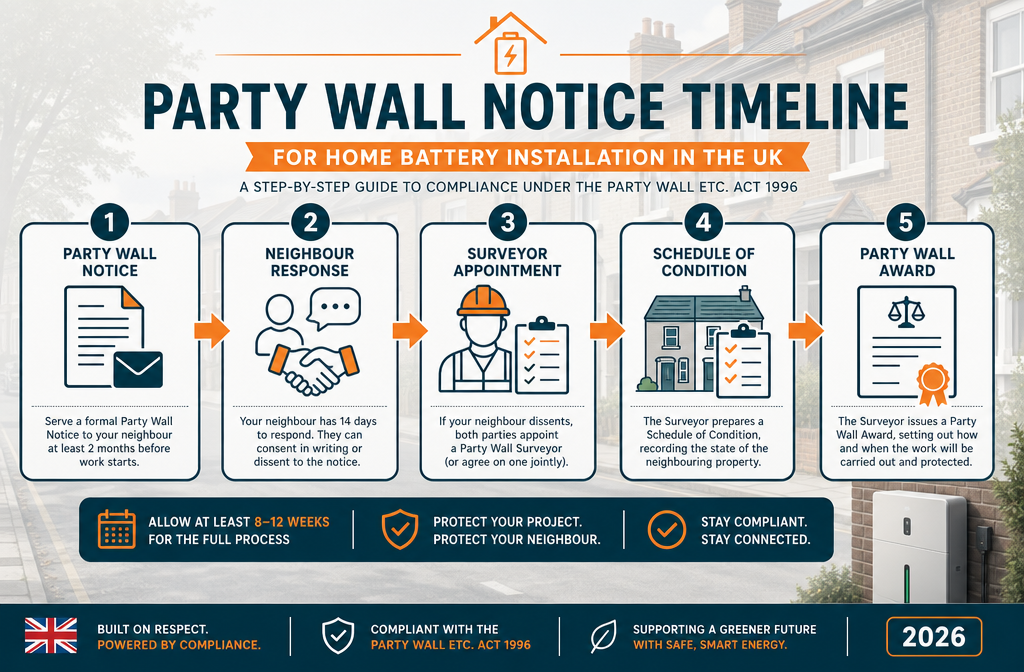
- Timing: Notice must be served at least two months before work begins for Section 2 works (works to a party wall).
- Content: The notice must describe the proposed works clearly, including the battery model, weight, fixing method, and cable routing.
- Format: While no prescribed form exists, the notice must comply with the Act's requirements. Many surveyors use standard templates.
For guidance on what to do when you receive a Party Wall Notice, adjoining owners should understand their right to consent, dissent, or request a surveyor appointment.
Step 3: Neighbour Response — Consent or Dissent
The adjoining owner has 14 days to respond to the notice. Three outcomes are possible:
- Written consent — Work can proceed. A Schedule of Condition is still strongly recommended.
- Dissent and agreement on a single agreed surveyor — One surveyor acts for both parties.
- Dissent and appointment of separate surveyors — Each party appoints their own surveyor; the two surveyors then select a third surveyor in case of dispute.
⚠️ Important: If no response is received within 14 days, a dispute is deemed to have arisen automatically, and the surveyor appointment process must begin.
Step 4: Schedule of Condition 📸
This is one of the most important — and most frequently skipped — steps in the process. A Schedule of Condition is a detailed record of the existing state of the adjoining owner's property before work begins. For battery installations, this typically covers:
- Photographs of the party wall surface on both sides
- Notes on existing cracks, damp patches, or plaster defects
- Condition of any shared services running through or along the wall
- Thermal imaging (increasingly used in 2026 to document existing heat signatures)
The Schedule protects the building owner from spurious damage claims and gives the adjoining owner a baseline against which post-installation damage can be measured. Monitoring surveys can provide an additional layer of protection for more complex installations.
Step 5: The Party Wall Award
If surveyors are appointed, they produce a Party Wall Award — a legally binding document that sets out:
- The permitted works (battery type, weight, fixing specification)
- The method of working (working hours, dust/vibration controls)
- The Schedule of Condition (appended to the Award)
- Rights of access for inspection during and after works
- Dispute resolution provisions
The Award can also specify that the building owner must reinstate the wall to its original condition if the battery is ever removed — an increasingly common provision given the evolving nature of energy storage technology.
Fire Safety, Structural Loading, and the 2026 Energy Independence Context
The 2026 energy independence push has created a policy environment that strongly encourages home battery adoption [3][4]. However, the enthusiasm of installers and homeowners sometimes outpaces awareness of legal obligations. Two technical issues deserve particular attention in survey protocols.
Fire Safety and Party Walls 🔥
Party walls in UK terraced housing are typically required to provide at least 60 minutes of fire resistance. Any installation that compromises this — through cable penetrations, bracket fixings that bridge the fire break, or the battery unit itself being positioned against the wall — must be addressed in the Party Wall Award.
In 2026, surveyors are increasingly referencing:
- Building Regulations Part B (fire safety) in conjunction with party wall assessments
- BS EN 62619 (safety requirements for secondary lithium cells and batteries for use in industrial applications) as a product standard benchmark
- BS 7671 (IET Wiring Regulations) for electrical installation compliance
While Ofgem and the Department for Energy Security and Net Zero have published extensive guidance on domestic flexibility and smart electrical systems, none of this guidance creates battery-specific party wall obligations — the Party Wall etc. Act 1996 remains the governing framework, applied through professional judgment.
Structural Loading Considerations ⚖️
A standard residential party wall in a Victorian terraced house is typically a 225 mm solid brick structure. While this is inherently robust, the concentrated point loads from heavy battery bracket fixings differ from the distributed loads the wall was designed to carry. Surveyors should assess:
- Fixing specification: Resin anchors vs. mechanical expansion bolts — resin anchors are generally preferred for masonry to distribute load more effectively.
- Number and spacing of fixing points: Spreading load across more fixing points reduces stress concentration.
- Existing wall condition: Spalling, previous repairs, or damp ingress can reduce the wall's load-bearing capacity at fixing locations.
For properties where structural assessment is needed alongside party wall work, a Level 3 Building Survey provides the most comprehensive structural analysis.
The Gap in Dedicated Guidance
It is worth being explicit: as of spring 2026, there is no dedicated UK government or Ofgem guidance specifically addressing party wall agreements for home battery storage systems. The existing Party Wall etc. Act 1996 applies in its general form, and professionals must extrapolate from established principles. This makes the role of an experienced, RICS-accredited party wall surveyor more important than ever.
Homeowners unsure whether their installation requires a Party Wall Agreement should consult the guidance on when you need a party wall agreement before proceeding.
Practical Guidance for Homeowners and Installers
What Homeowners Should Do Before Installation ✅
- Identify your wall type — check title deeds or ask a surveyor whether the installation wall is a party wall.
- Get the battery specification sheet — weight, dimensions, and fixing requirements are essential for any party wall assessment.
- Consult a party wall surveyor early — ideally 3 months before your planned installation date to allow time for notice periods.
- Do not rely solely on your battery installer for party wall advice — most installers are not qualified to assess party wall obligations.
- Document everything — keep records of all notices, responses, and agreements.
Common Mistakes to Avoid ❌
- Starting work without serving notice — this can result in an injunction stopping the works and significant legal costs.
- Assuming verbal agreement from a neighbour is sufficient — the Act requires written consent.
- Ignoring cable routing — drilling through a party wall for cable runs is itself notifiable work.
- Failing to prepare a Schedule of Condition — without it, any post-installation damage claim becomes a "your word against mine" dispute.
Costs to Expect 💷
Party wall surveyor fees for battery installation cases are typically lower than for major structural works, given the relatively contained scope. Expect:
- Single agreed surveyor: £400–£800 for a straightforward case
- Two surveyors (one per party): £600–£1,200 total
- Schedule of Condition only: £200–£400
These costs are generally the responsibility of the building owner (the person carrying out the installation).
For those in the London area, London property surveyors with party wall expertise can provide tailored advice and competitive quotes.
How the 2026 Energy Independence Push Is Reshaping Surveyor Practice
The scale of battery storage adoption in 2026 is genuinely reshaping how party wall surveyors approach their work. Several trends are emerging:
- Standardised battery installation clauses are beginning to appear in Party Wall Awards, covering reinstatement obligations if the unit is replaced or removed.
- Thermal imaging is being incorporated into Schedules of Condition to provide a pre-installation baseline for heat signatures near the party wall.
- Surveyors are collaborating with electrical engineers more frequently to assess combined structural and fire safety implications.
- Insurers are beginning to ask whether party wall procedures were followed as part of home battery installation claims — making compliance a financial as well as legal issue.
The Party Wall etc. Act 1996 as it applies to homeowners has not changed, but the range of works it must accommodate continues to expand with new technologies.
Conclusion: Actionable Next Steps for 2026
Party Wall Agreements for Home Battery Storage Systems: Survey Protocols Amid 2026 Energy Independence Push is not a niche concern for a handful of edge cases — it is a live compliance issue for hundreds of thousands of UK homeowners planning battery installations in terraced and semi-detached properties right now.
Your Action Plan 🎯
- Before purchasing a battery system, confirm with a chartered surveyor whether your intended installation wall is a party wall and whether the works are notifiable.
- Allow at least 10–12 weeks from initial surveyor consultation to installation start to accommodate notice periods and Award preparation.
- Commission a Schedule of Condition regardless of whether your neighbour consents — it protects everyone.
- Ensure your installer is aware of the Party Wall Award conditions, particularly regarding fixing methods and cable routing.
- Keep all party wall documentation with your property records — it will be required on any future sale.
The energy independence goals of 2026 are achievable and desirable. Achieving them without creating neighbour disputes, legal liability, or fire safety risks requires only one additional step: engaging a qualified party wall surveyor before the drill goes into the wall.
To find expert party wall and property surveying support, get a quote from a specialist surveyor or contact the team directly for tailored advice.
References
[1] Nj Battery Program 2026 – https://nuwattenergy.com/en/new-jersey/nj-battery-program-2026
[2] Energy Storage Grant Program – https://energy.maryland.gov/Pages/Energy-Storage-Grant-Program.aspx
[3] 2026 Trends Home Energy Storage – https://www.anernstore.com/blogs/diy-solar-guides/2026-trends-home-energy-storage
[4] Storing Solar Energy Everything You Need To Know – https://aurorasolar.com/home-solar/blog/energy-101/storing-solar-energy-everything-you-need-to-know
[5] 2026 Solar Incentives Guide – https://energy.briggsandstratton.com/en-us/resources/article-categories/resource-articles/2026-solar-incentives-guide
[6] facebook – https://www.facebook.com/groups/OurNK/posts/4485618065000751/
[7] Battery Storage Installation – https://vipenergyservice.com/energy-storage/battery-storage-installation/
[8] Solar United Neighbors Battery Storage Guide 1 – https://solarunitedneighbors.org/wp-content/uploads/2023/01/Solar-United-Neighbors-Battery-Storage-Guide-1.pdf
[9] Battery Storage For Data Centers In 2026 Feoc Compliance Ferc Co Location And The Deals Getting Done Now – https://davisgraham.com/news-events/battery-storage-for-data-centers-in-2026-feoc-compliance-ferc-co-location-and-the-deals-getting-done-now/
[10] Battery Storage – https://www.pge.com/en/clean-energy/battery-storage.html