

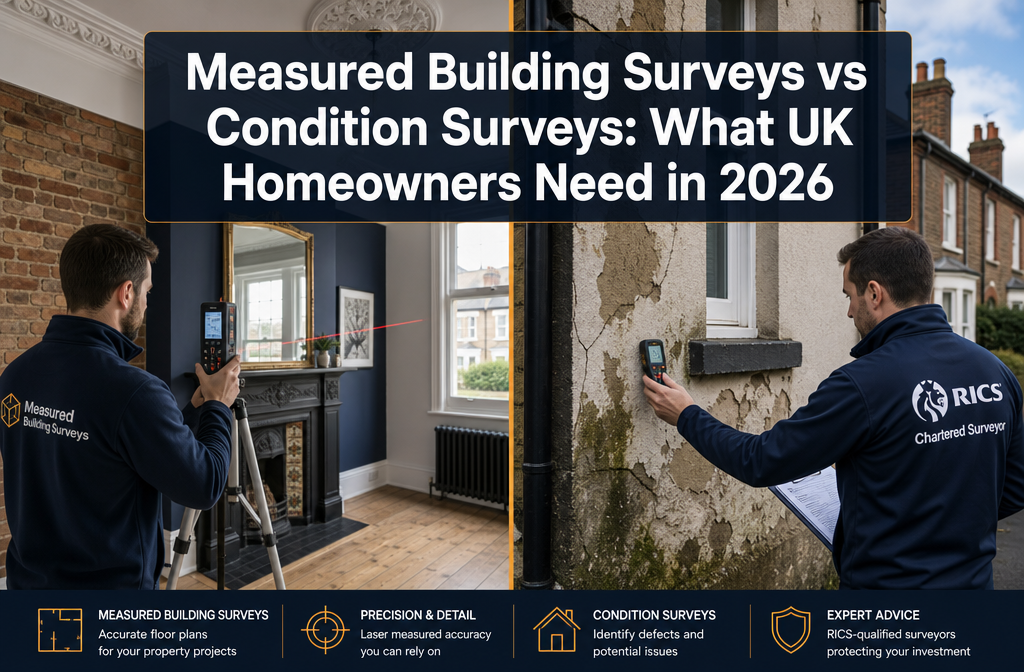
Over 60% of UK property transactions involve some form of professional survey — yet a significant number of buyers, developers, and landlords commission the wrong type, wasting money and missing critical information. Understanding Measured Building Surveys vs Condition Surveys: What UK Homeowners and Developers Actually Need in 2026 is not just a technical distinction; it is the difference between a smooth planning application and a costly rejection, or between a sound investment and an expensive surprise.
This guide cuts through the confusion with real-world scenarios, clear comparisons, and practical advice for every type of property stakeholder in the UK.
Key Takeaways 📋
- Measured building surveys produce precise spatial data (floor plans, elevations, sections) — essential for extensions, refurbishments, and planning applications.
- Condition surveys (RICS Level 2 and Level 3) assess the physical state of a property — essential for buyers, lenders, and landlords.
- The two survey types serve completely different purposes and are rarely interchangeable.
- Commissioning the wrong survey can delay planning applications, invalidate mortgage offers, or leave structural defects undiscovered.
- In 2026, digital tools like 3D laser scanning and BIM integration are raising the standard for both survey types.
Understanding the Core Difference: What Each Survey Actually Delivers
Before diving into scenarios, it helps to understand what each survey type is designed to produce.
What Is a Measured Building Survey?
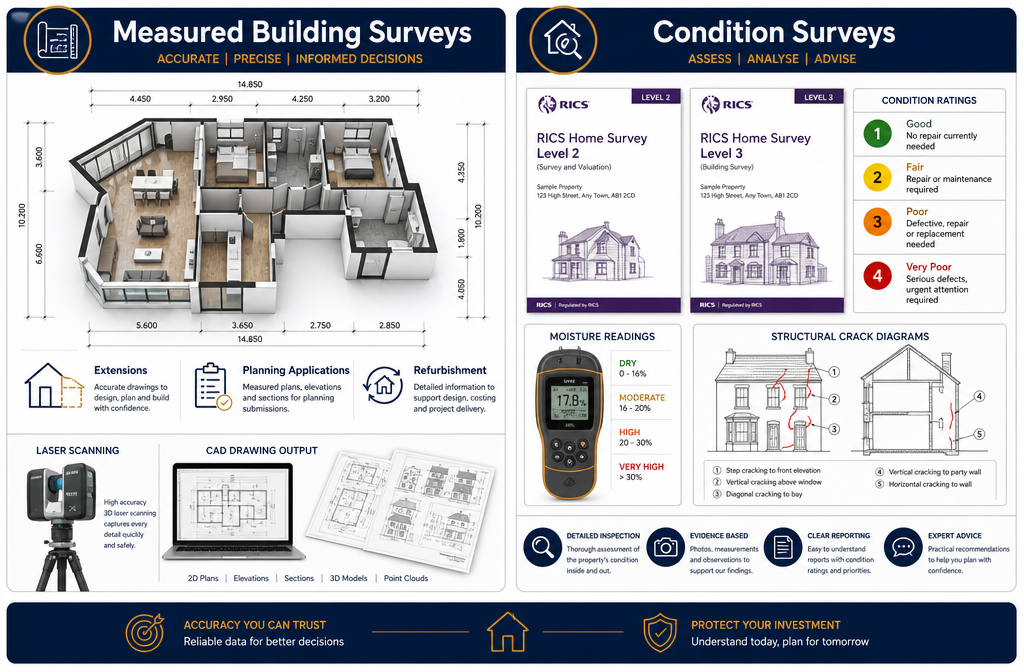
A measured building survey is a precise geometric record of a building. Surveyors use tools such as total stations, 3D laser scanners, and photogrammetry to capture accurate dimensions. The output typically includes:
- Floor plans with room dimensions and structural elements
- Elevations showing external façades
- Sections cutting through the building to show internal heights and structure
- Roof plans and site plans where required
The deliverable is a set of CAD drawings or BIM models — not a written report about the building's condition. A measured survey tells you where everything is and how big it is. It does not tell you whether the roof is leaking or the walls are damp.
What Is a Condition Survey?
A condition survey is a professional assessment of a building's physical state. In the UK, the Royal Institution of Chartered Surveyors (RICS) defines three levels:
| Survey Level | Formal Name | Best For |
|---|---|---|
| Level 1 | RICS Condition Report | New builds, modern homes in good condition |
| Level 2 | RICS HomeBuyer Report | Standard residential properties |
| Level 3 | RICS Building Survey | Older, complex, or altered properties |
Each level produces a written report with condition ratings, identified defects, maintenance advice, and (at Level 2 and 3) recommendations for further investigation. For a detailed breakdown of which level suits your property, the guide to Level 2 vs Level 3 surveys is an excellent starting point.
💡 Pull Quote: "A measured survey tells you the geometry of a building. A condition survey tells you its health. Confusing the two is like asking a doctor for a map."
Measured Building Surveys vs Condition Surveys: Real-World Scenarios for UK Homeowners and Developers in 2026
This is where the distinction becomes genuinely practical. The right survey depends entirely on what you are trying to achieve.
Scenario 1: Planning a Rear Extension or Loft Conversion 🏠
A homeowner in Wandsworth wants to add a rear extension and a loft conversion. Their architect needs accurate floor plans and elevations to produce planning drawings.
What they need: A measured building survey.
The local planning authority will not accept hand-drawn sketches or estate agent floor plans. A professionally measured survey — increasingly delivered as a BIM-ready CAD file in 2026 — gives the architect the precise base data needed to design the extension accurately and submit a valid planning application.
A condition survey would be irrelevant here. It would not produce the drawings the architect needs.
Scenario 2: Buying a Victorian Terraced House 🔑
A first-time buyer is purchasing a 1890s terrace in Islington. The mortgage lender has carried out a basic valuation, but the buyer wants to know whether the property has structural issues, damp, or roof problems before exchanging contracts.
What they need: A RICS Level 3 Building Survey (formerly a Full Structural Survey).
This is a condition survey — not a measured survey. It will identify defects, assess their severity, and recommend remedial action. For older properties, a Level 3 survey is strongly recommended. You can explore RICS survey options to understand which level is appropriate for your purchase.
A measured survey would produce floor plans — useful later for renovation work, but completely unhelpful for assessing whether the chimney stack is about to fall.
Scenario 3: Refurbishing a Commercial Property for Residential Conversion 🏗️
A developer in Southwark is converting a former office building into 12 residential units. They need both planning approval and detailed construction drawings.
What they need: Both surveys — but in sequence.
- First, a measured building survey to produce accurate existing drawings for the architect and structural engineer.
- Then, a condition survey (or a specific defect survey) to identify structural issues, services condition, and any elements requiring remediation before conversion begins.
This is one of the most common mistakes developers make in 2026: commissioning only one when both are required. For developers dealing with end-of-lease obligations, a dilapidations report may also be needed before vacating or acquiring a commercial space.
Scenario 4: Mortgage Lending and Valuation 💷
A buyer's lender instructs a surveyor to carry out a mortgage valuation. The buyer assumes this is a full survey. It is not.
What the lender gets: A mortgage valuation — a brief inspection to confirm the property is suitable security for the loan.
What the buyer still needs: A separate condition survey.
A mortgage valuation is neither a measured survey nor a condition survey. It is a financial assessment. This misunderstanding costs UK buyers thousands of pounds every year when defects emerge post-completion that a proper condition survey would have flagged. For more on this, see how an RICS survey can help you negotiate the property price.
Scenario 5: Party Wall Works and Neighbour Disputes 🏘️
A homeowner is about to carry out basement excavation works that affect the party wall. Their neighbour wants a record of the existing condition of their property before works begin.
What they need: A Schedule of Condition — a specific type of condition record attached to a Party Wall Award.
This is distinct from both a full condition survey and a measured survey. It documents the pre-existing state of the neighbouring property so that any damage caused by the works can be clearly attributed. Learn more about schedule of condition reports and how they protect both parties.
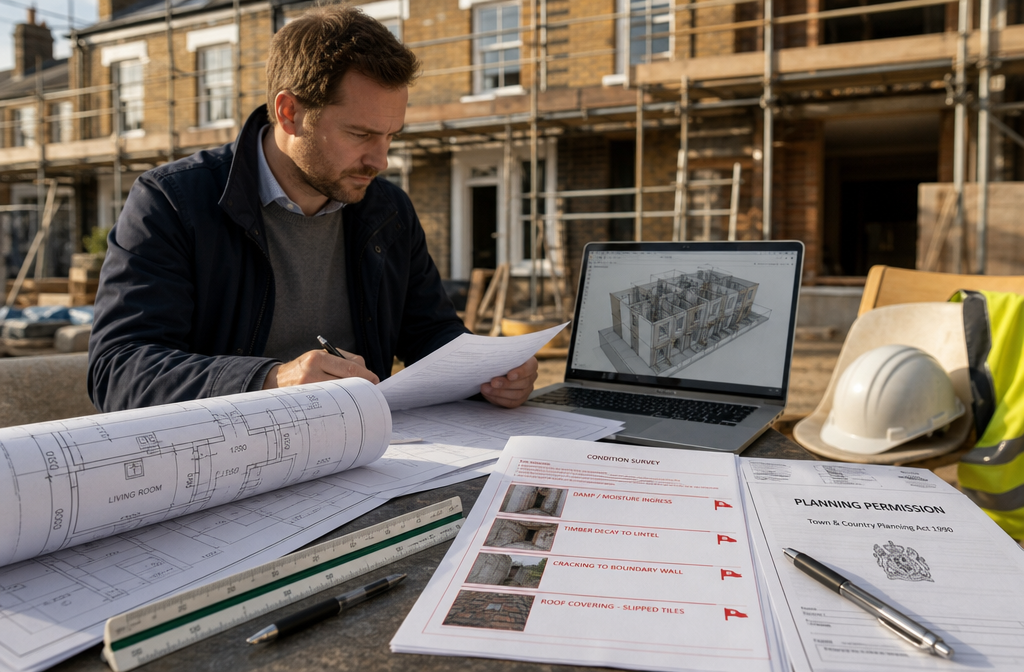
The Technical Landscape in 2026: How Technology Is Changing Both Survey Types
The surveying industry has changed significantly in the past five years. In 2026, both measured and condition surveys benefit from improved digital tools.
Measured Surveys: 3D Laser Scanning and BIM
3D laser scanning (LiDAR) has become the standard for complex measured surveys. A scanner captures millions of data points per second, producing a point cloud that can be processed into highly accurate CAD drawings or BIM models. Key benefits include:
- ✅ Sub-millimetre accuracy on large or complex buildings
- ✅ Faster site capture with reduced access requirements
- ✅ BIM-ready outputs compatible with Revit and ArchiCAD
- ✅ Reduced risk of human measurement error
For listed buildings, historic structures, and complex commercial properties, laser scanning has become the professional standard in 2026.
Condition Surveys: Digital Reporting and Thermal Imaging
Condition surveys have also evolved. RICS-registered surveyors increasingly use:
- Thermal imaging cameras to detect hidden damp, heat loss, and cold bridging
- Drone surveys for roof inspections on tall or inaccessible buildings
- Digital reporting platforms that deliver condition reports with embedded photographs, condition ratings, and cost estimates
These tools improve the accuracy of defect identification, particularly for issues that are not visible to the naked eye. For properties with suspected damp, a specialist damp survey may be recommended alongside or following a standard condition survey.
Choosing the Right Survey: A Practical Decision Guide
The following framework helps homeowners and developers identify the right survey type quickly.
Ask These Three Questions First:
-
Am I trying to understand the physical dimensions and geometry of the building?
→ If yes: You need a measured building survey. -
Am I trying to understand the physical condition, defects, or structural integrity?
→ If yes: You need a condition survey (Level 2 or Level 3 depending on property type and age). -
Am I dealing with a lease, party wall, or neighbour dispute?
→ If yes: You may need a schedule of condition or a specific defect survey.
Cost Benchmarks in 2026 (Approximate UK Figures)
| Survey Type | Typical Cost Range | Turnaround |
|---|---|---|
| Measured Building Survey (small residential) | £800 – £2,000 | 1–2 weeks |
| Measured Building Survey (large/commercial) | £2,000 – £8,000+ | 2–4 weeks |
| RICS Level 2 HomeBuyer Report | £400 – £900 | 3–5 days |
| RICS Level 3 Building Survey | £600 – £1,500+ | 5–10 days |
| Schedule of Condition | £300 – £800 | 3–5 days |
⚠️ Note: Costs vary significantly by location, property size, and surveyor. London and the South East typically attract higher fees.
Common Myths Worth Debunking 🚫
Many property buyers hold misconceptions about what surveys cover and deliver. Some of the most persistent myths include:
- "The mortgage valuation is a survey" — It is not. It protects the lender, not the buyer.
- "A measured survey will flag structural problems" — It will not. It records geometry, not condition.
- "A condition survey produces drawings I can use for planning" — It does not. Only a measured survey produces usable CAD drawings.
For a broader look at survey misconceptions, the article on common myths about property surveys is worth reading before commissioning any professional assessment.
Measured Building Surveys vs Condition Surveys: What UK Homeowners and Developers Actually Need in 2026 — Sector-Specific Guidance
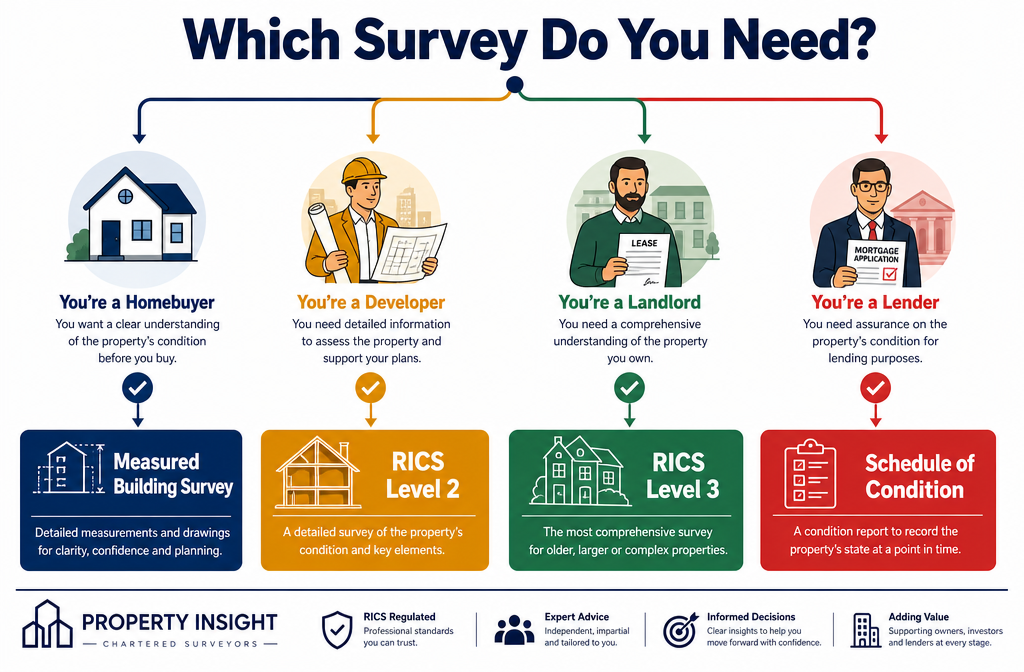
Different stakeholders have different priorities. Here is a quick-reference guide by sector.
For Residential Buyers 🏡
- Always commission a Level 2 or Level 3 condition survey before exchanging contracts.
- If planning immediate renovation work, also commission a measured survey so your architect has accurate base drawings.
- Do not rely on the mortgage valuation as a substitute for either.
- For leasehold properties, additional checks are required — see what to check before buying a leasehold property.
For Property Developers 🏗️
- Commission a measured survey at the earliest stage of any refurbishment, conversion, or extension project.
- Follow up with a condition survey or specific defect survey to identify structural and services issues before design work begins.
- For commercial acquisitions, factor in potential dilapidations liabilities.
- Ensure BIM-compatible outputs if working with architects using Revit or similar platforms.
For Landlords and Asset Managers 🏢
- Use schedules of condition at lease commencement and termination to protect against dilapidations disputes.
- Commission periodic condition surveys to maintain planned preventative maintenance schedules.
- For HMO properties, condition surveys support licensing applications and compliance documentation.
For Architects and Designers ✏️
- Always insist on a professionally measured survey before beginning design work on existing buildings.
- Estate agent floor plans are not accurate enough for planning submissions or construction drawings.
- In 2026, request point cloud data or BIM-ready outputs where possible to streamline the design process.
Conclusion: Match the Survey to the Mission
The debate around Measured Building Surveys vs Condition Surveys: What UK Homeowners and Developers Actually Need in 2026 ultimately comes down to one principle: match the survey to the mission.
A measured building survey is a precision tool for capturing spatial data. A condition survey is a diagnostic tool for assessing physical health. Neither replaces the other, and both are essential at different stages of the property lifecycle.
Actionable Next Steps ✅
- Define your goal first. Are you buying, building, extending, or managing? The answer determines the survey type.
- Do not rely on a mortgage valuation as a substitute for a professional condition survey.
- Commission both survey types if you are undertaking a significant refurbishment or conversion project.
- Use RICS-registered surveyors for condition surveys to ensure the report meets lender and legal standards.
- Request BIM-compatible outputs for measured surveys if working with architects on design projects in 2026.
- Seek specialist advice for leasehold properties, party wall matters, or commercial acquisitions where additional survey types may be required.
Getting the right survey at the right time is not just good practice — in 2026's competitive UK property market, it is essential protection for one of the most significant financial decisions most people will ever make.