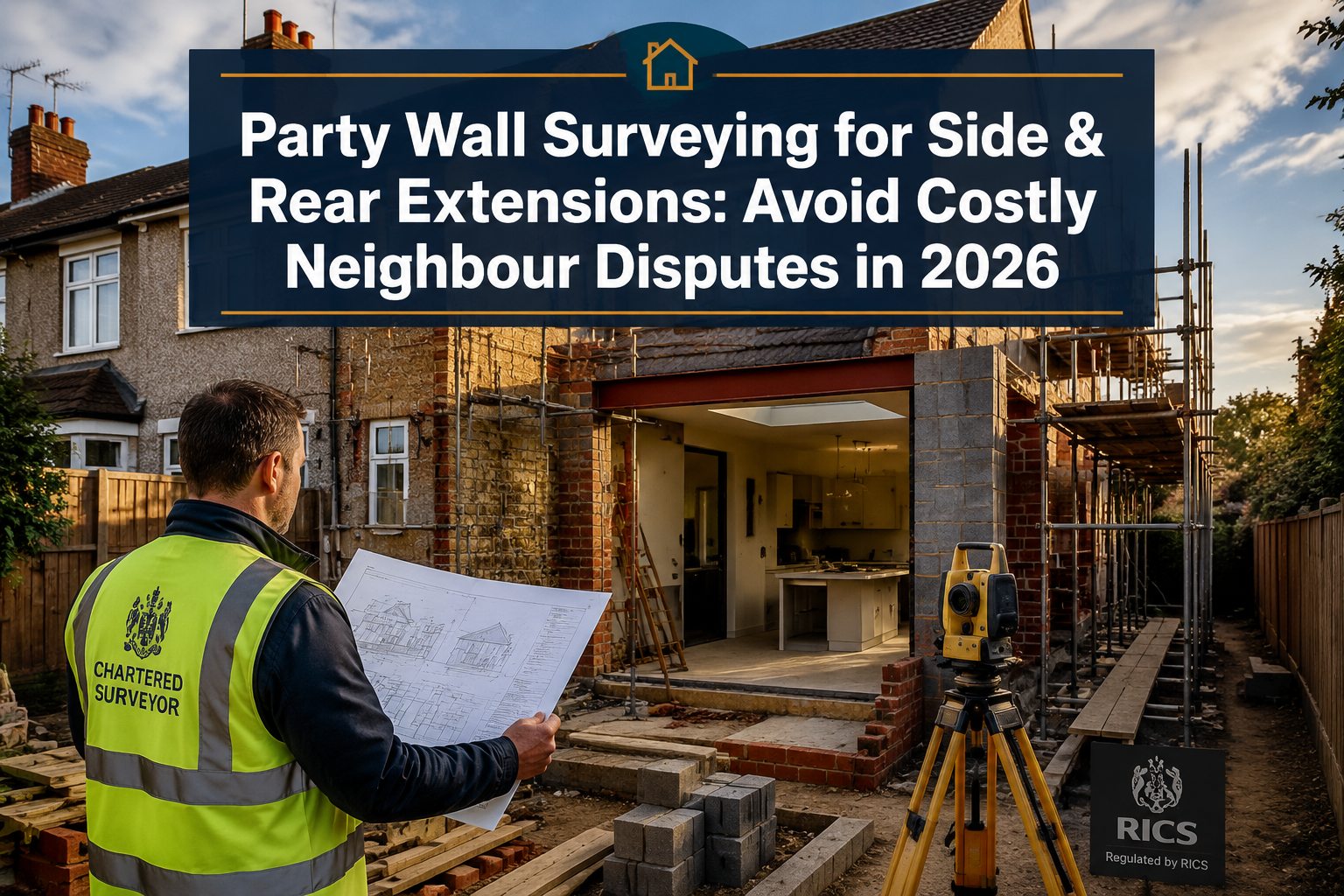
Extension applications across England surged by nearly 20% in the first quarter of 2026, driven by rising house prices that make moving less attractive than improving [3]. Kitchens are being pushed outward, side returns are being glazed over, and rear gardens are shrinking as homeowners invest in the space they already own. Yet buried inside this renovation boom is a legal obligation that thousands of homeowners overlook until it is too late: the Party Wall etc. Act 1996.
Party Wall Surveying for Side and Rear Extensions: How 2026 UK Homeowners Can Avoid Costly Neighbour Disputes is not just a bureaucratic formality — it is the framework that determines whether a build runs smoothly or ends in an expensive legal standoff. This guide explains exactly when the Act applies, what a surveyor needs from you, and the dispute flashpoints that professionals are flagging most frequently in 2026.
Key Takeaways 📋
- The Party Wall etc. Act 1996 is mandatory for most side and rear extensions — ignoring it can halt your build and expose you to legal liability.
- Notice periods are strict: two months for party wall works, one month for boundary walls or excavations.
- A Party Wall Award typically costs around £1,000, but disputes can cost many times more if the process is skipped.
- Surveyors need specific drawings and structural details before they can serve valid notices or draft an Award.
- Early, transparent communication with neighbours remains the single most effective way to avoid disputes in 2026.
When Does the Party Wall Act Apply to Your Extension?
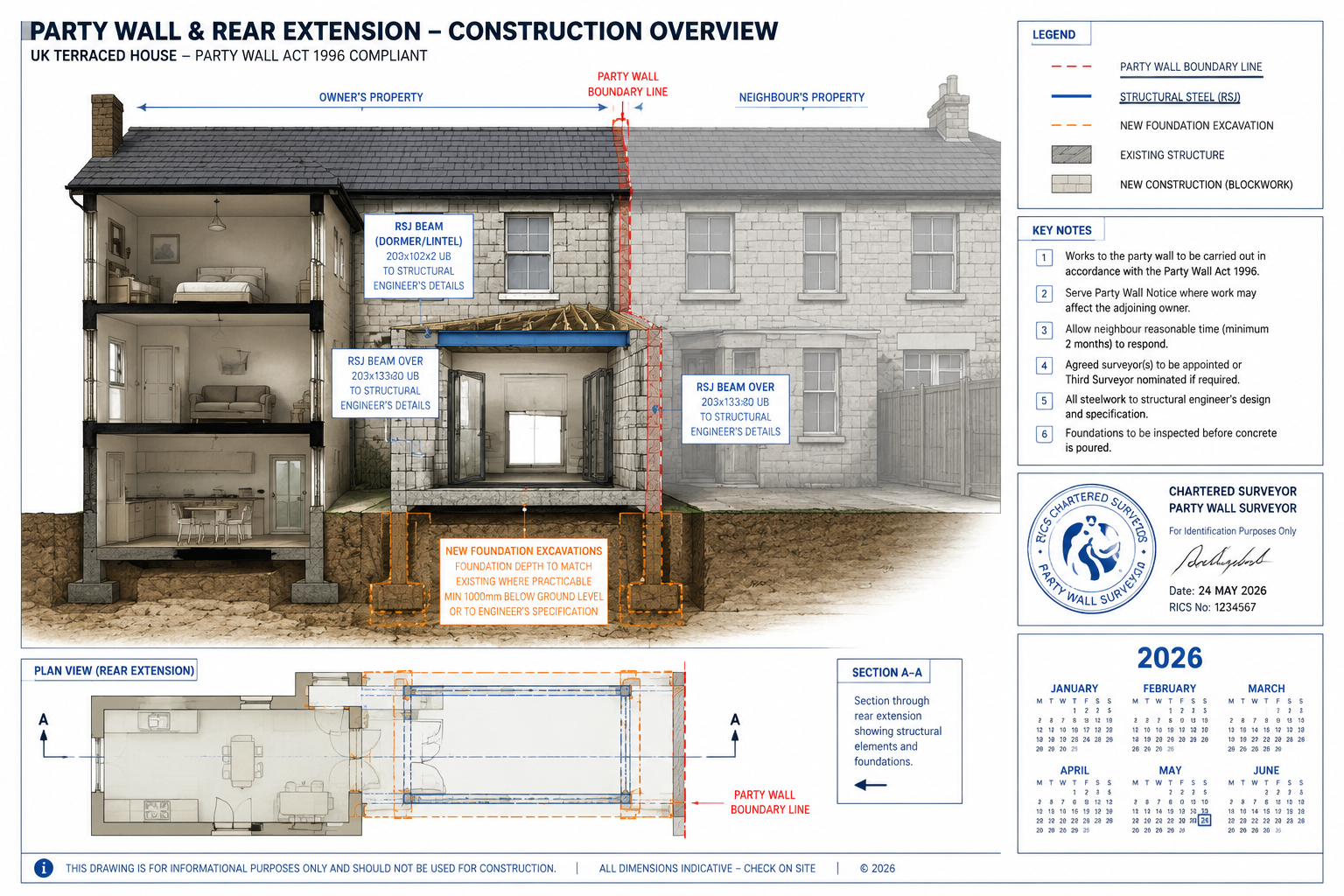
The Party Wall etc. Act 1996 covers three distinct types of work. Understanding which category your project falls into is the first step toward compliance.
The Three Triggers for Side and Rear Extensions
| Trigger | Typical Extension Scenario | Notice Period |
|---|---|---|
| Works to a party wall or structure | Cutting in steel RSJ beams, raising or underpinning a shared wall | 2 months |
| New wall built on or at the boundary | Side extension wall constructed along the property line | 1 month |
| Excavations near a neighbour's building | New foundations within 3m of an adjoining structure (or 6m for deeper excavations) | 1 month |
Most rear and side extensions trigger at least one of these categories — and many trigger two or all three simultaneously [4].
💡 Pull Quote: "A kitchen extension that looks straightforward on a sketch plan can trigger all three sections of the Act once the structural engineer specifies the foundations and steelwork." — A common observation among party wall surveyors in 2026 [6].
What Does NOT Require a Party Wall Agreement?
Minor internal works are exempt. Plastering, chasing walls for electrics, fixing kitchen units, or inserting plug sockets do not require a party wall notice. The key question is always: does the work physically affect the party wall or the ground near a neighbour's foundations? [4]
The Act applies in England and Wales only — not Scotland or Northern Ireland, which have separate legal frameworks.
What Drawings and Structural Details Does a Surveyor Actually Need?
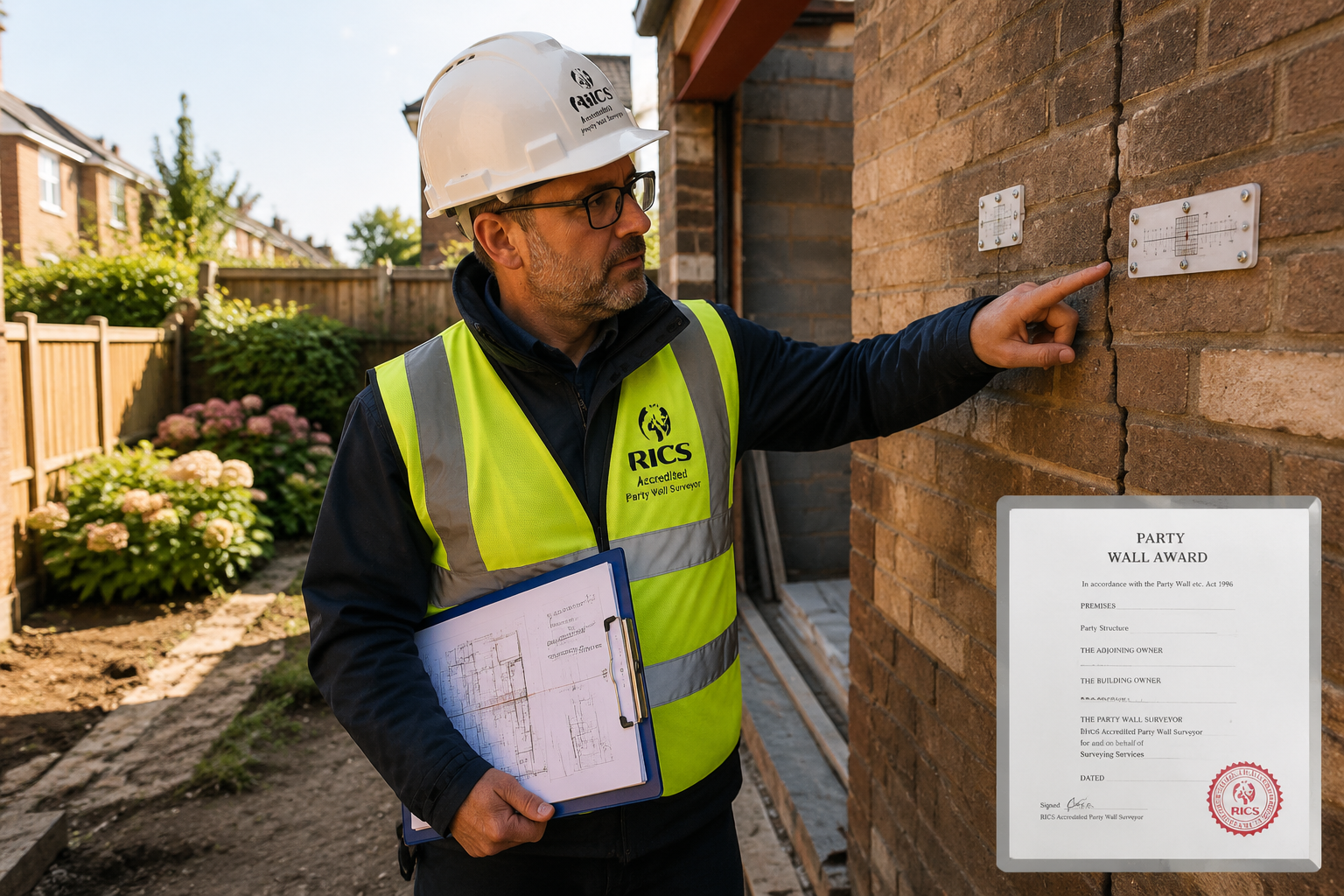
One of the most common causes of delay in 2026 is homeowners approaching a party wall surveyor without the right documentation. A surveyor cannot serve a legally valid notice — or draft a robust Party Wall Award — without specific technical information [8].
The Essential Document Checklist ✅
Architectural drawings:
- Existing and proposed floor plans (showing the party wall clearly)
- Elevations and sections through the extension
- Site location plan (usually 1:1250 scale)
Structural engineer's information:
- Foundation type, depth, and dimensions
- Position and size of any new steel beams (RSJs) bearing onto or near the party wall
- Load calculations where the party wall will carry new loads
Scope of works description:
- Written schedule of exactly what will happen to or near the party wall
- Sequence of works if phasing affects the neighbour
Schedule of Condition:
- A photographic and written record of the adjoining owner's property before works begin
- This is arguably the most protective document for both parties — it establishes the baseline against which any damage claims are measured [2]
Without a Schedule of Condition, a neighbour can claim that pre-existing cracks were caused by your extension. With one, the evidence speaks for itself.
The RICS 8th Edition Guidance: What Changed in 2026?
The RICS updated its party wall practice guidance in 2026, placing greater emphasis on proportionality, transparency, and digital record-keeping [8]. Surveyors are now expected to:
- Provide clearer fee estimates upfront before appointment
- Use digital condition surveys with geotagged photographs
- Communicate proactively with both building owners and adjoining owners throughout the process
For homeowners, this means surveyors should be more transparent about party wall surveyor costs from the outset — making budgeting for your extension more predictable.
The Most Common Dispute Flashpoints in 2026
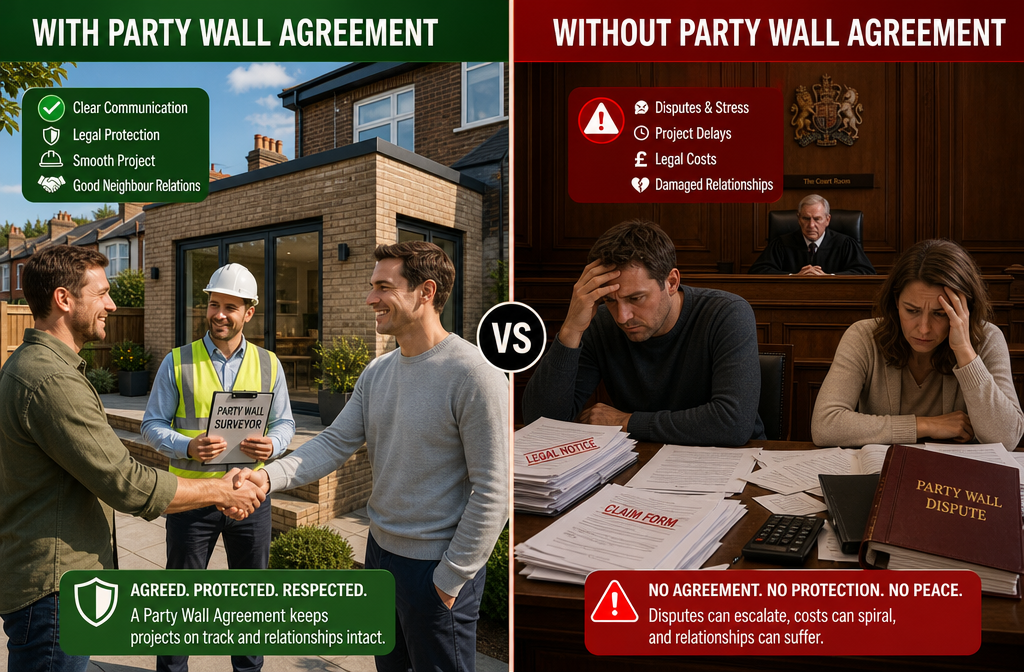
Surveyors operating across London and the South East are reporting a consistent set of flashpoints as the extension surge continues [6]. Knowing these in advance allows homeowners to address them proactively.
🔴 Flashpoint 1: Late or Missing Notices
The statutory notice periods are minimum lead times, not targets. Serving a two-month notice the day before you want to start work is not legally compliant — and starting work without any notice at all is an unlawful act under the 1996 Act [4].
In 2026, surveyors report that late notices are the single most common cause of project delays [3]. Build the notice period into your programme from the moment planning permission is granted.
🔴 Flashpoint 2: Neighbours Who Dissent — and What Happens Next
When a neighbour receives a party wall notice, they have three options:
- Consent in writing — works can proceed without a formal Award
- Dissent and agree to a single agreed surveyor — one surveyor acts for both parties
- Dissent and appoint their own surveyor — two surveyors (plus a potential third) draft the Award
Option 3 is the most expensive route. The building owner (the homeowner doing the extension) is generally responsible for paying all surveyor fees, including those of the neighbour's surveyor [4]. Understanding what a party wall surveyor does helps homeowners appreciate why these costs arise and how to minimise them.
💡 Pull Quote: "A neighbour who feels blindsided is far more likely to dissent and appoint their own surveyor. A five-minute conversation before serving the notice can save thousands of pounds." [3]
🔴 Flashpoint 3: Excavation Disputes and Foundation Depth
Side and rear extensions often require deeper foundations than the original house — particularly in London clay, where movement is a persistent concern. When new foundations are within 3 metres of a neighbour's structure and deeper than their foundations, Section 6 of the Act is triggered [4].
Neighbours frequently raise concerns about:
- Subsidence risk during excavation
- Vibration damage from piling or breaking out concrete
- Tree root disturbance near shared boundaries
A robust Schedule of Condition, combined with crack monitoring gauges installed before works begin, addresses the majority of these concerns before they escalate. Monitoring surveys can provide ongoing data throughout the build, giving neighbours objective reassurance.
🔴 Flashpoint 4: Steel Beams Into the Party Wall
Side-return extensions frequently require a large steel RSJ beam to span the new open-plan space. When that beam bears onto the party wall — even by a few centimetres — it constitutes notifiable work under Section 2 of the Act [6].
Surveyors in 2026 are seeing disputes arise because:
- Structural engineers specify beam bearings after notices have already been served (requiring re-notification)
- Builders cut pockets into the party wall without waiting for the Award to be made
- The depth and size of the beam bearing changes during construction without informing the adjoining owner's surveyor
The fix: Ensure structural drawings are finalised and reviewed by the party wall surveyor before notices are served. Any changes to beam specifications during the build must be communicated immediately [8].
🔴 Flashpoint 5: Damage Claims After Completion
Even when the party wall process is followed correctly, damage claims can arise after the extension is finished. Common issues include:
- Hairline cracks appearing in the neighbour's plasterwork
- Damp penetration at the junction of old and new walls
- Settlement cracks near new foundation edges
The Party Wall Award will specify the process for resolving these claims. Without one, disputes about legal disputes and liability can become protracted and expensive. With a properly drafted Award and a pre-works Schedule of Condition, resolution is typically straightforward.
Party Wall Surveying for Side and Rear Extensions: Costs and Budgeting in 2026
Budgeting for party wall surveying is an essential part of any extension project. The figures below reflect 2026 market rates [2][4]:
| Item | Typical Cost (2026) |
|---|---|
| Party wall surveyor hourly rate | £150–£200/hour |
| Party wall Award (single agreed surveyor) | ~£1,000 |
| Party wall Award (two surveyors) | £1,500–£3,000+ |
| Schedule of Condition | £300–£600 |
| Third surveyor (if required) | Additional fees apply |
The building owner pays. This is non-negotiable under the Act — the neighbour's reasonable surveyor fees are the building owner's responsibility [4].
⚠️ Important: Attempting to avoid party wall costs by proceeding without notices can result in an injunction stopping the works entirely — at far greater cost than the surveyor fees would have been [6].
For a detailed breakdown of what drives these costs, the party wall surveyor fee structures page provides further context on how location, complexity, and the number of adjoining owners affect the final bill.
Party Wall Surveying for Side and Rear Extensions: A Step-by-Step Compliance Guide
Follow this sequence to keep your 2026 extension on track:
Step 1 — Appoint your design team early
Architect and structural engineer should be working concurrently, not sequentially. The party wall surveyor needs structural information that only the engineer can provide.
Step 2 — Identify all notifiable works
Walk through the three triggers with your party wall surveyor before any notices are drafted. It is common for homeowners to underestimate the scope of notifiable work.
Step 3 — Serve notices at the right time
Build the statutory notice periods into your programme. For a two-month notice, this means serving before you need consent — not on the day you want to start.
Step 4 — Communicate with neighbours
A brief, friendly conversation explaining the project before the formal notice arrives dramatically reduces the likelihood of dissent [3]. Share the architect's drawings if the neighbour is interested.
Step 5 — Commission a Schedule of Condition
This protects both parties. A qualified surveyor should inspect and document the adjoining property's condition before any groundworks begin.
Step 6 — Obtain the Party Wall Award
The Award sets out the rights and obligations of both parties. Works should not begin until the Award is agreed and signed [4]. For guidance on what to do when you receive a party wall notice, there is detailed advice available for neighbours on the other side of the process.
Step 7 — Keep records throughout the build
Photograph the party wall at each stage. Notify the adjoining owner's surveyor of any changes to the structural specification.
Choosing the Right Party Wall Surveyor in 2026
Not all surveyors have the same level of experience with residential extensions. When selecting a professional, look for:
- RICS accreditation or membership of the Faculty of Party Wall Surveyors (FPWS)
- Specific experience with side and rear extensions (not just commercial or infrastructure projects)
- Transparent fee structures provided in writing before appointment [8]
- Local knowledge — surveyors familiar with local soil conditions, common construction methods, and local authority requirements add genuine value
Working with experienced party wall surveyors who specialise in residential extensions ensures that notices are correctly drafted, Awards are robust, and disputes are resolved efficiently if they arise.
Conclusion: Act Early, Communicate Clearly, Document Everything
The 2026 extension boom shows no sign of slowing — and neither does the potential for neighbour disputes when the Party Wall etc. Act 1996 is ignored or mishandled. Party Wall Surveying for Side and Rear Extensions: How 2026 UK Homeowners Can Avoid Costly Neighbour Disputes comes down to three principles: act early, communicate clearly, and document everything.
Actionable Next Steps for 2026 Homeowners:
- Before finalising your extension design, ask your architect to flag all potential party wall triggers.
- Appoint a RICS-accredited party wall surveyor as soon as structural drawings are available — not after planning permission is granted.
- Build notice periods into your project programme from day one. A two-month notice served late is a two-month delay.
- Talk to your neighbours before the formal notice arrives. A conversation costs nothing; a dispute can cost thousands.
- Commission a Schedule of Condition for every adjoining property before groundworks begin.
- Budget realistically — include party wall surveyor fees in your extension costs from the outset, using the Party Wall Act 1996 guide as a reference for the legal framework.
The Party Wall etc. Act 1996 exists to protect everyone — building owners and neighbours alike. Used correctly, it is not a barrier to building; it is the framework that makes building possible without destroying neighbourly relationships in the process.
References
[1] Party Wall Surveys For Infrastructure Projects 2026 Protocols In High Demand Regions Like Staffordshire – https://nottinghillsurveyors.com/blog/party-wall-surveys-for-infrastructure-projects-2026-protocols-in-high-demand-regions-like-staffordshire
[2] Party Wall Awards By Chartered Building Surveyors Rics Services Fee Structures And Case Studies For 2026 – https://manchestersurveyors.com/party-wall-awards-by-chartered-building-surveyors-rics-services-fee-structures-and-case-studies-for-2026/
[3] Party Wall Agreements For 2026 Renovation Surge Managing Notices As Buyer Confidence Returns – https://princesurveyors.co.uk/blog/party-wall-agreements-for-2026-renovation-surge-managing-notices-as-buyer-confidence-returns/
[4] Party Wall Agreement – https://hoa.org.uk/advice/guides-for-homeowners/i-am-improving/party-wall-agreement/
[5] Party Wall Agreement London 2026 – https://www.mayfairstudio.co.uk/blog/party-wall-agreement-london-2026
[6] Party Wall Surveys Amid 2026 Construction Uptick Rics Framework For Managing Surging Neighbour Disputes – https://partywallsurveyorlondon.uk/blogs/party-wall-surveys-amid-2026-construction-uptick-rics-framework-for-managing-surging-neighbour-disputes/
[7] Chasing Party Wall Works Is It Worth It For Uk Surveyors In 2026 – https://www.canterburysurveyors.com/blog/chasing-party-wall-works-is-it-worth-it-for-uk-surveyors-in-2026/
[8] Rics 8th Edition Party Wall Guidance 2026 Whats Changed And How Surveyors Must Adapt – https://wimbledonsurveyors.com/rics-8th-edition-party-wall-guidance-2026-whats-changed-and-how-surveyors-must-adapt/
[9] Party Wall Faqs – https://christopheranthony.org.uk/party-wall-faqs/
[10] Rics Launches Consultation Updated Party Wall Practice Guidance – https://todaysconveyancer.co.uk/rics-launches-consultation-updated-party-wall-practice-guidance/