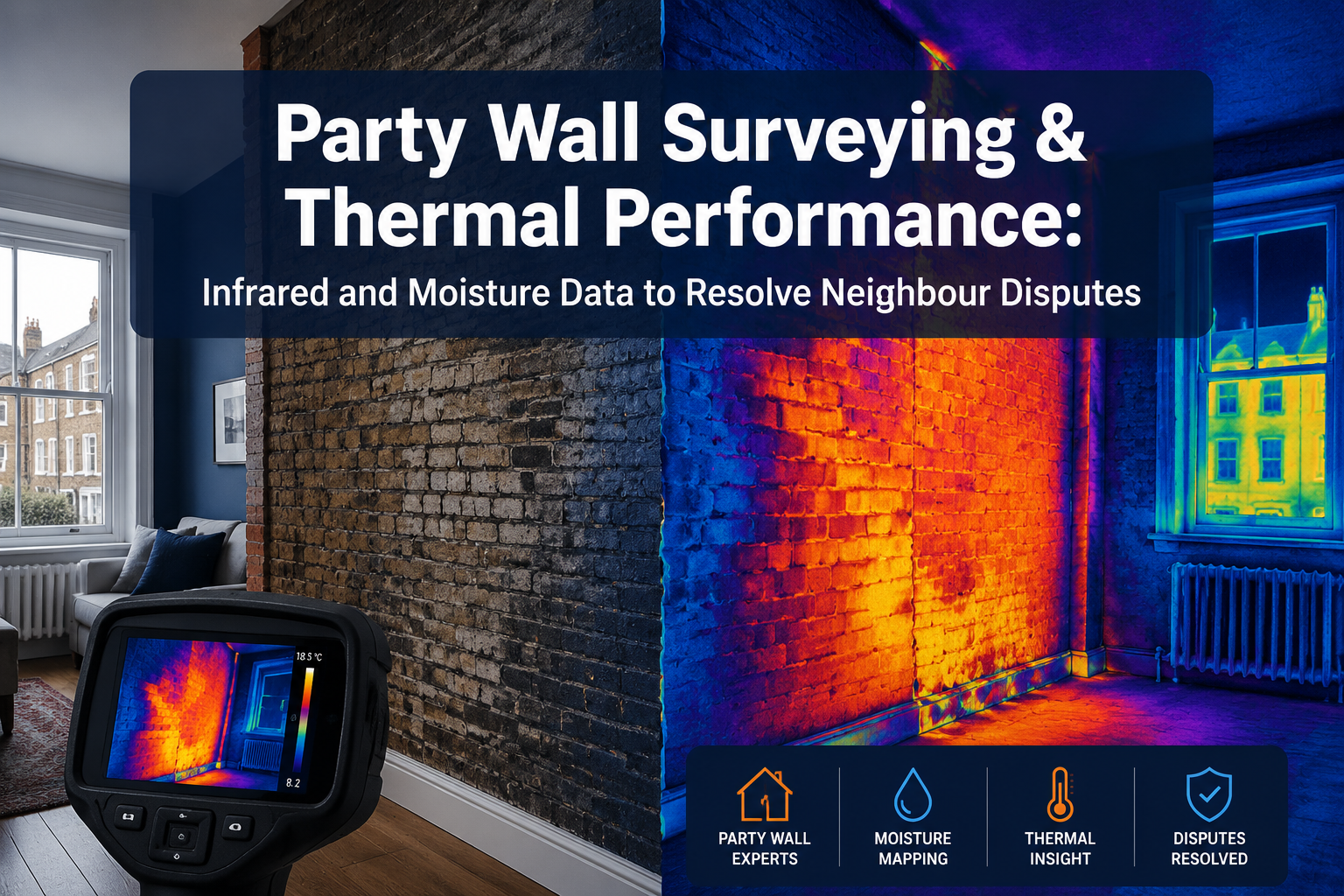
Nearly one in three party wall disputes that reach formal arbitration in England and Wales involves a claim about damp, heat loss, or insulation failure — yet the majority of those claims arrive without a single piece of objective thermal or moisture data to support them. That gap between allegation and evidence is exactly where modern party wall surveying and thermal performance diagnostics can make the difference between a robust, defensible award and a protracted legal battle.
This article explains how infrared thermography and calibrated moisture measurement are reshaping the way party wall surveyors document defects, allocate liability, and resolve neighbour disputes — especially under the updated RICS 8th Edition protocols now in force in 2026 [2][3].
Key Takeaways 📋
- Thermal imaging is now a core evidential tool under RICS 8th Edition party wall protocols, not an optional add-on — particularly for hidden damp, thermal bridging, and heat-loss claims [2].
- Infrared cameras do not detect moisture directly — they identify temperature anomalies that must always be confirmed with a calibrated moisture meter before being used in formal reports [5].
- A four-step workflow (thermal scan → moisture check → photographic record → comparative post-works analysis) is the industry-standard approach for building defensible evidence [2][3].
- Awaab's Law expansion in 2026 is driving stricter documentation of damp and mould risks in party wall contexts, making baseline surveys before works more important than ever [9].
- Pre-works Schedule of Condition surveys that include thermographic data are the single most effective tool for resolving "before and after" disputes between neighbours [2].
Why Thermal and Moisture Evidence Matters in Party Wall Surveying and Thermal Performance Disputes
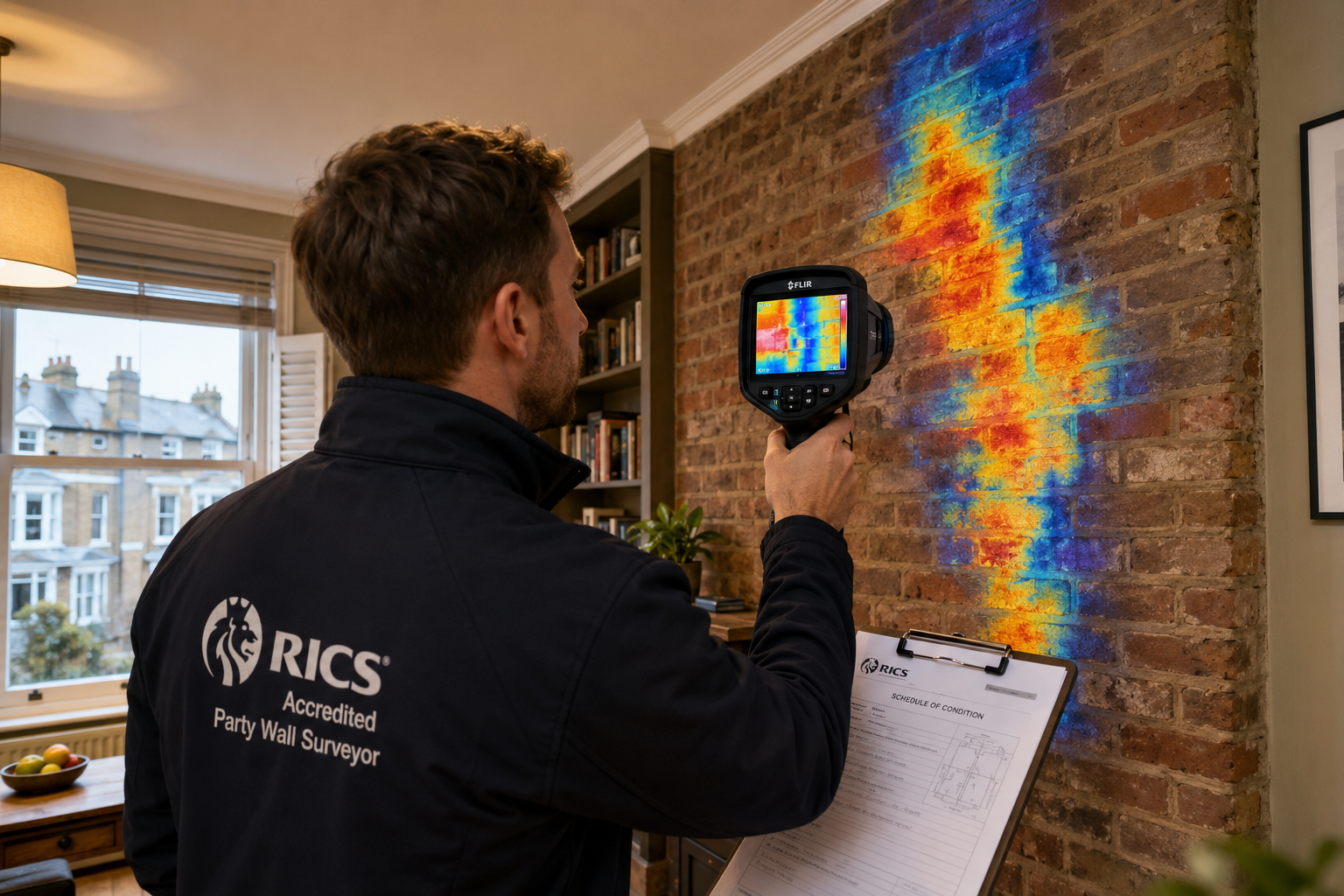
The Party Wall Act 1996 gives surveyors the authority to make binding awards about works on or near shared boundaries. What it does not do is specify how surveyors should gather evidence when a neighbour claims that construction work has caused new damp, cold spots, or insulation failure. For decades, that evidence gap was filled with little more than visual inspection and written descriptions.
That approach is no longer adequate — and the RICS 8th Edition guidance makes this explicit [2][10].
The Problem With Visual-Only Inspections
A surveyor who relies solely on what the eye can see will miss:
- Hidden moisture trapped behind plasterboard or within wall cavities
- Thermal bridges at junctions between new and old construction
- Insulation voids created when a neighbour's loft conversion disturbs party wall insulation
- Cold air infiltration around new penetrations for pipes or cables
These defects are invisible to the naked eye but highly visible to an infrared camera — and they are precisely the defects that generate the most contentious disputes, because neither party can easily prove when the problem started.
💬 "Thermal imaging is great for detecting signs of water damage but shouldn't be used alone for an inspection." — FLIR technical guidance [5]
This is the critical point: thermal imaging locates anomalies; moisture meters confirm them. Using one without the other produces evidence that can be challenged and dismissed.
RICS 8th Edition: Thermography as a Core Protocol
Under the updated RICS 8th Edition building survey and party wall quality standards, thermal imaging has moved from a discretionary extra to a recognised evidential method for detecting hidden defects [2][10]. The January 2026 edition of Modus by RICS reflects this shift, with guidance on integrating diagnostic technology into condition reporting [10].
For party wall surveyors specifically, this means that where a neighbour alleges heat loss or moisture ingress linked to construction works, a surveyor who did not commission a baseline thermographic survey before works began may find their award harder to defend if challenged.
The Four-Step Diagnostic Workflow for Party Wall Surveying and Thermal Performance Evidence
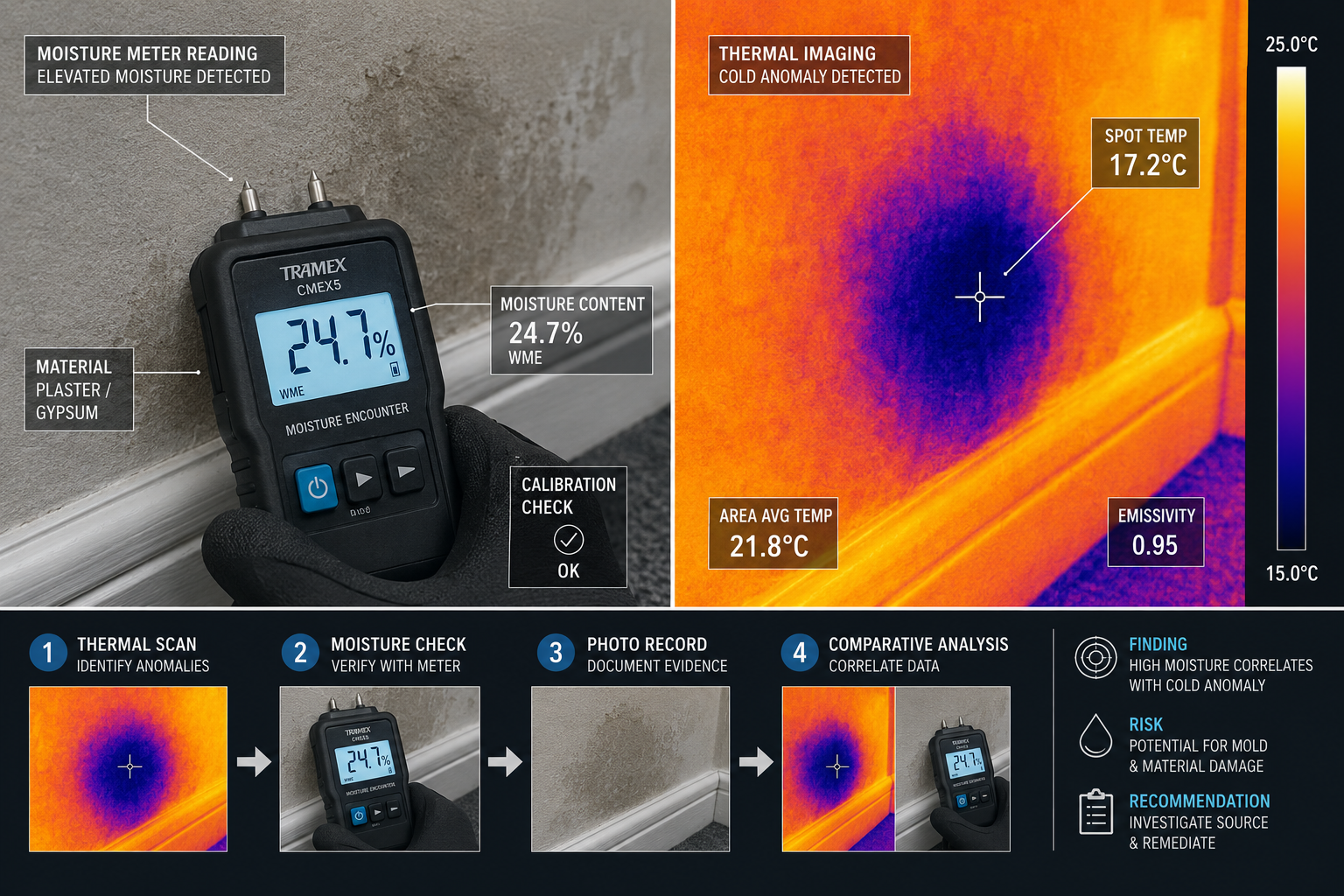
Industry commentary from 2026 — including guidance aligned with RICS 8th Edition protocols — sets out a clear, repeatable workflow that party wall surveyors should follow when thermal performance or moisture is in dispute [2][3][9].
Step 1: Thermal Scan to Locate Anomalies 🔍
The first step is a full infrared scan of the relevant party wall surfaces, ideally conducted:
- In heating season (October–March in the UK), when there is sufficient temperature differential between inside and outside for anomalies to show clearly
- Before works commence, so that pre-existing conditions are documented
- On both sides of the party wall where access is available
Professional-grade equipment — such as FLIR T-series cameras — can identify thermal bridges, missing insulation sections, and moisture-affected areas with high resolution [5][6][7]. The thermogram images are saved with GPS tags, timestamps, and ambient temperature data to ensure they are admissible as evidence.
What thermography can reveal:
| Anomaly Type | Thermal Signature | Likely Cause |
|---|---|---|
| Cold spot on internal wall | Blue/purple zone | Missing insulation or thermal bridge |
| Warm patch on external wall | Orange/red zone | Heat loss through defective masonry |
| Circular ceiling pattern | Cool ring shape | Moisture ingress from above |
| Linear cold line at wall junction | Blue streak | Air infiltration gap |
Step 2: Targeted Moisture Meter Checks 💧
Every anomaly identified in the thermal scan must be followed up with a calibrated moisture meter reading before it is recorded in any formal document. This is non-negotiable under current best practice [5][2].
Moisture meters measure the actual moisture content of the substrate — plaster, timber, masonry — and provide a percentage reading that can be compared against established thresholds. A reading above 20% in timber, for example, indicates active moisture risk.
This two-stage approach — thermal scan to find, moisture meter to confirm — is what separates robust party wall evidence from speculation. As FLIR's own technical guidance states, moisture meters should be "used in combination with a thermal camera to accurately gauge the presence of water" [5].
For more on the cost and scope of professional damp investigations, the damp survey cost guide provides useful context on what to expect from a thorough assessment.
Step 3: Photographic and Written Record 📸
Every thermal image must be paired with a standard visible-light photograph of the same area, taken from the same position. The formal record should include:
- Thermogram image (false-colour)
- Corresponding visible-light photograph
- Moisture meter reading at the same location
- Ambient temperature and relative humidity at time of survey
- Surveyor's written interpretation
This documentation package becomes an attachment to the Schedule of Condition — the legal record of the property's state before works begin. A well-prepared Schedule of Condition with thermographic data is the single most powerful tool for resolving "before and after" disputes, because it removes ambiguity about what existed prior to construction.
Step 4: Post-Works Comparative Analysis 📊
After construction is complete, a repeat thermal and moisture survey is conducted under comparable conditions. The post-works thermograms are then compared directly with the baseline images.
If a neighbour claims that a loft conversion or basement excavation has caused new cold spots or damp, this comparison provides objective, quantified evidence of whether conditions have materially changed. If the anomalies are identical to those recorded before works, the claim is demonstrably pre-existing. If new anomalies appear at locations consistent with the construction activity, the evidence supports the neighbour's allegation.
This comparative approach is described in detail in both the Wimbledon Surveyors and Notting Hill Surveyors 2026 guidance as the most defensible method for resolving thermal performance disputes [2][9].
Awaab's Law, Mould Documentation, and the Expanding Duty of Party Wall Surveyors
One of the most significant regulatory drivers behind the adoption of thermal and moisture diagnostics in 2026 is the expansion of Awaab's Law — legislation arising from the tragic death of two-year-old Awaab Ishak from mould-related illness in a social housing property.
While Awaab's Law initially targeted social landlords, its 2026 expansion has created a wider regulatory climate in which damp and mould documentation is under much greater scrutiny across all housing types [9]. Party wall surveyors are not immune to this shift.
What This Means in Practice
When a neighbour alleges that construction works have worsened condensation or mould growth — a claim that is increasingly common in terraced and semi-detached properties undergoing loft conversions or rear extensions — the surveyor's duty to document baseline conditions has become more pressing.
The recommended approach under 2026 guidance includes [3][9]:
- ✅ Baseline thermal and moisture survey before any excavation or wall alteration
- ✅ Repeat survey after works are complete
- ✅ Comparative analysis to show objectively whether conditions have changed
- ✅ Written interpretation linked to mould risk thresholds
This proactive documentation strategy serves two purposes: it protects the building owner from unfounded claims, and it gives the adjoining owner genuine recourse if works have genuinely worsened their thermal environment.
For property owners involved in boundary-related disagreements, understanding the legal requirements for boundary walls is an important first step before any works begin.
Practical Applications: What Party Wall Surveyors Are Identifying With Infrared Data
The range of defects that thermal imaging is now being used to document in party wall contexts has expanded significantly. Based on current industry practice [2][6][7], the most common applications include:
🏠 Insulation Mapping at Shared Boundaries
When a neighbour installs cavity wall insulation or upgrades their loft insulation, the thermal performance of the party wall can change. Infrared surveys can map exactly where insulation stops at the boundary — information that becomes critical if one neighbour's energy bills increase or comfort levels deteriorate after works.
🔥 Thermal Bridging at New Structural Elements
New steel beams, concrete lintels, or reinforced concrete pads introduced during basement excavations or structural alterations create thermal bridges — pathways through which heat escapes more rapidly than through the surrounding wall. These bridges are invisible from the surface but clearly visible in thermograms as linear cold zones.
💧 Moisture Ingress Tracing
Professional thermographic equipment — including FLIR T-series cameras — can be used to "ascertain the source of moisture ingress, as well as the extent of deterioration it may have caused" [6][7]. In party wall contexts, this is particularly valuable where a neighbour claims that excavation work has disturbed drainage or waterproofing, leading to damp penetration through the shared structure.
🧱 Pre-Existing Defect Documentation
Perhaps the most important application is the documentation of pre-existing defects before works begin. If historic damp staining, failed pointing, or missing insulation is recorded in the baseline thermographic survey, a subsequent claim that these issues were caused by the neighbour's construction is immediately refutable [2].
This is why a party wall agreement surveyor who integrates thermal diagnostics into their practice adds significantly more value than one who relies on visual inspection alone.
Making Awards More Robust: How Thermal Data Strengthens the Surveyor's Position
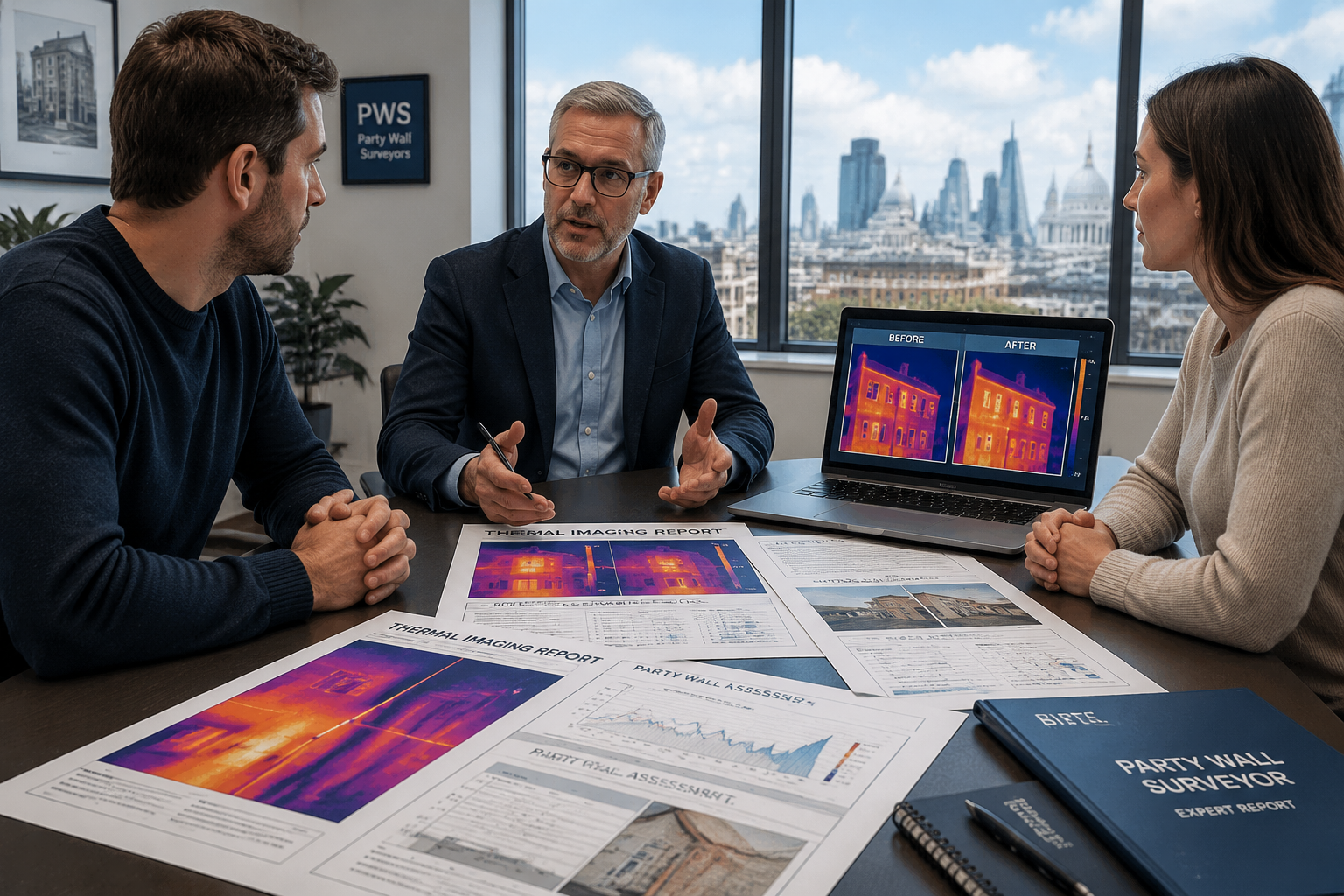
A party wall award that is supported by thermographic and moisture data is substantially harder to challenge than one based on subjective observation. Here is why this matters:
From a legal standpoint, thermal images with embedded metadata (timestamp, GPS, ambient conditions) constitute objective, reproducible evidence. They are not subject to the same credibility challenges as a surveyor's written description of "apparent dampness" or "possible cold bridging."
From a practical standpoint, comparative thermograms — before and after works — give the surveyor a clear, visual basis for their award that both parties can understand without specialist knowledge. This reduces the likelihood of disputes escalating to County Court.
From a professional standpoint, a surveyor who follows the RICS 8th Edition protocols for thermal and moisture documentation demonstrates due diligence that protects them from professional liability claims [10][2].
For those navigating legal disputes arising from party wall matters, the quality of the underlying survey evidence is often the determining factor in whether a dispute resolves quickly or drags on for months.
It is also worth noting that wall cracking — another common complaint in party wall disputes — can be assessed alongside thermal data to build a comprehensive picture of structural and environmental change.
Choosing the Right Surveyor for Thermal Performance Disputes
Not all party wall surveyors have the equipment or training to conduct thermographic surveys to RICS standards. When selecting a surveyor for a dispute involving heat loss, damp, or insulation failure, look for:
- ✅ RICS accreditation and familiarity with 8th Edition protocols
- ✅ Certified thermography training (Level 1 minimum; Level 2 preferred for complex cases)
- ✅ Calibrated moisture meters used alongside thermal cameras
- ✅ Experience preparing Schedule of Condition reports with thermographic attachments
- ✅ Clear workflow for pre- and post-works comparative surveys
The neighbourly communication support available through experienced surveyors can also help de-escalate tensions before they reach formal dispute stage — saving both parties time and money.
For London-based property owners, the London party wall agreement framework applies across all boroughs, and surveyors familiar with the specific construction challenges of London's dense urban housing stock — terraced Victorians, converted flats, basement extensions — will be best placed to apply thermal diagnostics effectively.
Conclusion: Actionable Next Steps
The integration of party wall surveying and thermal performance diagnostics — using infrared and moisture data to resolve neighbour disputes — represents one of the most significant practical advances in party wall practice in a generation. The evidence is clear: thermal imaging paired with moisture meter confirmation, documented in a rigorous Schedule of Condition, makes awards more robust, disputes shorter, and outcomes fairer for both parties.
What to Do Right Now ✅
-
If you are planning works that require a party wall notice, commission a baseline thermographic and moisture survey before works begin. Attach the results to your Schedule of Condition.
-
If you are an adjoining owner who suspects that works have caused new damp or heat loss, request a post-works thermal and moisture survey and compare it with any pre-works documentation.
-
If you are a party wall surveyor, review your current practice against RICS 8th Edition protocols and consider whether thermal diagnostics should be incorporated into your standard workflow for cases involving thermal performance allegations.
-
If a dispute has already arisen, seek a surveyor with thermographic capability who can conduct a comparative survey — even retrospectively, comparative data from the current state versus a future remediated state can help clarify liability.
-
Engage early — the cost of a thermographic survey is a fraction of the cost of County Court litigation. Objective data resolves disputes; subjective argument prolongs them.
References
[1] Thermal Imaging for Home Inspections (Video) – https://www.youtube.com/watch?v=bh1Udn-FDuU
[2] Thermal Imaging Applications In Party Wall Surveys Rics 8th Edition Protocols For Hidden Defect Detection – https://wimbledonsurveyors.com/thermal-imaging-applications-in-party-wall-surveys-rics-8th-edition-protocols-for-hidden-defect-detection/
[3] Thermal Imaging Revolution In Party Wall Surveys 2026 Protocols For Detecting Hidden Defects Before Excavations – https://nottinghillsurveyors.com/blog/thermal-imaging-revolution-in-party-wall-surveys-2026-protocols-for-detecting-hidden-defects-before-excavations
[4] S235271022401876x – https://www.sciencedirect.com/science/article/pii/S235271022401876X
[5] Ensuring Energy Efficiency For Homes Or Buildings With Thermal Imaging – https://www.flir.com/discover/professional-tools/ensuring-energy-efficiency-for-homes-or-buildings-with-thermal-imaging/
[6] Thermography Survey Methods – https://alpinesurveys.co.uk/thermography-surveys/thermography-survey-methods/
[7] Thermal Imaging Survey – https://surveyingcymru.co.uk/thermal-imaging-survey/
[8] United States Infrared Thermography Building Inspection – https://www.linkedin.com/pulse/united-states-infrared-thermography-building-inspection-bp3zf
[9] Thermal Imaging In Party Wall Surveys Detecting Hidden Defects And Resolving Neighbour Disputes Under Rics 8th Edition – https://nottinghillsurveyors.com/blog/thermal-imaging-in-party-wall-surveys-detecting-hidden-defects-and-resolving-neighbour-disputes-under-rics-8th-edition
[10] Modus By Rics January 2026 – https://www.rics.org/content/dam/ricsglobal/documents/to-be-sorted/MODUS-by-RICS-January-2026.pdf