


London's airspace could accommodate as many as 180,000 new homes — most of them delivered through rooftop overbuilds and airspace developments above existing buildings [3]. That single statistic reframes the party wall landscape entirely. As developers race to monetise the cubic metres above Victorian terraces and mid-century mansion blocks, the complexity of party wall risks in overbuilds, airspace developments and rooftop extensions is escalating fast — and UK surveyors who fail to flag issues early are leaving their clients exposed to costly disputes, structural failures and legal liability.
This guide breaks down the specific risks that arise when building upward rather than outward, and explains exactly what surveyors need to identify before a spade — or a structural steel beam — goes anywhere near a shared wall.
Key Takeaways
- 🏗️ Airspace and rooftop developments almost always trigger the Party Wall etc. Act 1996, requiring notices to multiple adjoining owners simultaneously.
- ⚠️ Structural loading is the most underestimated risk — existing party walls were never designed to carry additional storeys.
- 📋 RICS's forthcoming 8th Edition guidance will raise the bar for structural input at the party wall notice stage, making early surveyor involvement non-negotiable.
- 🔍 Rights of light, access rights and lease complications add layers of legal risk unique to vertical development that must be resolved before works begin.
- ✅ Early, proactive flagging by a qualified surveyor is the single most effective way to prevent disputes escalating into injunctions or litigation.
Why Rooftop and Airspace Projects Create Unique Party Wall Risks in Overbuilds, Airspace Developments and Rooftop Extensions
Traditional party wall work — a rear extension, a loft conversion, underpinning — follows relatively well-trodden procedural paths. Rooftop overbuilds are different. They combine vertical loading on ageing shared structures, complex ownership arrangements, and a legal framework (the Party Wall etc. Act 1996) that was drafted primarily with horizontal works in mind.
The Scale of the Problem in 2026
Bloomberg's CityLab reporting from January 2026 confirmed that listings for airspace above London buildings are now selling for hundreds of thousands of pounds, with developers treating rooftops as the city's last viable development frontier [3]. The pace of these schemes means that party wall procedures are being initiated on projects where the structural implications have not been properly assessed at feasibility stage.
"The party wall process is not just a procedural formality on rooftop schemes — it is often the first moment anyone formally interrogates whether the existing structure can actually carry what is being proposed."
For surveyors working in this space, understanding the Party Wall Act 1996 and its procedural requirements is the baseline. But rooftop projects demand considerably more than baseline knowledge.
Which Sections of the Act Apply?
| Work Type | Relevant Act Section | Notice Period |
|---|---|---|
| Works to a party wall or party structure | Section 2 | 2 months |
| New building on or at the boundary | Section 1 | 1 month |
| Excavation near adjoining buildings | Section 6 | 1 month |
| Raising a party wall height | Section 2(2)(a) | 2 months |
Rooftop overbuilds commonly trigger Section 2 (raising or cutting into the party wall), and in some cases Section 6 if new foundations are required. Where the development sits on a flat roof shared between leasehold units, the ownership of the structure itself becomes contested — and that question must be resolved before any notice is valid.
Structural Risks That Surveyors Must Identify Before Notices Are Served
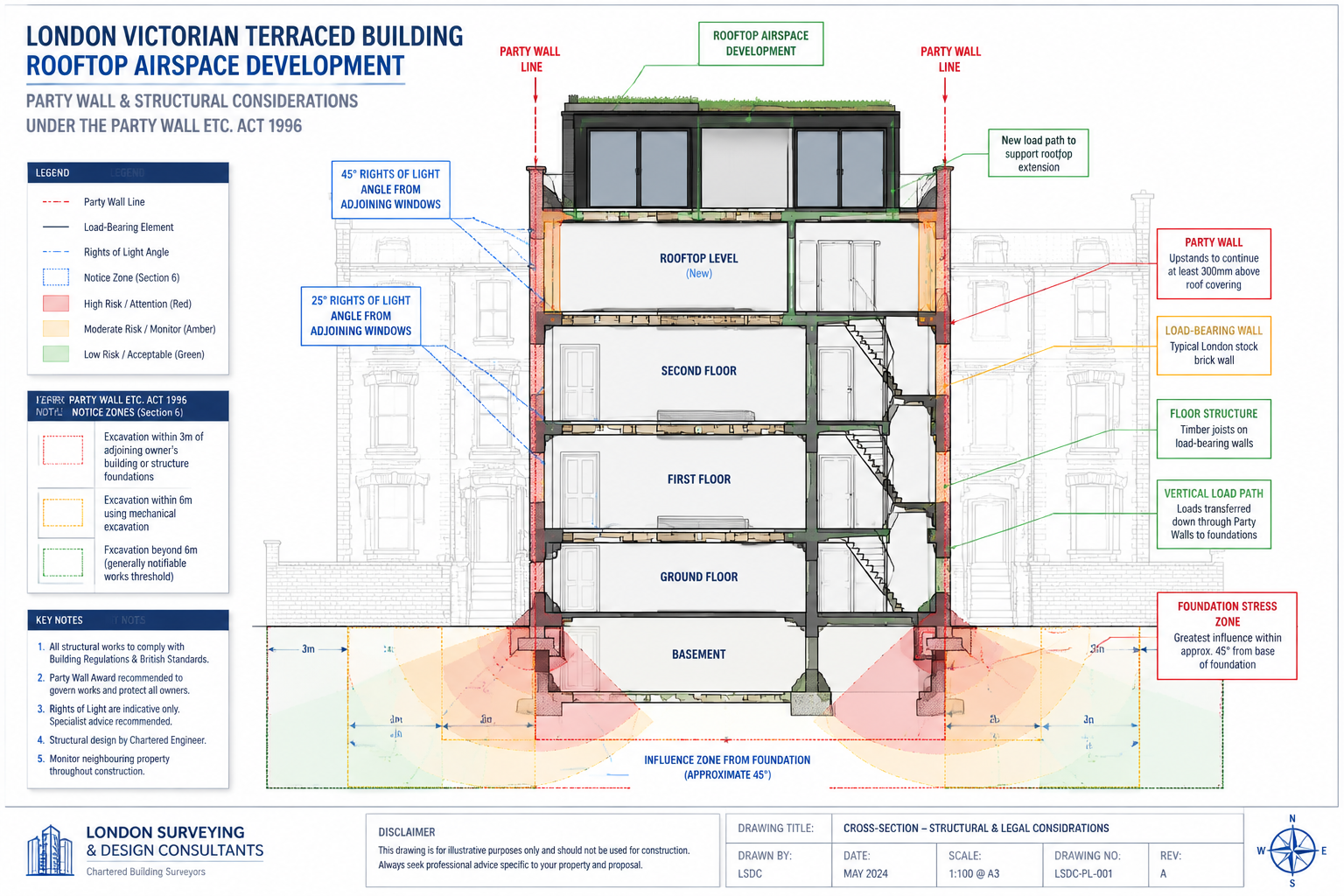
This is where party wall risks in overbuilds, airspace developments and rooftop extensions become most acute — and where early surveyor involvement delivers the greatest value.
1. 🏚️ Existing Wall Capacity
Victorian and Edwardian terraced houses, which make up a large proportion of London's rooftop development stock, were built with party walls designed to carry two to three storeys of masonry loading. Adding one or two additional storeys — even in lightweight modular construction — fundamentally changes the load path.
Surveyors must flag:
- Existing wall thickness and material (solid brick vs. cavity, lime mortar vs. cement)
- Foundation depth and type — many Victorian properties have shallow strip foundations that cannot absorb additional vertical load without settlement
- Condition of existing mortar joints and any existing cracking (see guidance on when wall cracking becomes a serious concern)
- Presence of chimney stacks within or adjacent to party walls, which are often structurally integral
A schedule of condition — prepared before works begin — is essential. Without one, any post-construction cracking claims become almost impossible to defend or prosecute fairly.
2. 🔩 Load Transfer and Temporary Works
Even where the final overbuild uses lightweight steel or timber frame, the construction phase introduces significant point loads. Crane outriggers, temporary propping and falsework can impose loads far exceeding the finished structure. Surveyors should insist that a structural engineer's report addressing temporary works is available before the party wall award is finalised.
3. 💧 Waterproofing and the Party Wall Interface
Rooftop extensions create new junctions between old and new fabric. The interface between the existing party wall and the new roofline is a high-risk zone for water ingress — both into the subject property and the adjoining owner's property. This risk is rarely addressed adequately in party wall awards and should be explicitly covered.
4. Vibration and Noise Transmission
Overbuilds often involve saw-cutting or core-drilling through existing party walls to create structural connections. This generates significant vibration that can cause damage to plasterwork, ceilings and internal finishes in adjoining properties. A pre-works vibration monitoring protocol should be flagged as a condition of the award.
The RICS 8th Edition: Raising the Bar for Structural Input
RICS has launched a consultation on a draft 8th Edition of "Party Wall Legislation and Procedure" [8], which is set to replace the existing 7th Edition guidance. The updated framework is expected to place greater emphasis on earlier structural engineering input for complex party wall matters — precisely the kind of multi-owner, vertically complex schemes that rooftop overbuilds represent [1].
For surveyors, this signals a clear direction of travel: the days of treating party wall procedure as a paperwork exercise, separate from structural due diligence, are ending. The 8th Edition is anticipated to formalise what best-practice surveyors already know — that on overbuild and airspace schemes, structural assessment and party wall procedure must run in parallel from day one [1].
Engaging a qualified party wall surveyor in London with experience in complex vertical developments is no longer optional on these projects — it is a professional necessity.
Legal and Procedural Risks: What Surveyors Need to Flag Early in Airspace Developments

Beyond structural concerns, party wall risks in overbuilds, airspace developments and rooftop extensions extend into legal territory that can derail a project entirely if not identified at feasibility stage.
Multiple Adjoining Owners — and the Notice Cascade
A rooftop overbuild on a converted Victorian terrace might adjoin four or five separate leasehold flats in the neighbouring building, each with their own legal interest in the party wall. Every one of those leaseholders — plus potentially the freeholder — may be an "adjoining owner" under the Act, each requiring a separate notice and potentially appointing their own surveyor [4].
The cost and time implications of this are significant. Surveyors should map all adjoining owner interests before the client commits to a development programme, not after notices have been served and disputes have already begun [6].
Airspace Ownership and Lease Complications
Who owns the airspace above a converted Victorian house? This question is more complex than it appears. Where the building has been converted into leasehold flats, the headlease or freehold may reserve airspace rights — but the precise position depends on the drafting of individual leases. A developer who proceeds without resolving this can find that the party wall award is valid but the development itself is unlawful.
Surveyors should flag the need for specialist leasehold legal advice at feasibility stage. For context on how lease structures affect property rights, the guide to statutory lease extensions provides useful background on how leasehold interests are structured.
Rights of Light
Rooftop extensions are among the most common triggers for rights of light claims. An adjoining owner whose windows are overshadowed by a new rooftop structure may have an actionable claim — and in some cases can obtain an injunction to halt or demolish the offending structure.
Rights of light is a distinct legal area from party wall law, but the two interact directly on rooftop schemes. Surveyors must flag the need for a rights of light assessment early, and should not allow a party wall award to be treated as a green light for works that may still be restrained by rights of light law.
Access Rights During Construction
Section 8 of the Party Wall etc. Act 1996 grants a building owner the right to access adjoining land for the purposes of executing works. On rooftop schemes, this frequently means scaffolding over or adjacent to an adjoining owner's property — a significant imposition that must be managed carefully, with proper notice and compensation where appropriate.
Practical Checklist: What Surveyors Should Flag at Feasibility Stage
Use this checklist when first instructed on any overbuild, airspace or rooftop extension project:
- Map all adjoining owners — including leaseholders, freeholders and any party with a legal interest in the shared structure
- Commission a structural survey of the existing party wall(s) and foundations before serving notice
- Confirm airspace ownership through title register review and lease inspection
- Instruct a rights of light specialist — do not rely on the party wall process to address this
- Prepare a detailed schedule of condition for all adjoining properties likely to be affected
- Identify temporary works risks and require a structural engineer's sign-off on the construction methodology
- Address waterproofing at party wall junctions explicitly in the award conditions
- Plan a vibration monitoring protocol for any cutting, drilling or demolition works
- Check for chimney stacks, flues and services within the party wall that may be affected
- Assess access requirements under Section 8 and notify adjoining owners of scaffolding proposals early
For a broader understanding of what a surveyor's role encompasses on complex projects like these, the overview of surveyor roles and responsibilities provides useful context.
Managing Disputes When They Arise
Despite best efforts, disputes on rooftop and airspace projects are common. The 2026 construction uptick has seen a marked increase in party wall disagreements, particularly on schemes where notices were served without adequate structural preparation [7][9].
When an adjoining owner dissents from a party wall notice, the matter passes to surveyors to resolve through an award. On overbuild schemes, awards are frequently more complex than standard, covering:
- Structural monitoring requirements during construction
- Restrictions on working hours and vibration levels
- Insurance obligations for the building owner
- Reinstatement obligations if damage occurs
- Access arrangements for scaffolding and plant
The government's guidance on what happens when party wall agreement cannot be reached outlines the statutory dispute resolution process, but surveyors on rooftop schemes should be prepared for awards that run to significantly more pages than a standard loft conversion award [4].
Where disputes escalate beyond the award process — for example, where an adjoining owner seeks an injunction on rights of light grounds — the costs can be catastrophic. Early, thorough flagging by a specialist party wall agreement surveyor is the most effective risk mitigation available.
The Commercial Opportunity for Surveyors in 2026
The growth of airspace and rooftop development is not just a risk management challenge — it is a significant commercial opportunity for surveyors who develop genuine expertise in this niche. With 180,000 potential new homes in London's airspace alone [3], the volume of party wall instructions associated with these schemes will be substantial.
Surveyors who can offer clients a genuinely integrated service — combining party wall procedure, structural risk assessment, rights of light coordination and multi-owner notice management — will be well positioned in a market where complexity is the norm [2]. The forthcoming RICS 8th Edition guidance will likely formalise higher competency standards for complex party wall matters, rewarding those who invest in specialist knowledge now [1][8].
For surveyors building a practice in London's most active development boroughs, understanding the specific dynamics of party wall work in London is increasingly a differentiator rather than a baseline.
Conclusion: Act Early, Flag Everything, Protect Everyone
The surge in London's rooftop and airspace development market is creating a new frontier for party wall practice — one where the stakes are higher, the structural risks are more complex, and the legal landscape is more treacherous than almost any other project type.
The core message for UK surveyors in 2026 is simple: early intervention prevents catastrophic outcomes. Every week that passes between a developer's feasibility decision and a surveyor's first structural and legal assessment is a week in which avoidable risks are compounding.
Actionable Next Steps for Surveyors
- Develop a rooftop-specific party wall protocol that integrates structural assessment, ownership mapping and rights of light review from day one.
- Build relationships with structural engineers and rights of light specialists who understand the unique demands of vertical development.
- Stay ahead of the RICS 8th Edition — review the consultation documents and ensure practice procedures align with the incoming guidance [8].
- Educate developer clients early — many do not understand that a party wall award on a rooftop scheme may take significantly longer to agree than on a standard extension.
- Never treat the party wall process as a formality on overbuild schemes — treat it as the primary risk management tool it is designed to be.
The buildings going up above London's rooftops today will define the city's skyline for generations. The surveyors who flag risks early, ask the hard structural questions, and manage the legal complexity with rigour will be the ones who protect both buildings and the people who live in them.
References
[1] RICS 8th Edition Party Wall Guidance 2026: What's Changed And How Surveyors Must Adapt – https://wimbledonsurveyors.com/rics-8th-edition-party-wall-guidance-2026-whats-changed-and-how-surveyors-must-adapt/
[2] Chasing Party Wall Works: Is It Worth It For UK Surveyors In 2026 – https://www.canterburysurveyors.com/blog/chasing-party-wall-works-is-it-worth-it-for-uk-surveyors-in-2026/
[3] London Developers Eye Airspace Above Buildings: CityLab Daily – https://www.bloomberg.com/news/newsletters/2026-01-29/london-developers-eye-airspace-above-buildings-citylab-daily
[4] If You Can't Agree – https://www.gov.uk/party-walls-building-works/if-you-cant-agree
[6] Party Wall Agreements For 2026 Renovation Surge: Managing Notices As Buyer Confidence Returns – https://princesurveyors.co.uk/blog/party-wall-agreements-for-2026-renovation-surge-managing-notices-as-buyer-confidence-returns/
[7] Party Wall Surveys Amid 2026 Construction Boom: Handling Disputes In High Demand UK Housing Markets – https://nottinghillsurveyors.com/blog/party-wall-surveys-amid-2026-construction-boom-handling-disputes-in-high-demand-uk-housing-markets
[8] RICS Launches Consultation On Updated Party Wall Practice Guidance – https://www.rics.org/news-insights/rics-launches-consultation-on-updated-party-wall-practice-guidance
[9] Party Wall Surveys And Neighbour Disputes In 2026's UK Construction Uptick: RICS Compliance Essentials – https://partywallsurveyorlondon.uk/blogs/party-wall-surveys-and-neighbour-disputes-in-2026s-uk-construction-uptick-rics-compliance-essentials/