Fewer than 30% of surveyors who accept their first expert witness instruction fully understand the legal obligations attached to it before they begin — and the consequences of that gap can be career-defining. If you are a building surveyor or valuer making the transition from standard survey reports to formal court-compliant expert evidence, this guide is your practical roadmap. A First-Time Expert Witness Surveyor? Step‑by‑Step Guide to Your First CPR Part 35 Instruction in Property and Construction Disputes is exactly what the profession needs more of, because the rules are strict, the stakes are high, and the learning curve is steeper than most expect.
Key Takeaways 📋
- Your overriding duty is to the court, not to the solicitor or client paying your fees — CPR 35.3 makes this non-negotiable [1].
- Before accepting any instruction, check for court permission, scope alignment, and conflicts of interest.
- Your expert witness report must follow a strict structure set out in Practice Direction 35 (PD 35) [3].
- Staying within the genuine boundaries of your expertise is critical to courtroom credibility [2].
- RICS is tightening its expectations for surveyors acting as expert witnesses in 2026, making early compliance habits essential [10].
Understanding CPR Part 35: The Legal Framework Every First-Time Expert Witness Surveyor Must Know
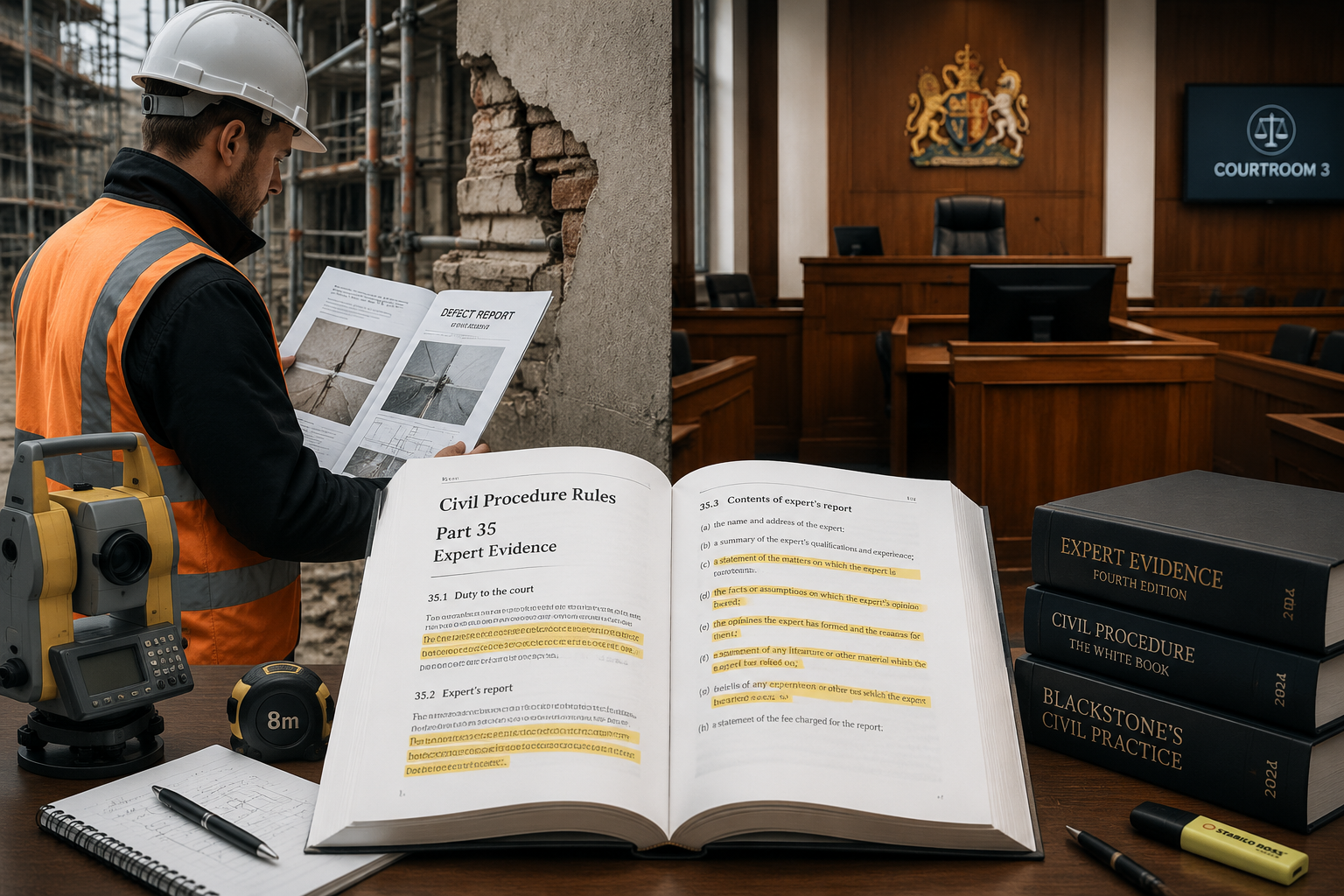
Before a single word of your report is written, you need to understand the rules governing expert evidence in England and Wales. The Civil Procedure Rules (CPR) Part 35 and its accompanying Practice Direction 35 (PD 35) are the foundation of everything you will do as an expert witness [3].
What CPR Part 35 Actually Says
CPR Part 35 governs the use of expert evidence in civil litigation. Its core principle is simple but profound: expert evidence must help the court, and that duty overrides any obligation to the party instructing you [1]. Specifically:
- CPR 35.3 — The expert's overriding duty is to the court, not to the instructing party.
- CPR 35.4 — Expert evidence requires the court's permission. It is not automatically allowed.
- CPR 35.10 — The expert's report must comply with Practice Direction 35 in both content and format.
- CPR 35.12 — Experts may be directed to meet and produce a Joint Statement of agreed and disputed issues.
💬 "The expert's duty to help the court overrides any obligation to the person from whom experts have received instructions or by whom they are paid." — CPR 35.3 [1]
This is often misunderstood by first-time experts, who feel pressure to support the case of the party who hired them. That instinct, however natural, is a compliance risk that can damage your credibility and, in serious cases, expose you to wasted costs orders [6].
Why This Matters for Property and Construction Disputes
In property and construction disputes — boundary disagreements, defect claims, party wall disputes, dilapidations, and professional negligence cases — surveyors are frequently called upon as experts. The technical complexity of these cases means courts rely heavily on expert opinion. That reliance comes with responsibility.
For context on the types of defect-related issues that often trigger litigation, a specific defect survey is often the starting point before formal proceedings begin. Understanding how that advisory role differs from your role as a court-appointed expert is the first mental shift you need to make.
Step-by-Step: From Initial Enquiry to Accepting Your First CPR Part 35 Instruction
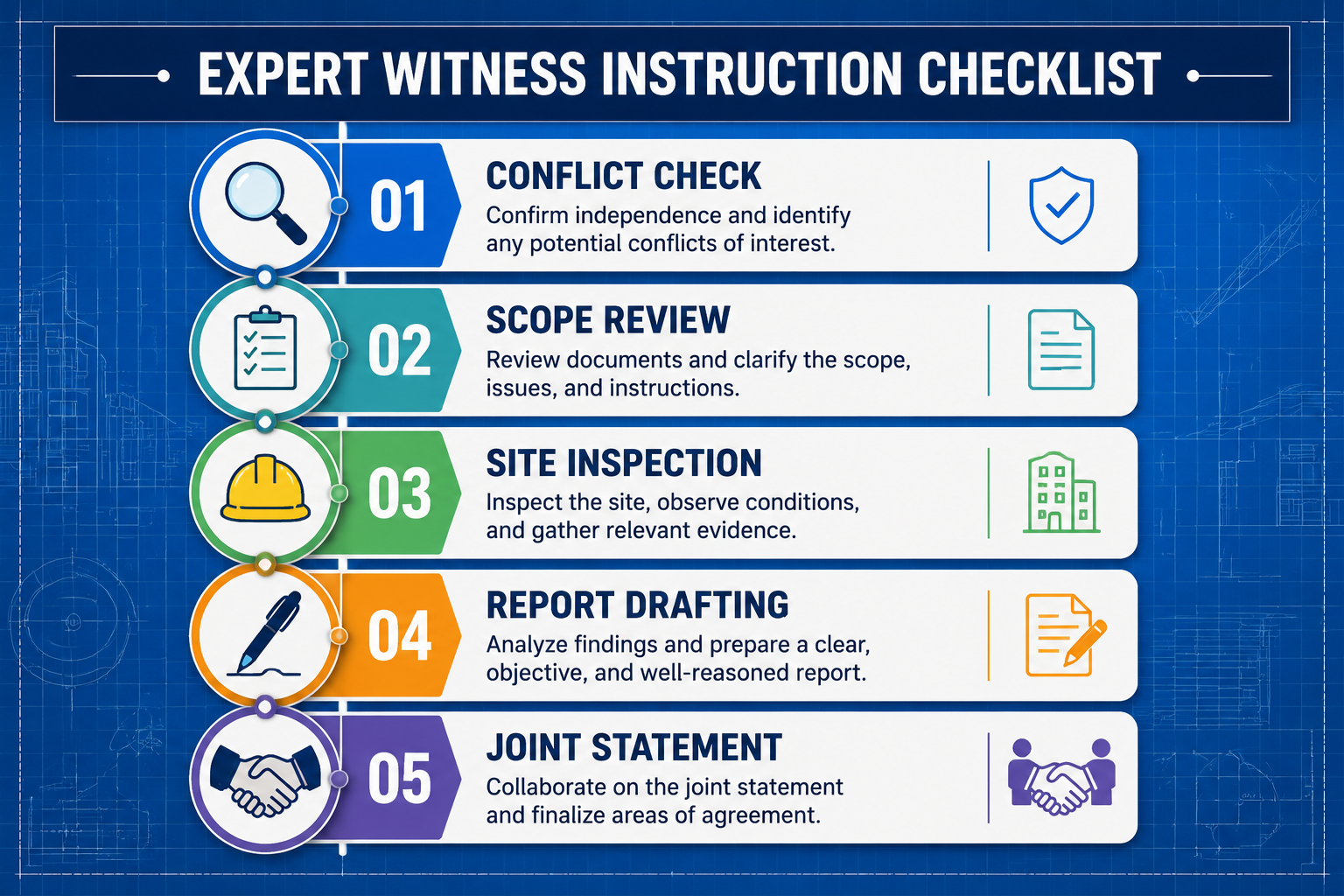
This is the practical roadmap section — the step-by-step process that takes you from the first phone call to the moment you formally accept the instruction.
Step 1: Assess Whether Court Permission Has Been Granted ✅
Under CPR 35.4, no party may call an expert without the court's permission. Before you do anything else, ask the instructing solicitor:
- Has permission been granted for expert evidence in this discipline?
- What is the scope of the permission — which issues are you permitted to address?
- Is there a costs budget or cap on expert fees?
If permission has not yet been granted, you can still be approached for a preliminary view, but you should not begin formal expert witness work until it is confirmed.
Step 2: Check Your Expertise Boundaries 🔍
One of the most consistent credibility risks for first-time expert witnesses is scope creep — accepting instructions that stretch beyond genuine competence [2]. Ask yourself honestly:
| Issue Type | Competent to Opine? |
|---|---|
| Building defects (your core specialism) | ✅ Yes |
| Structural engineering calculations | ❌ Refer to structural engineer |
| M&E systems failures | ❌ Refer to M&E specialist |
| Valuation of diminution in value | ✅ Only if RICS-qualified valuer |
| Party wall damage causation | ✅ If experienced in party wall matters |
RICS guidance and court commentary both stress that staying within your expertise is not a weakness — it is a professional obligation [10]. Overreaching damages your credibility and can result in your evidence being given little or no weight.
For surveyors who regularly handle party wall surveyor responsibilities, transitioning to expert witness work in party wall disputes is a natural fit — but even here, the line between advisory and judicial roles must be clearly understood.
Step 3: Conduct a Conflict of Interest Check ⚠️
Before accepting any instruction, check:
- Have you previously advised either party on this or a related matter?
- Do you have an ongoing professional or personal relationship with any party?
- Have you previously inspected the property in a non-expert capacity?
- Does your firm have a financial interest in the outcome?
Any potential conflict must be disclosed immediately to the instructing solicitor. If the conflict is material, decline the instruction. PD 35 requires that your independence is beyond reasonable question [3].
Step 4: Review and Agree Your Terms of Engagement 📄
Your terms of engagement as an expert witness are not the same as a standard surveying appointment. They must make explicit:
- That your duty is to the court, not the client
- The scope of issues you are instructed to address
- Your fee structure and payment terms (courts scrutinise disproportionate fees)
- That you retain the right to give an opinion adverse to the instructing party if the evidence requires it
Never accept terms that attempt to limit your independence or pre-determine your conclusions. This is a red line under CPR 35 [6].
Writing Your First CPR Part 35 Compliant Expert Witness Report
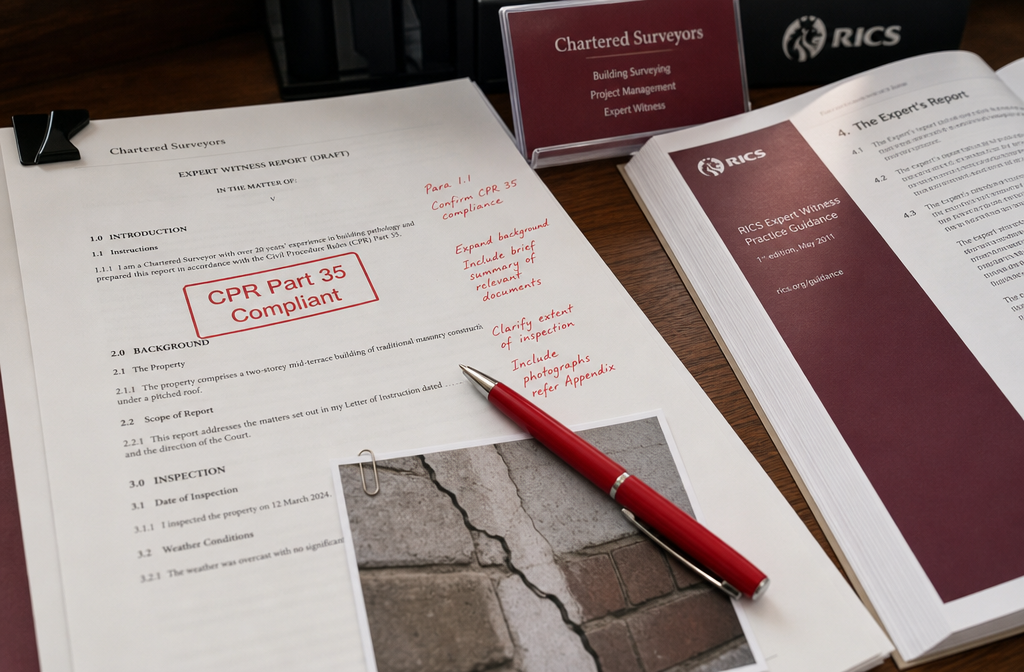
Once you have accepted the instruction, the report is the centrepiece of your work. PD 35 sets out mandatory content requirements that every first-time expert witness surveyor must follow [3].
Mandatory Report Structure Under PD 35
Your report must include the following elements:
- Details of your qualifications — RICS membership, relevant experience, specialism
- Literature or material relied upon — all sources, inspection notes, photographs
- Statement of facts — the factual basis on which your opinion rests
- Your opinion — clearly stated, reasoned, and impartial
- Qualification of opinion — where there is a range of reasonable views, say so
- Summary of conclusions — a brief, accessible summary
- Statement of truth and compliance declaration — the mandatory CPR 35 declaration [1]
The compliance declaration is not optional. It reads (in substance): "I confirm that I have made clear which facts and matters referred to in this report are within my own knowledge and which are not. I understand that proceedings for contempt of court may be brought against anyone who makes, or causes to be made, a false statement in a document verified by a statement of truth."
Writing Style: Clarity Over Complexity
Courts are not surveying practices. Judges and barristers need to understand your evidence without specialist knowledge. Write at a level that a well-educated non-surveyor can follow:
- Use plain English wherever possible
- Define technical terms when first used
- Use photographs, annotated drawings, and schedules to support your narrative
- Avoid advocacy language — phrases like "clearly" and "obviously" undermine objectivity
For reference on how professional survey reports are structured for non-specialist readers, the example homebuyers report and complete property survey guide illustrates accessible technical writing — though expert witness reports require a more formal, court-directed structure on top of this foundation.
Dealing With Uncertainty Honestly
One of the hallmarks of a credible expert witness is the honest acknowledgement of uncertainty. If the evidence supports a range of conclusions, say so. If you cannot determine causation with certainty, explain why and what further investigation would be needed. Courts value intellectual honesty far above false confidence [2].
💬 "An expert who acknowledges the limits of their opinion is far more credible than one who overstates certainty." — Fenwick Elliott, Expert Witness Commentary [6]
The Joint Statement Process and Conference With Counsel
What Is a Joint Statement (or Scott Schedule)?
After reports are exchanged, the court will often direct experts to meet — either in person or remotely — and produce a Joint Statement identifying:
- Issues on which the experts agree
- Issues on which they disagree, with reasons
- Whether any disagreement could be resolved with further information
This process is governed by CPR 35.12 and is one of the most valuable — and most misunderstood — parts of the expert witness process [8]. The Joint Statement is not a negotiation. You are not trying to reach a compromise. You are trying to accurately map the genuine areas of agreement and disagreement.
Common mistakes in Joint Statements:
- Allowing solicitors to draft or heavily edit the statement (impermissible)
- Conceding points under pressure rather than genuine reconsideration
- Failing to distinguish factual disagreements from opinion disagreements
Conference With Counsel: What to Expect
Before trial, you will likely be asked to attend a conference with counsel (the barrister representing your instructing party). Key points:
- Counsel will probe your report and test your reasoning
- You may be asked to reconsider aspects of your opinion — only change your view if genuinely persuaded by new argument or evidence
- Discuss how your evidence will be presented and what cross-examination might look like
- Confirm that your report remains accurate and up to date
For surveyors building a practice in expert witness work across London and the South East, understanding the local property market context is also valuable. Whether disputes arise in Westminster, Fulham, or outer boroughs, the technical issues in construction defect and boundary disputes share common threads regardless of geography.
RICS Standards and What's Changing in 2026
RICS is actively updating its guidance for surveyors acting as expert witnesses, with consultation materials in 2026 signalling tighter expectations around CPR 35 compliance, competence demonstration, and impartiality [10]. Key emerging requirements include:
- Clearer evidence of CPD in expert witness practice
- Stronger declarations of independence in terms of engagement
- Enhanced requirements for competence when giving oral evidence at trial
- Greater scrutiny of surveyors who act as both party wall surveyors and expert witnesses in related disputes
For surveyors who are RICS-qualified, these changes reinforce the importance of building expert witness practice on a foundation of genuine compliance — not just familiarity with the rules.
Quick Reference: CPR Part 35 Compliance Checklist 🗂️
| Stage | Action Required | CPR/PD Reference |
|---|---|---|
| Pre-instruction | Confirm court permission | CPR 35.4 |
| Pre-instruction | Conflict of interest check | PD 35 |
| Pre-instruction | Scope and expertise review | PD 35 |
| Report drafting | Include all mandatory elements | PD 35, para 3 |
| Report drafting | Sign compliance declaration | CPR 35.10 |
| Post-exchange | Attend experts' meeting | CPR 35.12 |
| Post-exchange | Produce Joint Statement | CPR 35.12 |
| Pre-trial | Conference with counsel | Practical requirement |
Conclusion: Your Actionable Next Steps as a First-Time Expert Witness Surveyor
The journey from standard surveying practice to compliant, credible expert witness work is not as long as it might seem — but it requires deliberate preparation. This First-Time Expert Witness Surveyor? Step‑by‑Step Guide to Your First CPR Part 35 Instruction in Property and Construction Disputes has mapped the key stages: understanding your overriding duty to the court, conducting pre-instruction checks, structuring a compliant report, navigating the Joint Statement process, and preparing for conference with counsel.
Here are your actionable next steps:
- 📖 Read CPR Part 35 and Practice Direction 35 in full before accepting any instruction — the MoJ publishes both free online [3].
- 🎓 Complete a recognised expert witness training course — RICS, the Academy of Experts, and the Expert Witness Institute all offer relevant programmes.
- 📋 Draft your standard terms of engagement for expert witness work, ensuring they explicitly state your duty to the court.
- 🔍 Build a conflict-of-interest register for your practice so checks become routine.
- 🤝 Shadow an experienced expert witness in a related discipline if possible — observing a Joint Statement meeting or trial appearance is invaluable.
- 📰 Monitor RICS consultation updates throughout 2026 to stay ahead of tightening standards [10].
The courts need competent, impartial surveying experts. With the right preparation, a first-time expert witness surveyor can contribute meaningfully to the resolution of complex property and construction disputes — and build a valuable specialist practice in the process.
References
[1] Expert Witness Rules Responsibilities Cpr Part 35 Explained Guide – https://www.expertwitnessgateway.co.uk/blogs/expert-witness-rules-responsibilities-cpr-part-35-explained-guide
[2] Expert Witness Impartiality Under Cpr Part 35 Building Surveyors Guide To Courtroom Credibility In 2026 – https://kingstonsurveyors.com/expert-witness-impartiality-under-cpr-part-35-building-surveyors-guide-to-courtroom-credibility-in-2026/
[3] Pd Part35 – https://www.justice.gov.uk/courts/procedure-rules/civil/rules/part35/pd_part35
[6] fenwickelliott – https://www.fenwickelliott.com/research-insight/newsletters/insight/39
[8] Civil Procedure Rules Part 35 Experts And Assessors – https://content.next.westlaw.com/practical-law/document/Ic4b5f105e83311e398db8b09b4f043e0/Civil-Procedure-Rules-Part-35-Experts-and-assessors?viewType=FullText&transitionType=Default&contextData=%28sc.Default%29
[10] View – https://consultations.rics.org/surveyorsasexpertwitness/view?objectID=257098181